
Day Trading Signals Real-Time Guide for Active Traders
- Steven Hartwell

- Jun 7
- 8 min read

Real-time day trading signals are automated alerts that notify traders of actionable market conditions the moment measurable triggers fire across price, volume, or momentum data. This day trading signals real time guide covers how to source, configure, and act on live alerts so you capture intraday opportunities before they close. You will learn which signal types matter most, how to build a session-phased alert system, and how tools like Big Move Algo and Alpaca’s WebSocket API power the data feeds behind every reliable signal. The difference between a profitable trade and a missed one often comes down to seconds, and the right setup closes that gap.
What are the essential types of real-time day trading signals?
Trading signals include chart pattern breakouts, moving average crossovers, volume and volatility alerts, and sentiment indicators such as RSI and MACD. Each type fires under specific market conditions, and knowing which one to trust in which context separates consistent traders from reactive ones.
Volume spike alerts are the most immediate signal available to a day trader. A stock printing 2x to 3x average volume signals institutional activity or a news catalyst, both of which create the momentum you need for a clean entry. Setting your multiplier below 2x floods your screen with noise; above 3x and you miss the early move.

Intraday RSI extremes work differently from the standard 30/70 thresholds most traders learn first. For intraday charts, tightening those levels to 20 and 80 filters out the constant oscillation that makes shorter timeframes messy. An RSI reading below 20 on a 5-minute chart during the first hour of trading is a genuine oversold condition worth watching, not just a blip.
Moving average crossovers and breakout signals give you structure when price action alone looks chaotic. A 9 EMA crossing above a 20 EMA on a 1-minute chart during the market open is a classic momentum trigger used in many of the best day trading strategies. Breakout signals, where price closes above a prior resistance level on elevated volume, combine two confirmation factors into one alert.
Financial news and economic event signals deserve their own category. A Federal Reserve rate decision, a surprise earnings beat, or a CPI print can generate more intraday movement in 10 minutes than a typical stock sees in a week. Pairing a news feed with your technical alerts means you are never caught off guard by the catalyst behind a sudden volume spike.
Pro Tip: Set up separate watchlists for large-cap and small-cap stocks and apply different RSI and volume thresholds to each. A 2x volume spike on a mega-cap like Apple means something very different than the same spike on a $500 million micro-cap.
How to access real-time market data streams for intraday signals
The data feed powering your signals determines everything. WebSocket streaming provides a live connection that pushes market data as it occurs, while REST polling requires your system to request updates at intervals. For latency-sensitive trading, REST polling is simply not fast enough. By the time your poll cycle fires, the signal has already moved.
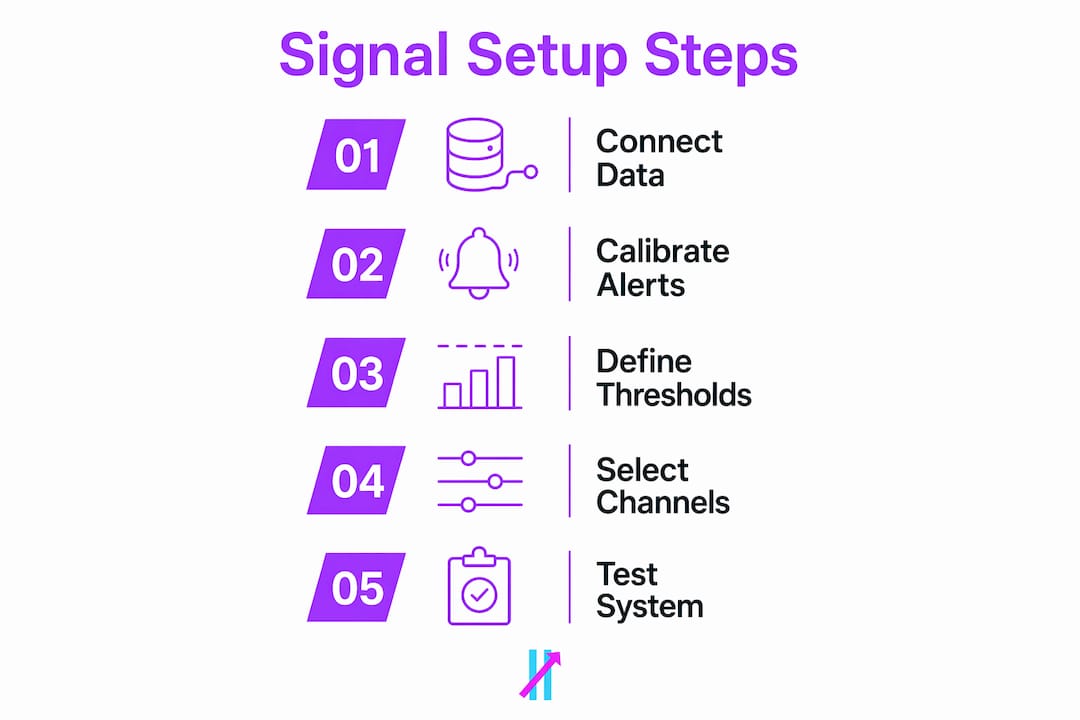
Alpaca’s streaming API is a practical reference point for understanding how real-time feeds work in practice. The system delivers minute bars right after each minute mark, but it also sends updated bars correcting late trades after the half-minute mark. This distinction matters because a signal that fires on an incomplete bar can send you into a trade that the corrected data would have filtered out.
Here is how to structure a reliable real-time data connection:
Connect via WebSocket, not REST, for any signal that requires sub-second responsiveness.
Subscribe to both minute bars and updated bars so your signal logic accounts for late-arriving trade data.
Implement asynchronous message handling to process incoming data without blocking your signal engine. Slow clients risk disconnection when server-side outgoing buffers fill up.
Monitor your message backlog continuously. A growing queue means your processing speed is falling behind the data rate, which degrades signal quality.
Build a reconnection protocol that automatically restores your WebSocket session after a drop without missing bars.
“Effective real-time signal engines treat event timelines as multi-stage, with a confirmation window for updated bars and late ticks before final trade entries. This approach reduces false entries caused by data latency and makes your system far more reliable under real market conditions.”
The confirmation window concept is one of the most underused techniques in retail signal design. Instead of acting on the first bar close, you wait one additional bar to confirm the signal holds after any late trade corrections arrive. You give up a small amount of speed in exchange for a significant reduction in false entries.
How to set up a real-time alert system for day trading
A well-organized alert system is not a single list of triggers. It is a session-phased workflow where different alert types activate at different times of day. Organizing alerts by trading session phase including pre-market, market open, midday, and power hour reduces noise and keeps your attention on the highest-probability setups at each stage.
Follow this setup sequence:
Pre-market (4:00 AM to 9:30 AM ET): Activate gap-up and gap-down alerts, earnings reaction alerts, and news-driven volume spikes. Thresholds can be looser here because you are scanning for candidates, not executing.
Market open (9:30 AM to 10:30 AM ET): Switch to tight volume spike alerts at 2x to 3x average, RSI 20/80 extremes, and SMA crossover signals. This is the highest-volatility window of the day and demands your sharpest filters.
Midday (10:30 AM to 2:00 PM ET): Reduce alert sensitivity. Midday chop produces more false signals than any other session phase. Percentage move alerts above 3% to 5% are more reliable here than momentum triggers.
Power hour (3:00 PM to 4:00 PM ET): Reactivate breakout and volume alerts. Institutional rebalancing and end-of-day positioning create real directional moves worth trading.
Notification channels matter as much as thresholds. Phone calls suit urgent signals requiring immediate action, push notifications work for important but slightly less time-critical alerts, and text or email serves as backup confirmation and end-of-day recap. Routing every alert through push notifications regardless of urgency is one of the fastest ways to develop alert fatigue.
Alert type | Best session phase | Recommended channel |
Volume spike (2x to 3x) | Market open, power hour | Phone call or push |
RSI extreme (20/80) | Market open | Push notification |
SMA crossover | Market open, power hour | Push notification |
Percentage move (3%+) | Midday | Text or email |
News/earnings reaction | Pre-market | Push notification |
Pro Tip: Group alerts by strategy, not just by ticker. A momentum breakout alert and a mean-reversion RSI alert on the same stock require completely different responses. Mixing them in one alert group creates confusion at the worst possible moment.
Common mistakes in using real-time trading signals and how to fix them
The most expensive mistake active traders make is treating every alert as a trade instruction. Tightening volume and RSI thresholds reduces low-quality alerts and improves decision confidence, but no threshold setting eliminates the need for human judgment. Signals identify conditions. You decide whether those conditions fit your current risk tolerance, position size, and market context.
Here are the most common pitfalls and their fixes:
Alert noise from loose thresholds. If your phone buzzes 40 times before 10:00 AM, your thresholds are too wide. Start with conservative settings and loosen them only after reviewing which alerts produced valid setups.
Ignoring updated bar corrections. Acting on the first version of a minute bar before late trades arrive can put you in a position based on incomplete data. Build a short confirmation window into your workflow, as described in the data section above.
Using the same settings across all market conditions. A trending market and a range-bound market require different RSI and volume thresholds. Review your alert performance weekly and adjust for current conditions.
No stop-loss integration. A live trading signal alert that fires without a pre-defined exit plan is incomplete. Every signal should have a corresponding stop-loss level set before you enter, not after.
Chasing late signals. If a volume spike alert fires and the stock has already moved 4% in two minutes, the signal is stale. Discipline means skipping the trade, not adjusting your entry to chase the move.
The real-time signal effectiveness depends on low data latency and robustness to bar updates. Even the best alert configuration fails if the underlying data feed is slow or unstable. Treat your data connection as infrastructure, not an afterthought.
Key takeaways
Real-time day trading signals work only when you combine accurate data feeds, calibrated thresholds, and disciplined execution into a single structured workflow.
Point | Details |
Use WebSocket over REST | WebSocket streaming delivers live data with far lower latency than polling-based REST connections. |
Calibrate thresholds by session | Apply tighter volume and RSI filters at the open and power hour; loosen them during midday chop. |
Match alerts to notification channels | Route urgent signals to phone calls and less critical alerts to push notifications or email. |
Confirm before entering | Wait for updated bar data before acting to avoid false entries caused by late-arriving trades. |
Treat signals as conditions, not commands | Human judgment on context and risk is required before every trade, regardless of signal quality. |
What I have learned after years of watching traders misuse signals
Most traders who struggle with real-time signals have the wrong mental model. They treat a signal like a green light at an intersection. The light turns green, you go. But a trading signal is closer to a weather forecast. It tells you conditions are favorable. It does not guarantee the outcome.
The traders I have seen succeed consistently share one habit: they spend more time reviewing their alert logs than their P&L. They look at which signals fired, which ones they acted on, and which outcomes followed. That feedback loop is where real improvement happens, not in chasing a higher win-rate indicator.
I also think the obsession with signal frequency is a trap. More alerts do not mean more opportunities. They mean more decisions, more cognitive load, and more chances to make an impulsive trade. The best setups I have ever seen come from traders running five to eight carefully tuned alerts, not fifty. Fewer, better signals force you to be selective. Selectivity is where edge lives.
One more thing worth saying directly: your data feed is your foundation. I have watched traders spend weeks optimizing RSI thresholds while running on a delayed data feed. You cannot build a precise signal system on imprecise data. Get the infrastructure right first, then tune the parameters.
— James
See real-time signals in action with Big Move Algo
If building a custom alert system from scratch sounds like more work than you want to take on right now, Big Move Algo offers a ready-built alternative that delivers exactly what this article describes.
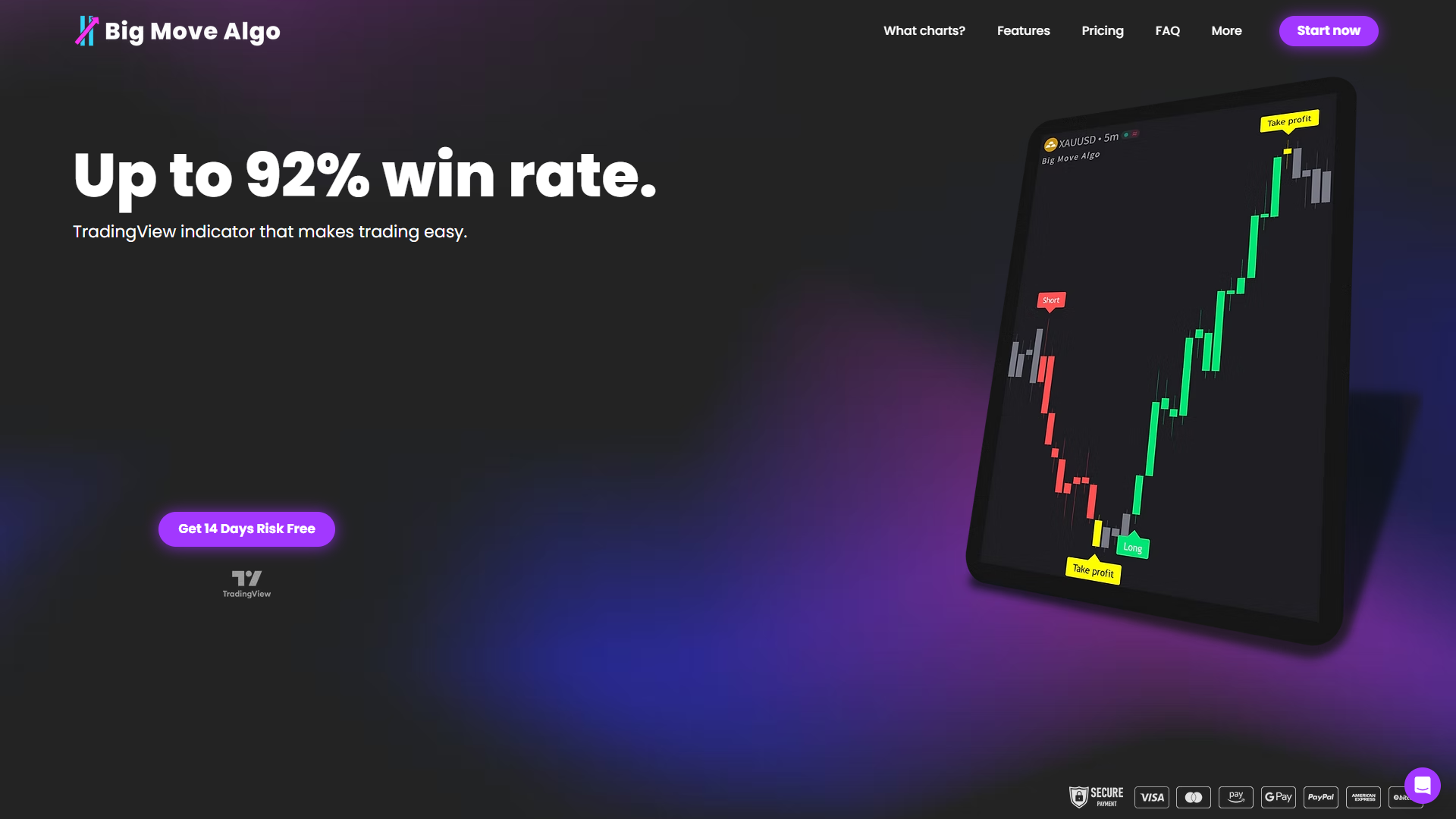
Big Move Algo is a TradingView indicator that analyzes markets in real time and outputs clear Long, Short, and Exit signals across crypto, forex, stocks, indices, and commodities. The built-in Fake Trend Detector filters out low-quality market conditions automatically, which solves the alert noise problem without requiring you to manually tune thresholds. The platform reports up to a 92% win rate across tested conditions. You can start with AUTO Mode for instant setup or switch to Manual Mode for deeper customization. Check the plans and pricing page to find the right subscription tier, and visit the how-to-use guide to get your first signals running today.
FAQ
What are real-time trading signals?
Real-time trading signals are automated alerts that fire the moment a measurable market condition, such as a volume spike, RSI extreme, or price breakout, meets a pre-set threshold. They give traders immediate notification of potential trade setups without requiring constant manual chart monitoring.
How do I interpret a volume spike signal?
A volume spike signal is most reliable when volume reaches 2x to 3x the average for that stock and timeframe. Combine it with a directional price move and a supporting technical trigger, such as a breakout above resistance, before entering a trade.
What is the difference between WebSocket and REST for trading data?
WebSocket streaming pushes data to your system the moment it is available, while REST polling requires your system to request updates at set intervals. For day trading, WebSocket is the correct choice because REST polling introduces latency that can make signals arrive too late to act on.
How should I organize my day trading alerts?
Organize alerts by session phase: use broad scanning alerts pre-market, tight momentum alerts at the open, reduced sensitivity during midday, and reactivated breakout alerts during power hour. This session-phased approach reduces noise and keeps your focus on the highest-probability windows.
Can beginners use real-time trading signals effectively?
Yes, but a day trading guide for beginners should emphasize starting with two or three signal types rather than activating every available alert. Volume spikes and RSI extremes are the most intuitive starting points. Add complexity only after you understand how each signal behaves across different market conditions.
Recommended
Comments