Traders: 30 Day Plan to Beat Emotional Trading With Written Rules
Rules beat raw emotion at scale: disciplined, written rules produce more consistent results than trading from impulse, but moderate emotional engagement can actually improve decision speed. That nuance matters more than the usual “kill your emotions” advice suggests. Below is the evidence behind that claim, what a working rules system looks like, and a practical playbook you can start using today.
TL;DR:
- Moderate emotional engagement, not absence, leads to the most profitable trading outcomes, with a U-shaped relationship between emotion and performance.
- Writing specific, enforceable rules for entry, risk, stops, and exits reduces impulsive decisions and helps traders avoid common biases like revenge trading and overconfidence.
- Volatility amplifies both emotional biases and the importance of strict rules, making discipline crucial during fast, unpredictable market movements.
- Automation tools and pre-set alerts reinforce rules and filter low-quality signals, supporting consistent behavior in high-pressure situations.
- Tracking rule violations, win rates, and drawdowns is essential for refining a rules-based system and preventing emotional triggers from dictating trades.
Table of Contents
- What emotional trading is and why traders fall into it
- What rules do to convert emotion into discipline
- The evidence: a U-shaped link between emotion and performance
- Practical rules playbook: what to write into your plan
- Techniques to reduce emotional interference while trading
- How signal tools like Big Move Algo help enforce rules
- Case studies: emotional trading versus rules-based outcomes in practice
- Common pitfalls when moving from emotional to rules-based trading
- How to build and customize a rule-based trading system
- How market volatility changes emotional and rules-based behavior
- A 30 day path from impulse to discipline
- Sources
- FAQ
What emotional trading is and why traders fall into it
Emotional trading means making entry, exit, or sizing decisions based on how you feel in the moment rather than a predetermined plan. It happens because markets deliver fast, ambiguous feedback, and your brain fills the gaps with fear, hope, or urgency.
A few biases show up again and again in trading behavior:
- Fear: cutting winners early or avoiding valid setups after a loss.
- Greed: oversizing a position because a trade “feels” certain.
- Revenge trading: re-entering immediately after a loss to “get it back.”
- FOMO: chasing a move that already happened without a plan.
- Loss aversion: holding losers too long to avoid realizing a loss.
- Overconfidence: increasing size after a winning streak.
These tendencies tend to surface around specific triggers: a losing streak that turns caution into desperation, a big winner that inflates confidence, unexpected news that spikes volatility, or thin, illiquid markets where price moves erratically. Recognizing the trigger is often the first step toward understanding trading psychology and interrupting the pattern before it costs money.
What rules do to convert emotion into discipline
A written trading plan works because it moves decisions out of the heat of the moment and into a calmer, earlier point in time. When entry, sizing, stops, and exits are defined in advance, there is less room to rationalize a bad trade while it is happening.
A workable rule set usually includes:
- Entry criteria: the exact technical or fundamental conditions that must be true before you act.
- Position sizing: a fixed percentage of equity or volatility-based formula, decided before you see the setup.
- Stop placement: set at the same time as the entry, never after.
- Exit rules: profit targets, scaling plans, or trailing conditions defined ahead of time.
- Time filters: hours or sessions you trade, and hours you deliberately avoid.
Writing these down reduces revenge trading because there is a documented standard to check yourself against instead of a feeling to justify. A concrete example: “Risk no more than 1% of equity per trade, stop placed at 1.5x the Average True Range, no new trades after two consecutive losses.” That single sentence removes three separate emotional decisions from a stressful moment.
The evidence: a U-shaped link between emotion and performance
The instinct to “eliminate emotion” from trading is not quite what the research supports. A PLOS One study that analyzed 886,000 trading decisions and more than 1.2 million instant messages from 30 professional day traders over two years found a U-shaped relationship: traders with moderate emotional activation made more profitable trades than those with very low or very high activation.
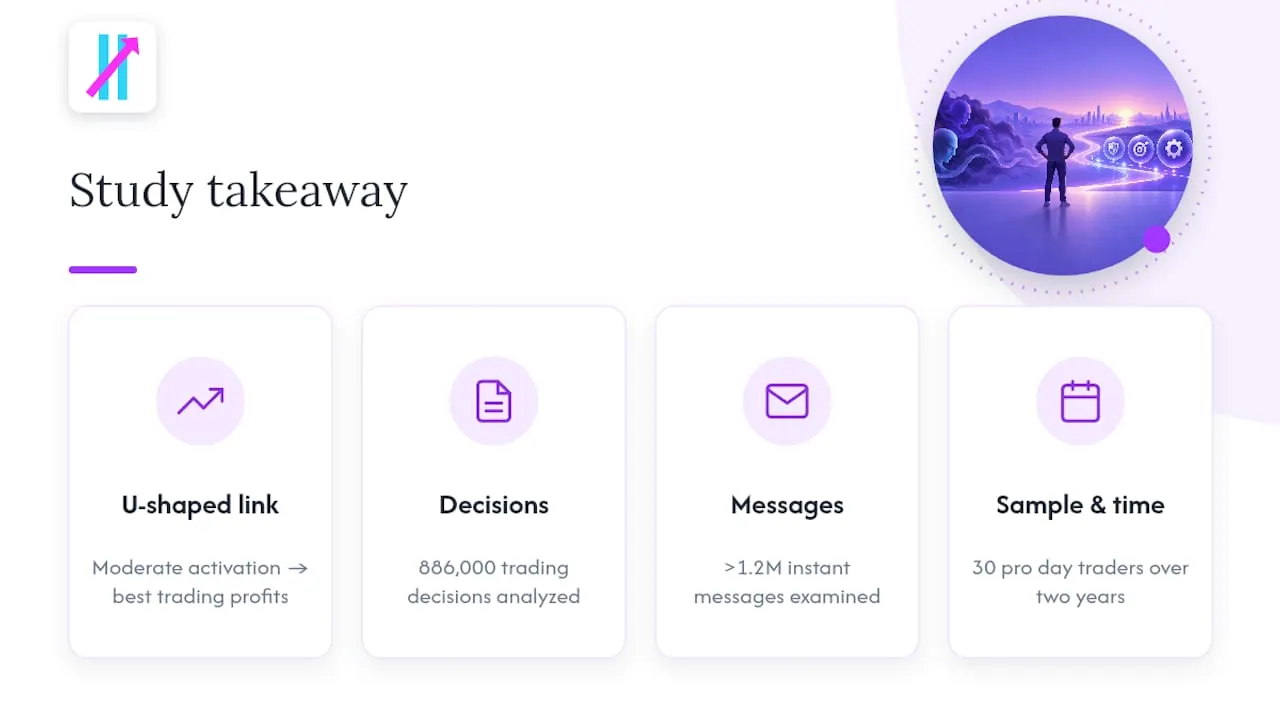
Moderate emotional engagement, not its absence, predicted the best trading outcomes in that dataset, which challenges the idea that a completely flat emotional state is the goal.
That same study sits alongside behavioral evidence from proprietary traders showing that losses often trigger loss aversion and recovery-driven risk-taking, with losing traders taking on more risk later in the day to try to recoup money, a pattern documented in research on behavioral biases in trading. On the regulatory side, FINRA’s day-trading risk disclosure warns that day trading is generally inappropriate for traders with limited capital or experience, and notes that having insufficient trading capital can significantly impair a retail day trader’s ability to achieve consistent profitability. Rules and calibrated emotion are not opposites. They are two controls on the same system.
Practical rules playbook: what to write into your plan
A rules playbook only works if it is specific enough to check against in real time. Start with a pre-trade checklist and build outward from there.
- Confirm liquidity and news risk before entering, and skip the trade if either looks unclear.
- Set your risk per trade, typically 0.5% to 2% of account equity, before you look at the chart.
- Place your stop at the same moment as your entry, calculated from volatility (an ATR multiple) rather than a round number.
- Define your exit in advance, whether that is a fixed target, a scale-out plan, or a trailing stop.
- Set a daily max loss that ends your trading session once it is hit, no exceptions.
- Cap trades per session so a bad morning cannot turn into a bad week.
- Force a break after a loss, even ten minutes away from the screen, before considering another trade.
Track a handful of metrics weekly: rule violations (what rule, which trade, why it happened), win rate, expectancy, and maximum drawdown. This turns “I felt off today” into a data point you can actually act on.
Pro Tip: Write your maximum daily loss and your position size formula on a sticky note next to your monitor. If you cannot see the rule, you will not remember it under pressure.
A quick-start version of this system is laid out in a one-page trading plan you can build in a week.
Techniques to reduce emotional interference while trading
The most effective approach to managing trading emotions is antecedent-focused: you design your environment and your rules before you trade, rather than trying to talk yourself down mid-position. Trying to regulate emotion in the moment, when adrenaline and loss aversion are already active, is a much harder fight to win.
Several techniques support this:
- Automation and alerts remove the split-second decision entirely by executing or flagging trades based on pre-set conditions.
- If-then planning (“if price hits my stop, I exit, no reconsideration”) pre-commits you to an action before emotion has a chance to argue.
- Short breathing or mindfulness pauses before entering a trade slow down impulsive reactions, a point echoed in general overviews of trading psychology.
- Forced delays, like a five-minute timer after a loss before any new entry, interrupt revenge trading.
- Session design, including fixed trading hours and a hard cap on trades per day, limits how many chances you give emotion to take over.
A structured FOMO checklist is one practical way to apply antecedent-focused thinking to one of the most common emotional traps.
How signal tools like Big Move Algo help enforce rules
Turning a written plan into consistent behavior is often the hardest part, which is where a structured, signals-based tool can help. Big Move Algo is a TradingView indicator that generates clear Long, Short, and Exit signals in real time, aimed at reducing the guesswork that leads to emotional decisions.
Its AUTO Mode gives newer traders a minimal-setup way to follow structured signals without building rules from scratch, while Manual Mode lets experienced traders adjust settings to match their own system. The built-in Fake Trend Detector is designed to filter out low-quality or misleading conditions where a signal might otherwise tempt an impulsive entry. Because the indicator produces a defined signal rather than a feeling, it functions as an antecedent-focused control: the decision criteria exist before the trade, not during it. The software can be used across various markets like crypto, forex, stocks, indices, and commodities, and can support use on multiple devices.
Case studies: emotional trading versus rules-based outcomes in practice
Consider two traders who face the same losing streak. The first trader, working without written rules, doubles position size after two losses to “make it back faster.” That decision matches the pattern documented among proprietary traders, where losing traders take on more risk later in the session to recover, often setting prices that reverse quickly against them, according to research on loss-aversion-driven risk-taking. The third trade in that sequence is rarely better reasoned than the first two. It is driven by the need to feel whole again, not by a fresh read of the market.
The second trader, working from a written plan, hits a daily max loss rule after the same two losses and stops trading for the day. There is no third trade to lose. The difference is not talent or market timing. It is that one decision (when to stop) was made in advance, while the other was made under pressure.
A similar contrast shows up around big winners. A trader riding a hot streak without rules tends to increase size past their normal risk tolerance, mistaking recent luck for skill. A rules-based trader with a pre-set sizing formula keeps the same risk percentage regardless of the recent outcome, which prevents a strong week from turning into a single catastrophic loss. Neither trader is smarter than the other. One simply removed the moment of choice from the equation before it mattered.
Common pitfalls when moving from emotional to rules-based trading
The switch from instinct to rules is rarely as clean as it sounds, and a few mistakes show up consistently.
The first is writing rules too vague to enforce. “Manage risk carefully” is not a rule. If a rule cannot be checked against a specific trade after the fact, it will not survive contact with a stressful session.
The second is treating the rules as optional during high-conviction trades. The moment a setup “feels” different enough to justify an exception is exactly the moment the rule exists to catch. A rule with built-in escape clauses is not really a rule.
The third is skipping the tracking step. Traders who write a plan but never log rule violations lose the feedback loop that makes the system improve over time. Without a journal, you cannot tell whether a losing streak came from bad luck or a broken process.
The fourth is expecting emotion to disappear entirely. As the U-shaped relationship in the PLOS One study suggests, the goal is not a blank emotional state, it is keeping activation moderate while the rules handle the decisions that matter most.
How to build and customize a rule-based trading system
Start with a single market and a single setup rather than trying to codify everything you do at once. Write down the exact entry trigger you already use most often, then attach a sizing rule, a stop rule, and an exit rule to it. That four-part skeleton, entry, size, stop, exit, is the foundation every other rule gets added to.

Customize sizing to the volatility of what you trade. A fixed dollar stop works differently on a low-volatility index than on a highly volatile crypto pair, so many traders use an ATR-based multiple instead of a flat number. Time filters matter too: a rule that works during a liquid session may fail during low-volume overnight hours, so restrict your trading window to the hours your setup was actually built for.
Test the rules on historical data or in a demo account before committing capital, and resist the urge to add a new rule after every losing trade. A ruleset with 20 exceptions is not a system, it is a diary. Add a rule only when a pattern of losses points to a specific, repeatable mistake, and check regime conditions (trending versus range-bound) before applying a rule that assumes one or the other, a distinction covered in more depth in this guide to trend versus mean-reversion regimes.
How market volatility changes emotional and rules-based behavior
Volatility amplifies whatever tendency a trader already has. For an emotional trader, a volatile session means faster losses, faster impulses to recover them, and less time to catch a bad decision before it compounds. The same behavioral pattern documented among proprietary traders, escalating risk after a loss, tends to show up fastest during the most volatile stretches of the day.
For a rules-based trader, volatility is a variable to plug into the system rather than a reason to panic. ATR-based position sizing automatically shrinks position size when volatility rises, which keeps risk per trade constant even as price swings widen. A daily max loss rule matters more, not less, in a volatile market, since the distance between a normal loss and an account-threatening one shrinks fast when price is moving erratically.
The gap between the two approaches widens under stress. Calm markets can hide the difference between a trader with rules and one without, since neither is tested much. Volatile markets remove that cover quickly, which is usually when undisciplined trading does the most damage in the shortest amount of time.
A 30 day path from impulse to discipline
Rules with calibrated emotion beat either extreme alone. A blank emotional state is not the goal, and neither is trading purely on feel.
For the next 30 days: write a one-page plan covering entry, size, stop, and exit. Log every trade against that plan. Add two automation checks, an alert and a hard stop, so the plan enforces itself. Keep enough capital that a single bad session cannot end your trading, in line with FINRA’s day-trading risk guidance.
— Steven Hartwell
Sources
- Do Emotions Expressed Online Correlate with Actual Changes in Decision-Making?: The Case of Stock Day Traders | PLOS One
- 2270. Day-Trading Risk Disclosure Statement | FINRA
- Do Behavioral Biases Affect Prices? (BYU facpub)
FAQ
What is emotional trading?
Emotional trading is making buy, sell, or sizing decisions based on feelings like fear or excitement rather than a predetermined plan. It often shows up as revenge trading after a loss or oversizing after a win, and research shows that moderate emotional activation predicts better outcomes than very low or very high levels, according to the PLOS One study.
What is the 3-5-7 rule in trading?
It is a popular heuristic rather than a formal regulatory standard, and traders typically adapt the exact percentages to their own risk tolerance.
What are the four types of traders?
Traders are commonly grouped by holding period and style: day traders, who open and close positions within a session, swing traders, who hold for days to weeks, position traders, who hold for weeks to months, and scalpers, who take very short, high-frequency trades. Each type carries different risk profiles and rule requirements, and FINRA’s day-trading disclosure specifically addresses the risks tied to frequent, short-term trading.
What is the 90% rule in trading?
What is documented is that FINRA warns limited capital significantly impairs a retail day trader’s ability to reach consistent profitability, which is the more reliable takeaway.
Can automation really remove emotion from trading?
Automation cannot eliminate emotion, but it can remove the split-second decision where emotion tends to take over, since rules like entry triggers and stop placement are set before the trade happens. Tools like Big Move Algo apply this by generating structured Long, Short, and Exit signals with a built-in Fake Trend Detector, so the filtering decision happens before a trader is staring at a live, moving chart.