Quants and Data Scientists: One Bar Tests to Catch Look Ahead Bias

A profitable backtest that leaks even one bar of future information will fail live, no exceptions. The fix order matters: shift every execution to the next tradable bar, confirm your data was actually available at decision time (point-in-time, not restated), and run a one-bar ablation test before you touch position sizing or parameter tuning. Do those three things first. Everything else in strategy validation depends on getting the timing right before you optimize anything else.
TL;DR:
- Ensuring data is only used as of the actual decision point prevents overestimation of strategy performance and guards against live failures.
- Running a one-bar shift test and manual spot-checks are effective ways to detect and confirm the absence of look-ahead bias in backtests.
- Using point-in-time data with timestamps and enforcing separate signal and execution calculations fundamentally eliminate common types of leaks.
- Proper validation involves multiple stages, including walk-forward analysis and null-data tests, to prevent false confidence from overly optimized results.
- For LLM-assisted signals, evaluate the likelihood of memorized information influencing forecasts by analyzing their correlation with training data and the model’s knowledge cutoff.
Table of Contents
- What Look-Ahead Bias Is and Why It Breaks Live Trading
- How to Detect Look-Ahead Bias: Tests That Actually Prove It
- Engineering Defenses That Prevent Leaks From Happening
- Validation Workflow: Proving Your Backtest Isn’t Cheating
- LLMs, Parametric Look-Ahead, and the Lookahead Propensity Test
- Practical Audit Checklist: Quick Tests Before You Risk Capital
- Author Perspective: Why Rigorous Validation Is the Best Risk Control
- Big Move Algo Helps You Close the Backtest-to-Live Gap
- Sources
- FAQ
What Look-Ahead Bias Is and Why It Breaks Live Trading
Look-ahead bias happens when a backtest uses information that would not have existed at the moment a trade decision was made. Quant researchers sometimes frame this formally: a signal at time t must be measurable with respect to the information set F_t, meaning everything known up to and including that timestamp, and nothing after it. Violate that condition and the backtest is no longer simulating a trading decision. It’s simulating clairvoyance.
The distinction matters because look-ahead bias is not a matter of degree the way overfitting is. Overfitting produces a strategy that works less well out of sample. Look-ahead bias produces a strategy that often stops working entirely, because the live version of the algorithm never had access to the future data the backtest quietly borrowed.
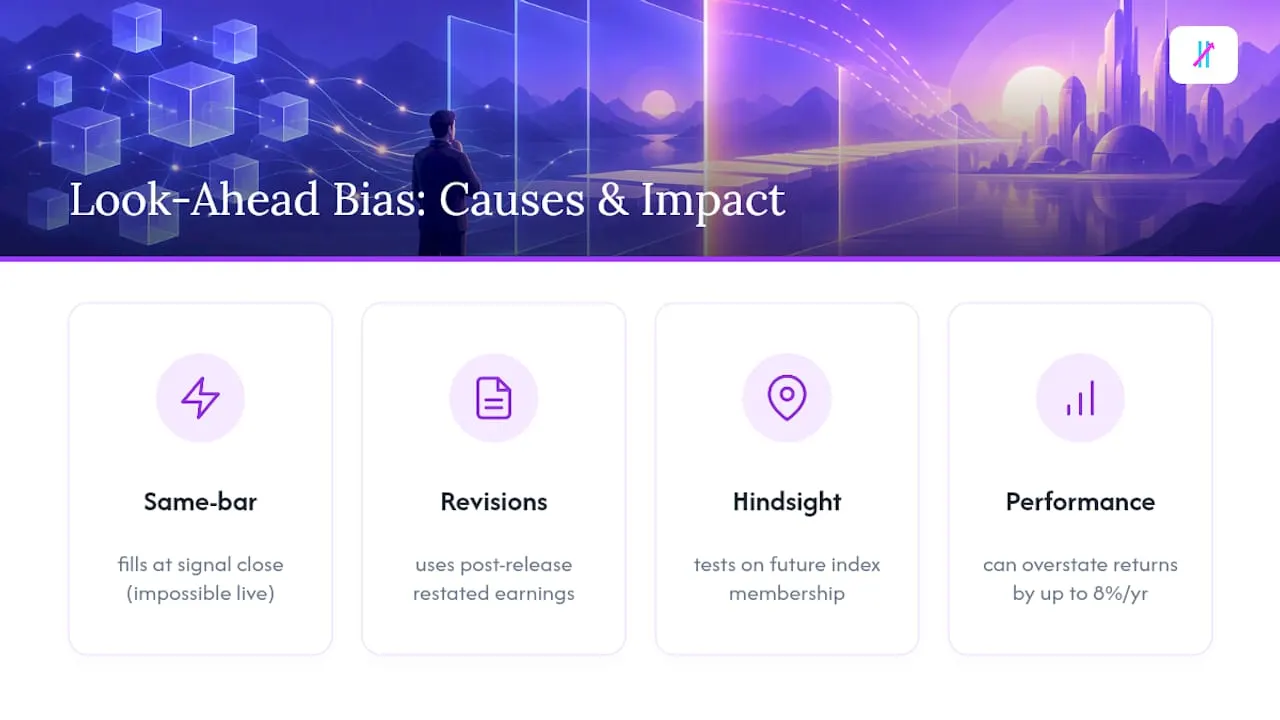
Three examples show up constantly in code review. A backtest that fills orders at the same closing price used to generate the signal assumes you could react instantly to information you’d just computed from that same bar’s close, which is physically impossible in live trading. A fundamentals-based model that pulls “as-reported” earnings data is often training on numbers that were revised or restated weeks after the original release, so the backtest is trading on knowledge that didn’t exist yet. An index-rebalancing strategy tested against today’s list of S&P 500 constituents assumes you knew in 2015 which companies would still be in the index in 2026, when in reality dozens have been added and removed.
The financial cost of these leaks is not trivial. Research on benchmark construction found that using final-constituent data instead of point-in-time membership can overestimate stock portfolio performance by up to 8% per year, and academic strategies with published results have collapsed once researchers corrected the underlying timing errors. That’s not a rounding error. That’s the difference between a strategy that clears its hurdle rate and one that quietly bleeds capital once deployed. Reporting from Rice Business documents real academic strategies whose published returns collapsed once researchers went back and corrected timing errors in the original analysis, sometimes turning a headline result into an unremarkable one.
How to Detect Look-Ahead Bias: Tests That Actually Prove It
Detecting look-ahead bias in trading systems doesn’t require guesswork. A handful of reproducible tests will surface it directly.
- Run the causality check. Re-execute your strategy’s rules using only data truncated to each historical decision point, then compare the trade decisions against your original backtest output. Any mismatch means the original run had access to information it shouldn’t have had.
- Run the one-bar ablation test. Shift every execution price forward by exactly one bar and rerun the full backtest. If your Sharpe ratio or total return collapses, the original result was likely built on same-bar fills. This single test catches the majority of look-ahead bias examples in retail-built systems, according to practitioner reviews of common backtesting errors.
- Log every trade and spot-check manually. Pull ten to twenty trades at random and compare the entry price, timestamp, and signal value against the actual historical print for that instrument on that date. This catches data-vendor errors that automated tests miss.
- Move to paper or forward testing. Nothing proves timing integrity like running the exact signal generation code against a live, unseen data feed for several weeks and comparing the paper trades against what the backtest would have predicted for the same window.
- Check statistical diagnostics. Run the strategy against randomly generated null data or scrambled price series. A strategy with a genuine edge should fail on random data; one that still produces suspiciously smooth returns on noise almost certainly has a leak or a selection artifact.
Statistic to watch: research on backtest selection inflation shows that optimized in-sample results can diverge sharply from walk-forward evidence, with the gap growing as the number of tested variations increases. That divergence is what a Backtest Inflation Factor is designed to quantify, comparing your best in-sample Sharpe against the Sharpe your process would have generated on genuinely unseen data.
The heuristic smells are easier to spot but harder to prove on their own. An equity curve that’s suspiciously smooth with almost no drawdown, a Sharpe ratio above 3 on a retail strategy with a handful of indicators, or performance that looks identical across wildly different market regimes are all signs worth investigating with the tests above before you trust the number.
Engineering Defenses That Prevent Leaks From Happening
Detection catches leaks after they’ve already been coded. Prevention means structuring your pipeline so the leak can’t happen in the first place.
Adopt point-in-time data as the default, not the exception. Every fundamental, economic, or index-membership dataset should carry both a value and a publication timestamp. When a vendor doesn’t provide that timestamp, apply a conservative reporting lag, typically a few days beyond the fastest realistic filing time, rather than assuming same-day availability.
Enforce a hard separation between signal computation and execution. Compute your signal using only data known as of time t, then fill the resulting order at the next tradable price, whether that’s the next bar’s open or the first liquid print after your signal fires. This single rule, consistently applied, eliminates the most common form of look-ahead bias in coded strategies.
Fit every transform inside the training fold, never across the whole dataset. Standardization parameters, PCA loadings, and outlier thresholds calculated on the full sample before splitting into train and test windows leak forward-looking statistical structure into your “historical” period. Recompute them fresh inside each fold.
Use purged and embargoed cross-validation whenever your labels span multiple periods. If a label looks 20 days forward, the training and test windows around that boundary need a purge and embargo gap equal to or larger than the label horizon, or the model effectively trains on information that overlaps its own test set.
Record provenance for every query your pipeline makes. Timestamp both event-time (when something happened in the market) and knowledge-time (when your system actually learned about it). Practical guidance on real-time data analysis recommends storing API request identifiers, cursor chains, and replay parameters so a run can be reconstructed exactly, which also makes accidental merge-on-latest joins far easier to catch during audit.
Add transaction costs, but treat them as a separate discipline. Realistic slippage and commission modeling matters for whether a strategy is profitable, but it does nothing to fix a temporal leak. A strategy can have perfectly modeled slippage and still be worthless if the underlying signal was generated with future data. Fix the timing first, then worry about friction.
- Store data with publication timestamps, not just values.
- Separate signal computation from order execution by at least one bar.
- Fit all preprocessing steps inside each cross-validation fold.
- Purge and embargo around any label that spans multiple future periods.
- Log the exact data snapshot used for every historical decision.
Pro Tip: Before you write a single line of strategy logic, write the data ingestion layer so that every table stores an “as-of” timestamp alongside the value. Retrofitting point-in-time tracking after your research pipeline already exists is far more painful than building it in from day one.
Validation Workflow: Proving Your Backtest Isn’t Cheating
A single clean backtest, no matter how careful the code, is not evidence. Trading system validation requires an ordered sequence of gates, each designed to catch a different way a strategy could be fooling you.
- Chronological non-interference check. Confirm that no data point used in a decision at time t comes from after time t, across every feature, label, and execution price in the pipeline. This is the causality and ablation testing from the detection section, applied systematically rather than spot-checked.
- Reserved out-of-sample holdout. Set aside a chunk of history, often the most recent 20 to 30%, that is never touched during research or parameter selection. Run the finalized strategy against it exactly once.
- Walk-forward analysis. Roll the training and testing windows forward through history in sequence, retraining or re-optimizing only on data that would have been available at each rolling point, then stitching the out-of-sample segments together into a single performance record.
- Monte Carlo and null-data searches. Randomize trade order, scramble price series, or generate synthetic data with similar statistical properties to your real market, then confirm your strategy’s apparent edge disappears on data that shouldn’t contain one.
- Report a selection-adjusted inflation diagnostic. A Backtest Inflation Factor or comparable metric quantifies how much your best in-sample result likely overstates genuine out-of-sample performance, based on how many variations you tested to find it. Research on this exact problem shows the gap between optimized and walk-forward results scales with the effective number of strategies searched.
A defensible go/no-go policy ties a real number to each gate: no live capital until the walk-forward Sharpe holds within a reasonable band of the in-sample Sharpe, the Monte Carlo null test rejects randomness, and the inflation diagnostic stays under a threshold you set in advance. A disciplined multi-gate pipeline combining these checks is what separates a strategy that survives contact with live markets from one that was only ever curve-fit to history.
LLMs, Parametric Look-Ahead, and the Lookahead Propensity Test
Large language models introduce a version of look-ahead bias that doesn’t come from your data pipeline at all. It comes from what the model already memorized during training.
An LLM trained on text up through a certain date has effectively “read” news articles, earnings calls, and analyst commentary describing events that, from the strategy’s simulated decision point, haven’t happened yet. Ask that model to forecast a historical outcome and it may answer correctly not because it reasoned well, but because the answer was sitting in its training corpus.
Researchers studying this problem defined a diagnostic called Lookahead Propensity, or LAP, which estimates the likelihood that a given prompt or its answer appeared in the model’s training data. The key test looks at the interaction between LAP and accuracy: if a model’s forecasts get systematically more accurate exactly when LAP is higher, that correlation is strong evidence the “forecast” is memorization dressed up as prediction, not genuine foresight.
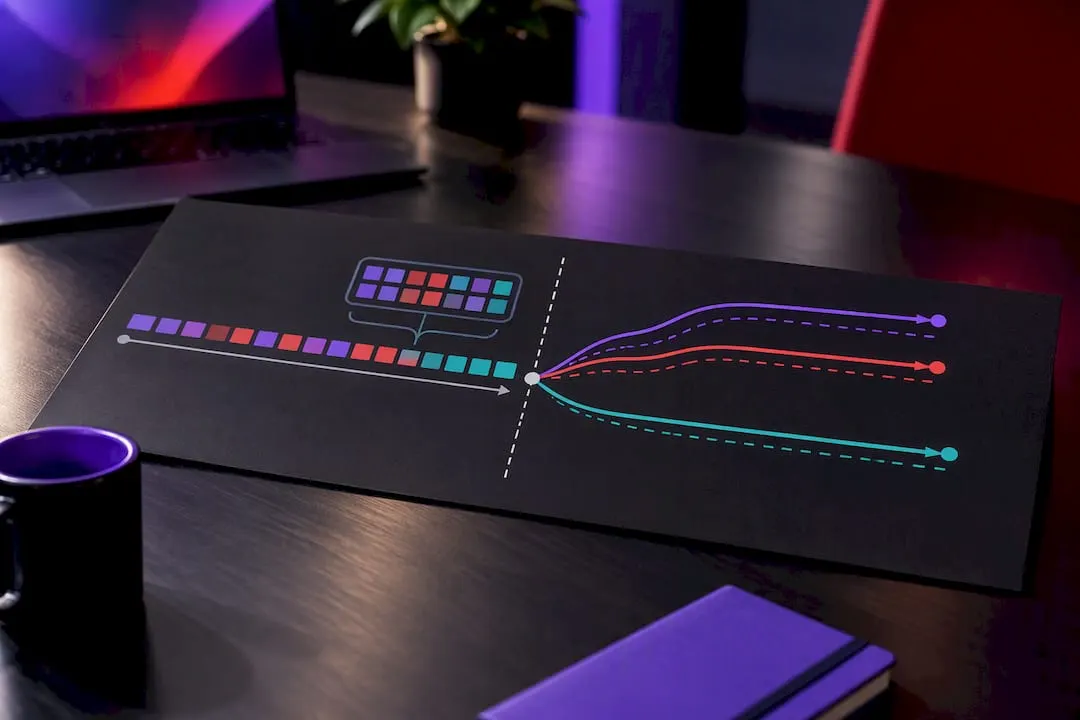
For anyone building LLM-assisted signals, the practical defense is straightforward: test forecasts against events strictly after the model’s training cutoff, run the LAP–accuracy check on any historical validation set, and treat unusually strong performance on well-known historical events with suspicion rather than pride.
Practical Audit Checklist: Quick Tests Before You Risk Capital
Run these roughly in order of effort, cheapest first, before committing real money to any strategy.
Quick checks (minutes):
- Insert a one-bar execution delay and compare results to the original backtest.
- Manually verify ten random trades against the actual historical price and timestamp.
- Confirm your TradingView strategy tester settings aren’t defaulting to same-bar fills, which is a common platform pitfall.
Data checks (hours):
- Confirm your fundamentals or macro data carries publication timestamps, not just values.
- Validate every merge or join uses knowledge-time, not event-time, as the join key.
- Flag any vendor field known to get backfilled or restated after initial release.
Model checks (a day or more):
- Refit every preprocessing transform inside cross-validation folds rather than across the full dataset.
- Purge and embargo the CV split boundaries around any multi-period label.
- Run the strategy against scrambled or synthetic null data to confirm the edge disappears.
Forward-testing gate (weeks, non-negotiable):
- Run the signal logic live on paper for two to four weeks minimum, then compare the paper trades directly against what the backtest would have produced over that same window. Big Move Algo’s own forward-testing guide for TradingView users walks through exactly how to structure this comparison.
Pro Tip: Keep a running log that maps every code change to the backtest result it produced. When a result improves dramatically after a small tweak, the log lets you check whether that tweak accidentally introduced a leak instead of a genuine improvement.
Author Perspective: Why Rigorous Validation Is the Best Risk Control
The order of operations here isn’t a stylistic preference. It’s the difference between a strategy that fails safely in research and one that fails expensively with real money on the line. Fix timing and data hygiene first. Tune parameters second. Reverse that order and you’ll spend weeks optimizing a model whose entire edge was manufactured by a leak you haven’t found yet.
The mistake I see most often isn’t exotic. It’s a team that built a careful, purged cross-validation setup for their model, then fed it a fundamentals table joined on calendar date instead of filing date. All that modeling rigor, undone by one join. Governance fixes for this are unglamorous but effective: require a documented publication timestamp on every non-price data source before it enters a pipeline, and make the one-bar ablation test a mandatory pre-commit check rather than an occasional audit.
My stronger opinion: forward testing shouldn’t be a courtesy step you run if there’s time before launch. It should be a release gate no strategy skips, the same way a software team wouldn’t ship to production without integration tests. A strategy that can’t survive two to four weeks of live, risk-controlled paper trading has no business managing real capital, no matter how clean its backtest looks.
— Steven Hartwell
Big Move Algo Helps You Close the Backtest-to-Live Gap
Fixing look-ahead bias gets your backtest honest. Closing the gap between an honest backtest and a clean live execution is a separate problem, and it’s the one Big Move Algo was built to simplify.
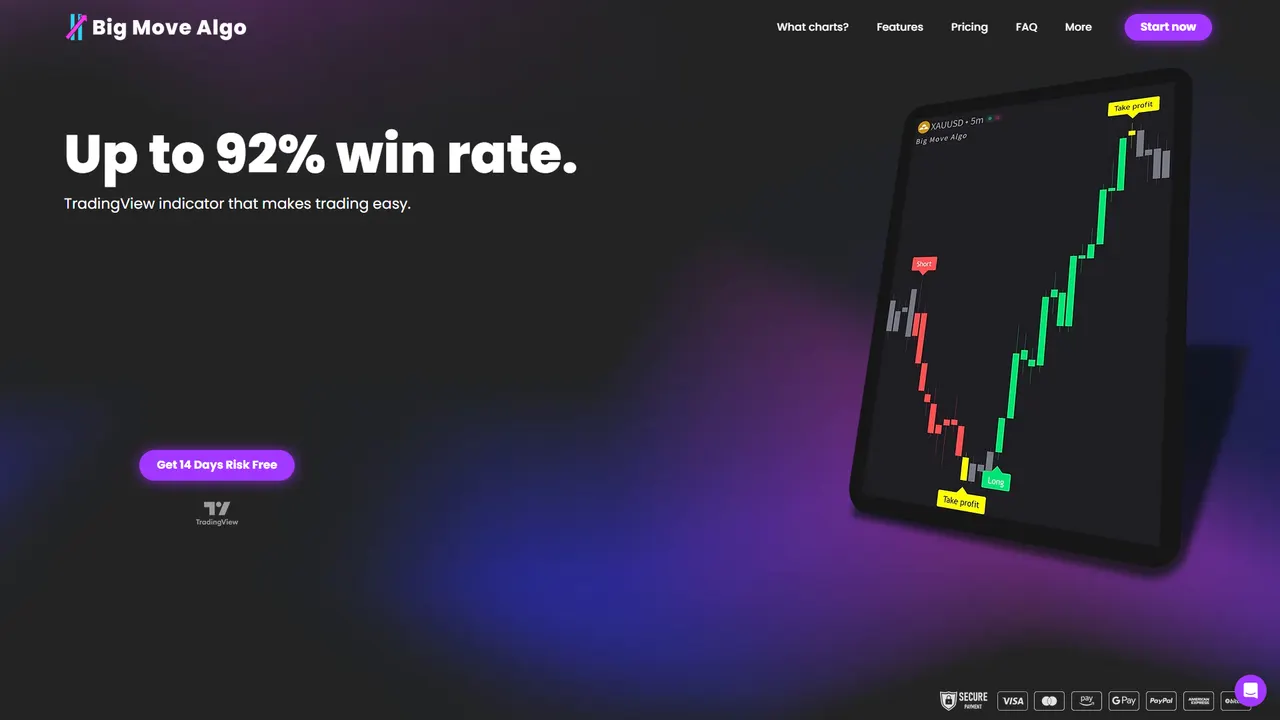
The software runs as a TradingView indicator that outputs clear Long, Short, and Exit signals in real time, so you’re reacting to the same information at the same moment the market delivers it, not a restated or same-bar version of it after the fact. It includes a Fake Trend Detector designed to filter out choppy, low-quality conditions where a signal is more likely to be noise, reducing ambiguous live results that can cause traders to question their backtest validity. An AUTO Mode allows quick startup with minimal setup, while a Manual Mode offers experienced traders options to adjust parameters for trading across multiple markets.
None of that replaces the validation discipline covered above; a clear signal still needs sound timing and data hygiene behind it. But if you want live execution that’s simple to monitor while you forward-test a strategy, see current Big Move Algo plans starting at $55 per month, or check the account setup guide if you’re moving the indicator to a new TradingView account.
Sources
For deeper reading, review the point-in-time backtesting guide for replay and provenance practices, the arXiv paper on backtest selection inflation for BIF methodology, and Obside’s practical breakdown of common backtesting errors.
This article is general information, not a substitute for advice from a qualified financial advisor. Consult a qualified financial professional about your own circumstances before acting on anything here.
- Point-in-time data & benchmark overestimation (ADS entry)
- Look-Ahead Bias in Backtesting: Detect and Avoid It | Obside
- Backtest selection inflation and diagnostics (arXiv 2604.15531)
- When research promises the impossible, investors pay the price | Rice Business
FAQ
What Is Look-Ahead Bias in Trading?
Look-ahead bias is when a backtest uses information that wasn’t actually available at the moment a trade decision was made, such as a same-bar fill price or a restated earnings figure. It’s a timing error, not a modeling error, and it typically causes strategies to look profitable in testing and then fail immediately in live trading.
What Are the 7 Types of Bias in Backtesting?
Backtests commonly suffer from look-ahead bias, survivorship bias, overfitting (data-mining bias), selection bias, transaction-cost bias, psychological or confirmation bias in strategy design, and time-period bias from testing over too short or too favorable a window. Look-ahead bias and survivorship bias are the two most damaging because they can make a losing strategy appear consistently profitable.
Is Look-Ahead Bias Really That Significant?
Yes. Research on benchmark construction found that using final-constituent data instead of point-in-time membership can overestimate stock portfolio performance by up to 8% per year, and academic strategies with published results have collapsed once researchers corrected the underlying timing errors. Leakage of future information, even a single data point, can be the entire source of an apparent edge.
What Is Hindsight Bias, and How Is It Different From Look-Ahead Bias?
Hindsight bias is a psychological tendency to believe, after an event, that it was predictable all along, even when it wasn’t. Look-ahead bias is a technical data error where your code literally has access to future values during testing; hindsight bias is a cognitive distortion in how a trader interprets past decisions, with no coding error involved.
What Is Forward Rate Bias, and Does It Relate to Look-Ahead Bias?
Forward rate bias refers to the tendency of forward exchange rates to be poor, systematically biased predictors of future spot rates, a well-documented anomaly in currency markets. It’s a market-behavior anomaly rather than a data-leakage problem, so it’s a different phenomenon from look-ahead bias even though both involve timing and prediction.
How Do I Correct Look-Ahead Bias Once I’ve Found It?
Shift execution to the next tradable bar after signal generation, replace any restated or backfilled data with point-in-time equivalents, and refit preprocessing steps inside cross-validation folds instead of across the full dataset. After making these fixes, rerun your walk-forward analysis to confirm the corrected performance still clears your deployment threshold.