NIH Alternatives: Non-Animal Research Methods Compared
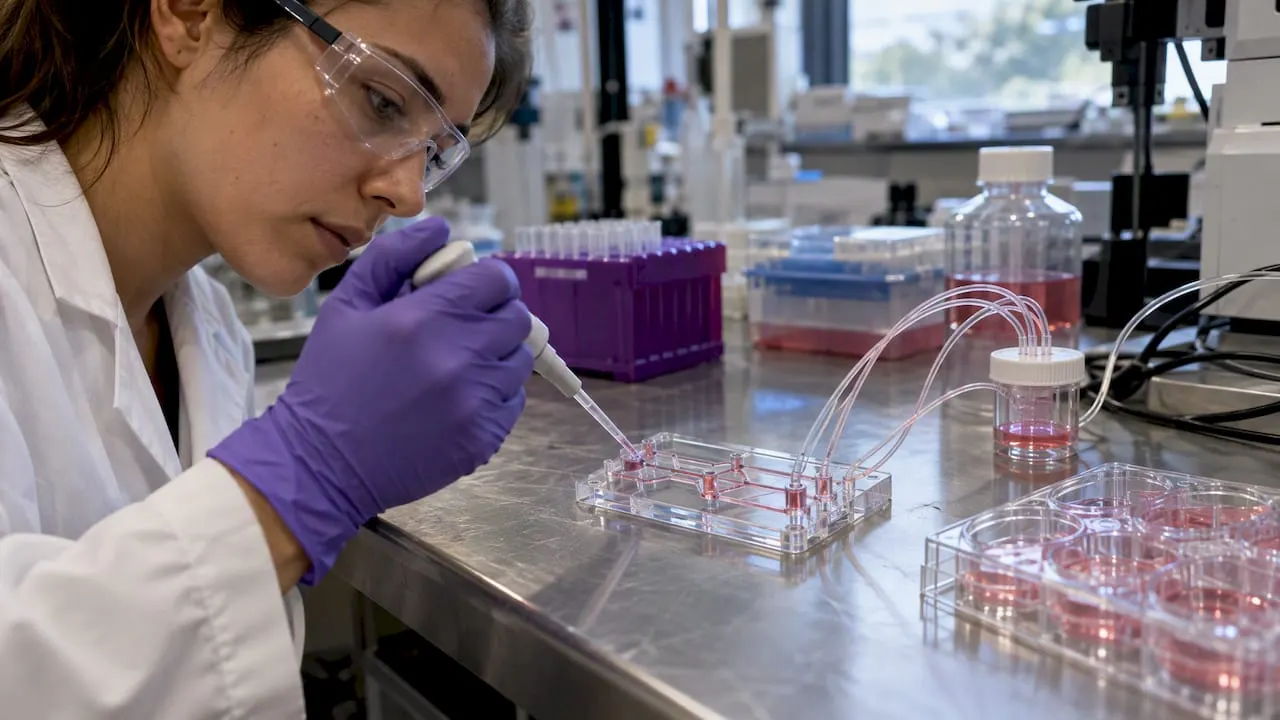
If you searched for NIH alternatives, the pages NIH itself publishes under that phrase are about replacing, reducing or refining animal use in research. This guide compares those options side by side: computer models, cell and tissue systems, chemistry-based assays and simpler organisms. It also covers what each can and cannot answer, where U.S. agencies accept them, and how researchers are expected to look for them.
One note on scope. We are a trading software company, not a laboratory, so everything about research methods below comes from U.S. government pages, linked where the claim is made. Our own view is in a short section further down, and it is about choosing tools carefully, not about biology.
TL;DR
- “Alternatives” covers three things, not one: replacement, reduction and refinement. Full replacement is only the most visible.
- The main non-animal families are in chemico, in silico and in vitro methods, plus some non-mammalian models such as zebrafish, per NIEHS.
- NIH says not every question can be answered with these methods. The right choice is the one that is fit for purpose, relevant, translatable and reproducible.
- FDA accepts some of them for specific uses, for example human stem-cell-derived heart cells in certain cardiac risk studies.
- Researchers applying for NIH funding must address alternatives in the Vertebrate Animals Section of their proposal.
Table of Contents
- What “alternatives” actually means
- The main options compared
- What these methods cannot do (yet)
- Where U.S. regulators accept alternatives
- What NIH policy and U.S. law require
- How researchers search for alternatives
- Perspective: the same discipline applies to any tool
- A note for readers who also trade
- FAQ
- Sources
What “alternatives” actually means
NIH uses the term broadly. Alternatives can be strategies that reduce animal use, improve animal welfare, or completely replace animals. NIH defines the three parts this way:
- Replacement: using alternatives to animal models.
- Reduction: methods that allow fewer animals to be used.
- Refinement: methods that minimize pain and distress.
The term NAMs (new approach methodologies) is sometimes used interchangeably with “alternatives” when the topic is complete replacement. NIH’s position is that reduction, refinement and better animal welfare remain part of responsible research when full replacement is not scientifically appropriate.
The USDA National Agricultural Library adds a useful distinction. Full replacement avoids animals completely. Partial replacement may still use animals that do not experience pain or distress during the study. USDA also lists examples across the three Rs: human tissues and cells, computer models, microphysiological systems, training manikins, careful experimental design, statistical evaluation, resource sharing, analgesia, humane handling, enrichment and humane endpoints.
The main options compared
NIEHS groups non-animal approaches into a few families. NIH’s own definition treats NAMs as an umbrella that includes in vitro, in chemico and in silico methods, covering human tissues, microphysiological systems, laboratory equipment, computer simulations and artificial intelligence.
| Option | What it is | Typical use | Main limit |
|---|---|---|---|
| In chemico | Experiments on biological molecules | Studying molecular interactions and chemical reactivity | Cannot show what happens in a whole living system |
| In silico | Mathematical modeling, simulation, machine learning and other computational techniques | Predicting chemical effects, simulating biological processes | Only as good as the data and assumptions behind the model |
| In vitro cultures | Cell, organoid and tissue cultures, including high-throughput screening | Testing many compounds quickly, studying disease mechanisms | A dish lacks the full body’s organ-to-organ signaling |
| Organs-on-chips (microphysiological systems) | Engineered devices that mimic features of human tissues or organs | Modeling human tissue responses | Still need fit-for-purpose validation for each use |
| Non-mammalian models | Zebrafish, nematodes, planaria | Studying biology and chemical effects in whole organisms lower on the phylogenetic scale | Biology differs from humans in important ways |
The first three families and the non-mammalian models come from NIEHS’s overview. The “main limit” column summarizes the general caution that NIH states, that these methods must be judged against the question being asked, rather than a claim made about each technique by a single page.
In chemico and in silico: the fastest to run
In chemico work happens at the molecular level, with no cells at all. In silico work happens on a computer. Both can be repeated cheaply, which suits early screening. NIEHS says these methods can model molecular interactions, biological processes, chemical effects on biology and behavior, and features of human tissues or organs.
In vitro and organs-on-chips: closest to human tissue
Cell, organoid and tissue cultures let researchers work with human material directly. High-throughput screening runs thousands of tests in parallel. Organs-on-chips, which NIEHS also calls microphysiological systems, try to recreate tissue-level function in a small device.
Simpler organisms: a middle path
Zebrafish, nematodes and planaria are listed by NIEHS as non-mammalian models. They keep a whole living system in play while sitting lower on the phylogenetic scale, which is one of the factors ORI says an alternatives search should consider.
What these methods cannot do (yet)
NIH is direct on this point: not every scientific question can be answered with NAMs. A method has to be fit for purpose, relevant, translatable and reproducible. That is why NIH tells researchers they may choose any scientifically appropriate model, including combinations of approaches.
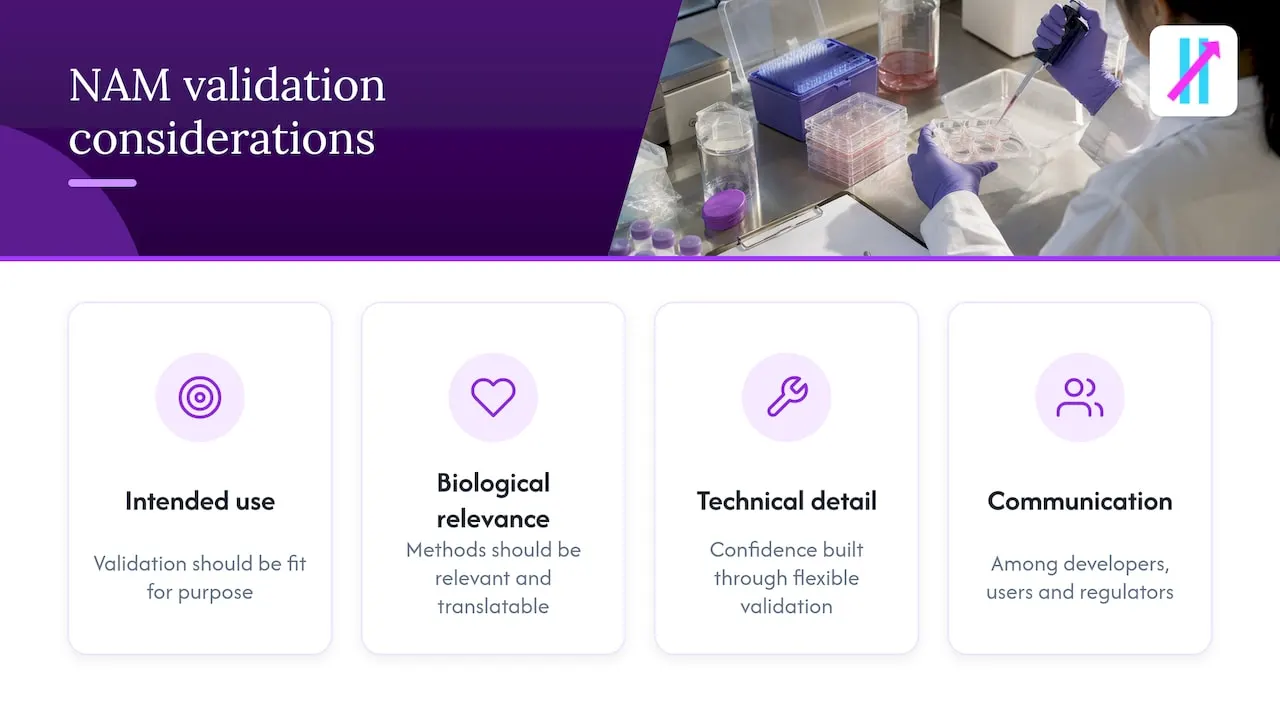
Validation is the other half of the story. The 2024 ICCVAM Validation Workgroup report says confidence in a NAM should be built through flexible, fit-for-purpose validation that weighs intended use, biological relevance and technical characterization. The same report says one-size-fits-all validation is unsuitable for NAMs and stresses communication among developers, users and regulators.
In practice, this means a method that works for one question (say, chemical skin sensitization) tells you nothing about another (say, long-term behavior effects). Compare the method to the question, not to the label “non-animal.”
Where U.S. regulators accept alternatives
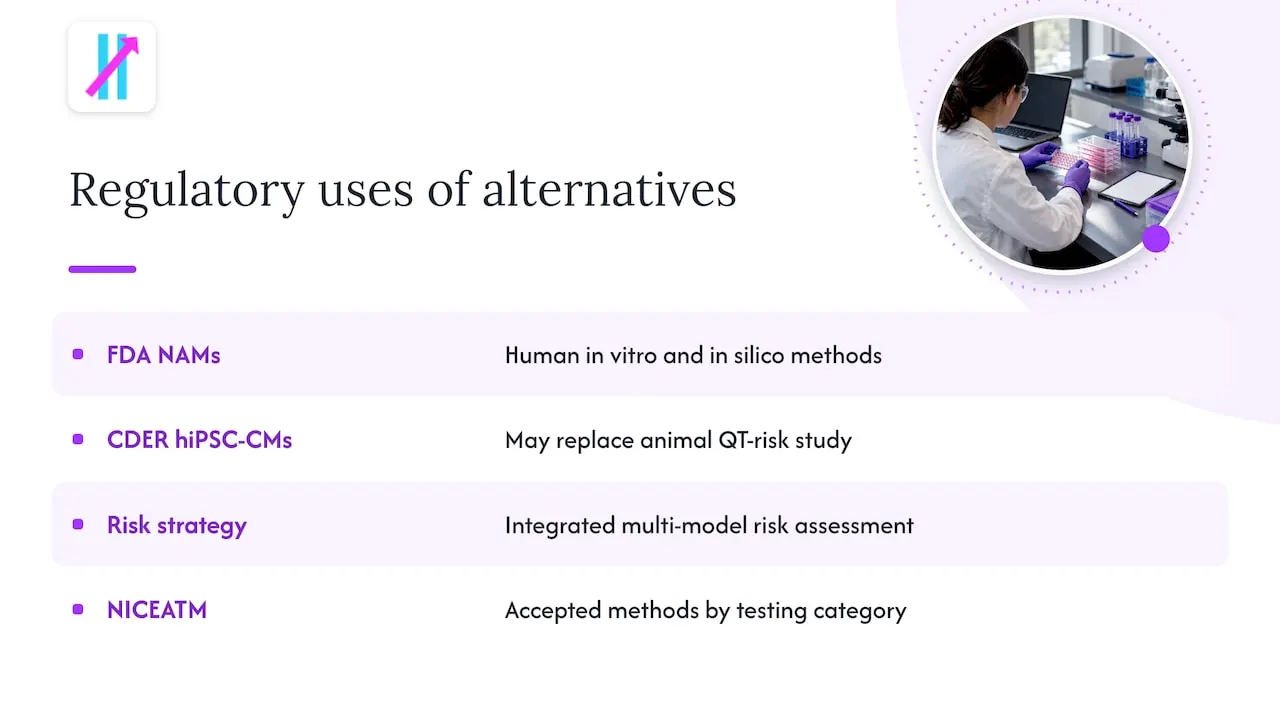
FDA defines NAMs as innovative methods and strategies for assessing the safety, efficacy and quality of FDA-regulated products, including human-based in vitro systems and in silico modeling. FDA says they may evaluate immunogenicity, toxicity and pharmacodynamics in humans, and can improve the predictive relevance of nonclinical testing while reducing or replacing animal use.
The most concrete example comes from FDA’s drug center. According to CDER, studies using human induced pluripotent stem cell-derived cardiomyocytes (hiPSC-CMs) that follow best practices can be used instead of an otherwise conducted animal study to evaluate QT prolongation or proarrhythmic risk. In vitro, in silico, ex vivo and in vivo models may also be combined in an integrated risk-assessment strategy. CDER adds that NAMs may be used when combined with pathway knowledge, pharmacology results and other relevant data.
For chemical and product safety testing, NIEHS’s NICEATM keeps a list of alternative methods accepted by U.S. agencies, organized by testing category. If you work in toxicology, that page is the practical starting point.
What NIH policy and U.S. law require
For animal use in NIH-supported work, the PHS Policy endorses the U.S. Government Principles. Investigators are to select an appropriate species and the minimum number of animals needed for valid results, and to consider mathematical models, computer simulation and in vitro systems. Applications that propose vertebrate animals must address the Vertebrate Animals Statement.
Two legal points from NIEHS are worth knowing:
- U.S. law and policy require scientists to consider alternatives before using animals for toxicology research and testing.
- The Animal Welfare Act requires the committees of research and testing facilities to approve proposed animal use and to ensure alternatives are used where appropriate.
How researchers search for alternatives
NIH’s advice is to start early. Identify relevant refinements or NAMs at the design stage, and get statistical help early so you use the fewest animals possible. Two literature resources are named: USDA’s AWIC and NICEATM’s ALTBIB. The Vertebrate Animals Section of the proposal has to cover replacement alternatives, refinements and measures to reduce animal use.
HHS’s Office of Research Integrity describes what a thorough search should consider: non-animal models, microorganisms, cell culture, computer simulation, species lower on the phylogenetic scale, experimental-design methods that reduce animal numbers, and procedures that eliminate or reduce pain and distress. ORI also notes that USDA animal-welfare regulations require a written narrative describing the methods used and sources consulted to decide whether alternatives are available.
A simple workflow:
- Write down the exact question the study must answer.
- Search AWIC and ALTBIB for replacement and refinement methods tied to that question.
- Check whether a regulator has already accepted a method for the same purpose.
- If animals are still needed, consult a statistician to size the study.
- Document the search, including sources and methods, in your narrative.
Perspective: the same discipline applies to any tool
We build trading software, so we are not the people to judge a cell assay. What we can speak to is how a good decision about tools gets made, because the lesson in NIH’s guidance carries over. Nobody should pick a tool because it is new or because it promises to replace everything. They should pick it because it fits the job, behaves the same way every time, and has been tested for the specific use.
That is the standard we hold Big Move Algo to as a TradingView indicator. It gives Long, Short and Exit signals, it does not repaint, and its Fake Trend Detector is there to say when conditions are poor and a trade is not recommended. Knowing when a tool should not be used is part of fit for purpose. We would rather a trader sit out a bad market than force a signal.
— Steven Hartwell
A note for readers who also trade
If your interest in alternatives to complicated tools extends to the markets, Big Move Algo is built for retail traders on TradingView. It works across crypto, forex, stocks, indices and commodities, with AUTO Mode for a quick start and Manual Mode for more customization. Version 2 is $55 per month or $660 per year, and Version 3 and Version 3 Plus are listed on the same page. It has nothing to do with laboratory research, so skip this section if that is all you came for.
FAQ
What is the difference between alternatives and NAMs?
Alternatives is the broader word. It covers replacing, reducing or refining animal use. NAMs, or new approach methodologies, is an umbrella for in vitro, in chemico and in silico methods, and the term is sometimes used interchangeably with alternatives when the aim is complete replacement.
Can non-animal methods fully replace animal studies?
Not for every question. NIH states that not every scientific question can be answered with NAMs, and that a method must be fit for purpose, relevant, translatable and reproducible. In some defined cases, such as certain cardiac risk assessments, FDA says a validated cell-based study can be used instead of an animal study.
Do NIH grant applications have to address alternatives?
Yes, if they propose vertebrate animals. The Vertebrate Animals Section must address replacement alternatives, refinements and measures to reduce the number of animals used.
Where can I find alternatives for my research question?
NIH points to USDA’s AWIC and NICEATM’s ALTBIB as literature-search resources. For toxicology and safety testing, NICEATM also lists methods accepted by U.S. and international regulators, grouped by testing category.
Sources
- Alternatives and NAMs | Grants & Funding (NIH)
- Alternatives to Animal Testing (NIEHS)
- Animal Use Alternatives (3Rs) (USDA National Agricultural Library)
- Validation, Qualification, and Regulatory Acceptance of New Approach Methodologies (ICCVAM, 2024)
- New Approach Methodologies (NAMs) (FDA)
- CDER Streamlined Nonclinical Studies and Acceptable NAMs (FDA)
- Alternative Methods Accepted by US Agencies (NICEATM)
- Principles of the welfare of laboratory animals (ORI)