Traders' Position Sizing Methods: 1% Fixed Fractional with ATR

Layer in fractional Kelly only once you have a proven, statistically validated edge. The formula behind all of it: Position size = Account risk ÷ stop distance. Everything else in this guide, from micro futures to margin buffers, is about making that number executable, not just correct on paper.
TL;DR:
- Use fixed-fractional sizing as the default method because it scales with account changes and balances risk effectively across different assets.
- Always round down share and contract counts after calculating position size to avoid overshooting your risk limits and recheck math after any stop adjustment.
- Adjust position size based on asset volatility using ATR or micro futures to keep dollar risk consistent regardless of market fluctuation.
- Limit risk per trade to around 1% to 2% of your account equity to withstand losing streaks without excessive drawdowns.
- Automate your sizing rules and log all trades to ensure consistent discipline, backtest formulas against historical volatility, and use risk filters to avoid sizing into weak setups.
Table of Contents
- Position Sizing Methods at a Glance
- How to Calculate Position Size: Formula and Examples
- Fixed-Fractional, ATR, Kelly, and Pyramiding: The Deep Dive
- Sizing by Asset Class: Stocks, Futures, Options, and Crypto
- Operational Reality: Liquidity, Margin, and the Mistakes That Sink Good Math
- Turning Sizing Rules Into an Enforced Workflow
- What I’d Actually Recommend
- Automate the Sizing Decision, Not Just the Signal
- Where to Go Deeper
- Sources
- FAQ
Position Sizing Methods at a Glance
Every position sizing method answers the same question differently: how much do you put on this specific trade? The right answer depends on your account size, the asset’s volatility, and how confident you are in your edge.
- Fixed-dollar sizing: You risk a flat dollar amount, say $200, on every trade regardless of account size or stop distance. It’s the easiest method to understand and a reasonable starting point for beginners testing a new strategy, but it doesn’t scale. A $200 risk on a $5,000 account is aggressive; the same $200 on a $500,000 account is irrelevant.
- Fixed-fractional sizing: You risk a fixed percentage, typically 1% to 2%, of current account equity per trade. This is the default recommendation for most traders because it scales automatically as your account grows or shrinks, compounding gains and cutting losses proportionally.
- Volatility-based (ATR) sizing: You size positions based on the asset’s Average True Range instead of a fixed percentage move, so a wildly swinging crypto asset gets a smaller share count than a sleepy blue-chip stock, even at equal dollar risk.
- Kelly and fractional Kelly: A formula-driven approach that calculates the mathematically optimal bet size given your win rate and payoff ratio. It’s powerful but punishing. Most practitioners use fractional Kelly (half or quarter Kelly) specifically to reduce drawdown and psychological stress.
- Pyramiding and equal-weighting: Pyramiding means adding to a winning position as it moves in your favor, using tighter stops on each new layer. Equal-weighting simply splits capital evenly across a fixed number of positions, useful for diversified swing or portfolio strategies where you want no single name to dominate.
Beginners usually start with fixed-dollar or fixed-fractional. Experienced traders layer ATR adjustments on top of fixed-fractional. Kelly sits at the far end for traders with enough trade history to trust the math.
How to Calculate Position Size: Formula and Examples
The math behind every trade decision comes down to one equation:
Position size = Account risk ÷ (Entry price − Stop price)
Account risk itself is calculated as account balance multiplied by your risk percentage. Here’s how that plays out in practice.
- Stock example. You have a $20,000 account and risk 1% per trade, or $200. You want to buy a stock at $50 with a stop at $47, a $3 stop distance. Position size = $200 ÷ $3 = 66 shares. Round down to 66 and confirm the trade costs roughly $3,300, well within a normal account allocation.
- Micro futures example. Same $20,000 account, same $200 risk. You’re trading Micro E-mini Nasdaq (MNQ) futures, where each point is worth $2. Your stop is 25 points away, so dollar risk per contract is $2 × 25 = $50. Position size = $200 ÷ $50 = 4 contracts. Because MNQ runs at one-tenth the size of the full NQ contract, a small account can still fine-tune risk instead of being forced into an all-or-nothing position.
- ATR-based stop example. You calculate a 14-period ATR of $2.50 on a stock trading at $80. You set your stop at 1.5× ATR, or $3.75 below entry. Risking $200 again, position size = $200 ÷ $3.75 = 53 shares. The wider the ATR, the smaller your share count, which keeps dollar risk constant even as volatility shifts week to week.
Round share and contract counts down, never up, and always recheck the math after a stop adjustment.
Fixed-Fractional, ATR, Kelly, and Pyramiding: The Deep Dive
Fixed-fractional sizing is the workhorse method because it compounds correctly in both directions. Risking more may grow capital faster during winning streaks, but drawdowns become more severe. Most traders start conservatively and adjust risk as experience grows.
Fixed-dollar sizing fits a narrow use case: small accounts under a few thousand dollars, or strategy testing where you want risk held perfectly constant while you evaluate win rate. It stops making sense once your account grows enough that a flat dollar figure no longer reflects a sensible percentage of equity.
The reasoning is straightforward: a $5 stock that moves $0.10 a day and a $5 stock that moves $1.00 a day carry wildly different risk profiles at the same share count. ATR sizing levels that gap so your dollar risk stays consistent across assets with different volatility regimes.
Kelly and fractional Kelly calculate the theoretically optimal fraction of capital to risk, based on your win probability and average win-to-loss ratio. The formula rewards a real edge aggressively, which is exactly the problem. Full Kelly sizing produces brutal equity swings even when the underlying edge is real, because it assumes your win-rate estimate is exact and stable, which it rarely is in live markets. That’s why most practitioners who use Kelly at all cut it to half or quarter Kelly, trading some theoretical growth for a smoother ride they can actually stick with.
Pyramiding means adding to a winner as the trade confirms your thesis, with each new layer using a tighter stop than the last so an early reversal doesn’t wipe out the whole position. It works well in trending markets and poorly in choppy ones, since every add-on is itself a fresh trade needing its own risk math.
- Fixed-fractional: scales with equity, best all-around default.
- Fixed-dollar: simple, useful for small accounts or early testing only.
- ATR-based: equalizes risk across assets with different volatility.
- Kelly/fractional Kelly: powerful with a proven edge, dangerous without one.
- Pyramiding: adds to winners with tightening stops, needs trend confirmation.
Pro Tip: Combine fixed-fractional with ATR by capping your dollar risk at a small percentage of account equity, then letting the ATR-based stop distance determine the share or contract count. You get the scaling benefit of fixed-fractional and the volatility-awareness of ATR in one calculation.
Sizing by Asset Class: Stocks, Futures, Options, and Crypto
Instrument mechanics change the sizing math even when your risk percentage stays fixed.
- Stocks: Round share counts down to avoid overspending your risk budget, and factor commissions into thinner accounts where a few dollars per trade can meaningfully eat into a 1% risk allowance.
- Futures: Contract multipliers do the heavy lifting. A full E-mini S&P (ES) contract moves $50 per point; the Micro (MES) moves $5 per point, letting smaller accounts hit precise risk targets instead of over-committing to one oversized contract. CME Group’s own guidance stresses matching contract count to account size using exactly this kind of multiplier math.
- Options: Size by controlling maximum loss through strike selection and contract count, not by treating options like shares. A single contract can represent 100 shares of exposure, so your effective dollar risk needs recalculating every time, not assumed from the premium alone.
- Crypto and thin stocks: Downsize below your calculated number when spreads are wide or average daily volume is low, since slippage on entry and exit can quietly erase the edge your sizing math assumed you had.
Operational Reality: Liquidity, Margin, and the Mistakes That Sink Good Math
A textbook-perfect position size means nothing if the market can’t absorb it without moving against you. Adjust your calculated size down when average daily volume is thin. Practitioner guidance from FINRA notes that order size relative to daily volume drives slippage, so a “correct” position on paper can still cost you real money on the fill.
Margin adds another layer of constraint. CME Group’s education materials explain that initial and maintenance margin levels directly limit executable contract counts, and margin requirements can shift intraday during volatile sessions. Keep a buffer above maintenance margin, not right at the line.
Concentration risk is the mistake most traders miss entirely. FINRA advises investors to “look under the hood” of their holdings to confirm real diversification, since three “different” positions in correlated tech names carry the concentrated risk of one oversized trade. Portfolio margin rules also require monitoring aggregated exposure across accounts, not just position by position.
Common errors that undo good sizing discipline:
- Moving a stop further away mid-trade instead of accepting the original loss.
- Sizing up right after a winning streak, when overconfidence is highest.
- Ignoring commissions and spread costs on smaller accounts.
- Treating correlated positions as independent risk.
Roughly 1% to 2% of account equity per trade is the range professional traders commonly use, according to TradingSim’s position sizing research, precisely because it survives losing streaks without requiring heroic win rates to recover.
Turning Sizing Rules Into an Enforced Workflow
A sizing rule only works if it’s followed on every single trade, which is where most manual discipline breaks down. The chain should run: signal generates, stop distance gets set, risk percentage applies, position instruction follows automatically. Whether you’re running systematic trading frameworks or a discretionary approach, that chain needs to be consistent or your sizing math is theoretical.

Volatility filters matter here too. A volatility filter that flags choppy or low-conviction conditions helps you avoid sizing into setups where your edge probably isn’t present, which is functionally more important than the size calculation itself. Automated risk controls like per-trade caps, max daily loss limits, and aggregated exposure checks catch what manual tracking misses during a fast session.
Before deploying any sizing rule live:
- Paper-test the rule across at least a few dozen trades first.
- Backtest the sizing formula against historical volatility, not just entries.
- Log every trade’s intended size against its actual filled size.
- Set alerts for when aggregated exposure crosses your comfort threshold.
Pro Tip: Treat your position sizing rule as a piece of code, not a habit. If you can’t write the exact if-then logic behind your risk percentage and stop distance, you don’t have a rule yet, you have a preference.
What I’d Actually Recommend
Save fractional Kelly for after you have 200 or more validated trades logged, not a strong hunch. Get more conservative on small accounts, illiquid markets, or any strategy you haven’t traded live for at least a few months. Review your sizing decisions weekly against outcomes, not just your win rate.
— Steven Hartwell
Automate the Sizing Decision, Not Just the Signal
Most sizing failures aren’t math errors, they’re discipline failures under pressure. Big Move Algo turns a Long, Short, or Exit signal into a structured decision point instead of a judgment call made mid-trade. The built-in Fake Trend Detector filters out the choppy, low-quality conditions where even correctly sized positions tend to lose, and AUTO Mode gets you a clean setup fast while Manual Mode lets experienced traders fine-tune entries across crypto, forex, stocks, indices, and commodities.

Test it the way you’d test any sizing rule: run it in AUTO Mode against your own risk percentage before committing real size, and confirm the signals hold up across the assets you actually trade. Subscription plans are available monthly or annually, and current prices and access details can be found on the Big Move Algo plans page. If you’re switching from another setup, the TradingView account guide walks through connecting your account so you can start applying these sizing rules against live signals today.
Where to Go Deeper
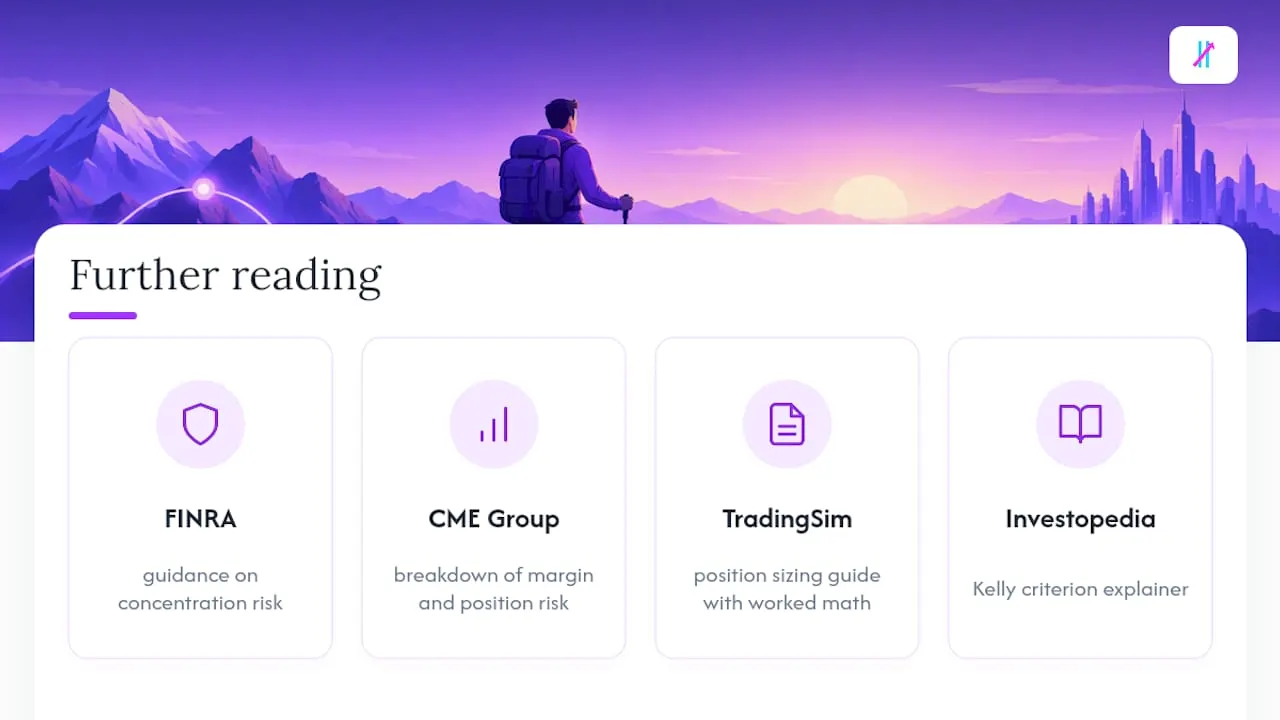
For regulatory grounding, read FINRA’s guidance on concentration risk and CME Group’s breakdown of margin and position risk. For formulas and worked math, TradingSim’s position sizing guide and Investopedia’s Kelly criterion explainer cover the calculations in more depth.
Sources
- Position and risk management | CME Group
- Position Sizing Guide | TradingSim
- How to determine position size | Investopedia
FAQ
What is the best position sizing strategy?
Layering in ATR-based adjustments refines it further by keeping risk consistent across assets with different volatility.
What is the formula for position sizing?
The core formula is Position size = Account risk ÷ (Entry price − Stop price), where account risk equals your account balance multiplied by your chosen risk percentage. TradingSim’s guide confirms this is the standard calculation professional traders use.
How do I do position sizing step by step?
Round down and confirm the trade fits within your margin and liquidity constraints before entering.
What is the 3-5-7 rule in trading strategy?
It’s not a formal industry standard, and most professional risk frameworks favor the more precise 1% to 2% fixed-fractional approach instead.
Can Big Move Algo help with position sizing?
Big Move Algo doesn’t calculate position size directly, but its Long, Short, and Exit signals combined with the Fake Trend Detector help you avoid sizing into weak setups in the first place. Pairing its signals with your own fixed-fractional or ATR-based sizing rule keeps the whole workflow consistent from signal to trade execution.