Power Thesaurus Alternatives: 6 Options Worth Trying in 2026

The best Power Thesaurus alternative depends on what you do with words. For example sentences and trustworthy definitions, use Cambridge or Merriam-Webster. For a familiar all-rounder, use Thesaurus.com. For offline lookup on a Windows PC, use WordWeb. For rhymes, word games and quick reference, use WordHippo. Below, we compare them on the things that decide whether a thesaurus helps you or just hands you a longer list of words.
One note on who we are. We are Big Move Algo, a company that builds a TradingView indicator, not a dictionary publisher. We wrote this guide for people who work with words every day, including traders who write journals, newsletters and market commentary. We have a short section later about where we fit, but the comparison itself is about thesauruses.
TL;DR
- Cambridge Thesaurus is the strongest pick for examples, with synonyms and antonyms built on a research corpus and covering British and American English.
- Thesaurus.com is the broadest general-purpose option, with results sorted by strength and part of speech, but ads and thin context are its known weak spots.
- Merriam-Webster is the cleanest reading experience, and its print thesauruses cost $22.95 or less.
- WordWeb Pro is the pick for Windows desktop users who want offline lookup from almost any program.
- Whatever you choose, check each suggested word against your sentence. No thesaurus knows your tone.
Table of Contents
- Why people look beyond Power Thesaurus
- What a good thesaurus should offer
- The alternatives, one by one
- Side-by-side comparison
- How to choose
- The risk every thesaurus shares
- Where we fit
- Our perspective
- FAQ
- Sources
Why people look beyond Power Thesaurus
Power Thesaurus presents itself as an easy-to-use online thesaurus for students, writers, editors and language professionals, according to its Trustpilot profile description. It is popular for good reason. Searches are fast and the pages are simple.
People still go shopping for alternatives, and the reasons are usually practical:
- They want definitions and example sentences on the same page as the synonyms.
- They want a tool that works offline, inside a word processor, or as a desktop app.
- They want a brand with editorial backing, such as a dictionary publisher, when they are writing for work or school.
- They want extras: rhymes, pronunciation, translations, idioms or word-finder filters.
- They simply want a second opinion, because one tool’s list of words is never the full picture.
Those needs point to a handful of well-known candidates. We will take them one at a time, then compare them side by side.
What a good thesaurus should offer
Before ranking anything, it helps to know what to look for. A writers’ overview of thesauruses lists the features a useful tool should have: synonyms and antonyms organized by context, parts of speech, single-word and multi-word search, example sentences, pronunciation, rhymes, translations, idioms and word-finding filters.
A peer-reviewed media review of Thesaurus.com in the journal Teaching Languages and Technology goes further. It argues that synonym lists alone are not enough. Contextual examples, parts of speech, pronunciation and a sense of the differences between shades of meaning are what help a writer pick the right word.
That is the standard we use below. Six questions matter most:
- Context: does it separate senses of a word, or dump everything into one list?
- Examples: does it show the word in a real sentence?
- Strength and register: can you tell a strong word from a mild one, a formal word from a casual one?
- Platform: web, desktop, mobile, offline?
- Cost: free, ad-supported, one-time or subscription?
- Friction: ads, sign-ups and clutter.
The alternatives, one by one
Cambridge Thesaurus
The Cambridge Thesaurus is the option to try first if examples matter to you. It offers thousands of synonyms and antonyms with real-world examples, in both British and American English, and its content draws on original research from the Cambridge English Corpus.
Best for: students, teachers, learners of English and anyone who wants to see a word used before borrowing it.
Watch out for: a dictionary-style layout that suits reading more than rapid-fire lookups. If you only want a quick list of options, it can feel slower than a bare-bones tool.
Thesaurus.com
Thesaurus.com is the broad, general-purpose alternative most people already know. The 2024 peer-reviewed review cited above says it offers synonym and antonym results organized by strength and part of speech, along with pronunciation, definitions, authentic example sentences and cross-platform access.
The same review also names its drawbacks: ad overload and limited contextual nuance. Writer Teddi Deppner described a similar frustration when she explained why she moved away from Thesaurus.com and where authors go instead.
Best for: fast everyday lookups when you want familiar results and do not mind ads.
Watch out for: treating the color-coded strength ranking as a verdict. It is a guide, not a guarantee that a word fits your sentence.
Merriam-Webster Thesaurus
Deppner recommends Merriam-Webster for its intuitive interface and for putting words ahead of ads, in the same blog post. That matches what many American writers say: it is a calm, readable page with a dictionary behind it.
It is also the only option here that sells print editions you can keep on a desk. The Merriam-Webster shop lists the Collegiate Thesaurus at $22.95 and Webster’s All-in-One Dictionary & Thesaurus at $17.98. Prices change, so check the shop page before you buy.
Best for: American English writers, students and editors who want a reputable publisher and a clean interface.
Watch out for: print is a different experience from search. You trade instant lookup for a book you can browse.
WordWeb
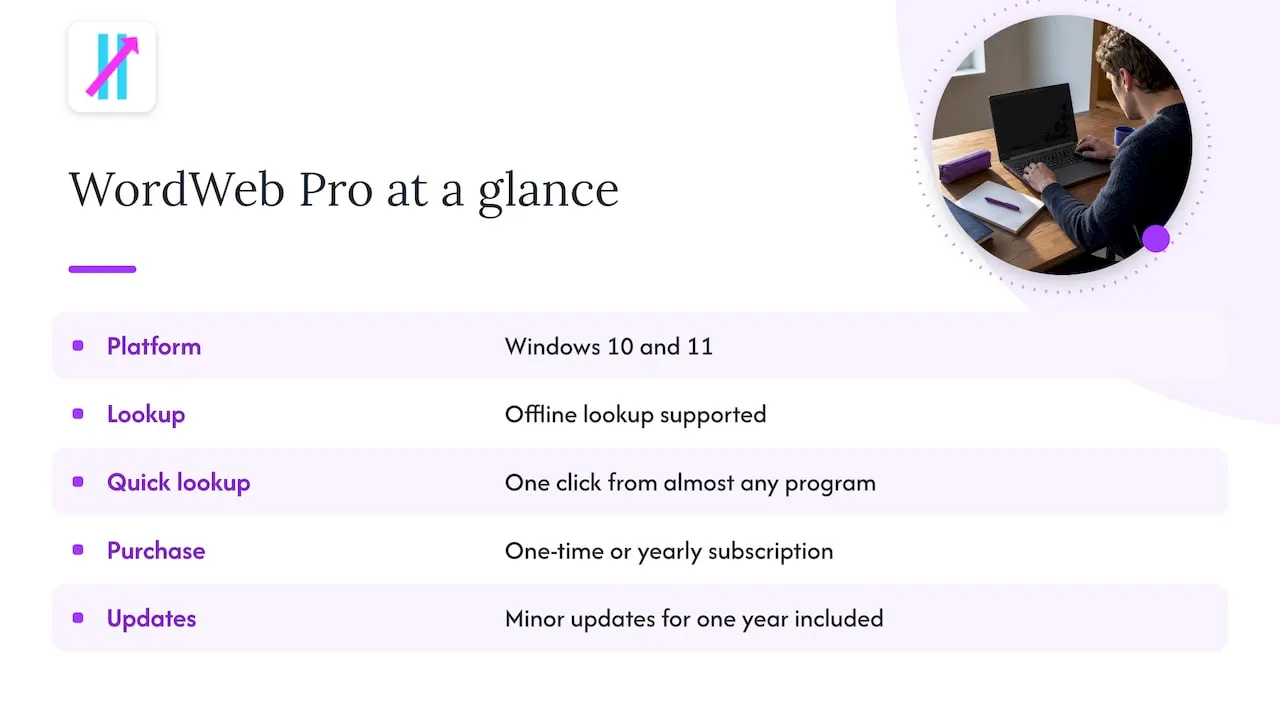
WordWeb is a desktop tool rather than a website. WordWeb Pro runs under Windows 10 and 11, supports offline lookup and offers one-click lookup from almost any program. That last feature is its real selling point: highlight a word in your email client, spreadsheet or word processor and look it up without opening a browser.
On cost, WordWeb Pro can be bought as a one-time purchase that includes minor updates for one year, or by yearly subscription if you want continuing future upgrades. The site does not list a Mac version in the pages we used, so Mac users should check the official page before committing.
Best for: Windows users who write all day and want a lookup that never leaves the document.
Watch out for: the pro features sit behind payment, and the platform support is narrower than a web tool.
WordHippo
WordHippo is the utility-belt option. Deppner notes that it has rhymes and a Scrabble finder but finds its desktop navigation confusing. That is a fair summary of what to expect: lots of tools, with a layout that rewards patience.
Best for: poets, lyricists, puzzle fans and anyone who needs rhymes alongside synonyms.
Watch out for: the busy interface. If you want a quick synonym and nothing else, a simpler site will be faster.
Wiktionary and community-driven references
Alternative-listing sites such as AlternativeTo’s Power Thesaurus page name Wiktionary, Dictionary.com, WordWeb and Merriam-Webster among the closest alternatives, and describe Wiktionary as a free, open-source, multilingual dictionary project. It is useful as a cross-check, especially for etymology and less common words, but treat it as a second source rather than your only one.
Side-by-side comparison
| Tool | Strongest feature | Examples | Platform | Cost |
|---|---|---|---|---|
| Cambridge Thesaurus | Corpus-based synonyms and antonyms, British and American English | Yes, real-world examples | Web | Free to browse |
| Thesaurus.com | Results organized by strength and part of speech | Yes | Web and cross-platform access | Free, ad-supported |
| Merriam-Webster | Clean interface, publisher backing | Yes, in dictionary entries | Web, plus print books | Print: $22.95 and $17.98 titles listed |
| WordWeb Pro | One-click lookup from almost any Windows program, offline | Via entries | Windows 10 and 11 | One-time purchase or yearly subscription |
| WordHippo | Rhymes and word-game tools | Varies | Web | Free |
| Wiktionary | Open, multilingual, etymology | Varies | Web | Free |
The Cambridge, Thesaurus.com and WordWeb rows rest on the pages linked above. Where a cell says “varies,” the tool offers the feature on some entries but not consistently, so test it with the words you actually use.
How to choose
The best thesaurus for writers, according to one writing blog’s testing, is the one that helps you find a word matching the sentence’s tone, voice, style, clarity and simplicity, used with timing and judgment. We agree with that, and it translates into a few rules of thumb.
If you write for school or work
Pick a tool with examples and a publisher behind it: Cambridge or Merriam-Webster. When a teacher or editor asks why you chose a word, you can point to a definition and a sample sentence.
If you write fast and a lot
Pick the tool with the least friction. For Windows users, WordWeb’s one-click lookup removes the browser entirely. For everyone else, a clean web page beats a feature-heavy one.
If you write creatively
Use two tools. One gives you volume (Thesaurus.com or WordHippo), and one gives you precision (Cambridge or Merriam-Webster). Browse wide, then verify narrow.
If English is your second language
Prioritize example sentences and the British and American distinction. Cambridge covers both varieties, which helps when you are writing for a specific audience.
The risk every thesaurus shares
A thesaurus is not a translator between equals. A company that builds a synonym tool, BeLikeNative, explains that automated synonym databases often rely on co-occurrence data rather than true semantic equivalence, so results can include words of different intensity or usage. In practice, “big,” “huge” and “enormous” are not interchangeable in every sentence, and “ignore” and “disregard” carry different tones.
A simple habit protects you:
- Pick a candidate word.
- Read its definition and one example sentence.
- Say your full sentence aloud with the new word in it.
- If you would not say it that way, keep your original word.
That four-step check takes ten seconds and prevents most thesaurus mistakes.
Where we fit
We do not make a thesaurus, and we will not pretend a trading indicator replaces one. But many of the people who search for writing tools are also people who write about markets: trade journals, weekly recaps, social posts and newsletters. For those readers, our indicator solves a different problem, the one that happens before the writing.
Big Move Algo is a proprietary TradingView indicator that analyzes markets in real time and gives Long, Short and Exit signals across crypto, forex, stocks, indices and commodities. It has an AUTO Mode for quick setup and a Manual Mode for more customization, plus a built-in Fake Trend Detector that helps filter out low-quality conditions.
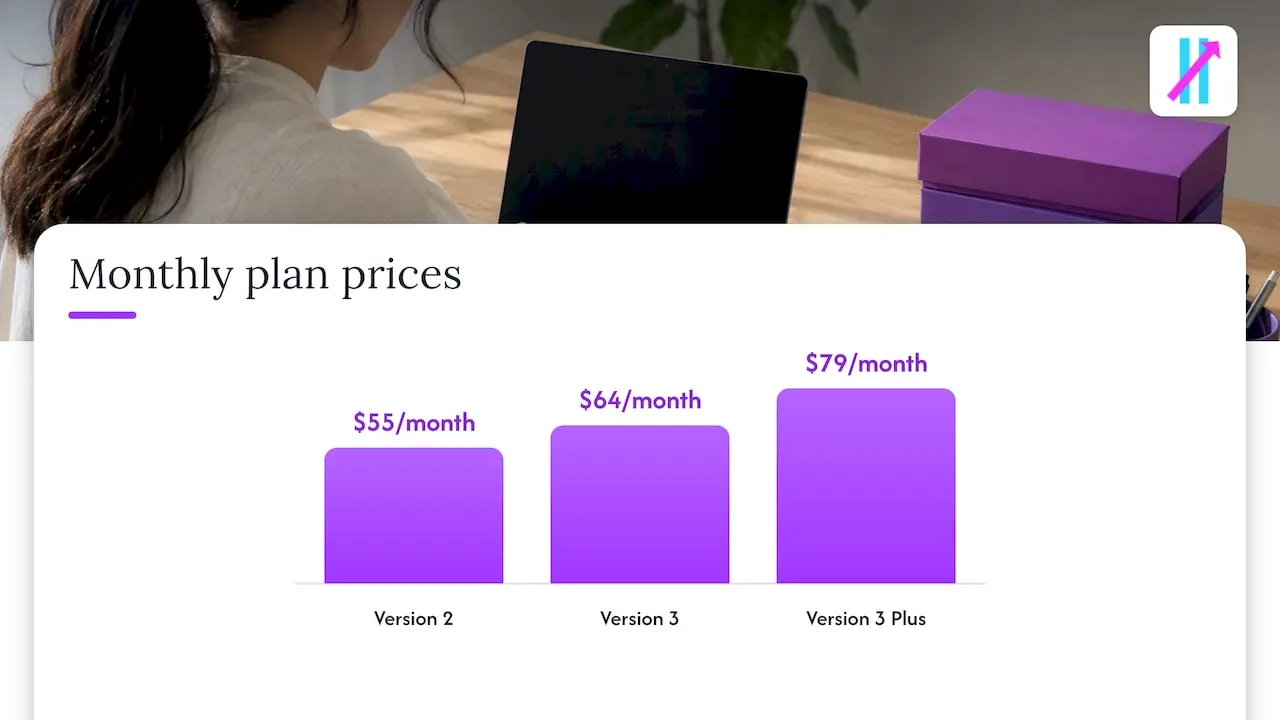
Plans are published on our site: Version 2 at $55 per month or $660 per year, Version 3 at $64 per month or $768 per year, and Version 3 Plus at $79 per month or $948 per year. You can compare them on the Plans & Pricing page. If you only came for synonyms, you can skip this section. If you are a TradingView user who wants structured signals, that is the page to start from.
We also publish a similar comparison for another reference tool, in our guide to en.wikipedia.org alternatives.
Our perspective
We build software for people who are tired of too much information. That shapes how we look at thesauruses too.
A long list of options feels helpful and often is not. A trader staring at twenty indicator settings and a writer staring at forty synonyms have the same problem: the choice itself becomes the work, and guesswork and mood creep in. In both cases the fix is structure, not volume.
For a thesaurus, structure means context, examples and a clear sense of strength. For trading, it means a defined signal, a defined exit and a way to filter conditions where acting is a bad idea. We built Big Move Algo around clarity, speed and ease of use for that reason: AUTO Mode lets a beginner start without tuning anything, and Manual Mode is there once you know what you want to change.
The lesson carries over to word tools. Pick one or two you trust, learn their quirks and stop browsing. The same goes for any decision tool, including ours: no tool replaces your own judgment, and none removes risk from trading.
— Steven Hartwell
FAQ
Is Power Thesaurus free?
Power Thesaurus is an online thesaurus that people use for free lookups, and its pages show an optional “PRO” link. We have not verified current PRO pricing, so check the official site for what it includes today. Most of the alternatives above, including Cambridge, Thesaurus.com and WordHippo, are free to browse.
Which Power Thesaurus alternative has the best example sentences?
Cambridge is the strongest on this front. Its thesaurus is built on real-world examples drawn from the Cambridge English Corpus. Thesaurus.com also offers example sentences, though a 2024 academic review flags limited contextual nuance.
Is there an offline thesaurus?
Yes. WordWeb Pro supports offline lookup on Windows 10 and 11. Print thesauruses from Merriam-Webster are the other offline route, at $22.95 for the Collegiate Thesaurus and $17.98 for the All-in-One Dictionary & Thesaurus at the time of writing.
Can I trust a thesaurus to pick the right word?
Not on its own. Automated suggestions can include words with different intensity or usage, so read the definition and an example, then test the word in your sentence. Treat the list as a set of candidates, never a final answer.
Do I need two thesauruses?
It helps. Use a broad tool for ideas and a publisher-backed one such as Cambridge or Merriam-Webster to confirm the meaning. Two tabs open is enough.
Sources
- Cambridge Thesaurus: synonyms, antonyms and examples
- A Thesaurus in Focus: A Media Review of Thesaurus.com
- Why I broke up with thesaurus.com, and where authors go for synonym help
- Merriam-Webster Shop: Thesauruses
- WordWeb: Features
- WordWeb: One-off purchase
- Thesauruses Aren’t Created Equal: Overview
- The Best Thesaurus for Writers
- BeLikeNative: AI Synonym Finder
- Power Thesaurus reviews on Trustpilot
- AlternativeTo: Power Thesaurus alternatives