Active Traders: 3 Examples to Test Broker Aware Trailing Stop Alerts

A trailing stop alert tracks a set percentage or dollar distance from a stock’s favorable price extreme and notifies you when price reverses far enough to threaten your gains. It lets a winning trade keep running while giving you a defined point to reassess or exit. Before you rely on one, check whether your platform simply notifies you or actually places an order when the trigger hits.
TL;DR:
- Trailing stop alerts notify you of potential exit points but do not automatically execute trades unless your platform offers true order placement.
- Setting the trailing distance should consider the stock’s volatility, choosing methods like ATR or percentage-based trails rather than a fixed number for better results.
- Alerts work best in trending markets and can trigger prematurely if set too tight or during sideways, noisy conditions, leading to unnecessary exits.
- Always verify whether your broker’s trigger source is last sale, bid, or ask, as different methods can cause variations in execution prices.
- Testing and logging past trades with ATR-based trails helps refine your strategy and avoid surprises during fast or gap openings.
Table of Contents
- What trailing stop alerts are and how they differ from trailing stop orders
- Common methods to set a trailing stop
- When trailing stop alerts help and where they fail
- Building a setup checklist before you trust an alert
- Worked examples: turning a rule into an actual number
- How rule-based signals fit into a trailing alert workflow
- What I’ve learned watching traders adopt trailing alerts
- Where Big Move Algo fits if you want less manual tracking
- Sources
- FAQ
What trailing stop alerts are and how they differ from trailing stop orders
A trailing stop works off a moving reference point. For a long position, the stop level rises each time the stock sets a new high, staying a fixed percentage or dollar amount behind price, but it never falls when price pulls back. That one-way ratchet is what locks in gains while leaving room for the trade to continue.
The distinction that trips up most traders is alert versus order. An alert only sends a notification: you still have to act. A trailing stop order, once triggered, is submitted automatically, typically as a market or limit order. The Investor walks through this exact difference and warns that execution can land away from the trigger price.
Brokers and exchanges do not all define “triggered” the same way:
- Some venues use last-sale prices to decide whether a stop level was reached.
- Others use bid or ask quotes instead, which can trigger at a different moment.
- Not every brokerage even supports true trailing stop orders, only alerts.
That variation matters because two traders with identical rules can get different outcomes depending on which platform executes the trade.
Common methods to set a trailing stop
Picking a trailing method is really about matching the rule to the stock’s volatility and your holding period. The main approaches:
- Percent-based trails: set the stop a fixed percentage below the highest price reached, common for swing trades on stocks with steady volatility.
- Dollar trails: set the stop a fixed dollar amount below the high, useful for low-priced tickers or when you want a constant, easy-to-calculate risk per share.
- ATR-based trails: multiply the 14-day Average True Range by a chosen factor (often 1.5 to 3) and trail by that distance, so the stop widens automatically during volatile stretches and tightens when price calms down.
- Chart-based rules: trail below a rising moving average, a recent swing low, or a support level, letting market structure rather than a fixed number define the exit.
Investopedia’s overview of trailing stops notes there is no universal best percentage: the right distance depends on volatility, timeframe, and the instrument itself. Intraday traders generally need tighter, faster-reacting trails, swing traders lean on ATR or moving averages, and position traders often use wider percentage trails to avoid getting shaken out by routine noise.
When trailing stop alerts help and where they fail
Trailing stop alerts do their best work in a trending market, where they let you hold a winning position without constantly watching the screen. Investopedia points out that trailing stops are built for trend-following and tend to underperform in sideways, choppy conditions where price whips back and forth without a clear direction.
Common mistakes worth avoiding:
- Setting the trail too tight relative to the stock’s normal volatility, which triggers exits on ordinary noise.
- Never testing how your specific broker determines a trigger, then getting surprised by the fill.
- Ignoring the fact that real execution can differ from the trigger price, especially in fast markets.
- Applying the same trail distance to every stock regardless of how differently each one moves.
A reasonable rule of thumb is to size the trail to the instrument’s own volatility and your timeframe rather than picking a round number because it feels safe.
Pro Tip: Start with an ATR-based trail and adjust it only after you’ve watched it perform through at least a few real trades.
Building a setup checklist before you trust an alert
Treat this as a pre-flight check, not a one-time setup:
- Confirm whether your platform’s trailing stop is a true order or just a notification, and check if webhook-driven auto-orders are available if you want automatic execution.
- Identify the trigger price source, last sale, bid, or ask, and how the platform handles extended-hours or overnight price moves.
- Run the alert in a paper or demo account first, watching for latency between the trigger and the notification, plus any false triggers on quiet days.
- Decide which notification channels you’ll use (push, SMS, e-mail) and whether there’s a cooldown between repeat alerts, then map out a manual execution plan for moments when you can’t act on an automated order.
If you plan to route alerts to a broker automatically, our guide to setting up TradingView indicator alerts covers the webhook side in more detail.
Worked examples: turning a rule into an actual number
Numbers make trailing rules concrete. Here are three quick walk-throughs.
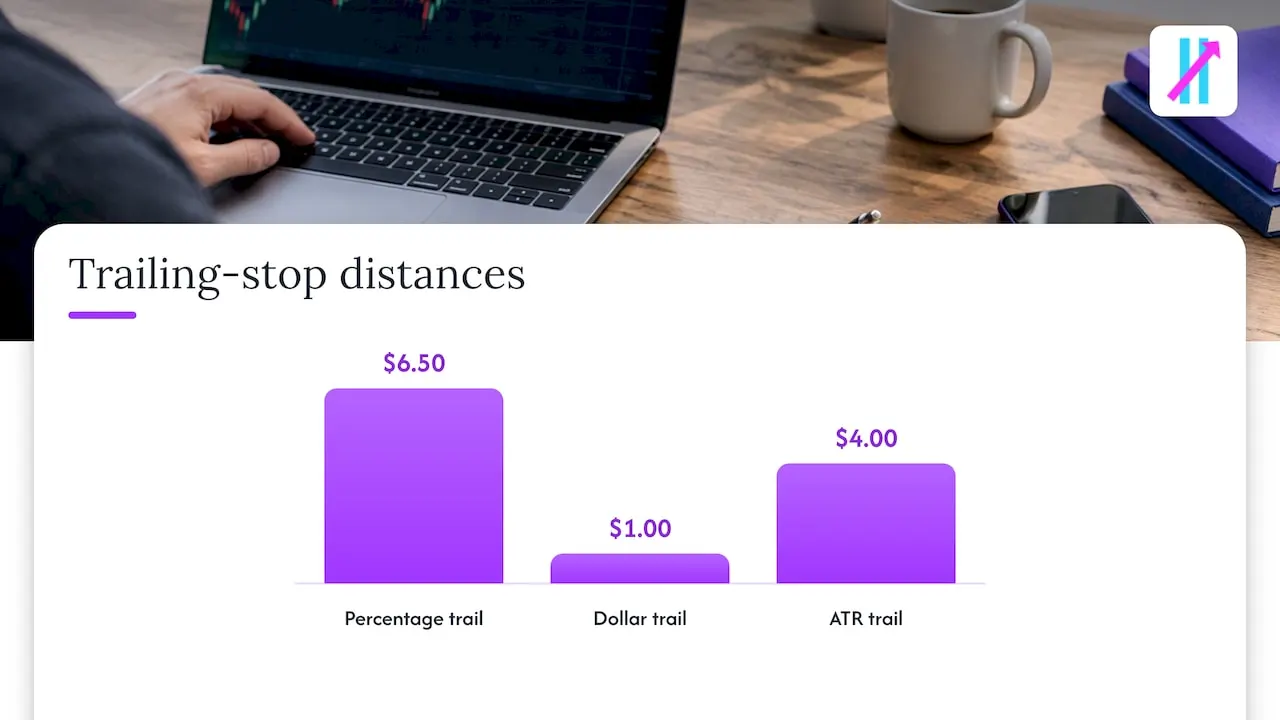
If it climbs further to $65, the stop rises to $58.50. It never moves down, only up, as new highs form.
Dollar trail: the Investor.gov bulletin uses a buy at $20, a rise to $24, and a $1 trailing stop, which locks the stop at $23. That fixed-dollar version is often favored on lower-priced shares where a flat percentage might feel too wide or too narrow.
ATR trail: if a stock’s ATR(14) is $2.00 and you apply a 2x multiplier, your trail sits $4.00 below the highest close, widening automatically if volatility picks up and tightening if it settles down.
None of these guarantee your exact fill. The Investor.gov bulletin notes that once a trailing stop order triggers, the resulting execution can land away from the $23 trigger price in the example above, particularly during fast-moving markets or gaps at the open.
How rule-based signals fit into a trailing alert workflow

Manually tracking trail levels across several positions gets tedious fast, which is why many traders pair alerts with a rules-based indicator that flags exits directly on the chart. Some rule-based indicators output Long, Short, and Exit signals in real time and may include filters to screen out weak setups before they generate a signal.
A few practical points if you go this route:
- One mode may require minimal setup, while another mode lets experienced traders adjust parameters.
- Signals can often be paired with alerts and routed through webhooks, reducing the manual checking that trailing-stop management usually demands.
- Before trusting any signal-driven exit in live trading, test it on a paper account, confirm the webhook payload format, and start with small position sizes while you log outcomes.
For the technical side of routing signals to a broker, see our webhook reference for sending alerts to brokers.
What I’ve learned watching traders adopt trailing alerts
My own recommendation is unglamorous: demo test for a few weeks, start with an ATR-based trail rather than an arbitrary percentage, and log every trigger against what actually happened to the stock afterward. Alerts are a workflow tool that supports a trade plan, not a substitute for one. Discipline in testing beats any clever trailing formula.
— Steven Hartwell
Where Big Move Algo fits if you want less manual tracking
If you’re tired of eyeballing charts to see whether your trail has been hit, Big Move Algo turns that judgment call into a structured signal: real-time Long, Short, and Exit alerts, AUTO Mode for a fast start, Manual Mode for finer control, and a Fake Trend Detector that screens out weak setups before they reach you.
A sensible next step is to test it on a demo account, confirm your webhook or alert integration works the way you expect, and size positions small while you get a feel for the signals. If you’re ready to try it, you can review the current subscription plans or walk through the quick installation guide to get set up on TradingView.
Sources
Official guidance came from Investor.gov’s bulletin on stop orders, the SEC, and Investopedia’s trailing stop entry. For rule-based trading discipline, see this overview of trading rules.
- Stop, Stop-Limit, and Trailing Stop Orders – Investor Bulletin
- Trailing Stops: What They Are, How to Use Them in Trading
FAQ
What are common mistakes with trailing stops?
The most frequent errors are setting the trail too tight for the stock’s normal volatility, never testing how the broker actually determines a trigger, and assuming the fill will match the trigger price exactly. Traders also tend to apply one trail distance to every stock instead of adjusting for volatility and timeframe.
Is a trailing stop loss a good idea?
Trailing stops work well for letting a trending position run while capping downside, but Investopedia notes they tend to underperform in choppy, sideways markets. Whether it’s a good idea depends on the trade’s timeframe, the stock’s volatility, and how the trail distance is chosen.
What does a trailing stop mean?
A trailing stop means the stop price sits a fixed percentage below the highest price the stock has reached since you bought it, and it only moves up as new highs form.
What is the best stock alert service?
There’s no single best service since the right choice depends on whether you need a simple notification or full order automation, and on which broker or charting platform you already use. Traders often compare rule-based signal tools like Big Move Algo against basic broker alerts based on how much manual tracking they want to eliminate.