PMC Alternatives: 8 Ways to Find Biomedical Research in 2026

The best alternative to PubMed Central (PMC) depends on what you need. For free full text, try Europe PMC or Google Scholar. For citations and abstracts, use PubMed. For systematic or drug and device searches, add Embase or Web of Science. Most serious searches combine two or three of these, because no single database covers everything.
Below, we compare each option on coverage, full-text access and search features. We also answer the questions people ask next: whether PMC is reliable, whether it is peer reviewed, and how to check an article you found there.
TL;DR
- PMC is a free full-text archive. PubMed is a database of citations and abstracts. They overlap but are not the same thing.
- Free alternatives: Europe PMC, The Lens, Google Scholar, DOAJ and medRxiv. Paid or library-based: Embase, Web of Science, Scopus.
- Being in PMC does not guarantee peer review. It holds preprints and author manuscripts as well as published articles.
- Pair a broad free tool with a specialist one, then check each article’s review status before you rely on it.
Table of Contents
- What PMC is, and what it is not
- Why people look for alternatives
- Is PMC reliable, and is it peer reviewed?
- The alternatives compared
- Which one should you use?
- How to check whether an article is peer reviewed
- A note on reading research and acting on it
- Trade with the same clarity: Big Move Algo
- FAQ
- Sources
What PMC is, and what it is not
PMC is the National Library of Medicine’s free full-text archive of biomedical and life-sciences journal literature. NIH describes it as developed and maintained by the National Center for Biotechnology Information (NCBI) at NLM and publicly available since 2000. That answers the common “is ncbi.nlm.nih.gov legit?” question: it is a U.S. government library service, run by the same institution that runs PubMed.
The PMC archive has also served since 2005 as the designated repository for papers under the NIH Public Access Policy. It receives papers covered by other research-funder public-access policies too. That is why so much taxpayer-funded research can be read for free there.
PMC versus PubMed
People often mix the two up. NLM explains that PubMed is a database of citations and abstracts, while PMC is an archive of full-text articles. Most PMC articles have PubMed entries, but some PMC material, such as book reviews, falls outside PubMed’s scope. Searching the two can therefore return different results.
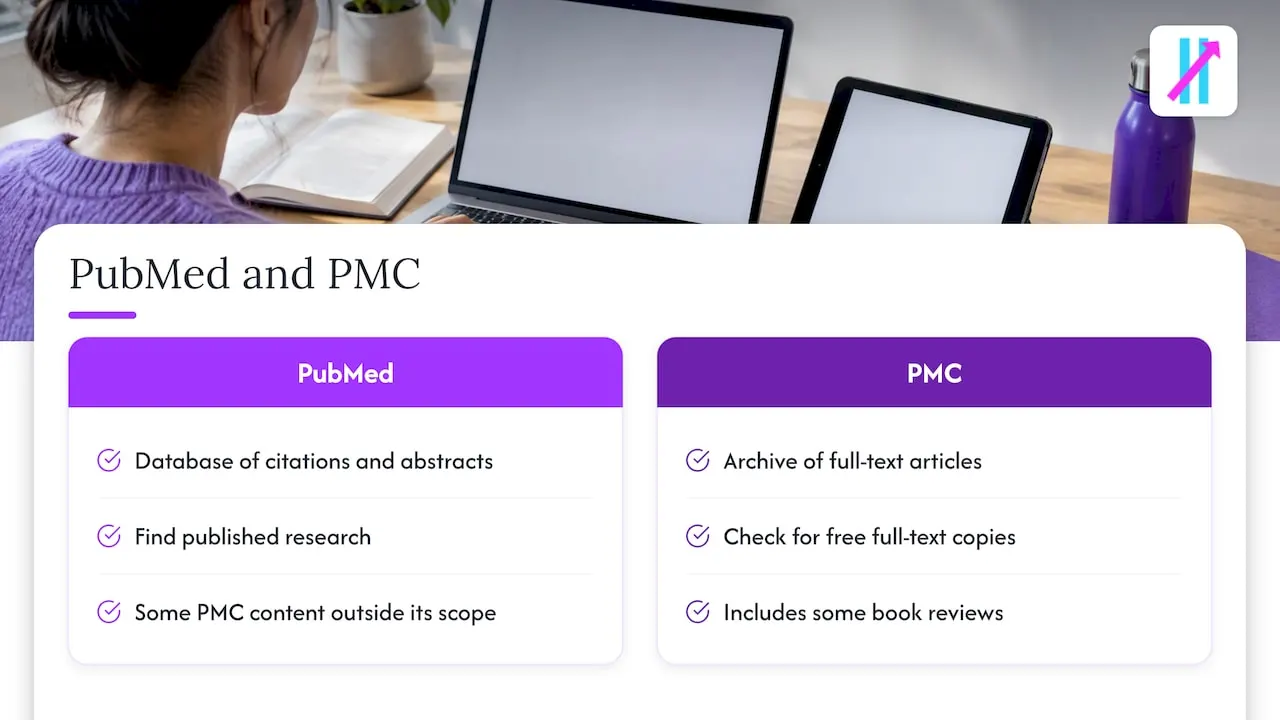
The practical upshot: if you want to know what has been published on a topic, start in PubMed. If you want to read the paper without a paywall, check whether a free full-text copy sits in PMC.
What PMC collects
According to the PMC FAQ, the collection includes complete journal deposits, selective publisher deposits, author manuscripts deposited under funder policies, and historically significant digitized journals. The same FAQ separates free-to-read from free-to-reuse. Many items remain under copyright. Only the PMC Open Access Subset carries Creative Commons or similar licenses that permit reuse.
Why people look for alternatives
There are four common reasons.
- Coverage gaps. PMC is not comprehensive. The University of Arizona’s guide notes that it includes NIH-funded research but does not hold everything.
- Mixed quality signals. PMC holds more than finished, peer-reviewed journal articles (more on that below).
- Specialist needs. Drug safety, medical devices and systematic reviews need controlled vocabularies and citation tracking that PMC alone does not give you.
- Different search habits. Some readers prefer a tool that searches the full text of everything at once.
Is PMC reliable, and is it peer reviewed?
PMC is a legitimate library, but inclusion is not an endorsement. NLM’s disclaimer says NLM is not a publisher and that an item’s presence in PubMed or PMC does not imply endorsement by NLM, NIH or the federal government. It also says the databases include articles and author manuscripts that may not have undergone scientific review, as well as preprints that have not been peer reviewed.
NLM’s About page lists three kinds of content: formally published journal articles, peer-reviewed author manuscripts accepted for publication, and preprints made public before peer review. So the right answer to “is NIH PubMed Central peer reviewed?” is: much of it is, but you have to check each item.
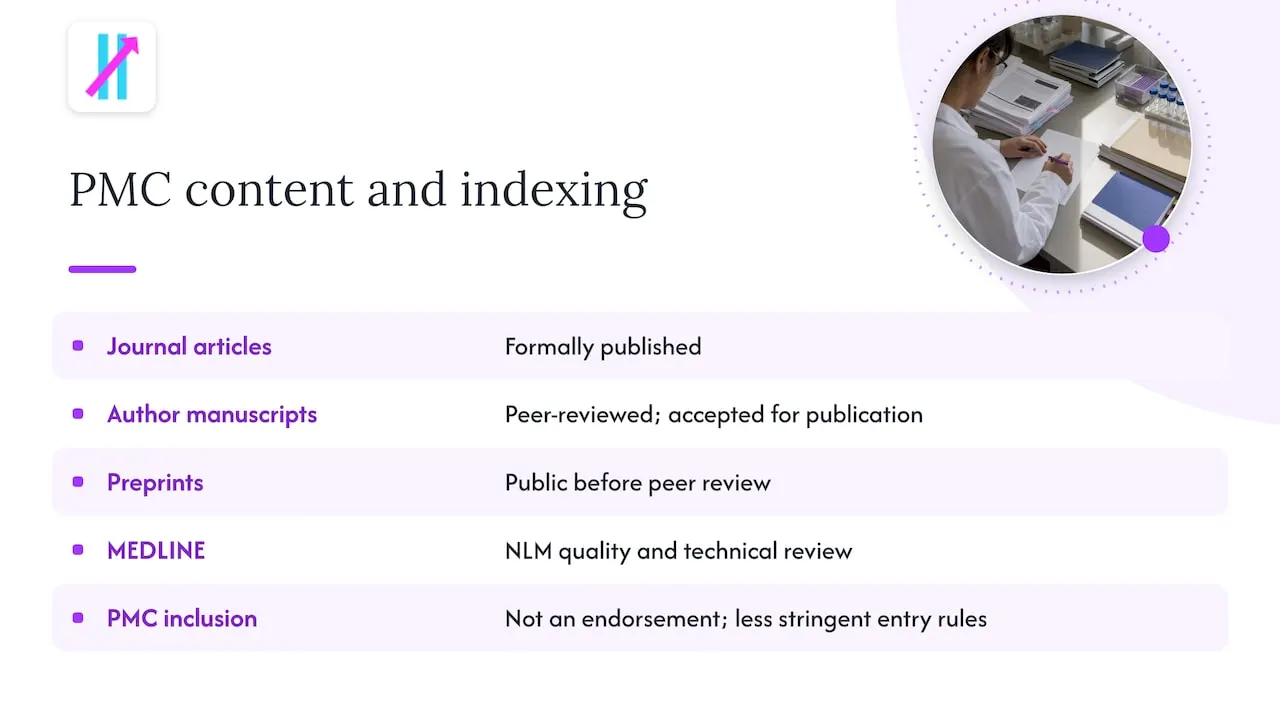
A related trap is MEDLINE. Yale’s medical library explains that MEDLINE inclusion requires NLM review for quality and technical standards, whereas PMC has no equally stringent entry requirements. A journal being searchable in PubMed or present in PMC does not mean it is MEDLINE-indexed. Yale’s advice is to verify MEDLINE indexing rather than accept a publisher’s looser claim.
The alternatives compared
| Option | Cost | Best for | Full text? | Watch out for |
|---|---|---|---|---|
| PubMed | Free | Finding citations and abstracts, MeSH searching | Links out; some free via PMC | Not an archive of full text |
| Europe PMC | Free | Combined PubMed, PMC, Agricola and preprints | Yes, for open content | Preprints are mixed in, so read the labels |
| The Lens | Free | Scholarly plus patent searching | Links out | Aggregator, so depth varies by source |
| Google Scholar | Free | Broad, full-text keyword searching | Sometimes free, sometimes paywalled | Supplement, not a replacement |
| DOAJ | Free | Open-access journal directory | Open-access journals | Journals only, multidisciplinary |
| medRxiv | Free | Early health-science preprints | Yes | Not peer reviewed |
| Embase | Subscription, usually via a library | Drugs, devices, pharmacovigilance | Links out | Access usually needs an institution |
| Web of Science / Scopus | Subscription, usually via a library | Citation tracking across fields | Links out | Web of Science has no controlled vocabulary |
The sections below explain each row.
PubMed
If you only need discovery, PubMed is the natural companion to PMC. Harvard Library describes PubMed as including MEDLINE records indexed with MeSH, along with in-process, older and non-MEDLINE material. MeSH indexing lets you search by concept rather than by guessing every synonym an author might use.
Europe PMC
This is the closest free substitute. Brown University Library says Europe PMC combines PubMed, PMC, Agricola and life-sciences preprint servers in one search. A peer-reviewed article on searching Europe PMC adds a useful detail: it marks preprints with a visible Preprint label and warning, and can expose peer reviews or recommendations where they exist. That labeling helps with the peer-review problem above.
The Lens
Brown also points to The Lens, which aggregates PubMed, Crossref, OpenAlex, ORCID and other scholarly and patent sources. It is a good pick if your question touches both papers and patents, for example how a technique moved from a journal into a filed invention.
Google Scholar
Google Scholar is the broadest free tool. Harvard notes that it searches full text, which finds papers that title and abstract searching misses. The same guide treats it as a supplement rather than a replacement for specialist databases. The University of Arizona guide adds that full text found through Scholar may be free or paywalled.
DOAJ and medRxiv
The Arizona guide presents DOAJ as a multidisciplinary open-access journal directory. It is useful when you want a guaranteed free read. It also lists medRxiv, a health-science preprint server whose content has not been peer reviewed. Use medRxiv to see where a field is heading, not as settled evidence.
Embase
Embase adds European and Asian journals and conference abstracts, and it uses its own Emtree vocabulary, per Harvard’s comparison. Brown’s guide adds that it is particularly useful for drug, medical-device and pharmacovigilance research. It is a commercial product, so most readers reach it through a university or hospital library.
Web of Science and Scopus
Both are multidisciplinary and offer forward and backward citation searching, according to Brown. You can start from one key paper and walk through everything that cites it, or everything it cites. Harvard notes that Web of Science has biomedical-edge coverage and no controlled vocabulary, so expect to try more keyword variants.
Cochrane Central, ClinicalTrials.gov and others
For evidence on interventions, Harvard lists Cochrane Central, which focuses on trials. ClinicalTrials.gov lists trials, some with posted results. CINAHL and PsycINFO cover nursing and psychology respectively.
Which one should you use?
Match the tool to the job.
- Quick background on a health question: Google Scholar, then PubMed for the abstracts.
- Free full text of a specific paper: search the title in Europe PMC. If it is there, you can read it.
- A thorough review of the literature: Harvard recommends combining PubMed or another PubMed-data interface with Embase, Web of Science and Google Scholar, because no single database covers all literature.
- Drug or device safety: Embase, through a library.
- Patents and papers together: The Lens.
- Not affiliated with a university: The Arizona guide’s view is that unaffiliated readers can use PubMed and PMC for free discovery and full text, but should expect incomplete coverage and use publisher, open-access or library-access links to get the rest. A public or medical library card can unlock more than people expect.
Brown’s view is worth keeping in mind: free tools such as Europe PMC and The Lens broaden coverage, but commercial resources stay valuable for specialized indexing, citation navigation and drug or device searches.
How to check whether an article is peer reviewed
Whichever database you use, run through this short routine before you trust a paper.
- Look for a Preprint label. Europe PMC shows one. In PMC, read the article’s status and the journal name. Preprints have not been peer reviewed, and NLM warns that their results and conclusions may change.
- Check the journal, not only the database. Confirm whether the journal is MEDLINE-indexed, as Yale advises.
- Identify author manuscripts. A peer-reviewed author manuscript accepted for publication is different from an unreviewed deposit. The article page should tell you which it is.
- Look for corrections and retractions. NLM states that it relies on the scientific publishing process to identify comments, corrections and retractions, so check the publisher’s page for the paper too.
- Do not assume. The Arizona guide recommends checking article status rather than assuming peer review.
A note on reading research and acting on it
The same habit applies far beyond medicine: check where a claim comes from, how it was tested and whether anyone reviewed it. If you also research markets, our guides apply that approach to other tools, such as our comparison of NIH research alternatives.
Our perspective
We build trading software, not research databases, so we will not tell you which journal index to use. What we do know is how people behave when they are buried in information. Traders who open ten indicators and a dozen tabs rarely decide better; they hesitate, second-guess and act on emotion.
Researchers face the same trap. A good search routine, one broad free tool, one specialist tool and a short checklist for review status, beats opening every database at once. Clarity comes from a structure you trust, not from more data.
That is the thinking behind Big Move Algo. It turns market analysis into clear Long, Short and Exit signals, with AUTO Mode for a fast start and Manual Mode for experienced users who want more control. Our Fake Trend Detector is designed to filter out low-quality conditions, so you are not forced to judge every setup yourself.
Steven Hartwell
Trade with the same clarity: Big Move Algo
If your reading list also includes charts, we can help with that side. Big Move Algo is a TradingView indicator that gives Long, Short and Exit signals across crypto, forex, stocks, indices and commodities. You get instant access after purchase, support for unlimited devices and free updates.

Plans are published on our site. Version 2 costs $55 per month or $660 per year, Version 3 costs $64 per month or $768 per year, and Version 3 Plus costs $79 per month or $948 per year. You can compare them on our plans and pricing page or start from the Big Move Algo homepage.
FAQ
Is PMC a reliable source?
PMC is a legitimate archive run by the National Library of Medicine, but NLM says presence in PMC does not imply endorsement by NLM, NIH or the federal government. Reliability depends on the individual article and journal. Check the review status before citing it.
Is NIH PubMed Central peer reviewed?
Not entirely. PMC holds formally published journal articles and peer-reviewed author manuscripts, but also preprints made public before peer review. Confirm each item’s status rather than assuming it.
Is PubMed primary research?
No. PubMed is a database of citations and abstracts that points to research published in journals. PMC is the archive of full-text articles, and the original studies live in the journals themselves.
What is the best free alternative to PMC?
Europe PMC is the closest match because it combines PubMed, PMC, Agricola and life-sciences preprint servers. Google Scholar is broader and searches full text, but its results may sit behind paywalls. Many readers use both.
Do I need a university login to use the alternatives?
Not for the free ones. Embase, Web of Science and Scopus are commercial and usually reached through a library. For everything else, a free search plus publisher or open-access links will often get you the article.
Sources
- What is the difference between PubMed Central (PMC) and PubMed? (NLM Support)
- About PMC
- PMC and Research Funder Policies
- PMC FAQs
- PMC Disclaimer
- Scholarly Communication, Yale Medical Library
- Resources for Alumni and Unaffiliated Health Professionals, University of Arizona
- Databases and Sources, Harvard Library
- Beyond PubMed, Brown University Library
- Searching and Evaluating Publications and Preprints Using Europe PMC