Signal Confirmation Rules: 6 Checks Before Retail Traders Enter

Before you act on any signal, require trend, trigger, momentum, volume, a defined invalidation level and a position size tied to it. That sequence follows the CME technical-analysis framework and the order guidance on Investor. Test every threshold per instrument and timeframe. Our Big Move Algo indicator provides trading signals on TradingView.
TL;DR:
- A touch of support or resistance is not a trigger; wait for a close beyond the level, a reversal candle, or a break from consolidation.
- Treat RSI’s 30/70 levels and volume at 1 to 1.5 times recent average as starting points, then test one threshold change at a time.
- A stop order can fill materially away from its trigger in fast markets, while a stop limit may never execute; size positions from entry to invalidation.
- Backtest frozen rules across trending, ranging, and volatile periods, include commissions, spreads, and slippage, then validate once on data held out from development.
- When a major scheduled release falls inside your holding window, stand aside, cut position size, or accept wider stop risk before entering.
Table of Contents
- What to check, in order, when a signal appears
- How do you set confirmation thresholds for each market and timeframe?
- How can you test confirmation rules without fooling yourself?
- Which entry templates can you copy and test?
- Should news and fundamentals count as confirmation?
- Why do rules beat instinct in live trading?
- Can you automate these confirmation checks?
- FAQ
- Sources
What to check, in order, when a signal appears
Run these checks in sequence. If any one fails, skip the trade.
- Market structure and trend. Mark the higher-timeframe trend and the nearest support and resistance. Alignment means your trade direction matches that trend, or you are trading a clear reversal at a mapped level. CME treats price as the foundation of analysis, with everything else adding context.
- Trigger. Wait for something concrete: a close beyond a resistance or support level, a reversal candle at a mapped level, or a continuation break from a consolidation. A line merely touched is not a trigger.
- Momentum. Look for a MACD cross of its signal line, RSI turning near its conventional 30/70 reference levels, or Stochastics near 20/80. CME’s oscillator guidance says these readings should not be used alone, and that overbought does not automatically mean short. Oscillators can stay extended in strong trends.
- Volume or liquidity. Compare the trigger bar’s volume with its recent average. A volume-based confirmation adds weight, while thin trading is a warning sign. Our guide to confirming signals with volume goes deeper.
- Invalidation and order type. Decide the price where the idea is wrong, then choose a market, limit, stop or stop-limit order. Investor.gov explains that a stop order becomes a market order when triggered, so in fast markets the fill can differ materially from your stop price. A stop-limit narrows price uncertainty but may not execute at all.
- Position size. Size from the distance between entry and invalidation, not from conviction. Many traders cap risk at a small fixed fraction of the account per trade, such as 1%.
Pro Tip: Write the six answers on a note before you click buy. If you cannot fill in the invalidation price, you do not yet have a trade.
How do you set confirmation thresholds for each market and timeframe?
Thresholds are hypotheses, not constants. Academic research finds that momentum and reversal behavior depends on turnover and horizon, so a rule that works on a liquid index at the daily level may fail on a thin crypto pair at a different timeframe.
Treat these as starting points to test:
- RSI bands: 30/70 as reference levels, then test tighter or wider bands for your instrument.
- Volume multiplier: a trigger bar at 1 to 1.5 times its recent average volume.
- Trend strength: use ADX as a filter, with a threshold tested for your instrument and timeframe, as explained in our trend strength rules.
- MACD timing: faster settings for intraday, slower for swing trades.
Adapt the numbers to conditions. In low-liquidity markets, account for spreads and gaps when setting stops and evaluating volume confirmation. For short-term trading, adapt the rules to the timeframe and account for the added noise. For longer swings, relax the volume filter and lean harder on higher-timeframe structure. Change one threshold at a time so you know which change moved the results.
How can you test confirmation rules without fooling yourself?
Treat a backtest as hypothesis testing, not proof. A rule that fits last year’s chart perfectly has probably been shaped by it. Our walkthrough on verifying a trading signal pairs well with these steps:
- Write the rule in full before looking at results, then freeze it.
- Test across trending, ranging and volatile regimes, not one favorable stretch.
- Include commissions, spreads and slippage in every trade.
- Hold back data for out-of-sample validation and run it once.
- Repeat on each instrument and timeframe you plan to trade.
Popular patterns deserve extra skepticism. Research on illusory correlations in US equity markets found the head-and-shoulders pattern coincided with increased trading volume but did not profitably predict directional movements.
The head-and-shoulders pattern drew more trading volume without predicting direction profitably, so heavy participation alone does not prove a signal works. Statistical validation does that job.
Which entry templates can you copy and test?
These are starting hypotheses. Backtest each before risking money, and see our longer entry confirmation rules.
- Trend-following. Higher-timeframe uptrend, a pullback toward support, a MACD bullish crossover and volume at least 1.2 times average. Place the stop under the recent swing low and risk 1% of capital.
- Breakout. A confirmed close above resistance with volume that supports the move and RSI not at an extreme. Enter on a limit order at the breakout retest, or a stop-limit above the level. Put the stop under the breakout point.
- Mean-reversion. RSI below 30, bullish divergence and a tight spread. Use a tighter stop and a smaller position, since you are fading a move.
Pro Tip: Track each template in a simple journal for at least a few dozen trades before changing any threshold. Small samples mislead.
Should news and fundamentals count as confirmation?
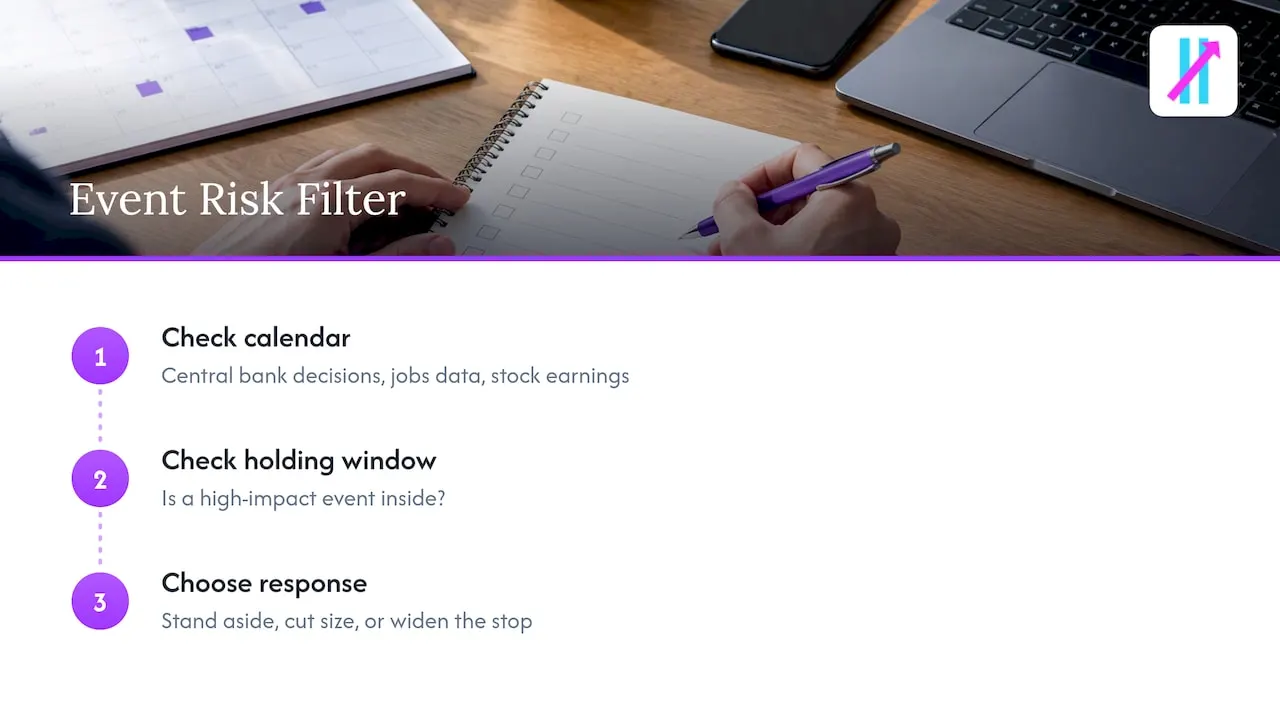
Yes, as a filter rather than a trigger. A clean technical setup minutes before a scheduled release is a coin flip with a wider spread. Check an economic calendar before entry: central bank decisions, jobs data, and earnings for individual stocks. If a high-impact event sits inside your holding window, either stand aside, cut size, or widen the stop and accept the smaller position that implies.
Fundamentals can also strengthen the case. A long breakout in a stock with an upgraded earnings outlook, or a currency trade that agrees with the direction of interest rate expectations, has two independent reasons behind it. That is the principle behind every other check here: stack different kinds of evidence instead of repeating one indicator in several costumes.
News also raises execution risk. Investor.gov’s stop order bulletin notes that stops can fill at materially different prices in fast markets, which is exactly what happens around headlines and gaps. Define your invalidation level before the release, not after the candle spikes. Write down the rule too: “no new entries around a scheduled high-impact event” is easy to test and hard to rationalize away in the moment.
Why do rules beat instinct in live trading?
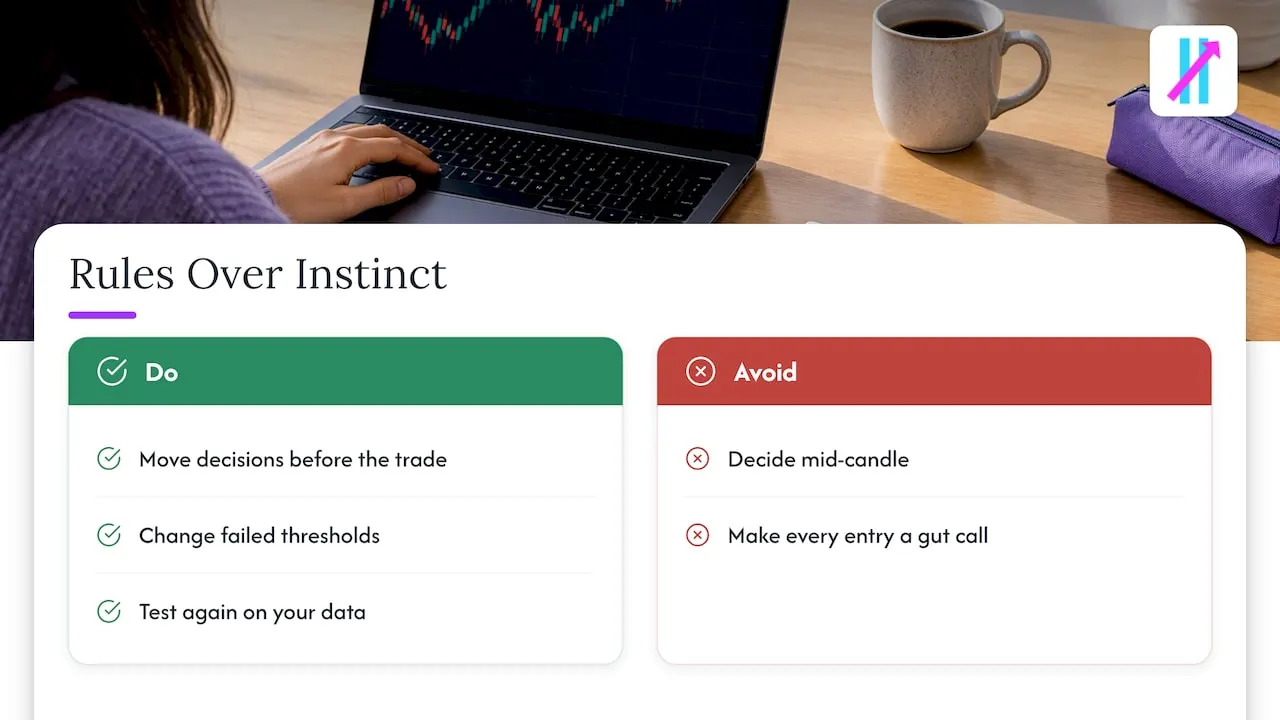
Most of the damage I have seen in retail accounts comes from decisions made mid-candle, not from bad strategies. A checklist moves the decision to before the trade, when you are calm. It also makes your results repeatable: if a trade lost while following the rules, you learn about the rules. If it lost because you skipped a step, you learn about yourself. Both are useful, and neither is available when every entry is a gut call.
Treat everything above as a draft to be broken by your own data. If a threshold fails on your instrument, change it and test again.
— Steven Hartwell
Can you automate these confirmation checks?
If running the checks by hand across several charts is slow, we built Big Move Algo to provide trading signals on TradingView:
- AUTO Mode for quick setup and Manual Mode for customization
- Long, Short and Exit signals with alerts to multiple platforms
- A built-in Fake Trend Detector that filters low-quality conditions
- Monitoring across crypto, forex, stocks, indices and commodities
Automation helps most when you scan many markets or trade fast. Manual judgment still matters around news and thin liquidity. Our automated trading risk controls guide covers the safeguards to set first. Plans start with Version 2 at $55 per month, and you get access right after purchase on our site.

This article is general information, not a substitute for advice from a qualified financial advisor. Consult a qualified financial professional about your own circumstances before acting on anything here.
FAQ
What are signal confirmation rules in trading?
They are the criteria you require before acting on a trade signal, such as trend alignment, a valid trigger, momentum and volume support. CME describes this approach as a framework, not a guarantee.
How many confirmations do you need before entering a trade?
There is no universal number. Use independent kinds of evidence, such as trend, momentum and volume, rather than several similar indicators, and test your own count on historical data.
Can an oscillator alone confirm a signal?
No. CME cautions that oscillator readings should be used with other information, since overbought markets can keep rising.
Do confirmation rules work on every timeframe?
Not necessarily. Research on momentum and reversal shows the behavior depends on turnover and horizon, so validate thresholds for each instrument and timeframe.
Sources
- Cmegroup
- Oscillators: MACD, RSI, Stochastics
- Investor
- Noise Trading and Illusory Correlations in US Equity Markets* | Review of Finance | Oxford Academic
- Openaccess