
What Is a Trading Signal? A Trader's Guide
- Steven Hartwell

- Jun 16
- 8 min read

A trading signal is a precise, condition-based trigger that tells you when to buy or sell a financial asset, generated through analysis by humans or algorithms using inputs like technical indicators, economic data, and market sentiment. Investopedia defines trade signals as emotion-free, mechanical decision aids that draw from multiple disciplines including technical analysis, fundamentals, and sentiment. Signals are not predictions. They are structured prompts that remove guesswork from your entry and exit decisions. Whether you trade crypto, forex, or stocks, understanding what a trading signal is and how to use one correctly is the foundation of any repeatable strategy.
What is a trading signal and what makes it actionable?
A trading signal becomes actionable only when it contains every piece of information you need to execute a trade without improvising. A vague alert like “Bitcoin looks bullish” is not a signal. A real signal specifies the asset, the direction, and the exact conditions for entering and exiting the trade.
Complete trading signals include all of the following components:
Asset or instrument: The specific market being traded, such as EUR/USD, BTC/USD, or S&P 500.
Direction: Buy (long) or sell (short). This is the core instruction.
Entry price or zone: The price level at which you open the trade.
Stop-loss level: The price at which the trade closes automatically if it moves against you.
Take-profit target: The price level at which you lock in your gain and exit.
Timeframe: Whether the signal applies to a 5-minute chart, a daily chart, or something else.
Rationale: The reason behind the signal, such as a moving average crossover, an earnings release, or a breakout pattern.
NAGA Academy confirms that without all elements, especially the stop-loss and rationale, a signal is incomplete and creates real risk for the trader. The stop-loss is not optional. It is what separates a structured trade from a gamble.
Pro Tip: Before acting on any signal, check that it includes an entry price and a stop-loss. If either is missing, treat the signal as an opinion, not an instruction.
How are trading signals generated?
Trading signals come from two distinct sources: human analysts and automated software. Each has a different process, different strengths, and different failure points.

Manual signal generation
Manual signals are produced by experienced analysts who study price charts, economic calendars, and market news. They apply their judgment to identify high-probability setups and then publish alerts for subscribers. The strength of manual signals is contextual awareness. A skilled analyst can factor in a central bank announcement or a geopolitical event that no algorithm has been trained to interpret. The weakness is speed and consistency. Human analysts cannot monitor 50 markets simultaneously, and their output varies with fatigue and bias.
Automated signal generation
Automated signals are produced by software that applies predefined mathematical rules to market data. The software scans for conditions, such as a Relative Strength Index reading below 30 or a price crossing above a 200-period moving average, and fires an alert the moment those conditions are met. Tools like TradingView’s Pine Script, custom algorithmic trading systems, and machine learning models all fall into this category. Automated systems deliver signals via SMS, email, and push notifications so traders can act without delay.
The key technical distinction in automated systems is batch versus streaming computation. Batch and streaming signal generation are fundamentally different modes. Batch processing is used in backtesting, where you test a strategy against historical data. Streaming is used in live trading, where signals must fire in real time with no lag. Mixing the two, or allowing future data to leak into a backtest, produces results that look great on paper but fail in live markets. Experienced quants treat these two environments as completely separate systems.
The choice between manual and automated signals depends on whether you prefer human judgment or systematic data scanning. Most professional traders use both: automated signals for speed and coverage, human review for context and confirmation.
Pro Tip: If you use an automated signal tool, verify that its backtested results were produced on out-of-sample data. A strategy that was tested on the same data it was built from is almost certainly overfitted and will underperform live.
What types of trading signals exist?
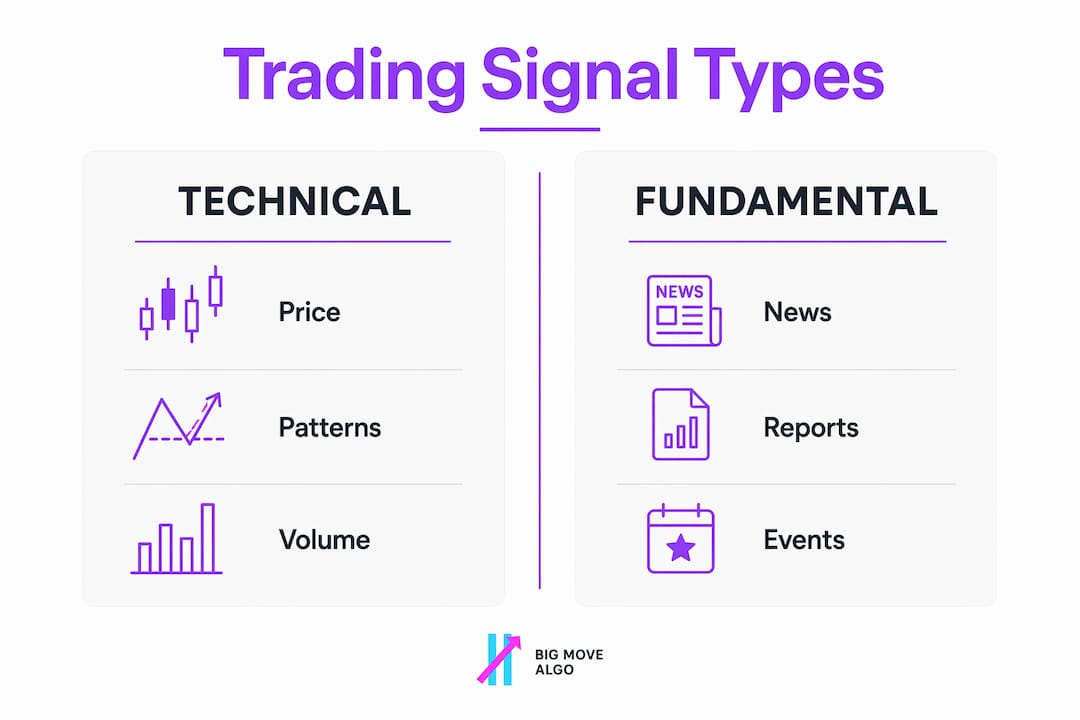
Trading signals fall into three main categories: technical, fundamental, and algorithmic. Each type draws from different data sources and suits different trading styles.
Technical signals are based entirely on price action, chart patterns, and volume data. Examples include a MACD crossover, a Bollinger Band squeeze, or a support level bounce. These signals work on any timeframe and any market. Day traders and swing traders rely on them most heavily because they respond to what the market is actually doing, not what analysts think it should do.
Fundamental signals are triggered by real-world events: earnings reports, Federal Reserve interest rate decisions, GDP releases, or company mergers. A trader who goes long on a stock immediately after a strong earnings beat is acting on a fundamental signal. These signals are most useful for position traders and investors who hold trades for days or weeks.
Algorithmic signals combine multiple data sources, including price, volume, sentiment, and sometimes alternative data like social media activity, into a single statistical model. Quantitative hedge funds like Renaissance Technologies and Two Sigma build their entire edge around proprietary algorithmic signals. Retail traders access simpler versions through platforms like TradingView.
Signal Type | Data Source | Best For | Typical Timeframe |
Technical | Price charts, volume, indicators | Day traders, swing traders | Minutes to days |
Fundamental | News, economic data, earnings | Position traders, investors | Days to weeks |
Algorithmic | Multi-source statistical models | Systematic traders | Any |
Your trading style determines which type fits best. If you watch charts for hours each day, technical signals are your primary tool. If you trade around macro events, fundamental signals give you the edge. If you want a system that runs with minimal manual input, algorithmic signals are the answer.
How to use real-time trading signals effectively
A real-time trading signal is only as useful as your ability to act on it quickly and correctly. Speed matters, but discipline matters more.
The most common mistake traders make is treating a signal as a guarantee. Signals suggest favorable probability moves, not certain outcomes. Every signal carries a probability, not a promise. That distinction changes how you size your position and how you manage the trade once it is open.
Here is a practical workflow for using real-time signals:
Receive the alert via your chosen channel: push notification, SMS, or platform alert.
Verify the signal components: confirm the asset, direction, entry price, stop-loss, and take-profit are all present.
Check your risk: calculate the position size so that the stop-loss, if hit, costs you no more than 1–2% of your account.
Execute at or near the entry price: if the market has already moved significantly past the entry level, skip the trade. Chasing a signal is a common and costly error.
Let the trade run: do not move your stop-loss to avoid a loss. The stop-loss is part of the signal’s logic.
Timely signal delivery across multiple channels is what allows traders to optimize entries and exits. A signal that arrives 10 minutes late on a 5-minute chart is useless. This is why platform integration matters. When your signal tool connects directly to your charting platform, you eliminate the delay between alert and action. You can learn more about real-time signal delivery and how to set it up for active trading.
Balancing signals with your own analysis is also critical. Signals remove emotional trading and guesswork, but they are not a substitute for understanding what you are trading. A trader who blindly follows every signal without knowing why it was generated cannot adapt when market conditions change.
Pro Tip: Set your trading platform to send push notifications for every signal. Then review the signal on your chart before executing. This two-step process keeps you fast and deliberate at the same time.
Key takeaways
Trading signals work because they replace guesswork with structured, rules-based triggers that include entry, stop-loss, and take-profit levels across technical, fundamental, and algorithmic categories.
Point | Details |
Signal definition | A trading signal is a condition-based trigger to buy or sell, not a vague opinion or prediction. |
Complete signal structure | Every valid signal must include direction, entry price, stop-loss, and take-profit to be tradable. |
Generation methods | Signals come from human analysts or automated software, each with distinct strengths and limitations. |
Three signal types | Technical, fundamental, and algorithmic signals suit different trading styles and timeframes. |
Effective usage | Act on signals quickly, verify all components, and size positions so one loss never exceeds 1–2% of your account. |
Why most traders misuse signals before they understand them
The most persistent misconception I see is that a trading signal is a shortcut. Traders subscribe to a signal service, follow every alert without question, and then blame the signals when they lose money. The signal was never the problem. The position sizing was wrong, or they chased entries, or they moved their stop-loss because they “felt” the trade would recover.
A signal is a structured input, not a decision made for you. The decision is still yours: how much to risk, whether the market context matches the signal’s assumptions, and whether you have the discipline to exit when the stop-loss is hit. I have seen traders with access to genuinely high-quality signals lose money consistently because they treated those signals as certainties rather than probabilities.
The other thing worth understanding is how fast signal technology has improved. Tools that required a professional quant team five years ago are now accessible to retail traders through platforms like TradingView. But accessibility does not equal understanding. Learning to read conflicting indicators and filter out low-quality signals is a skill that takes time to develop. The traders who get the most from signal tools are the ones who understand what the signal is measuring and why it fires when it does.
— Steven Hartwell
See trading signals in action with big move algo
Understanding trading signals is the first step. Seeing them applied to live markets is where real learning happens.
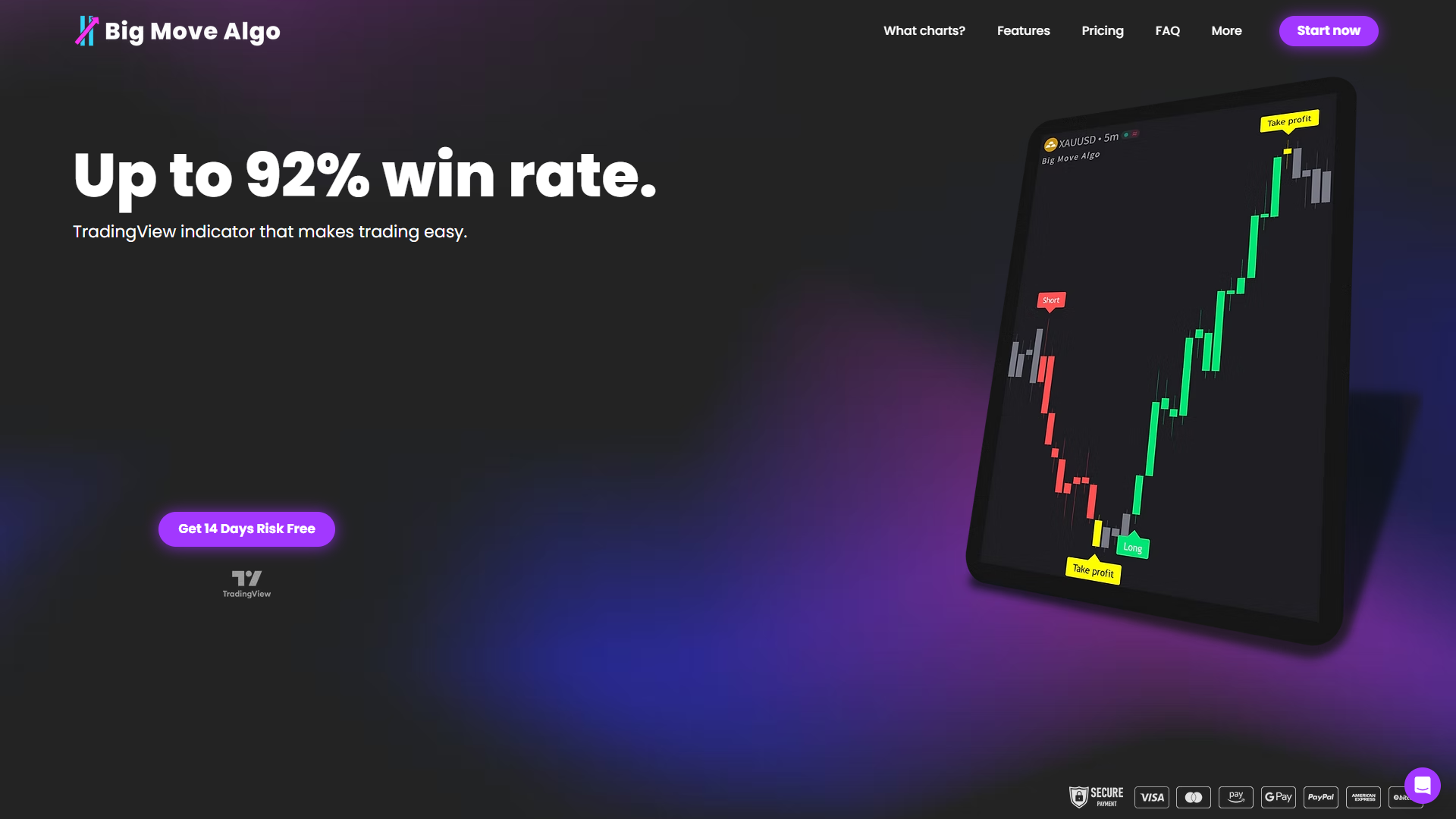
Big Move Algo is a proprietary TradingView indicator that delivers clear Long, Short, and Exit signals in real time across crypto, forex, stocks, indices, and commodities. The platform reports a win rate of up to 92% and includes a built-in Fake Trend Detector that filters out low-quality market conditions before a signal fires. New traders can start with AUTO Mode for instant setup, while experienced traders can switch to Manual Mode for deeper customization. Payments are processed through Stripe with instant access after purchase. If you want to see how the platform works before committing, the step-by-step usage guide walks you through every feature.
FAQ
What is a trading signal in simple terms?
A trading signal is a specific instruction to buy or sell a financial asset, generated by analysis of market data. It tells you what to trade, which direction to go, and where to set your stop-loss and take-profit.
Are trading signals guaranteed to be profitable?
No. Signals are probabilistic indicators based on historical patterns and market logic, not guarantees. They work best when combined with disciplined position sizing and consistent risk management.
What is a real-time trading signal?
A real-time trading signal fires the moment predefined market conditions are met, delivering an alert instantly via push notification, SMS, or email so you can act without delay.
What is a trading signal subscription?
A trading signal subscription gives you ongoing access to a signal provider’s alerts, typically delivered through a platform, app, or messaging channel, often on a monthly or annual fee basis.
How do i choose between technical and fundamental signals?
Choose technical signals if you trade short timeframes using price charts. Choose fundamental signals if you trade around economic events or earnings releases over days or weeks.
Recommended
Comments