
Trading Psychology: Control Emotions and Trade Better
- Steven Hartwell

- 4 minutes ago
- 11 min read

Trading psychology is the set of emotions, cognitive biases, and behavioral patterns that shape your trading decisions and execution. In plain terms, it’s the mental side of trading — what happens inside your head when real money is on the line, markets move fast, and your plan suddenly feels hard to follow.
Three things you can do right now:
Keep a trading journal. After every trade, write down what you felt, not just what you did. Patterns show up fast.
Set a fixed risk per trade (most practitioners suggest 1–2% of account equity) before you enter, so position size is never an emotional decision.
Use a cool-off rule. After consecutive losses, step away for a short period before placing another trade.
Why does this matter? Because the gap between a sound trading system and consistent profits is almost always psychological, not analytical.
Table of Contents
What is trading psychology, and why does it shape every trade you make?
Trading psychology covers four overlapping layers: your emotions in the moment, the cognitive shortcuts your brain takes under pressure, the behavioral patterns those shortcuts create over time, and the identity you attach to your results. Together, these layers determine whether you follow your plan or abandon it.
The mechanism is partly physiological. Neuroscience research shows that hormones like cortisol and testosterone fluctuate with profits, losses, and market volatility, directly altering your risk perception in real time. A winning streak can make you feel invincible. A sharp drawdown can trigger the same stress response as a physical threat. Neither state is conducive to calm, rule-based execution.
Statistic callout: Execution errors driven by psychological reactions are a primary cause of retail trader failure, even when the underlying trading system is mathematically sound. The system isn’t broken. The trader’s response to it is.
Time pressure compounds everything. Markets don’t wait. When you have seconds to decide whether to enter or exit, your brain defaults to heuristics — mental shortcuts that work well in everyday life but often misfire in trading. That’s the causal chain: stress triggers hormones, hormones distort risk perception, distorted perception produces impulsive execution, and impulsive execution erodes an otherwise valid edge.
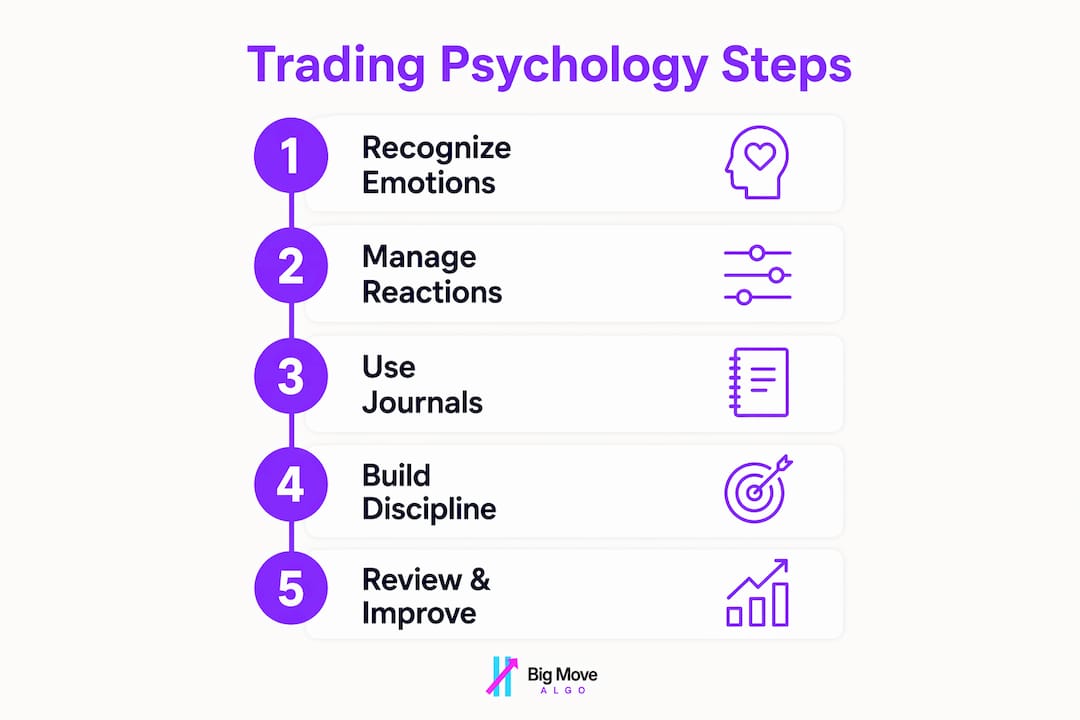
How emotions change your behavior in real trading sessions
Every trader experiences the same core emotions. What separates disciplined traders from struggling ones is recognizing which emotion is driving a decision before acting on it.

Emotion | Typical behavior | Example in a trade |
Fear | Early exit or no entry | Closing a long position 30 seconds after entry because price dips slightly |
Greed | Over-leveraging, ignoring stops | Doubling position size after three wins in a row |
FOMO | Chasing entries after the move | Buying a breakout well above the ideal entry because you don’t want to miss it |
Regret | Revenge trading | Immediately re-entering after a stop-out to “make it back” |
Pride | Refusing to cut a loss | Holding a losing trade for days because admitting the loss feels like admitting failure |
Fear and greed are the two most studied drivers in trading psychology, but regret and pride cause just as much damage in practice. Regret pushes you into trades that don’t meet your criteria. Pride keeps you in trades that should have been closed. Both feel rational in the moment, which is what makes them dangerous.
Key cognitive biases that quietly wreck trading decisions
Emotions are loud and obvious. Cognitive biases are quieter and harder to catch because they feel like logic.
Loss aversion: You feel losses roughly twice as intensely as equivalent gains, so you hold losers too long and cut winners too short. Example: You exit a 3% winner immediately but hold a 3% loser for days, hoping it recovers.
Overconfidence: After a strong run, you overestimate your edge and underestimate risk. Example: You skip your usual pre-trade checklist because “you know this setup.”
Confirmation bias: You seek out information that supports a trade you’ve already decided to take. Example: You ignore three bearish signals on a chart because you found one bullish analyst note.
Anchoring: You fixate on a specific price (your entry, a recent high) and make decisions relative to it rather than current market conditions. Example: You refuse to exit a losing trade until it returns to your entry price, regardless of what the chart says.
Recency bias: You weight the last few trades too heavily. After three wins, you feel the system is infallible. After three losses, you abandon it entirely. Example: You stop following your plan after a losing week, even though the system has a positive expectancy over 200 trades.
Behavioral finance has documented all five of these biases across decades of market research, and they show up consistently in retail trader behavior.
Pro Tip: The most effective counter to recency bias and revenge trading is a pre-commitment rule written into your trading plan before the session starts. Something like: “If I take two losses in a session, I close the platform for the day.” Written rules made in a calm state override emotional decisions made in a reactive state.
Why trading psychology affects your P&L more than you might expect
A technically sound strategy can be destroyed by psychological lapses at the execution level. The mechanism is straightforward: every time you deviate from your plan, you introduce variance that your backtested edge didn’t account for.
Chopping is one of the most common consequences. A trader who exits early, re-enters on impulse, and then exits again on fear can take four trades where the plan called for one, paying spread and commission four times while capturing a fraction of the intended move. Revenge trading is worse. After a loss, the emotional drive to recover quickly leads to larger position sizes, lower-quality setups, and often a second, larger loss.
“The market is a device for transferring money from the impatient to the patient.” — Warren Buffett
That quote isn’t just motivational. It describes a measurable dynamic. Impatience in trading has a direct cost: wider entries, premature exits, and positions sized by emotion rather than risk parameters. Strategy and psychology are symbiotic — good psychology helps you execute a sound system, and a sound system reduces psychological stress by giving you clear, repeatable signals to follow.
Neglecting psychology doesn’t just cost you individual trades. It erodes your confidence in your own system, which leads to constant strategy-switching, which makes it impossible to accumulate the sample size needed to evaluate any edge at all.
How to build stronger trading psychology: a practical step-by-step program
Structure is the antidote to emotional decision-making. The more decisions you make in advance, the fewer you have to make under pressure.
Write a trading plan before the session. Define your entry criteria, exit criteria, maximum risk per trade, and the market conditions under which you will not trade. Leave no room for improvisation on the core rules.
Set position size by formula, not feel. A simple approach: risk no more than 1% of account equity per trade. If your stop is 50 pips and your account is $10,000, your maximum position size is determined by that math, not by how confident you feel.
Run a pre-session checklist. Before opening a chart, confirm: Are you rested? Is there a high-impact news event in the next hour? Is your risk per trade set? If any answer is problematic, reduce size or skip the session.
Use hard stop-losses on every trade. A stop-loss placed at entry removes the in-trade decision of when to exit a loser. That decision, made under pressure, is where most psychological damage happens.
Journal every trade with emotional data. Record entry, exit, result, and — critically — what you felt before, during, and after. Journaling helps you detect emotional patterns and make more measured decisions over time.
Build a post-session review ritual. Spend 10 minutes after each session reviewing whether you followed your plan, not whether you made money. Process-based identity — valuing execution quality over outcomes — is what separates traders who improve from those who stagnate.
Apply a shutdown ritual after losses. After two consecutive losing trades, close the platform and step away for at least 15 minutes. This breaks the emotional feedback loop before it becomes revenge trading.
A sample journal prompt set: What was my emotional state before this trade? Did I follow my entry criteria exactly? What did I feel when price moved against me? Did I move my stop? Why or why not?

Exercises and habits that train emotional regulation
The goal isn’t to feel nothing. Trying to suppress emotions often leads to subconscious leaks — the emotion comes out anyway, just in a disguised form like “adjusting” a stop or “just checking” a position you already closed. The goal is to manage intensity and stay anchored to your plan.
Exercise | How to do it | Frequency |
Simulated trade sessions | Trade a demo account using your live rules for 2–4 weeks before going live with a new strategy | Weekly until consistent |
15-minute cool-off rule | After two consecutive losses, physically close the platform and do something unrelated | Every session as needed |
Implementation intention | Write: “If I feel the urge to chase a missed entry, then I will wait for the next valid setup on my checklist” | Pre-session, daily |
Mindfulness check-in | Before entering a trade, take three slow breaths and name the emotion you’re feeling | Before every entry |
Weekly pattern review | Review your journal for emotional triggers that preceded your worst trades | Once per week |
Implementation intentions are particularly well-supported by behavioral research. The “if-then” format pre-loads a response to a specific trigger, which means you don’t have to make a decision under pressure — the decision is already made. For tracking options trades or any other instrument systematically, the same principle applies: structured logging before and after each trade builds the data you need to identify your specific emotional triggers.
Three scenarios where psychology changed the outcome
The fear exit: A trader enters a long position with a clear plan and a stop 20 points below entry. Price dips slightly, and fear of a larger loss triggers an early exit. Price then rallies significantly to the original target. The system worked. The psychology didn’t. After applying a rule that prohibits manual exits before the stop is hit, the trader captures the full move on the next identical setup.
The FOMO chase: A breakout occurs while a trader is away from the screen. Returning to see a 12% move already underway, the trader enters at the top of the candle, well outside the planned entry zone. Price consolidates and the position stops out. The fix: a written rule that any entry missed by more than 3% from the planned level is skipped entirely, with a note in the journal. Beginner traders frequently cite FOMO entries as their single most costly mistake.
The pride hold: A short position moves notably against the trader. The original stop was in place. Rather than accepting the loss, the trader removes the stop and adds to the position, convinced the analysis is correct. The loss doubles. After committing to a hard, non-adjustable stop on every trade, the same trader’s maximum single-trade loss drops to a manageable level, and the account survives to trade the next setup.
Is trading really 70% psychology?
You’ve probably heard it: “Trading is 70% psychology, 30% strategy.” It’s a useful shorthand, but the percentage is invented. No rigorous study has produced that split, and treating it as a fact misses the more important point.
Psychology and strategy are not separable variables you can weight independently. Good psychology cannot save a fundamentally flawed strategy. If your system has no edge, disciplined execution of it just means you lose money consistently instead of chaotically. Conversely, a strong system is worthless if you can’t execute it under pressure.
The practical takeaway: allocate time to both. Build and test a system with a demonstrable edge. Then build the psychological infrastructure — plan, journal, rules, rituals — to execute it without deviation. Neither half works without the other. The “70%” framing is useful only as a reminder that most traders underinvest in the mental side relative to the analytical side.
How behavioral finance explains what traders actually do
Behavioral finance is the academic field that challenged the assumption that market participants act rationally. Its core finding: humans make predictable, systematic errors in judgment under uncertainty, and those errors show up in asset prices and individual trading records alike.
The biases covered earlier — loss aversion, overconfidence, anchoring, confirmation bias, recency bias — are all documented in behavioral finance literature. Understanding where they come from (evolutionary risk-avoidance instincts that don’t map well to financial markets) helps explain why they’re so persistent and why willpower alone rarely fixes them. Structural rules work better than intentions.
“Becoming a successful trader requires more than technical knowledge. You also need to develop the right mindset to navigate the psychological intricacies of trading.” — Britannica Money
Three resources worth your time: Thinking, Fast and Slow by Daniel Kahneman is the foundational text — read it for the theory behind every bias listed in this article. Trading in the Zone by Mark Douglas applies the behavioral concepts directly to trading execution. For a shorter, applied read, the CMC Markets trading psychology guide covers the core concepts clearly and is free. Use these for conceptual grounding, but prioritize the exercises and journal work over academic depth — reading about psychology doesn’t change behavior; practice does.
Key Takeaways
Trading psychology determines whether a sound strategy produces consistent results or gets destroyed by emotional execution errors.
Point | Details |
Manage emotion, don’t suppress it | Acknowledge what you feel and stay anchored to your plan; suppression causes subconscious leaks. |
Structure beats willpower | Pre-written rules, hard stops, and cool-off rituals outperform in-the-moment self-control every time. |
Journal emotional data, not just trades | Recording your emotional state alongside trade outcomes reveals the patterns that cost you money. |
Psychology and strategy are inseparable | A disciplined mindset can’t rescue a flawed system; a sound system still fails without disciplined execution. |
Process identity beats outcome identity | Measuring success by plan adherence, not P&L, builds the consistency that produces long-term results. |
The part most traders skip
The conventional advice on trading psychology focuses on mindset — stay calm, think long-term, don’t let losses affect you. That framing is almost useless in practice because it treats emotion as a problem to be solved by attitude.
What actually works is treating emotion as information and building systems that reduce the number of decisions you have to make while emotional. The traders who improve fastest aren’t the ones who meditate more or read more books. They’re the ones who write better rules, keep more honest journals, and build structural safeguards that make the right action easier than the wrong one.
There’s also something worth saying about identity. Experienced traders describe the process of improvement as personality modification — overriding evolutionary instincts that actively work against disciplined risk-taking. Loss avoidance kept your ancestors alive. In trading, it makes you hold losers and cut winners. Recognizing that the instinct isn’t a character flaw but a biological default makes it easier to build systems around it rather than fighting it directly.
Start with one change: shift your success metric from “did I make money today?” to “did I follow my plan today?” That single reframe changes what you optimize for, and what you optimize for is what you get better at.
Useful resources for going deeper
“The goal of studying trading psychology is not to eliminate emotions. The goal is to recognize their influence and, where possible, avoid letting them override your considered judgments.” — CMC Markets
Books:
Thinking, Fast and Slow — Daniel Kahneman. The foundational text on cognitive biases. Read Part IV for the sections most directly applicable to financial decision-making.
Trading in the Zone — Mark Douglas. The most widely cited applied text on trading psychology. Best used alongside a live journal practice.
Articles and guides:
CMC Markets: Trading Psychology Explained — clear, free overview of core concepts.
Investopedia: Trading Psychology — solid reference for definitions and bias explanations.
Britannica Money: Trading Psychology — good entry point for mindset and emotional management frameworks.
Tools and templates:
A trade journal template should include: date, instrument, entry/exit price, position size, planned stop, actual stop, result, and three emotional data fields (pre-trade state, in-trade reaction, post-trade reflection).
For no-code algorithmic execution that removes discretionary decisions from your workflow, QuantGenie lets you build and run rule-based strategies without writing code — useful for traders who want to enforce their plan mechanically.
Automated trade signals reduce the number of real-time decisions you make under emotional pressure, which is one of the most direct ways to limit execution errors.
Big Move Algo’s automation guide shows how AUTO and MANUAL modes work in practice — worth reviewing if you want a structured signal framework that takes the guesswork out of entries and exits.
Recommended
Comments