
Best AlgoAlpha.io Alternatives for TradingView Traders in 2026
- Steven Hartwell

- 1 day ago
- 9 min read
For most AlgoAlpha users looking to switch, Big Move Algo is the closest direct replacement: it delivers Long, Short, and Exit signals on TradingView across crypto, forex, stocks, indices, and commodities, with an AUTO mode that gets you live in minutes and a Fake Trend Detector that filters out the noise AlgoAlpha users frequently complain about.
Here is how the other top options stack up by category:
AI-first signals: Quantzee leads here, with machine-learned pattern detection and experimental backtest integrations built into its TradingView suite.
Visual/discretionary overlays: LuxAlgo is the go-to for traders who want polished chart overlays and configurable signal filters without committing to a systematic workflow.
Budget-conscious premium signals: Zeiierman targets cost-sensitive traders who want professional-grade signals at a lower monthly outlay.
Momentum and volatility focus: Lune Indicators Suite suits crypto and FX traders who build strategies around momentum and volatility breakouts.
Key Takeaways
The strongest direct replacement on popular trading platforms in 2026 is Big Move Algo, which matches the core feature set while adding AUTO mode deployment and a built-in Fake Trend Detector that filters low-quality signals at the indicator level.
Point | Details |
Top direct replacement | Big Move Algo covers multi-market signals, AUTO/Manual modes, and noise filtering in one subscription. |
AI-first alternative | Quantzee offers ML-driven signal generation and backtest integrations for traders who need data-driven workflows. |
Budget-conscious option | Zeiierman delivers competitive signals at a lower price point for cost-sensitive traders. |
Verify non-repainting claims | All five tools carry vendor-stated non-repainting claims; request backtest artifacts before committing. |
Paper-test first | Run any new suite for at least two weeks on your primary markets before trading real capital. |
Table of Contents
Why are traders looking for AlgoAlpha alternatives in 2026?
AlgoAlpha is a TradingView-based indicator suite that delivers chart signals, alerts, and overlays for discretionary and semi-systematic traders. Its vendor-documented feature set covers signal generation, alert customization, and multi-timeframe overlays. For a segment of its user base, that has been enough. For a growing number, it has not.
The triggers driving the search for options to algoalpha.io in 2026 cluster around four issues. First, non-repainting proof: traders increasingly demand independently verifiable evidence that a signal does not repaint after the bar closes, and vendors who cannot produce backtest artifacts are losing trust fast. Second, AI and backtesting features: the bar has moved. Suites without some form of ML-assisted signal filtering or at least a documented backtest workflow now feel dated. Third, automation and broker integration: traders want alerts that fire into execution layers like 3Commas or Alertatron without manual intervention. Fourth, pricing transparency: Trustpilot reviews for AlgoAlpha show recurring complaints about pricing clarity and update cadence, two things traders check before committing to an annual plan.
The trust signals most traders verify before switching: TradingView marketplace presence and follower counts, independent backtest screenshots or third-party audits, and user-review patterns on open platforms. Community listings on SourceForge and Slashdot confirm that the search for replacements is active and broad.
Pro Tip: Before you cancel any subscription, export your current alert settings and note which timeframes and markets you use most. That list becomes your minimum-viable-feature checklist for any replacement.
Top AlgoAlpha.io alternatives: profiles and quick verdicts
Big Move Algo
Big Move Algo is built for traders who want a fast start without sacrificing control. AUTO mode requires almost no configuration: you subscribe, add the indicator to your TradingView chart, and signals appear immediately. Manual mode opens up parameter customization for traders who want to tune sensitivity, timeframe weighting, or signal frequency. The built-in Fake Trend Detector is the feature that sets it apart from most alternatives: it actively flags low-quality market conditions and suppresses signals when the environment does not support clean directional moves.
Markets covered: crypto, forex, stocks, indices, and commodities. Alerts fire to multiple platforms and can connect to automated execution layers. Pricing is subscription-based (monthly and annual tiers) with instant access after payment through Stripe.
Long, Short, and Exit signals with real-time delivery
Fake Trend Detector to filter noise and low-probability setups
AUTO mode for immediate deployment; Manual mode for experienced customization
Multi-market coverage across five asset classes
Alert delivery to external platforms and automation-compatible
Best for: Retail traders at beginner-to-intermediate level who want a structured, low-friction replacement for AlgoAlpha with room to grow into deeper customization.
LuxAlgo

LuxAlgo has one of the largest TradingView followings among indicator suite vendors, and the visual quality of its overlays is genuinely strong. Its signal filters are configurable, and the suite covers most major asset classes. Where it earns its reputation is with discretionary traders who want to see market structure clearly rather than follow a binary signal.
The trade-off: LuxAlgo’s pricing sits at the higher end of the market, and its non-repainting documentation is vendor-stated rather than independently audited. For traders who need a clean automation path from alert to execution, the setup requires more manual work than Big Move Algo’s alert architecture.
Highly visual overlays and signal filters
Configurable for multiple strategies and timeframes
Strong TradingView community presence
Pricing at a premium tier; trial availability varies by plan
Best for: Active discretionary traders who prioritize chart clarity and signal visualization over automation speed.
Zeiierman
Zeiierman positions itself as a premium signal suite at a price point below the market leaders. Its community-driven support model means you get access to forums and Discord channels alongside the indicator itself. Signal quality is competitive for the price, though independent non-repainting verification is not prominently published.
The appeal is straightforward: if AlgoAlpha’s pricing felt steep and you do not need cutting-edge AI features, Zeiierman delivers a capable signal set for less. The documentation is functional rather than comprehensive.
Signal generation across major TradingView-supported markets
Community support via Discord and forums
Competitive pricing relative to feature set
Non-repainting claims are vendor-stated
Best for: Cost-conscious traders who want professional signals without paying a premium-tier price.
Quantzee
Quantzee is the most AI-forward option on this list. Its signals are generated through machine-learning models rather than traditional indicator logic, and it offers experimental backtest integrations that let you stress-test signal performance before going live. If you have been frustrated by AlgoAlpha’s lack of ML-driven filtering, Quantzee is the natural next stop.
The caveat: ML-generated signals can behave unpredictably in low-liquidity or highly correlated market conditions. Quantzee’s own positioning as an AlgoAlpha alternative leans heavily on the AI angle, which is accurate but also means the learning curve is steeper than AUTO-mode tools.
AI/ML signal generation with pattern detection
Experimental backtest integrations
TradingView-based delivery
Steeper setup curve than no-code alternatives
Best for: Traders who want AI-assisted signal discovery and are comfortable with a more experimental, data-driven workflow.
Lune Indicators Suite
Lune Indicators Suite is built around momentum and volatility. If your strategy depends on catching breakouts, trend accelerations, or volatility expansions, Lune’s indicator set is purpose-built for that. It performs well on crypto and FX pairs where volatility is a primary driver of opportunity.
It is a narrower tool than the others on this list. Traders who need broad multi-market coverage or a clean automation path will find it limiting. But for momentum-focused crypto or FX traders, the signal specificity is a genuine advantage.
Momentum and volatility-focused indicators
Strong fit for crypto and FX strategies
Volatility filters to reduce false signals in ranging markets
More specialized than full-suite alternatives
Best for: Crypto and FX traders who build strategies around momentum and volatility breakouts.
How do these alternatives compare head to head?
Verifiability note: Non-repainting claims across all five tools are vendor-stated. TradingView follower counts and marketplace presence are independently checkable via each vendor’s public TradingView profile. Pricing details are subject to change; verify directly with each vendor before purchasing.
The core trade-off on this list: traders who prioritize getting live fast with reliable signals across multiple markets will find Big Move Algo’s AUTO mode and Fake Trend Detector the most direct path. Traders who need ML-driven signal discovery or code-first backtesting should weigh Quantzee’s AI features against its steeper setup requirements. No single suite wins on every axis.
How do you choose the right TradingView indicator suite?
The decision comes down to matching the tool to your actual workflow, not the feature list that sounds most impressive.
Criteria checklist:
Asset coverage matches your primary markets (crypto, forex, stocks, futures)
Non-repainting proof is available, ideally with backtest artifacts or third-party verification
Automation path is clear: can alerts fire directly into your execution layer?
Alert reliability is documented: what is the latency from signal to alert delivery?
Update cadence is transparent: how often does the vendor push improvements?
Documentation covers setup, parameters, and troubleshooting
Support channels are responsive (Discord, email, or ticketing)
Pricing model fits your budget with no hidden renewal terms
Questions to ask any vendor before subscribing:
Can you provide a non-repainting proof or backtest artifact showing signal performance on closed bars?
What is the typical latency between signal generation and alert delivery?
Which automation platforms or alert executors does your tool integrate with natively?
How frequently do you push indicator updates, and how are users notified?
What is your refund or cancellation policy if the tool does not fit my workflow?
Red flags to watch for: no clear non-repainting statement anywhere in the documentation; closed-source claims with no supporting tests; TradingView presence that is thin or inactive; pricing that changes between the sales page and checkout; support that only exists in a Discord server with no official ticketing.
As QuantMonitor’s classification of algorithmic tools makes clear, the right fit depends heavily on whether you are a chart-first discretionary trader or a systematic builder who needs code-first backtesting. Those are different workflows, and no single indicator suite serves both equally well.
Trading indicators are analytical tools, not guarantees. Paper-test any new suite before committing real capital, and size positions according to your own risk management rules.
Pro Tip: Run any new indicator on at least two weeks of historical replay before going live. Check signal frequency, false-signal rate in ranging markets, and whether the Fake Trend Detector (or equivalent filter) actually reduces noise on your primary asset.
How we verified the claims in this comparison
Transparency about the research process matters here, because the indicator suite market has no shortage of vendor marketing dressed up as independent analysis.
Methods used:
Reviewed vendor documentation and official setup guides for each tool
Checked TradingView profiles for marketplace presence, published ideas, and follower counts
Consulted community listings on SourceForge and Slashdot to cross-reference which alternatives appear most frequently in open discussions
Reviewed user sentiment on Trustpilot for recurring complaint and praise patterns
Referenced TradeAlgo’s roundup of automated trading platforms to cross-check category positioning for no-code versus developer-focused tools
Checked third-party roundups for category-fit framing
Trust signals we weighted most heavily: independent backtest artifacts (rare but decisive when present), TradingView marketplace presence and follower counts (publicly verifiable), transparent pricing pages, and user-review patterns that show consistent themes rather than isolated complaints.
Scope note: We reviewed vendor documentation, multiple third-party comparison pages, and user-review platforms across the five shortlisted tools. Non-repainting claims could not be independently audited for any tool on this list; all such claims are vendor-stated and should be verified directly before purchase.
Pro Tip: Community listings and comparison pages are a useful first filter, but they often repeat vendor marketing copy. Weight independently verifiable signals, like TradingView follower counts and published ideas, more heavily than aggregator star ratings.
Why Big Move Algo is the recommended direct replacement
The case for Big Move Algo as the primary AlgoAlpha replacement rests on three concrete things, not marketing language.
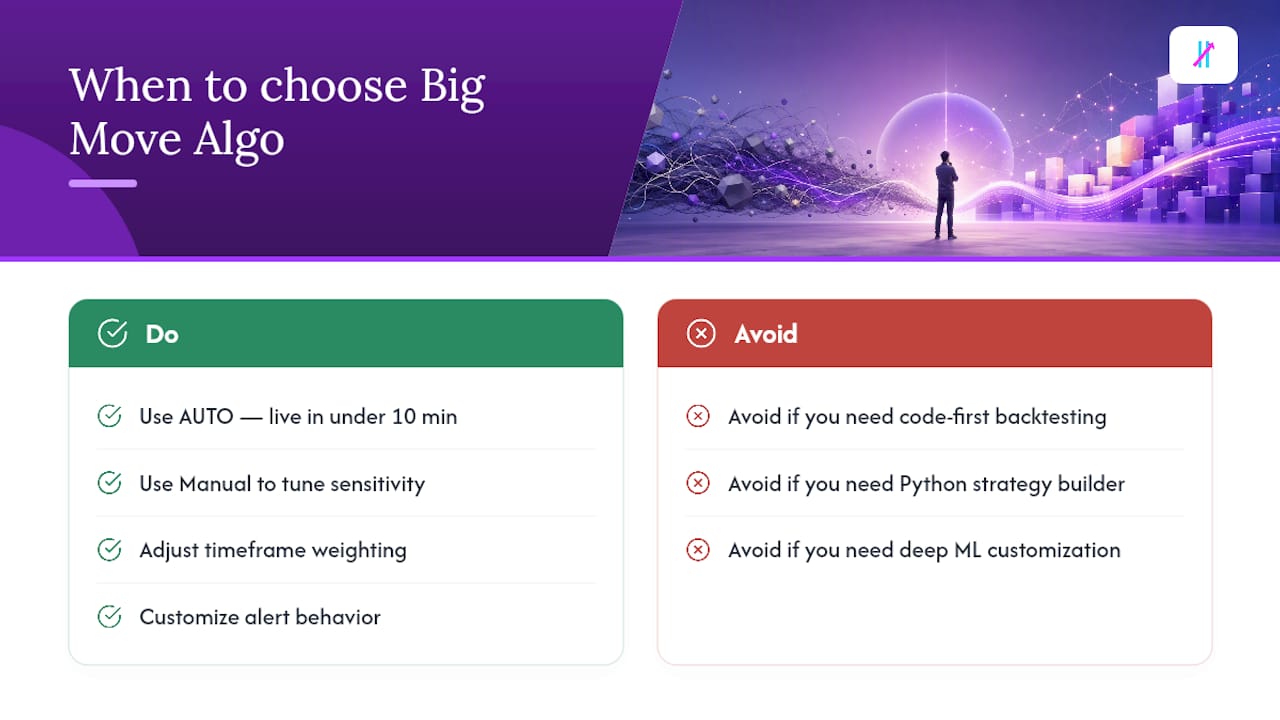
AUTO mode means a trader can go from subscription to live signals on TradingView in under ten minutes. That matters if you are switching mid-week and do not want to spend a session configuring parameters. Manual mode is there when you are ready for it: you can tune signal sensitivity, adjust timeframe weighting, and customize alert behavior without touching code.
The Fake Trend Detector is the feature that most directly addresses what AlgoAlpha users complain about. Low-quality market conditions, choppy ranges, and false breakouts generate noise that erodes confidence in any signal suite. Big Move Algo filters those conditions at the indicator level rather than leaving the trader to figure it out manually.
Multi-market coverage across crypto, forex, stocks, indices, and commodities means you are not locked into one asset class. Traders who run multiple watchlists across different markets do not need to subscribe to separate tools.
Where Big Move Algo is not the best fit: if you need a code-first backtesting engine, a Python-based strategy builder, or deep ML model customization, you are looking at a different category of tool entirely. Quantzee’s AI features or a dedicated algorithmic trading platform would be a better starting point for that workflow.
Ready to test Big Move Algo as your AlgoAlpha replacement?
The fastest way to evaluate any indicator suite is to run it on your actual markets with your actual timeframes. Big Move Algo’s subscription gives you instant access after payment, so you can be testing signals within the same session you sign up.
Here is what to do in the first 48 hours: enable AUTO mode on your primary chart, set up at least one alert to your preferred notification channel, and run the indicator across a ranging market and a trending market to observe how the Fake Trend Detector performs in both conditions. Note the signal frequency, check whether false signals cluster in low-volatility periods, and confirm alert delivery latency to your execution layer.
Paper-test before committing real capital. Manage position sizing according to your own risk rules, not the signal alone. Visit the Big Move Guard page to review current plan options and get started.
Sources
This article is general information, not a substitute for advice from a qualified financial advisor. Consult a qualified financial professional about your own circumstances before acting on anything here.
Recommended
Comments