Best Trend-Following Indicators for TradingView in 2026
The best trend-following indicators are the ones that tell you direction and trend strength without burying you in settings. For most traders that means a moving average or EMA crossover for direction, ADX for strength, MACD for confirmation and a volatility tool such as ATR for risk. If you would rather have those judgments packaged into clear Long, Short and Exit signals on TradingView, Big Move Algo is the option we built for that job. Below we compare each tool, show when it works and when it stalls, and add the daily loss rules that keep one bad session from becoming a bad month.
TL;DR
- Moving averages, MACD and Supertrend are the classic trend tools. All of them lag, and all of them struggle when price moves sideways.
- ADX does not give direction. It tells you whether a trend is strong enough to trade: readings above 25 suggest a strong trend, below 20 suggest none.
- Big Move Algo combines Long, Short and Exit signals with a built-in Fake Trend Detector, so choppy conditions are flagged before you enter.
- Whatever you use, set a daily loss limit before the session starts, not after the first red trade.
- Plans run from $55 per month (Version 2) to $79 per month (Version 3 Plus).
Table of Contents
- What a trend-following indicator actually does
- The best trend-following indicators compared
- How to tell whether an indicator suits the market you are in
- Free tools or a packaged signal: how to choose
- Our perspective
- Set a daily loss limit before you trade
- Try Big Move Algo on TradingView
- FAQ
- Sources
What a trend-following indicator actually does
Trend following rests on a simple idea: price trends are more likely to continue than not. Academic work on the topic describes it as the predominant style for managed futures funds and commodity trading advisers, who take long positions in rising markets and short positions in falling ones. Graham Capital’s primer adds that trends are read from price history, with lookback periods from weeks to several months, and that position size usually shrinks when volatility rises.
An indicator is a filter. Price is noisy, and the same research frames the challenge as pulling a signal out of random moves. Moving-average crossovers and time-series momentum are the two primary methods it names for doing that.
That tells you what to expect from every tool below. A trend indicator will not predict a turn. It will confirm a move that has already started, which means you give up the first part of a trend in exchange for fewer false starts.
The best trend-following indicators compared
This table summarizes the tools most traders put on a TradingView chart first. Several are free built-in tools, so cost is mostly a question of what you add on top.
| Indicator | What it tells you | Main strength | Main weakness | Best for |
|---|---|---|---|---|
| Moving averages (SMA/EMA) | Direction and slope | Simple, easy to read | Lags, whipsaws in ranges | Swing and position traders |
| MACD | Momentum and direction changes | Good confirmation tool | Late on fast reversals | Confirming a bias on a higher timeframe |
| ADX | Trend strength, not direction | Keeps you out of weak trends | Needs a direction tool beside it | Filtering entries |
| Supertrend | ATR-based trend flips | Clear on-chart state | Frequent flips in chop | Day and swing traders |
| RSI | Momentum, pullbacks inside trends | Spots pullback entries | Easy to misread as a reversal call | Timing entries within a trend |
| Big Move Algo | Long, Short and Exit signals with a Fake Trend Detector | Packaged decisions, AUTO Mode | Subscription required | Traders who want structure over settings |
Moving averages
Moving averages smooth price to reduce short-term noise. Investopedia’s rule is plain: a rising average with price above it points to an uptrend, a falling one with price below it points to a downtrend. Fidelity’s guide treats 50-bar SMAs as a common intermediate-trend proxy and 200-bar SMAs as a common long-term one, and notes that price crossing the line can serve as a long, short or exit signal.
The cost is lag. By the time a 50-bar average turns, a good part of the move is behind you. In a sideways market, price crosses the line repeatedly and each cross is a small loss.
MACD
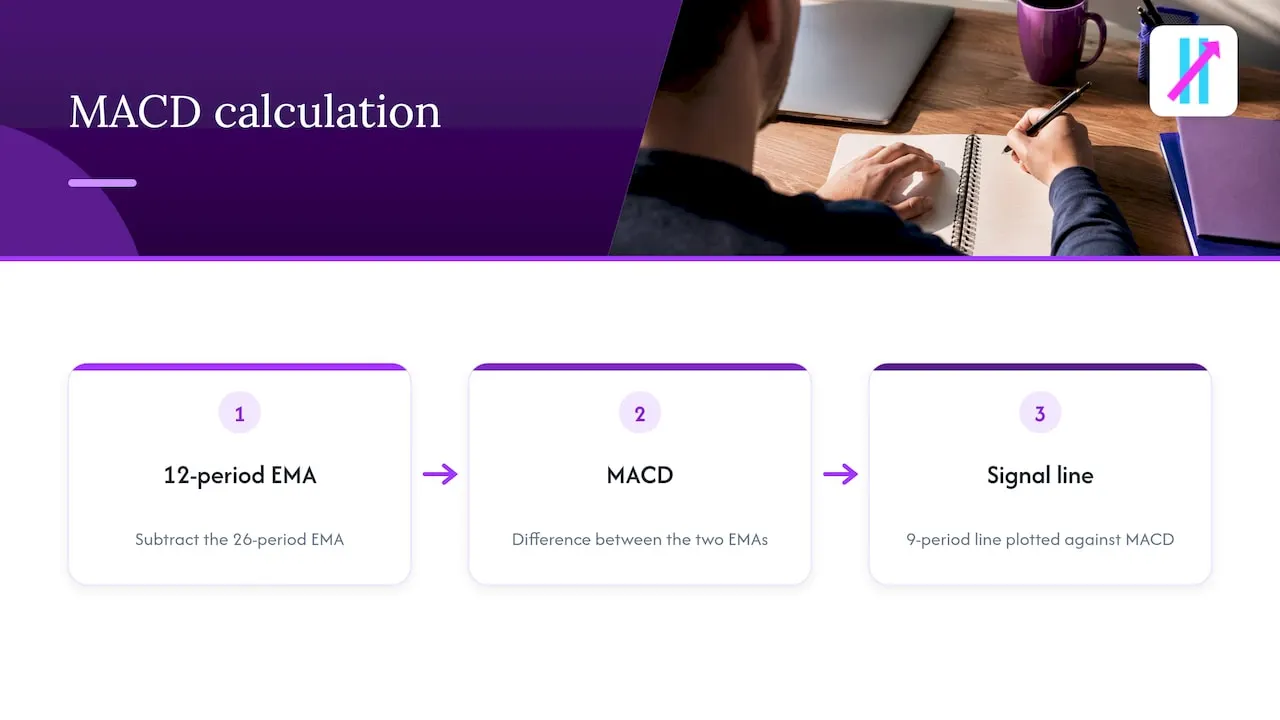
MACD takes the difference between a 12-period and a 26-period EMA and plots a 9-period signal line against it, as Investopedia explains. A comparison of free TradingView tools describes it as a higher-timeframe confirmation tool rather than an entry trigger. That is a sensible way to use it: check the daily MACD, then take your entries on a lower timeframe in the same direction.
ADX
ADX is the filter most beginners skip and most experienced traders add. Fidelity’s guide says ADX above 25 indicates a strong trend and below 20 indicates no trend. John Murphy’s rule of thumb goes a step further: a rising ADX favors moving averages, a falling ADX favors oscillators. We cover the practical side in our guide to trend strength rules around ADX 25.
Supertrend and EMA crossovers
Both are free on TradingView. The same TradingView comparison characterizes Supertrend as an ATR-based binary trend-flip tool and EMA crossovers as crossover-event tools. Supertrend is attractive because it shows one state on the chart: up or down. Its weakness is the same as every binary tool, which is that a flat market produces a string of flips.
RSI inside a trend
RSI is usually filed under reversal tools, but IG points out that overbought or oversold readings can indicate trend strength rather than an imminent reversal, and that RSI can help locate pullbacks within a trend. Used that way it becomes an entry-timing tool rather than a signal to fade the move.
Big Move Algo
Big Move Algo is our proprietary TradingView indicator. It analyzes the market in real time and prints Long, Short and Exit signals, so you are not stitching together four panes of lines and deciding what they mean at 9:31 a.m. Two features matter most for trend traders:
- AUTO Mode needs minimal setup, so you can start quickly. Manual Mode gives experienced traders more customization.
- The Fake Trend Detector is designed to filter out low-quality or misleading conditions where trading may not be recommended. This is the problem ADX tries to solve, built into the signal itself.
It works across crypto, forex, stocks, indices and commodities, runs on unlimited devices, sends alerts to multiple platforms, and can connect to automated trading platforms. We designed it not to repaint and include free updates with every plan.
How to tell whether an indicator suits the market you are in
The most common reason a good trend indicator “stops working” is that the market stopped trending. A regime-comparison guide recommends moving-average crossovers, ADX, MACD and breakouts in trending conditions, and RSI, Stochastic and Bollinger Bands in ranges. It also notes that aligned, fanned-out moving averages look like a trend, while tangled ones look like a range.
A quick routine before you take a signal:
- Check the bigger picture. Schwab notes that some traders start with a broad index like the S&P 500 to see whether it is trending or consolidating.
- Read trend strength. ADX above 25 is a green light, below 20 a reason to wait.
- Look at the averages. Are they pointing the same way and separating, or flat and crossing?
- Confirm with volume. Our volume confirmation checklist walks through a 1.5× rule.
- Size for volatility. Smaller positions in volatile markets, larger in quiet ones, which is how the Graham primer describes professional trend followers sizing trades.
We lay out a fuller version of this routine in 5 checks that keep you out of chop, and the logic behind the signals in five rules for trend-following signals.
Lagging does not mean useless
Every tool in the table above lags, by design. The question is not whether an indicator is late but whether you know what it is late at. Our note on lagging versus leading indicators explains why pairing one of each is usually more useful than hunting for a perfect single tool. For a wider map of what is available, see the TradingView indicator categories guide.
Free tools or a packaged signal: how to choose
Free built-in indicators are enough to learn how trends behave. If you enjoy building a system, a 50 EMA, ADX and MACD on a clean chart is a fair start. The trade-off is time: you pick the lengths, decide how to resolve disagreements between tools, and write your own rules for exits.
The common problem for traders who are overwhelmed by indicators is not a lack of information. It is too many conflicting readings and an emotional decision at the worst moment. A packaged signal is built for that case. With Big Move Algo, the decision arrives as Long, Short or Exit, and the Fake Trend Detector speaks up when conditions are poor. If you are working toward automation, the structured output also makes it easier to connect alerts to an automated platform.
| If you are… | Start with |
|---|---|
| Learning how trends behave | EMAs, ADX and MACD on a clean chart |
| A swing trader who wants fewer chart decisions | Big Move Algo in AUTO Mode |
| An experienced trader who wants control | Big Move Algo in Manual Mode, plus your own filters |
| Trading several markets (crypto, forex, stocks) | One consistent signal framework across all of them |
If you are also curious about the opposite approach, mean reversion signals are the natural counterpart for ranging markets. And for the broader field of quantitative trading tools and automated strategies, it helps to understand how rule-based systems are built before you trust any of them with real money.
Our perspective
Most traders do not lose because they picked the wrong moving average. They lose because they traded when there was no trend, or because they could not follow their own rules once money was on the line.
That is why we built Big Move Algo around clarity. A signal should say Long, Short or Exit, and it should stay quiet when the market is not worth trading. The Fake Trend Detector exists for exactly that reason: the best trade is often the one the indicator keeps you out of.
We also think setup should not be a barrier. AUTO Mode lets a newer trader be productive on day one, while Manual Mode leaves room for an experienced trader to tune the tool to a personal style. Either way, the goal is the same: replace guesswork and emotion with a structured process you can repeat.
Pair any trend tool, ours included, with a risk plan. A clear signal and a firm daily loss limit are what turn a good idea into a durable routine.
Steven Hartwell
Set a daily loss limit before you trade
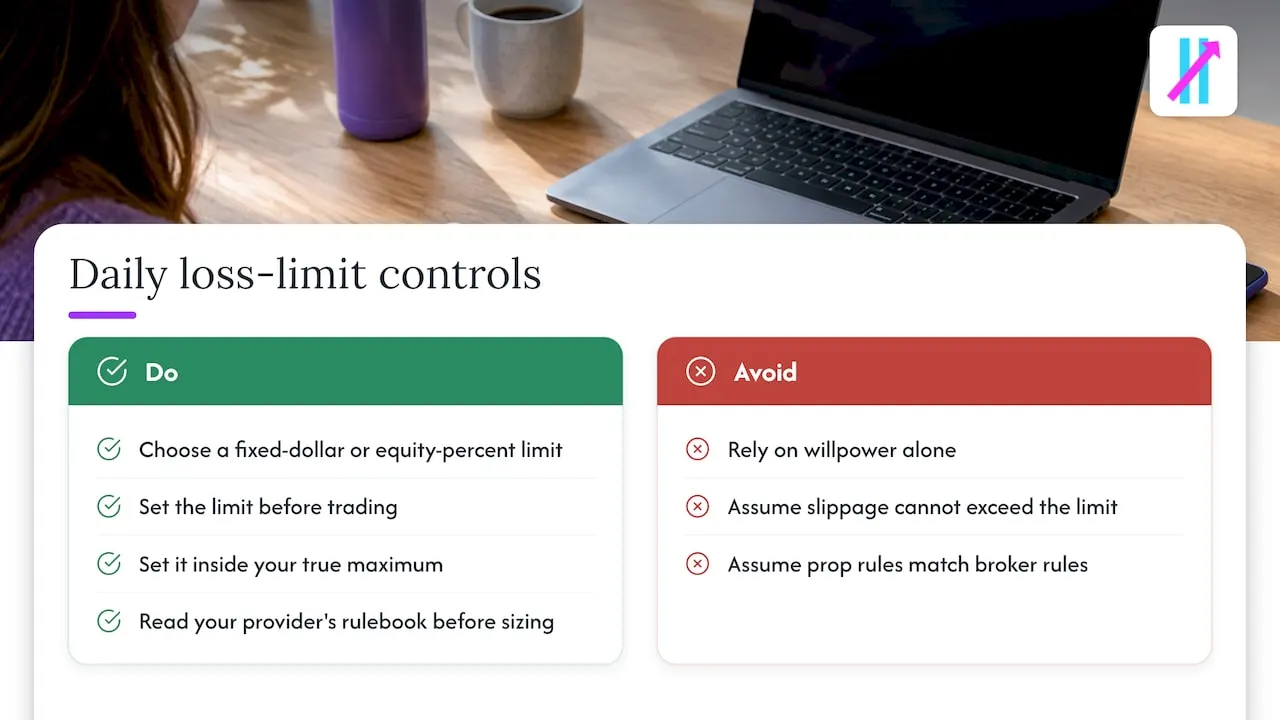
A trend system will have losing stretches, because trends are interrupted by ranges. A daily loss limit caps what any one day can cost you. Decide the number in advance, as a fixed dollar amount or a percentage of equity, and treat reaching it as the end of the session.
You can enforce it with software rather than willpower. NinjaTrader’s documentation says traders can configure automatic daily-loss, weekly-loss, profit-trigger and trailing-drawdown limits on eligible live or demo accounts. When a limit is hit, open positions are closed, working orders are canceled and the account becomes liquidation-only. The same page warns that market-order slippage can produce a realized loss larger than the limit, so set it a little inside the number you truly cannot exceed.
If you trade a funded or prop account, the rules are different from a regular brokerage account. FundingPips explains that its simulated model has daily-loss and maximum-loss rules, with the daily limit anchored to the day’s opening balance or equity and reset at platform midnight, while a traditional broker mainly imposes margin requirements. The same indicator strategy can therefore survive on one platform and breach the rules on another. Read your own provider’s rulebook before you size a trade.
Our guide to automated trading risk controls for TradingView users covers how to build these limits into an automated setup, and volatility filters show how to cut bad trades early.
Try Big Move Algo on TradingView
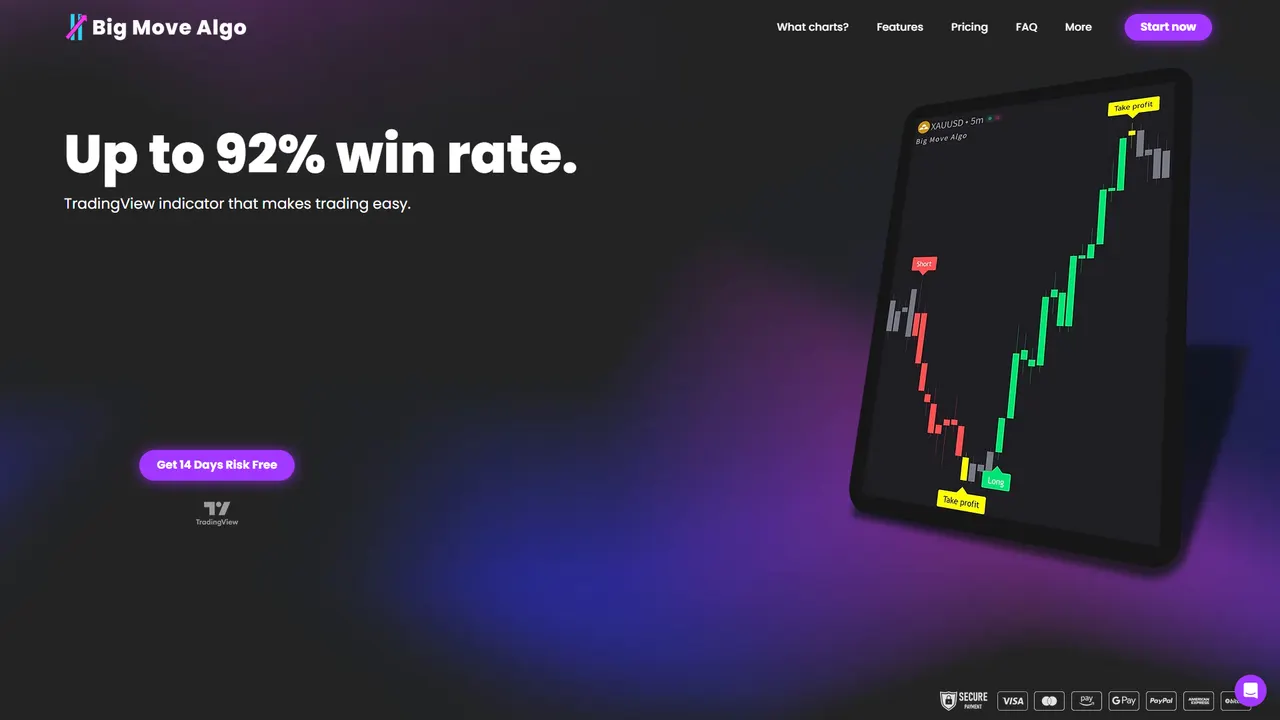
Big Move Algo gives you Long, Short and Exit signals, AUTO and Manual modes and the Fake Trend Detector in one TradingView indicator. Access is instant after payment, which is processed through Stripe.
Plans, as published on our pricing page:
| Plan | Monthly | Annual |
|---|---|---|
| Version 2 | $55 per month | $660 per year |
| Version 3 | $64 per month | $768 per year |
| Version 3 Plus | $79 per month | $948 per year |
Pick a plan on the Big Move Algo site and have the indicator on your chart in minutes.
FAQ
What is the best trend-following indicator for beginners?
Start with a 50-period moving average and ADX. The average shows direction and ADX tells you whether the trend is strong enough to bother with. If you want that judgment handled for you, Big Move Algo’s AUTO Mode needs minimal setup and prints Long, Short and Exit signals.
Which trend-following indicators are free on TradingView?
Supertrend, EMA crossovers, MACD, RSI, ATR, VWAP and Volume Profile are listed among the free TradingView tools. Third-party indicators such as Big Move Algo are added on top and are paid by subscription.
How do I avoid false signals in a sideways market?
Check trend strength first. ADX below 20 suggests no trend, and tangled, flat moving averages point to a range. Our Fake Trend Detector is designed to filter out low-quality conditions in the same spirit.
How big should a daily loss limit be?
There is no universal figure. Choose an amount you could lose repeatedly without changing how you trade, and set it in your platform so it is enforced automatically. Allow for slippage, since a market order can fill beyond the limit.
Sources
- Which Trend Is Your Friend? (Levine and Pedersen, 2016)
- Graham Capital Trend-Following Primer, January 2022
- Investopedia: The Four Key Indicators for Trend Trading
- Fidelity: Understanding Indicators in Technical Analysis
- IG: Trend trading, a beginner’s guide
- Best TradingView Indicators for Futures Trading (2026)
- Trend vs Range Trading: Matching Tools to the Market Regime
- Schwab: Choosing Technical Indicators to Analyze Stocks
- John Murphy’s Ten Laws of Technical Trading
- NinjaTrader: Risk Settings
- FundingPips: Understanding Trading Mechanics
- Trading cuantitativo: tecnología real o gancho para estafas