Crypto Futures Signals: How to Compare Your Options in 2026

Crypto futures signals come in three main forms: messages from Telegram or Discord groups, signal apps and feeds, and indicator-based signals that run on your own charts. For most U.S. retail traders who want clear Long, Short and Exit calls without waiting on a stranger’s message, a TradingView indicator like Big Move Algo is the most structured of the three. Below we compare all three on the criteria that matter: what you get in each signal, how it arrives, what it costs, and how you can check it before you put money behind it.
TL;DR
- A futures signal normally gives you an asset, an entry, take-profit targets and a stop-loss. Some add leverage and timeframe.
- Options fall into three groups: chat-room callers, signal apps and feeds, and chart-based indicators.
- Chart-based signals show up on your own screen in real time, so you are not racing a group of followers to the entry.
- Big Move Algo plans run from $55 per month (Version 2) to $948 per year (Version 3 Plus).
- Whatever you choose, size every trade by the stop-loss distance and verify the provider’s claims on your own charts first.
Table of Contents
- What a crypto futures signal actually contains
- How signals are generated and delivered
- The three kinds of crypto futures signal services
- Big Move Algo: Long, Short and Exit on your own chart
- Side-by-side comparison
- Perspective
- How to vet any crypto futures signal before you use it
- Which option fits which trader
- Start with Big Move Algo
- FAQ
- Sources
What a crypto futures signal actually contains
A signal is a trade suggestion. According to Kraken’s educational page on crypto signals, it typically names the asset, a suggested entry price, take-profit targets and stop-loss levels. Some also include leverage suggestions, the reasoning behind the trade and a timeframe.
For futures, two things matter more than they do in spot trading:
- Direction. Futures let you go long or short, so a good signal says which, and says when to close.
- Leverage. A signal that suggests leverage is telling you how large the exposure is relative to your margin. A small move against you hurts more at higher leverage, so the stop-loss placement is the real risk control.
Entries are often given as a zone, not a single price, because your fill may not land exactly on a round number. A useful habit: if price has already left the zone by the time you see the message, the signal’s setup no longer applies as written.
The stop-loss is the field that defines where the idea is wrong. A signal without one is a opinion, not a trade plan.
How signals are generated and delivered
Bitrue’s guide to futures signals describes three common sources: technical analysis (chart patterns, RSI, MACD), fundamental analysis (regulation, project news) and algorithmic or AI-based analysis. Delivery is often through Telegram, WhatsApp or Discord, and some signals can connect to copy-trading platforms for automatic execution.
That gives us a practical way to sort the market. The source of the signal matters less than three questions:
- Can you see the logic behind it?
- Does it reach you fast enough to act?
- Can you check its past calls independently?
The answers differ a lot by category.
The three kinds of crypto futures signal services
Telegram and Discord signal groups
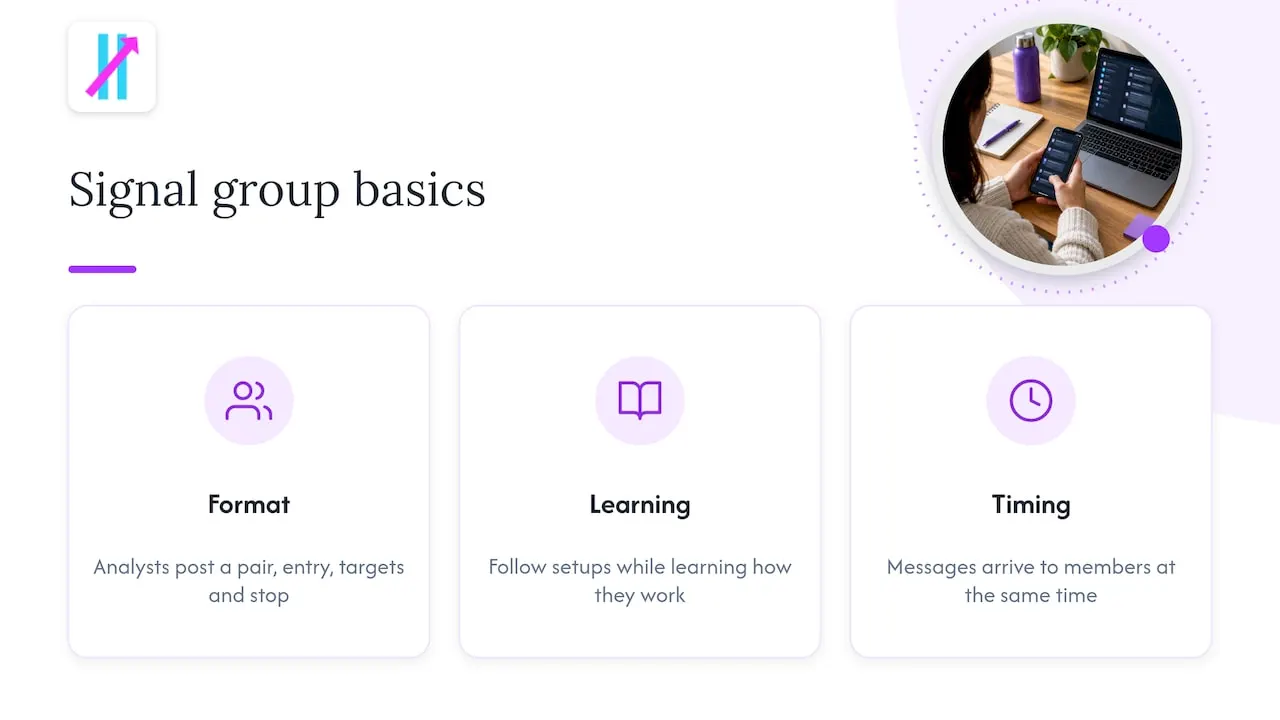
This is the category the search results lean on most. Roundups of the best crypto signal groups list services such as the Crypto Inner Circle, which is known for its focus on Binance futures. The format is simple: an analyst or team posts a pair, entry, targets and stop, and members copy it.
What works: low effort, and you can follow along while you learn how setups are structured.
What to plan for: you receive the message at the same moment as every other member. Kraken notes that crypto is extremely volatile and a signal’s value can degrade quickly, so reaction speed matters, and it advises against chasing the market. If price has run past the entry zone, the disciplined move is to skip that trade, not to jump in late.
Group pricing varies by provider and changes often, so check each group’s own page for the current fee and terms.
Signal apps and feeds
Apps on mobile stores and feeds that plug into automation platforms promise AI-powered spot and futures signals. Some feeds are free to subscribe to and limit how often they publish. Others sit behind a subscription.
What works: push notifications, and in some cases a path to automation through a bot platform.
What to plan for: the logic is usually a black box. Most providers state that signals are informational and educational, that trading carries substantial risk of loss and that past performance does not predict future results. Treat that as the baseline for the entire category, and use the checks later in this guide.
Chart-based indicators on TradingView
The third group works differently. Instead of a message from someone else, an indicator reads the market in real time and prints the signal directly on your chart. You see the same candles the indicator sees, which means you can judge a signal in context before you act.
This is the category where Big Move Algo sits.
Big Move Algo: Long, Short and Exit on your own chart
Big Move Algo is our proprietary TradingView indicator. It analyzes markets in real time and gives three clear outputs: Long, Short and Exit. It works across crypto, forex, stocks, indices and commodities, so a trader who watches Bitcoin and Ether in the morning and an index in the afternoon uses one tool.
Here is how we designed it to help with the problems that futures traders raise most often:
- Clarity. Three signal types, not a wall of settings. The goal is to remove guesswork and emotional decision-making.
- Two modes. AUTO Mode needs minimal setup so you can start quickly. Manual Mode gives experienced traders more customization.
- Fake Trend Detector. Built to filter out low-quality or misleading market conditions where trading may not be recommended. For futures, where chop plus leverage is a costly mix, that filter is the feature we would point to first.
- No repainting. Signals are built so they do not rewrite themselves after the fact, which matters when you review past calls.
- Alerts and automation. Alerts can be delivered to multiple platforms, and the indicator can be integrated with automated trading platforms. If you want alerts in your chat app, see our walkthrough on sending TradingView alerts to Telegram. If you plan to connect a bot, read how to send alerts to a bot without duplicate trades.
- Access. Unlimited devices, free updates and instant access after purchase, with payments processed by Stripe.
Big Move Algo is for TradingView users. If you do not use TradingView, it is not the right fit.
Big Move Algo pricing
These are the plans as published on our site in 2026:
| Plan | Monthly | Annual |
|---|---|---|
| Version 2 | $55 | $660 |
| Version 3 | $64 | $768 |
| Version 3 Plus | $79 | $948 |
If you plan to trade for a full year, the annual price lets you commit once and stay focused on trading instead of renewals.
Side-by-side comparison
| Criterion | Telegram/Discord groups | Signal apps and feeds | TradingView indicator (Big Move Algo) |
|---|---|---|---|
| What you receive | Pair, entry, targets, stop in a message | Push alerts or feed entries | Long, Short, Exit on your chart |
| Speed to you | Same time as all members | Depends on app and feed | Real time, as the chart updates |
| Can you see the logic | Often only the analyst’s notes | Often limited | Yes, on the same candles you trade |
| Customization | None | Limited | AUTO and Manual modes |
| Markets | Mostly crypto | Mostly crypto | Crypto, forex, stocks, indices, commodities |
| Automation path | Copy-trading in some cases | Bot platforms in some cases | Alerts to multiple platforms, automated platform integration |
| Pricing | Set by each group | Free to paid, set by each provider | $55 to $79 per month, $660 to $948 per year |
The row that decides it for many traders is the third one. When you can look at the chart that produced the signal, you stay the decision maker.
Perspective
We built Big Move Algo because we kept seeing the same pattern among retail traders. They did not lack information. They had too much of it: dozens of indicators, several chat rooms, a stack of conflicting opinions. Then a fast futures market punished the hesitation.
Our view is that a signal should do one job: tell you plainly whether the setup favors Long, Short or Exit, and tell you when to stay out. That is why we put so much weight on the Fake Trend Detector. Knowing when not to trade is part of a structured system, and it is the part emotional traders skip.
We also think the signal belongs on your chart, not in a message that arrives after the move has started. In AUTO Mode a newer trader can start quickly with minimal setup. In Manual Mode an experienced trader can shape the tool around their own style. The goal in both cases is the same: simple, structured decisions.
Steven Hartwell
How to vet any crypto futures signal before you use it
This part applies to every option, including ours. The aim is to learn how a signal behaves before real money depends on it.
- Read the full signal. Does it give an entry (or zone), a target and a stop-loss? Can you tell where the idea is invalidated? Our guide on how to verify a trading signal before entering a trade walks through this check by check.
- Compare signals to the chart, not to a screenshot. Screenshots of winners are easy to pick. Replay or review past signals on the actual chart. With a non-repainting indicator, what you see is what was shown at the time.
- Check timing. Ask how long after the move a signal reaches you. Kraken’s point that a signal’s value can degrade fast applies to every delivery method.
- Log your own results. Keep a simple record of each signal, your entry, exit and result for several weeks. Your log is the only performance record that is fully yours.
- Start small. Use a size where a stop-out is a minor event. Futures with leverage can lose more quickly than spot positions, so the stop-loss distance should decide your position size, not your enthusiasm.
Fees and U.S. considerations
Three cost layers sit on top of any signal: the signal subscription itself, exchange trading fees and funding costs on perpetual positions. Confirm current fee schedules on your exchange’s own page. Also confirm that the exchange or platform you plan to use for crypto derivatives is available to U.S. residents, since availability differs by platform and can change. Taxes on crypto trading gains are a separate matter, and a qualified tax professional can tell you how your trades are treated.
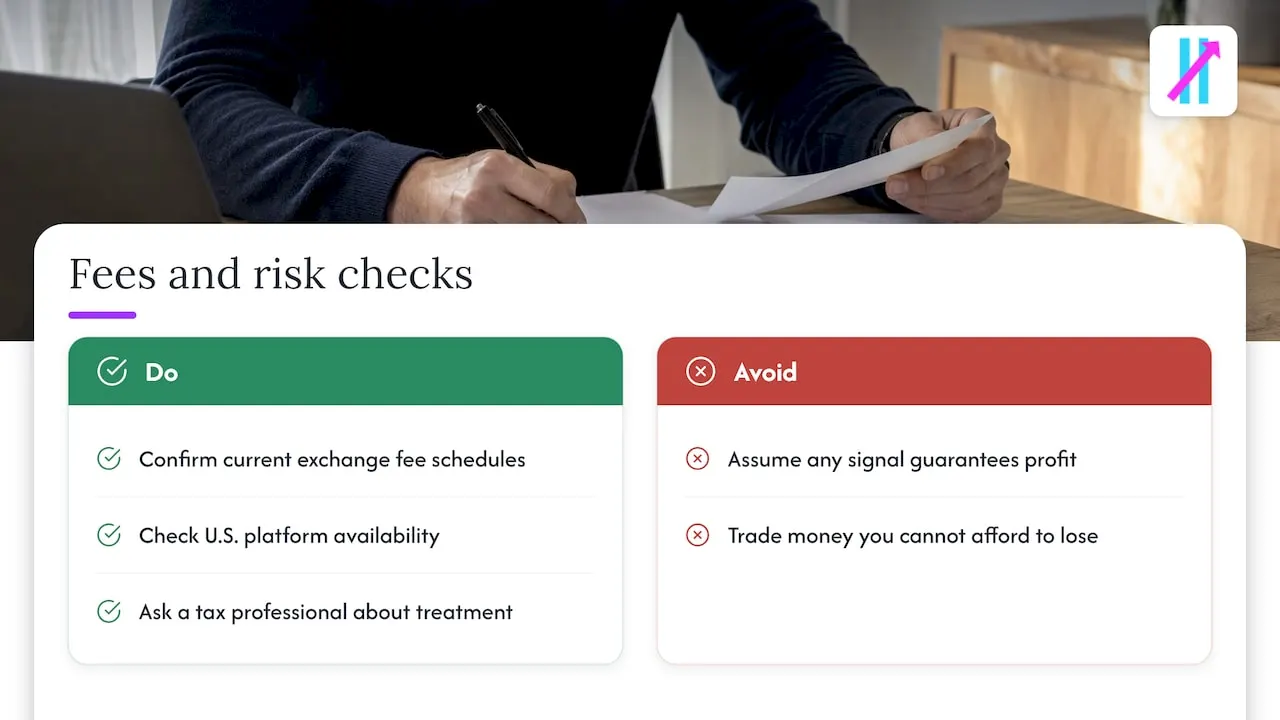
No signal, ours included, guarantees profit. Futures trading carries substantial risk of loss, and you should only trade with money you can afford to lose.
Which option fits which trader
- You are new to futures and want structure: a chart-based indicator in AUTO Mode keeps the number of decisions low. Pair it with our guide to getting clear long and short trading signals.
- You are an active day trader: real-time signals on your chart fit the pace. See our real-time guide for day trading signals.
- You want to automate: alerts that feed an automated platform remove manual order entry. Read the duplicate-trade guide linked above before you connect anything.
- You trade more than crypto: one indicator covering crypto, forex, stocks, indices and commodities means one workflow. Our piece on indices trading signals shows how that carries over.
- You like following a human caller: a chat group can work, as long as you skip trades when you arrive late and apply the same vetting steps.
For a wider view of the approach, our articles on the benefits of signal-based crypto trading and the U.S. crypto trading signal strategy go further.
Start with Big Move Algo
If you already use TradingView, you can have Long, Short and Exit signals on your charts right after purchase. Access is instant, it works on unlimited devices and updates are free. Choose Version 2 at $55 per month, Version 3 at $64 per month or Version 3 Plus at $79 per month, or take an annual plan at $660, $768 or $948.
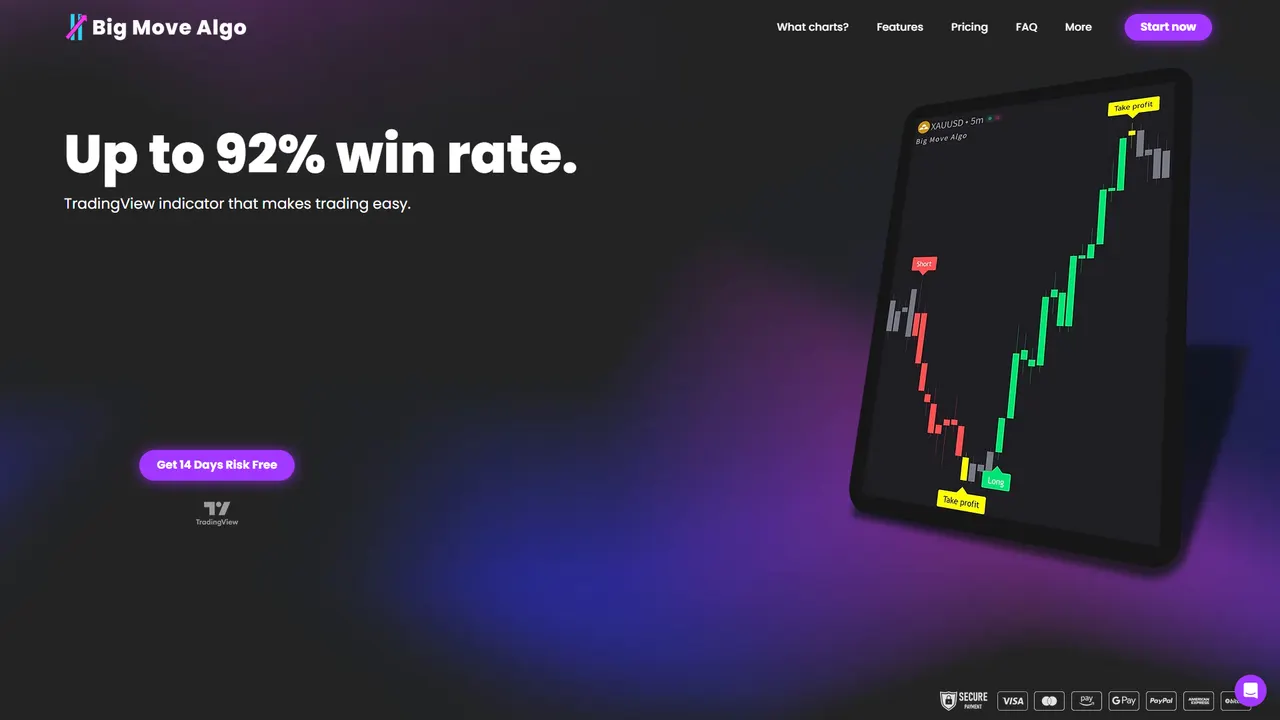
See the plans on the Big Move Algo site and pick the version that matches how you trade.
FAQ
What is a crypto futures signal?
It is a trade suggestion that names an asset, a direction, an entry, take-profit targets and a stop-loss. Some signals add leverage and timeframe. You decide whether to act and how large to trade.
How are futures signals delivered?
Commonly through Telegram, WhatsApp or Discord, and sometimes through copy-trading platforms. Chart-based indicators like Big Move Algo show the signal on your TradingView chart and can send alerts to multiple platforms.
Are free crypto futures signals worth using?
Free feeds can help you study how signals are structured. Apply the same checks you would to a paid one: a stop-loss on every call, a review of past calls on the chart and a small test size. Providers also commonly state that their signals are informational only and not financial advice.
How much leverage should a beginner use with signals?
A signal’s leverage suggestion is only a suggestion. Many beginners choose low leverage and size positions by how much they can lose if the stop is hit. A licensed financial professional can help you set limits for your own situation.
Can Big Move Algo be used for crypto futures?
Big Move Algo gives Long, Short and Exit signals on crypto markets inside TradingView, and it can integrate with automated trading platforms. You choose the exchange and the instruments you trade, and you manage your own risk.
Sources
- What are crypto signals? (Kraken)
- Crypto Futures Trading Signals: What They Are and How to Use Them (Bitrue)