US Crypto Trading Signal Strategy 2026 Guide

A US crypto trading signal strategy in 2026 is defined as a regulatory-aware, systematic method for generating and acting on buy, sell, or exit triggers in crypto markets under current SEC and CFTC frameworks. This is the industry-standard term: “signal-based trading strategy,” applied specifically to the US retail market. The stakes are higher than ever. The SEC and CFTC both issued major guidance in early 2026, reshaping which platforms, products, and signal types are legally accessible to retail traders. Whether you use breakout signals, scalping alerts, or automated execution, the rules governing your trades have changed. This guide covers what you need to know to trade smarter and stay compliant.
How do 2026 US regulations shape crypto signal strategies?
The regulatory environment for US crypto signal strategies shifted materially in the first quarter of 2026. The SEC issued an interpretive release effective March 23, 2026, clarifying how federal securities laws apply to specific crypto assets and transactions. This release directly affects which tokens your signal strategy can legally target, since assets classified as securities require trading on registered venues. Signal providers who make broad claims about applicability across all tokens now face real legal exposure under this guidance.
The CFTC moved in parallel. Following its December 2025 Crypto Sprint, the agency clarified that leveraged retail spot crypto transactions must generally occur on CFTC-registered exchanges, with limited exceptions for SEC-registered venues. This matters enormously for traders running signal strategies that involve margin or leverage. If your signal fires on a platform that does not meet these requirements, executing the trade puts you outside the regulated structure.
The CFTC also issued FAQs on March 20, 2026, clarifying that crypto assets as margin collateral are permitted under strict conditions. Bitcoin, ether, and certain stablecoins qualify, but only with pre-notice filings and specific risk controls in place. For retail traders using leveraged signal strategies, this means your broker’s collateral structure is now a compliance variable, not just a financial one.
Key compliance checkpoints for US retail traders in 2026:
- Confirm your trading platform is registered with the CFTC or SEC before executing leveraged signals
- Verify that the tokens your signals target are not classified as unregistered securities under the March 2026 SEC release
- Check that your broker’s margin collateral structure aligns with CFTC FAQ guidance on bitcoin, ether, and stablecoin use
- Separate your spot trading activity from leveraged products, since different regulatory regimes apply to each
Pro Tip: Before subscribing to any signal service, ask whether their signals are designed for spot or leveraged products. The answer determines which regulatory framework governs your execution, and that affects your platform choice, not just your risk tolerance.
What are the most effective crypto signal types for US traders?
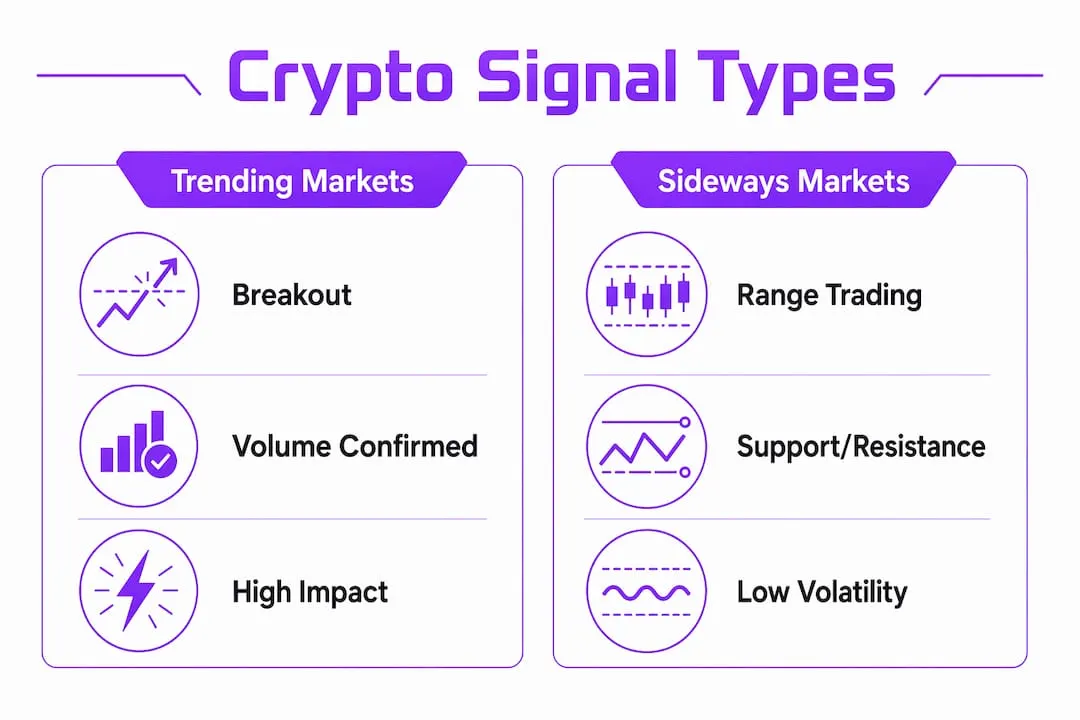
Signal-based trading strategies fall into three core archetypes, and each performs differently depending on market conditions. According to KuCoin’s 2026 day trading overview, the three primary intraday signal types are scalping, range trading, and breakout trading. Each has a distinct risk profile and execution requirement.

Breakout signals fire when price moves decisively above resistance or below support. The critical filter here is volume confirmation. Without a volume spike confirming the move, breakout signals are prone to fakeouts, where price briefly crosses a level and reverses. This is the most common reason traders lose money on breakout strategies. Volume confirmation is not optional; it is the signal’s validity test.
Scalping signals target small price movements across multiple trades per session. They require tight spreads, fast execution, and strict stop-loss placement. Scalping works best in high-liquidity conditions and becomes dangerous in low-volume or news-driven markets where spreads widen unpredictably.
Range trading signals identify support and resistance bands and trigger entries near the edges. They perform well in sideways markets but generate false signals during trending conditions. The key discipline is recognizing when the market has transitioned out of range behavior before the signal fires.
| Signal type | Best market condition | Primary risk | Key filter |
|---|---|---|---|
| Breakout | Trending, high momentum | Fakeouts without volume | Volume confirmation required |
| Scalping | High liquidity, low volatility | Spread widening, overtrading | Tight stop-loss, fast execution |
| Range trading | Sideways, defined bands | False signals in trends | Regime identification first |
| Automated signals | Any, with defined rules | Magnified errors if poorly specified | Signal testing and stop-loss rules |
Aligning your signal type to the current market regime is the single most important execution decision you make. Strategies tied to prevailing market conditions consistently outperform fixed directional predictions. A breakout signal in a range-bound market is not a signal. It is noise.
Pro Tip: Before placing any trade, classify the current market as trending, ranging, or transitioning. This single step eliminates a large percentage of low-quality signal entries before they cost you capital.
What tools and workflows support implementing crypto signals effectively?
Executing a signal strategy well requires more than a good signal source. You need a structured workflow that covers monitoring, testing, execution, and review. Here is a practical sequence for US retail traders building a signal execution system in 2026.
- Set up TradingView alerts for your chosen signal criteria. TradingView supports price-level alerts, indicator-based alerts, and webhook connections to execution platforms. This removes the need to watch charts manually and reduces emotional interference.
- Test your signal specification on at least 30 historical setups before trading live. Identify the win rate, average risk-to-reward ratio, and the conditions under which the signal fails most often. This is not optional for automated execution.
- Define your invalidation rule before every trade. An invalidation rule is the specific condition that tells you the signal is no longer valid. For breakout signals, a close back below the breakout level is a standard invalidation. Without this rule, you hold losing trades longer than the signal ever justified.
- Apply a volume filter to every breakout signal. If volume at the breakout candle is below the 20-period average, the signal does not qualify. This single filter eliminates the majority of fakeout entries.
- Set stop-loss orders at the platform level, not just in your head. Automated execution magnifies errors when signals are poorly specified, and a hard stop-loss at the exchange level is the only reliable protection against runaway losses.
Beyond the workflow steps, two additional practices separate disciplined traders from reactive ones:
- Use a signal quality checklist that includes entry criteria, regime filter, volume confirmation, and invalidation rule before every trade. Experienced traders codify these rules to prevent discretionary drift under pressure.
- Review your signal performance weekly, not just when you lose. Patterns in your losing trades reveal whether the problem is signal quality, execution timing, or regime misalignment.
How to avoid common mistakes in US crypto signal execution
The most expensive mistake in signal-based trading is automating a signal you have not tested. Automated execution does not fix a bad signal. It scales the damage. This is the most consistent finding across 2026 reviews of crypto trading bots and signal services.
The second most common error is ignoring the regulatory venue constraint. A signal that fires on a leveraged product on an unregistered platform is not just a bad trade. It is a compliance risk. US retail traders need to treat platform registration as a precondition for execution, not an afterthought.
Common execution pitfalls to eliminate from your workflow:
- Entering breakout trades without volume confirmation, which produces fakeout losses at a high rate
- Ignoring regime filters and trading range signals in trending markets or vice versa
- Overtrading by acting on every signal regardless of quality score or market condition
- Skipping stop-loss placement because the setup “looks strong”
- Using signal services that make broad token applicability claims without addressing the SEC’s 2026 security classification guidance
“The best signal strategy is the one you can execute consistently without second-guessing. Discipline in execution beats brilliance in signal design every time.”
Pro Tip: Run a monthly audit of your last 20 trades. Categorize each loss by cause: bad signal, bad execution, wrong regime, or regulatory venue issue. The category with the most losses tells you exactly where to focus your improvement effort.
Adapting to changing market conditions is not a soft skill. It is a technical requirement. A signal strategy that worked in a trending Q1 market will underperform in a ranging Q2 market unless you update your regime filter. Build a review cycle into your trading process, not just a reaction to drawdowns.
Key takeaways
A compliant, regime-aware US crypto trading signal strategy in 2026 requires combining SEC and CFTC regulatory knowledge with disciplined signal selection, volume-confirmed execution, and hard stop-loss rules.
| Point | Details |
|---|---|
| Regulatory compliance first | Confirm platform registration and token classification before executing any signal strategy. |
| Match signals to market regime | Breakout, scalping, and range signals each require specific market conditions to perform reliably. |
| Volume confirmation is mandatory | Breakout signals without volume confirmation produce fakeouts at a high rate and should be filtered out. |
| Automate only tested signals | Automated execution scales errors; test every signal specification on historical data before going live. |
| Review performance regularly | Weekly trade reviews by loss category reveal whether the problem is signal quality, execution, or regime mismatch. |
Why most US traders underestimate the regulatory layer in 2026
Most retail traders I talk to treat regulation as someone else’s problem. They focus on signal quality, win rates, and entry timing, then discover mid-trade that their platform does not meet CFTC registration requirements for the leveraged product they just entered. That is not a trading problem. That is a structural problem, and no signal strategy fixes it.
What I have found working with traders building signal systems in 2026 is that the ones who perform best treat regulatory compliance as part of their signal specification, not a separate concern. They know whether their signal targets a spot or leveraged product. They know which exchange is registered for that product. They know whether the token is classified as a security under the March 2026 SEC release. That knowledge is built into their workflow before the signal fires.
The second thing I have learned is that the traders who combine manual regime identification with automated signal execution consistently outperform those who go fully automated or fully manual. Full automation without regime filters generates overtrading. Full manual trading without automation generates emotional entries. The combination, where you identify the regime manually and let the system execute within it, is where the real edge lives.
My advice for US retail traders entering the crypto signal environment in 2026 is straightforward. Start with spot products on registered platforms. Test your signal specification before automating it. Build your stop-loss and invalidation rules before your entry rules. And treat the SEC and CFTC guidance not as obstacles but as the structure that makes compliant, sustainable trading possible.
— Big
How Bigmovealgo helps you execute better crypto signals in 2026
Bigmovealgo is built for exactly the kind of disciplined, signal-based trading this article describes. The platform delivers up to 92% win rate signals directly on TradingView, with clear Long, Short, and Exit labels that remove guesswork from execution. The built-in Fake Trend Detector filters out low-quality market conditions automatically, which addresses the regime-alignment problem most retail traders struggle with.

For traders who want to automate their signal execution, Bigmovealgo’s automation workflow guide walks you through connecting signals to execution without losing the stop-loss and invalidation discipline the strategy requires. The risk management tools built into Big Move Guard add another layer of protection for leveraged and spot positions alike. If you are ready to apply a structured signal strategy to the 2026 US crypto market, explore the plans and pricing to find the right fit.
FAQ
What is a crypto trading signal strategy?
A crypto trading signal strategy is a defined system for generating and acting on buy, sell, or exit triggers in crypto markets based on technical, volume, or algorithmic criteria. In the US, compliant execution requires aligning signal types with registered trading venues under SEC and CFTC frameworks.
How do SEC and CFTC rules affect my signal strategy in 2026?
The SEC’s March 2026 interpretive release determines which tokens can be legally traded as non-securities, while CFTC guidance requires leveraged retail spot crypto to execute on registered exchanges. Both frameworks directly shape which platforms and products your signal strategy can target.
What is the best signal type for US crypto traders in 2026?
The best signal type depends on the current market regime. Breakout signals work in trending markets with volume confirmation, range signals work in sideways conditions, and scalping signals require high liquidity. Matching signal type to regime is more important than the signal type itself.
How do I avoid fakeouts in breakout signal trading?
Volume confirmation is the primary filter for fakeouts. If the breakout candle does not show volume above the 20-period average, the signal does not qualify as a valid breakout entry. This filter eliminates the majority of false breakout signals before they generate losses.
Is automated crypto signal trading safe for US retail traders?
Automated execution is safe only when the underlying signal has been tested on historical data and includes hard stop-loss and invalidation rules. Automating an untested or poorly specified signal scales errors rather than profits, which is the most consistent risk identified in 2026 crypto bot reviews.