Entry Checklist for Trading: 8 Checks Before You Click Buy

A good entry checklist is eight yes-or-no questions you answer before every order: is the setup valid, is there a trigger, where is the idea wrong, how big can the position be, is the reward worth the risk, can the order fill, is anything scheduled that can break the trade, and have you written it down. If any answer is no, you skip the trade. We built Big Move Algo around the same idea, which is why its Long, Short and Exit signals and its Fake Trend Detector give you a structured starting point for the first checks.
Below is the full checklist, the math behind the stop and size, how to adapt it to day trading, swing trading, forex and crypto, and how to treat Ethereum trading signals.
TL;DR
- Run the same eight checks before every entry: setup, trigger, invalidation, size, risk-reward, execution, calendar, record.
- Place the stop where the idea is wrong, then calculate size from that distance. Never pick size first.
- Many disciplined traders require at least 2:1 reward to risk before they take a trade.
- A signal, from any tool, is one input. It still has to pass your stop, size and event checks.
- Write the plan down before the order. That is the simplest defense against impulsive entries.
Table of Contents
- The 8-point entry checklist
- Check 1: Is the setup real?
- Check 2: What is the trigger?
- Check 3: Where is the idea wrong?
- Check 4: Size the position last
- Check 5: Is the reward worth the risk?
- Check 6: Can the order actually be filled?
- Check 7: What is on the calendar?
- Check 8: Write it down
- Adapting the checklist to your style and market
- Ethereum trading signals: how to use them
- Where Big Move Algo fits
- Our perspective
- FAQ
- Sources
The 8-point entry checklist
Print this or paste it into your notes app. Each item is expanded in the sections that follow.
- Setup: Is this one of the setups I have defined, on the market and timeframe where I trade it?
- Trigger: What specific price action or signal says enter now, not just soon?
- Invalidation: At what exact price is the idea wrong?
- Size: Given that stop distance and my risk cap, how many shares, coins or contracts?
- Reward: Is there a logical target, and is the risk-reward ratio acceptable?
- Execution: Is the spread tight, is liquidity normal, and do I know my order type?
- Calendar: Are earnings, a major data release or a rate decision about to hit?
- Record: Have I written the plan, including my emotional state?
The structure is not exotic. Investopedia’s 5-step trade test asks for confluence in the setup, an entry trigger, a stop loss, a price target and a risk-reward ratio. A pre-trade sequence published by Tradeify adds sizing from the stop, execution costs and events, and a record of the decision. Our list merges them into one pass you can finish in under a minute once it is habit.
Check 1: Is the setup real?
A setup is a repeatable pattern you can describe in a sentence: “pullback to the 50-period average in an uptrend on the 4-hour chart,” or “breakout above a multi-week range on rising volume.” If you cannot describe it, you are guessing.
Confluence means several independent things agree. Investopedia’s test names trend, volume, volatility, technical patterns and macro context. You do not need all five every time, but you should know which two or three your setup requires and refuse trades that have only one.
Charles Schwab’s trade-plan guide gives examples of entry rules set before buying: a bounce off support, a breakout from resistance, or a close above the 200-day simple moving average. Pick rules like these, write them once, and reuse them.
One trap is trading a chart that does not match your rule. If your rule describes the daily chart, a 5-minute spike is not your setup, however exciting it looks.
Check 2: What is the trigger?
A setup tells you where to pay attention. A trigger tells you when to act. Mixing them up leads to early entries that sit through the whole pullback.
Good triggers are objective. Examples: a candle closes above a named level, price reclaims a moving average, or a signal on your indicator appears on a closed bar. Bad triggers are feelings: “it looks ready,” “it’s moving without me.”
This is where a signal tool earns its place. Big Move Algo is a TradingView indicator that gives Long, Short and Exit signals, so the trigger is a defined event on the chart rather than a judgment call made in the heat of the moment. Our indicator is designed not to repaint, which means a signal you saw on a closed bar is meant to stay where it appeared. For a step-by-step approach to confirming one, see our guide on signal confirmation rules and the 6-step entry confirmation rules.
Confirming with more than one timeframe
A common method is to let a higher timeframe set direction and a lower one time the entry. If you trade the 1-hour chart, check that the daily trend does not oppose you. Then confirm that volume and a nearby level support the trigger. The goal is not more indicators. It is to avoid buying a 1-hour bounce directly under a daily downtrend.
Check 3: Where is the idea wrong?
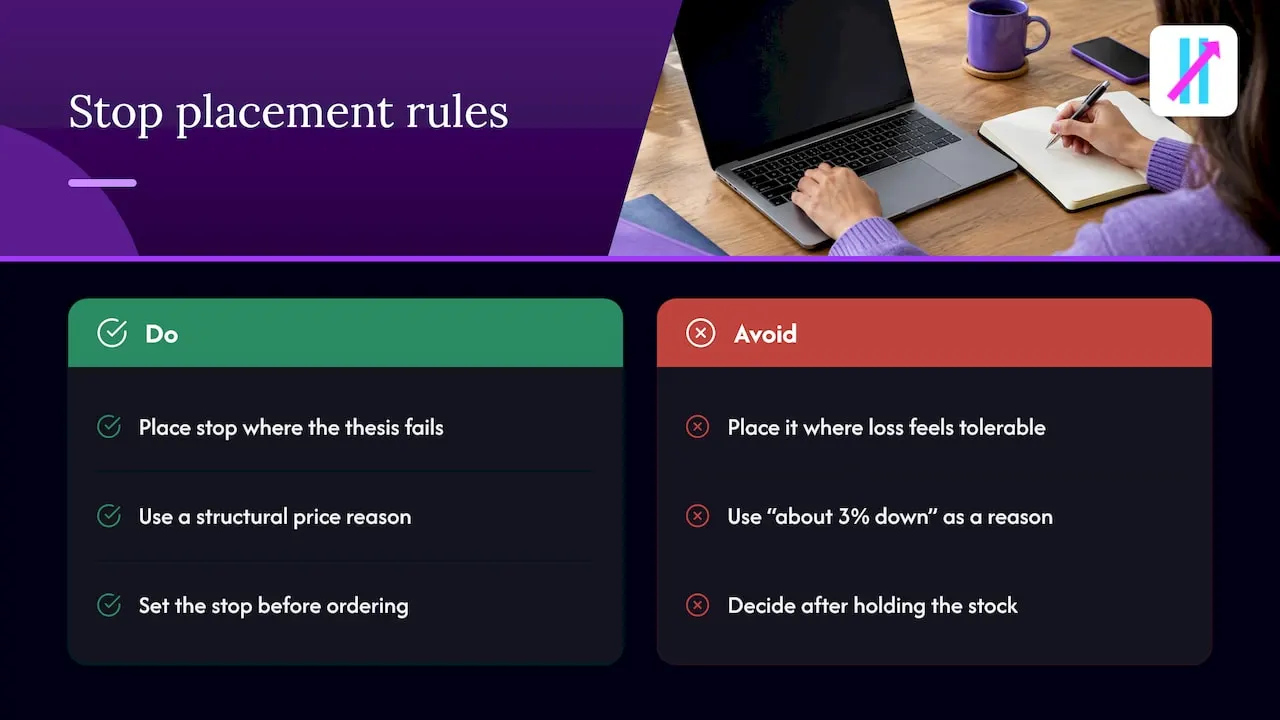
This is the most important line on the checklist. A stop belongs at the price where your thesis fails, not at the price where a loss feels tolerable.
ExtremeToMean frames it as placing the stop where you are wrong rather than where you are scared. A stop that is too close sits inside normal volatility and gets hit by noise. One that is too far lets the position live long after the idea has died.
TradeOlogy Academy’s pre-trade checklist asks for a specific price with a structural reason: for example, a stop at $138 below the most recent swing low, because a close under it breaks the uptrend structure. “About 3% down” is not a reason. A swing low, a broken level or a failed breakout is.
Set the stop before the order, not after. E*TRADE notes that deciding on your loss target only after you hold the stock lets emotions push you to hold too long and take a bigger loss.
Keep three ideas separate, as Traddictiv’s guide argues. Confirmation is the evidence needed to enter. Invalidation is the condition that makes the premise wrong. The objective is where the reward may be realized. Blend them and you get late entries, arbitrary stops and targets treated like promises.
Check 4: Size the position last
Beginners often choose a size first (“I’ll buy 500 shares”) and then place a stop that fits. That is backward. StockCharts calls it the biggest position-sizing mistake: the right sequence is setup, then the point where the thesis fails, then the distance to that point, and size last.
The formula is simple:
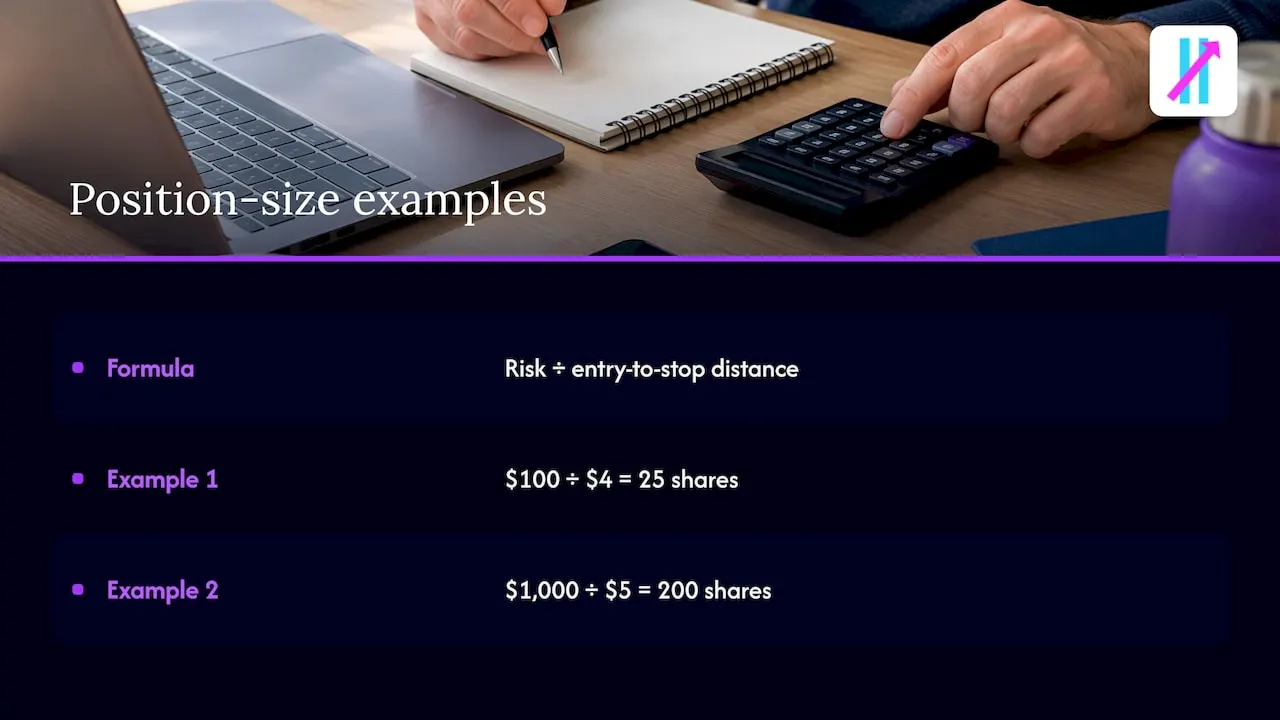
Position size = dollars you are willing to lose ÷ distance from entry to stop
Worked example, using the figures from TradeOlogy’s checklist: entry at $142, stop at $138, so the distance is $4. With a $10,000 account and a 1% risk cap, you risk $100. Size is $100 ÷ $4 = 25 shares. StockCharts shows the same math at a larger scale: a $50,000 account with a 2% cap risks $1,000, and with a $5 stop distance that is 200 shares.
If the structural stop is so far away that the correct size is tiny, the answer is a smaller position or no trade. Traddictiv says to reduce quantity or decline the trade rather than move the stop to make a preferred size fit. The correct size can be zero.
Two cautions for leveraged accounts. Margin is collateral, not risk: a position that fits your available margin can still lose far more than you intended. And fees, expected slippage and gaps belong in the calculation, because a stop order does not guarantee the exact exit price in fast markets.
Check 5: Is the reward worth the risk?
Before you enter, name a logical target: the next resistance, a prior swing high, a measured move. Then compare reward to risk.
Investopedia’s test notes that disciplined traders typically require a minimum 2:1 reward-to-risk ratio, for example risking $1 to gain $2.50. In our $4-risk example, a 2:1 trade needs a target at least $8 above entry, so $150 or higher. If the nearest obstacle is at $145, the trade does not pass, however good the setup looks.
Also decide how you will exit before you enter. Schwab’s guide stresses specifying in advance when and how you will close the position. With Big Move Algo, the Exit signal gives you a defined event for that part of the plan, and our article on a checklist-first range-bound strategy at 1:2 R:R shows how the reward-to-risk check fits into an automated rule.
Check 6: Can the order actually be filled?
A perfect plan fails on a bad fill. ChartMini’s pre-trade checklist suggests checking the bid-ask spread, liquidity, regular versus extended hours, whether your broker supports the order type, unusual volatility and trading halts.
The SEC’s Investor.gov guidance on online investing adds practical rules for US investors: know why you are buying or selling and the risk of the investment, use limit orders rather than market orders to avoid bad fills, and verify that an order executed before you re-enter it. It also warns that in a cash account, buying and selling before paying for the stock is freeriding, which violates Federal Reserve Regulation T and can lead to a 90-day account freeze.
Check 7: What is on the calendar?
Scheduled events can invalidate a clean setup in seconds. ChartMini lists earnings, CPI and employment reports, central-bank announcements and contract expirations. Look at the calendar before you enter, and decide whether you will hold through the event, reduce size, or wait. Holding through an event is a decision, not an accident.
Check 8: Write it down
The last check is the one that turns a checklist into a habit. Record the instrument, setup, trigger, stop, size, target and how you feel. IG notes that a trading diary can capture entry and exit points, reasoning and emotions, and that reviewing it helps surface patterns and weaknesses.
Writing forces specificity. If you cannot fill in the stop field, you are not ready. If your emotion field says “revenge,” you have found the problem before it cost you. We cover the practice in what a trading journal is and why it matters, and our guide to verifying a trading signal before entering shows what to log beside each signal.
Adapting the checklist to your style and market
The eight checks stay the same. The thresholds change.
| Style or market | Timeframes to check | What to tighten |
|---|---|---|
| Day trading stocks | Daily for direction, 5 to 15 minutes for entry | Spread, liquidity, regular vs extended hours, news at the open |
| Swing trading | Weekly or daily trend, 4-hour or daily entry | Earnings dates, gap risk overnight, wider stops with smaller size |
| Forex | Daily direction, 1-hour or 4-hour entry | Central-bank announcements, data releases, session overlaps |
| Crypto | Daily direction, 1-hour or 4-hour entry | Weekend liquidity, sharp volatility, exchange order types |
Big Move Algo works across crypto, forex, stocks, indices and commodities, so you can keep one checklist and one signal style as you move between markets. AUTO Mode needs minimal setup, and Manual Mode lets more experienced traders customize. Our Fake Trend Detector is designed to filter out low-quality or misleading market conditions where trading may not be recommended, which supports the setup check on days when nothing is worth taking. Our article on the 6 filter checklist for high-probability setups goes deeper on that screening step.
Ethereum trading signals: how to use them
Traders searching for Ethereum signals want a clear Long or Short on ETH. Treat any signal, ours included, as the trigger in check 2, not as the whole checklist. It still has to pass your invalidation, size, reward and calendar checks.
Three practical points for ETH specifically:
- Volatility is part of the sizing. The SEC’s investor bulletin on bitcoin and ether products calls both highly speculative investments and urges investors to consider price volatility. Wider swings mean wider stops, which means smaller size for the same dollar risk.
- Confirm on a higher timeframe. An ETH long signal on the 1-hour chart carries more weight when the daily trend agrees.
- Check the venue. The same bulletin notes that spot crypto trading platforms are not registered with the SEC. Know where your order will execute and which order types it supports.
Big Move Algo delivers alerts to multiple platforms and allows integration with automated trading platforms, so a signal on an ETH chart can reach you wherever you trade.
Where Big Move Algo fits
A checklist removes guesswork only if its first steps are fast and objective. Big Move Algo gives you a TradingView indicator with Long, Short and Exit signals, AUTO and Manual modes, a Fake Trend Detector, unlimited devices and free updates, with instant access after payment through Stripe.
Plans, as published on our site: Version 2 is $55 per month or $660 per year. Version 3 is $64 per month or $768 per year. Version 3 Plus is $79 per month or $948 per year. You can see all plans on the Big Move Algo site.
If you want the setup and trigger checks handled by a structured signal so your attention goes to stop, size and reward, that is what the indicator is for. Our entry signal templates show how to write each signal into a repeatable plan.
Our perspective
Most traders do not lose because they lack a strategy. They lose because the strategy gets renegotiated at the moment of entry, when the chart is moving and emotion is loudest.
That is why we built Big Move Algo around clarity. A Long, Short or Exit signal is a defined event, and a Fake Trend Detector that helps screen out poor conditions means fewer decisions made under pressure. AUTO Mode lets a newer trader start quickly with minimal setup, and Manual Mode gives experienced traders room to customize.
Our view is that a checklist and a signal tool work best together. The checklist enforces risk: stop, size, reward. The indicator makes the entry trigger consistent across crypto, forex, stocks, indices and commodities. Run both on every trade and the process becomes something you can review, rather than a mood you have to defend.
Steven Hartwell
FAQ
What should be on a pre-trade checklist?
At minimum: the setup, a specific entry trigger, a stop at the point where the idea is wrong, a position size derived from that stop, a target with an acceptable reward-to-risk ratio, execution conditions and upcoming events. Add a written record of the plan and your emotional state.
What risk-reward ratio should I require before entering?
Investopedia’s trade test says disciplined traders typically require at least 2:1, such as risking $1 to gain $2.50. Choose your minimum in advance and apply it to every trade, so the number is not negotiable when a setup looks exciting.
How much of my account should I risk per trade?
The sources above use examples of 1% and 2% of the account per trade. The right figure for you depends on your account and tolerance for loss, so write a cap into your plan and size every position from it. If you are unsure, a licensed financial adviser can help you set one.
Is a trading signal enough to enter a trade?
No. A signal is a trigger. Before you act, confirm the setup fits your rules, the higher timeframe does not oppose it, the stop and size are calculated and the calendar is clear. Big Move Algo’s signals are designed to give you a clear trigger so you can focus on those checks.
Can I use the same checklist for crypto and forex?
Yes. The eight checks do not change. Adjust the timeframes, the stop width and the calendar items: central-bank news matters most in forex, while volatility and venue matter most in crypto.
Sources
- Trade Smart: The 5-Step Approval Process, Investopedia
- Online Investing, Investor.gov
- Trade Setups and Confirmation Explained With Entry Timing, Tradeify
- Elements of a Smart Trade Plan, Charles Schwab
- Pre-Trade Checklist: 10 Questions Before Every Trade, ChartMini
- Risk-First Trading: Risk, Invalidation, and Stop Placement, ExtremeToMean
- The Pre-Trade Checklist, TradeOlogy Academy
- What to Know Before You Buy Stocks, E*TRADE
- Trade and Risk Management Guide, Traddictiv
- StockCharts Insider: Why Position Sizing Sometimes Matters More Than Stock Picking
- The Essential Trading Checklist, IG
- Exchange-Traded Products Providing Exposure to Bitcoin and Ether, Investor.gov