Forex Swing Signals: How to Compare Your Options

Forex swing signals come in three main forms for U.S. traders: free signal apps, paid signal groups, and indicators that run on your own charts. A signal is only useful if it gives you a direction, an entry, a stop and a target for a trade you can hold for days or weeks. For traders who already use TradingView, a rules-based indicator such as Big Move Algo is the option we think fits best, because the logic is visible on your chart and you control the alerts.
Below, we explain what a swing signal should contain, compare the options on the criteria that matter, settle the SMA vs EMA question that sits behind most signals, and show how to format alerts so they are clear enough to act on.
TL;DR
- A usable swing signal states the pair, direction, entry, stop-loss and take-profit, and the setup behind it.
- Free apps are easy to start with, signal groups hand you someone else’s calls, and a TradingView indicator lets you see and test the rules yourself.
- EMA reacts faster than SMA; neither is universally better, and swing traders often pair a faster and a slower average.
- U.S. retail forex leverage is capped at 50:1 on major pairs and 20:1 on others, so position size matters more than signal count.
- Big Move Algo gives Long, Short and Exit signals on TradingView, with plans at $55 per month, $64 per month or $79 per month.
Table of Contents
- What a forex swing signal should tell you
- The three kinds of forex swing signal sources
- How the options compare
- What to check before you pick a signal tool
- SMA vs EMA: what sits behind most swing signals
- Perspective
- From signal to alert: formatting it clearly
- Risk rules every U.S. forex trader should know
- Big Move Algo for forex swing trading
- A simple swing routine using signals
- FAQ
- Sources
What a forex swing signal should tell you
Swing trading means holding a currency pair for a few days to a few weeks. A swing signal is a trade recommendation built for that horizon. According to MonkeyTrade’s guide to swing signals, a proper signal specifies an entry price, a stop-loss and a take-profit, so you act on a defined plan rather than a vague opinion.
The same guide gives a well-formed example: long GBP/USD at 1.2650, stop 1.2580, target 1.2790. From those three numbers you can work out the plan. The risk is 70 pips, the reward is 140 pips, and the reward-to-risk ratio is 2:1. If a signal does not let you do that arithmetic, it is not finished.
FXStreet adds a useful distinction. A signal is a condition that validates the idea, tied to the setup, and it is separate from the trigger that tells you when and how to place the order. It also says a clear signal has objective invalidation criteria, for example a breakout that is void if price falls back into the range.
That gives you five things to look for in any swing signal:
- Pair and direction. Long or short, on which instrument.
- Entry condition. A price or an observable event, such as a candle close above a level.
- Stop-loss. Where the idea is proven wrong.
- Take-profit. One or more targets.
- Context. The timeframe and the reason the setup exists.
If you want a template for writing these out, our guide to clear entry signal templates walks through the format.
The three kinds of forex swing signal sources
Most searches for forex swing signals end up at one of three sources. They differ in who makes the decision, what you can inspect, and how the signal reaches you.
Free signal apps
Free mobile apps are the easiest entry point. One of the top results for this keyword is a free Forex Signals app on Google Play, which describes its signals as based on daily moving averages, pivot break points and technical analysis. The appeal is obvious: no cost and nothing to set up.
The tradeoff is that you receive a call without the working. You usually cannot change the inputs, test the rules on past data or route the alert into your own charting and execution setup. That matters for swing trading, where one position can stay open for weeks and you need to know why it was opened.
Paid signal groups
Chat-based groups send a post when a trade idea appears. The format varies by provider, and so does the quality. Some include entry, stop and target; others post a pair and a direction and leave the rest to you.
The weakness is dependency. You act on someone else’s timing, often with a delay between their post and your fill. You also inherit their risk choices. Before you pay any group, ask whether every signal includes a stop and a target, and whether you can see the full history of closed trades, not only the winners.
Indicators on your own charts
A TradingView indicator turns the analysis into signals directly on the chart, using rules that apply the same way to every candle. You see the signal form, you can scroll back through history and you can set alerts. For swing traders this is the option that most closely matches how a discretionary trader thinks, only with the repetitive part automated.
This is the category Big Move Algo belongs to. It is a proprietary TradingView indicator that analyzes markets in real time and prints Long, Short and Exit signals.
How the options compare
Here is how the three sources stack up on the criteria that matter for a swing trader.
| Criterion | Free signal app | Paid signal group | TradingView indicator (Big Move Algo) |
|---|---|---|---|
| Who decides the trade | The app | The provider | Rules on your chart |
| Can you see the logic on a chart | Rarely | No | Yes |
| Entry, stop and target | Varies | Varies | You set stop and target around the signal using your own risk rules |
| Exit guidance | Varies | Varies | Exit signal included |
| Markets | Mostly forex and crypto | Depends on the group | Crypto, forex, stocks, indices and commodities |
| Alert delivery | App notification | Chat message | TradingView alerts to multiple platforms |
| Automation | Usually none | Manual copying | Integration with automated trading platforms |
| Cost | Free | Varies by provider | $55, $64 or $79 per month, or annual plans |
The row that most traders underweight is the third one. When you can see the logic, you can learn from losing trades instead of only suffering them. That is the point of a structured system, and it is why we built Big Move Algo around visible signals rather than hidden calls.
What to check before you pick a signal tool
Whatever you choose, run it through the same checklist.
- Completeness. Does each signal include a direction, an invalidation level and an exit? If a tool only says buy, it is half a signal.
- No repainting. A signal that moves or disappears after the candle closes makes history look better than live trading. Ask whether signals are fixed once printed. Big Move Algo states that it does not repaint.
- Filtering of bad conditions. Swing setups fail most often in choppy, directionless markets. Big Move Algo includes a Fake Trend Detector designed to flag low-quality conditions where trading may not be recommended.
- Delivery. Swing trading does not need split-second alerts, but you do need the alert where you will see it. Big Move Algo delivers alerts to multiple platforms and works across unlimited devices.
- Setup time. Big Move Algo offers AUTO Mode with minimal setup, and Manual Mode for traders who want more customization.
- Your own confirmation step. No signal replaces a check. Our signal confirmation rules lay out six checks to run before entry, and how to verify a trading signal covers the same ground step by step.
SMA vs EMA: what sits behind most swing signals
Most swing signals, from free apps to paid indicators, lean on moving averages somewhere. So the SMA vs EMA question is worth settling.
A simple moving average (SMA) gives equal weight to each price in its lookback window. An exponential moving average (EMA) gives more weight to recent prices, so it reacts sooner. FXGlory describes the SMA as useful for a cleaner trend or location filter and the EMA for more responsive, shorter-term movement, and notes that neither is universally better. EBC Financial Group makes the same point about EMA reacting more quickly to changes.
| SMA | EMA | |
|---|---|---|
| Weighting | Equal across the window | Heavier on recent prices |
| Speed | Slower, smoother | Faster, more reactive |
| Typical swing use | Trend and location filter | Entry timing and shorter trend reads |
| Main risk | Late entries and exits | More false turns in choppy markets |
All moving averages lag, because they are built from past prices. A longer lookback lags more. That lag is not only a flaw: it can keep you out of early entries in messy conditions by forcing the market to confirm first.
How crossovers become entries and exits
EBC explains that a shorter average crossing above a longer one is often used as an upward entry signal, and the reverse for downside, and cautions that it is not foolproof and should be combined with other indicators. FXGlory adds that a pullback toward an average needs a separate candle or structure condition for entry, and that exit rules should be defined on their own.
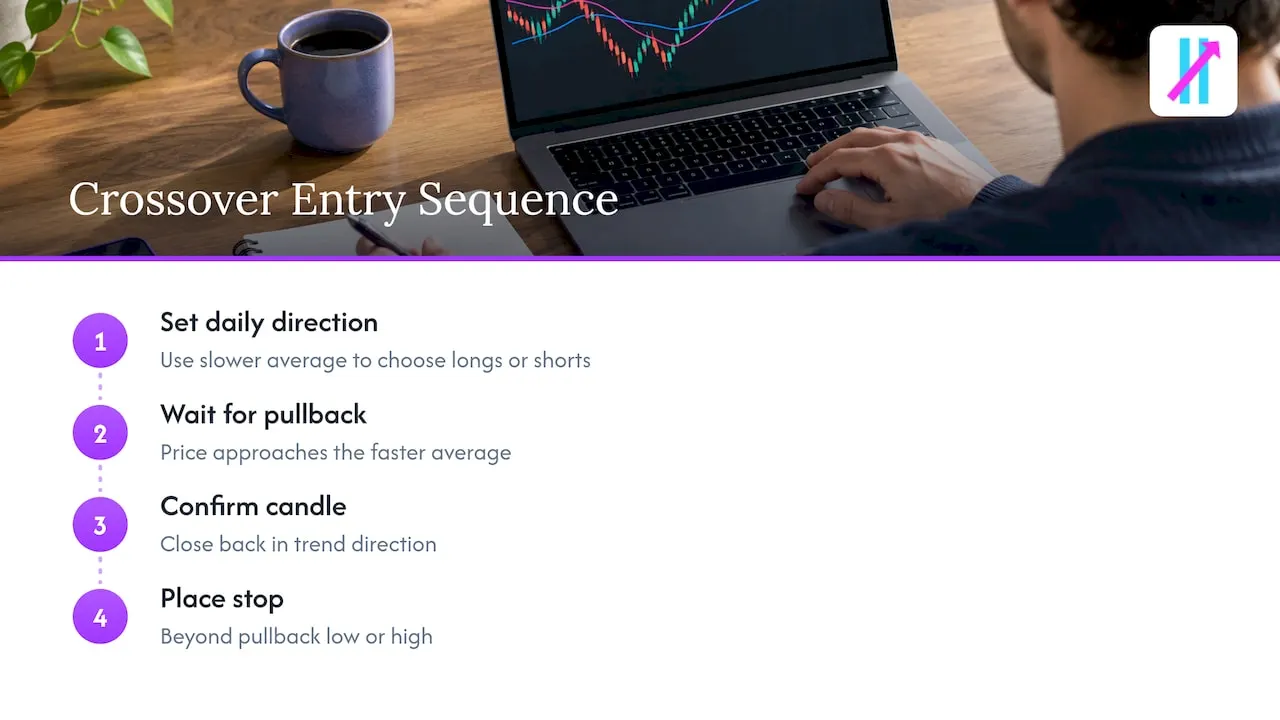
A practical swing example, in plain terms: use a slower average on the daily chart to decide whether you want longs or shorts at all, then wait for price to pull back toward a faster average and for a candle to close back in the trend direction. Place the stop beyond the pullback low or high. That is the same five-part structure as before, built from averages.
The weakness of any single crossover is the sideways market, where averages cross repeatedly and every cross loses a little. This is exactly the situation a trend-quality filter is meant for, and why we built the Fake Trend Detector into Big Move Algo. For a longer checklist, see our six-filter guide to high probability setups.
Perspective
We built Big Move Algo for the trader who knows what a good setup looks like but does not trust their own timing at 2 a.m. or after three losers in a row.
Swing trading is slower than scalping, but it is still decided by emotion at the moment of entry and, more often, at the moment of exit. Our view is that a signal tool earns its place by removing that guesswork. That means a clear Long, Short or Exit, a filter that says when to stand aside, and no settings maze between you and the chart.
That is why we offer AUTO Mode for a fast start and Manual Mode for traders who want to tune things later. We would rather you understand a few clear signals and apply them with discipline than collect a dozen overlapping tools. Used with sensible position sizing and a stop on every trade, a structured signal gives you something to follow and something to review.
Steven Hartwell
From signal to alert: formatting it clearly
A swing signal that only exists as a feeling on the chart does not help when you are away from your screen. Alerts fix that, but only if the message is readable.
Documentation for trade copiers gives a good baseline. Expert Advisor Pro’s copier documentation says the symbol and the operation, buy or sell, are required, while entry, stop-loss and take-profit are optional, with support for up to three take-profit levels. For human reading, treat the optional fields as mandatory.
A clear alert message for a swing trade looks like this:
- Pair: EUR/USD
- Action: Long
- Timeframe: Daily
- Entry: 1.0850
- Stop: 1.0780
- Target 1: 1.0990
- Invalid if: daily close below 1.0780
The numbers above are only a format illustration, not a trade idea.
If you send alerts into an execution tool, the format becomes stricter. TradeAdapter’s TradingView alert documentation lists fields such as ticker, order action, order price, stop loss and take profit for MetaTrader alerts. An InakaTrader guide on automating MT5 notes that TradingView alerts send a JSON payload with fields like symbol, action, volume, sl and tp. Each platform has its own required names, so copy the format from its documentation exactly.
For exit alerts, see our walkthrough of take profit alerts and automation, and for risk settings when you automate, automated trading risk controls for TradingView.
Risk rules every U.S. forex trader should know
Signals do not make a trade safe. Three facts shape how you should size and manage swing positions in the United States.
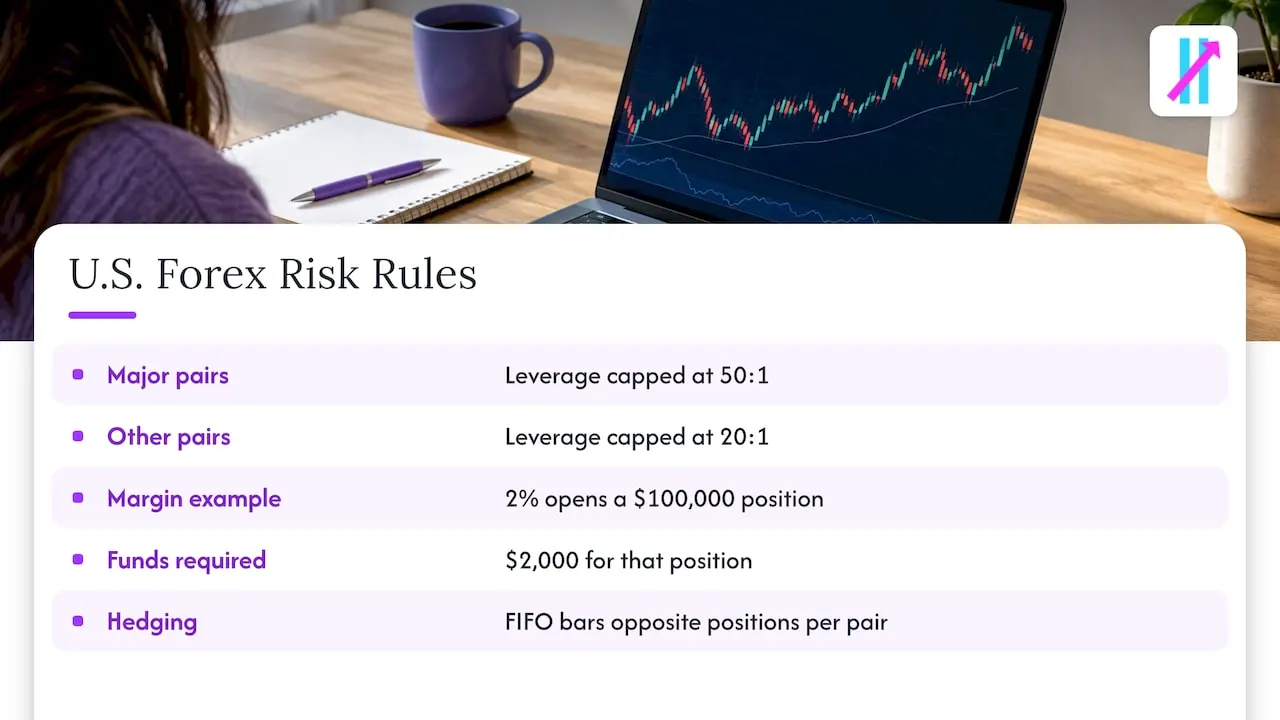
Leverage is capped. The CFTC’s retail forex rules, published August 30, 2010, limit leverage to 50:1 on major currencies and 20:1 on all others, as Investment Law Group describes. Invezz illustrates what that means: a 2% margin requirement lets you open a $100,000 position with $2,000, which magnifies gains and losses alike. A swing trade that moves against you for several days can hurt a heavily leveraged account quickly, so size the position from your stop distance, not from the maximum your broker allows.
Brokers may restrict hedging. According to FXBrokerTrust’s NFA overview, NFA rules require FIFO handling, which effectively prohibits holding long and short positions in the same pair at once. If you plan to take opposite signals on one pair, check how your broker treats it.
Always use a stop. The InakaTrader guide warns against running without stop losses and says relying on “let it ride” in backtests can destroy live accounts. It also recommends that automation include trailing stops, breakeven moves and partial take-profits. Those are good habits for manual swing trading too.
Forex trading carries a risk of loss, and a signal does not guarantee an outcome. If you are unsure how much of your account to risk per trade, talk to a licensed financial professional.
Big Move Algo for forex swing trading
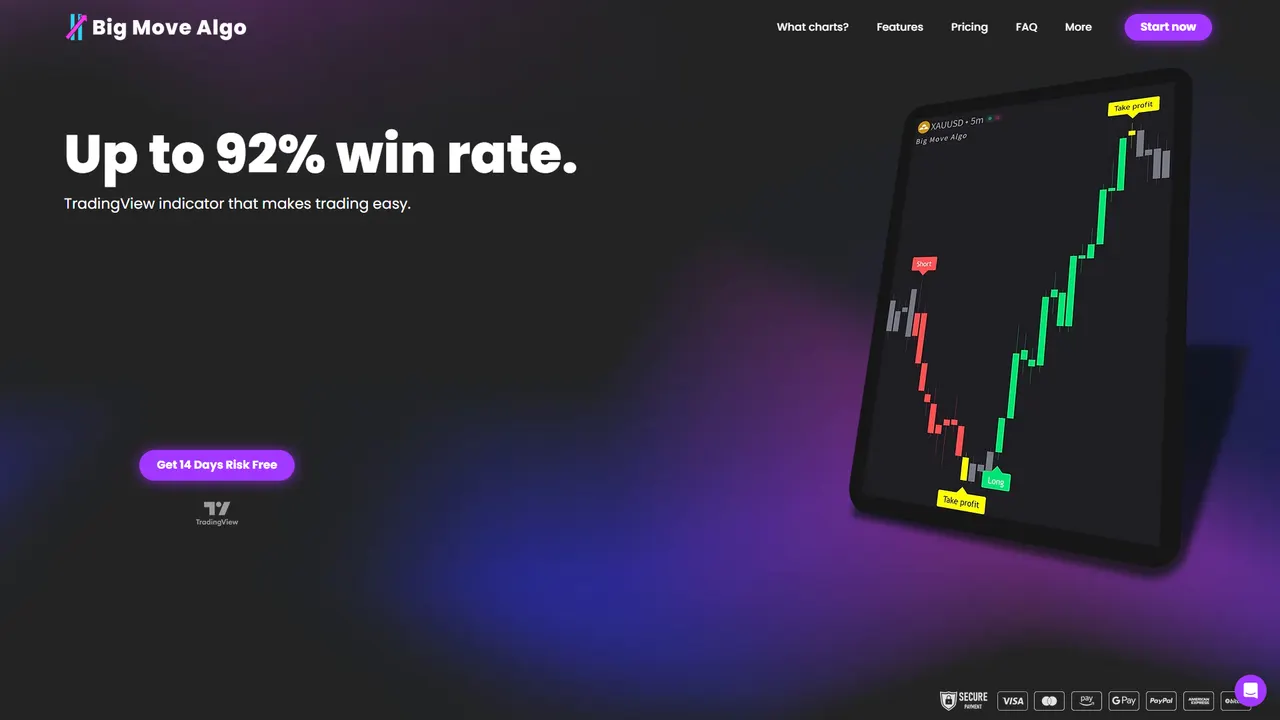
If you already chart on TradingView, Big Move Algo puts Long, Short and Exit signals on the same screen you already use. You can run it in AUTO Mode with minimal setup or switch to Manual Mode for more control. It covers forex alongside crypto, stocks, indices and commodities, so one subscription can follow your swing ideas across markets. Access is instant after purchase, payments run through Stripe, and updates are free.
Plans as published on our site:
| Plan | Monthly | Annual |
|---|---|---|
| Version 2 | $55 per month | $660 per year |
| Version 3 | $64 per month | $768 per year |
| Version 3 Plus | $79 per month | $948 per year |
You can compare the versions and subscribe on the Big Move Algo plans page. To learn how the signals read before you subscribe, start with our guide to getting clear Long and Short signals.
A simple swing routine using signals
Signals work best inside a repeatable routine. Here is one you can adapt.
- Set your timeframe. Many swing traders use the daily chart for direction and a lower timeframe for timing. Pick yours and stick with it.
- Wait for a signal and a confirmation. Treat the signal as a condition, then run your checks. Our entry confirmation rules give you six steps you can copy.
- Check volume if you trade instruments that report it. Our volume confirmation checklist shows one way to do it.
- Size from the stop. Decide the dollars you are willing to lose, then work backward to position size.
- Write the plan in the alert. Pair, direction, entry, stop, target and invalidation, so you can act when you are away from the screen.
- Review every closed trade. Note whether you followed the rules. That record is what improves your results over time.
FAQ
Are there free forex swing signals?
Yes. Free apps publish buy and sell signals, often built on moving averages and pivot levels. They are a low-cost way to see how signals look, but they usually cannot be customized or tested on your own charts. If you want visible logic and alerts you control, a TradingView indicator is the next step.
What time frame suits forex swing signals?
Swing trades are typically held from a few days to a few weeks, so the daily and four-hour charts are common choices. The right frame is the one you can check consistently without watching every tick. Pick one, and judge your signals on that frame only.
Is EMA or SMA better for swing signals?
Neither is universally better. EMA reacts sooner to recent price changes, while SMA is smoother and works well as a trend or location filter. Many traders use a slower average for direction and a faster one for timing, then add a separate confirmation step before entry.
How much does Big Move Algo cost?
Version 2 is $55 per month or $660 per year. Version 3 is $64 per month or $768 per year. Version 3 Plus is $79 per month or $948 per year. Current plans are listed on our plans page.
Sources
- MonkeyTrade: Forex Swing Trading Signals
- FXStreet: What does a trading signal look like?
- FXGlory: Moving Average Forex Strategy
- EBC Financial Group: How to Spot High-Probability Forex Swing Trading Signals
- Expert Advisor Pro: How the copier detects signals
- TradeAdapter: TradingView Alerts
- InakaTrader: How to Automate MT5 Trading with TradingView Alerts
- Investment Law Group: A New Era of Regulation for Retail Forex Traders
- Invezz: How to Trade Forex in 2026
- FXBrokerTrust: NFA Regulator Review