
Global Trading Market Types Overview for 2026
- Steven Hartwell
- a few seconds ago
- 7 min read

Global trading markets are defined as organized systems where buyers and sellers exchange financial assets, including stocks, bonds, currencies, commodities, and derivatives. As of Q2 2026, the bond market exceeds $145 trillion in total value, global equity markets represent approximately $127 trillion, and the forex market processes roughly $7.5 trillion in daily volume. This global trading market types overview covers every major category, how each one works, and what distinguishes them from each other. Whether you trade stocks, currencies, or futures, knowing the structure of each market is the foundation of every sound trading decision.
1. What are the major types of global trading markets?
Financial markets fall into two structural categories: public markets and private markets. Public markets are transparent, regulated, and accessible through standard brokerage accounts. Private markets have grown to over $10 trillion in assets under management and involve transactions known only to the parties involved.
Within those two structures, the main asset class categories are:
Stock markets — traders buy and sell ownership stakes in publicly listed companies
Bond markets — debt securities issued by governments and corporations
Forex markets — currency pairs traded through a decentralized dealer network
Commodity markets — physical goods like oil, gold, and agricultural products
Derivatives markets — contracts whose value is derived from an underlying asset
Private markets — private equity, venture capital, and private credit outside public exchanges
A second structural distinction separates exchange-traded markets from over-the-counter (OTC) markets. Exchange-traded venues centralize bid/ask prices, while OTC markets like forex rely on decentralized dealer networks for liquidity and price discovery. Retail traders benefit from understanding this difference because it directly affects execution quality, transparency, and cost.
Pro Tip: When you are new to trading, start with exchange-traded markets like stocks or futures. Centralized pricing makes it easier to understand how orders fill and how spreads work.

2. How do stock and bond markets differ in global trading?
Stock markets give traders ownership in a company. When a company lists on an exchange like the NYSE or NASDAQ, it sells shares to the public through a primary market offering. After that, traders buy and sell those shares on the secondary market, where price is set by supply and demand in real time.
Bond markets work differently. A bond is a loan from an investor to a government or corporation, repaid with interest over a fixed term. The global debt market surpasses equity in total value and serves as a fundamental benchmark for interest rates and credit risk across the entire financial system.
Key differences between the two markets:
Ownership vs. debt — stocks represent equity ownership; bonds represent a creditor relationship
Return profile — stocks offer capital gains and dividends; bonds offer fixed coupon payments
Risk level — stocks carry higher volatility; government bonds are considered lower risk
Market size — bond markets at $145 trillion exceed equity markets at $127 trillion as of Q2 2026
Liquidity — large-cap stocks on major exchanges trade with high liquidity; some corporate bonds trade infrequently
Bond yields also function as economic signals. When yields rise, borrowing costs increase across the economy, which tends to pressure equity valuations. Traders who watch both markets gain a clearer picture of where capital is flowing.
Pro Tip: Track the 10-year U.S. Treasury yield alongside your equity positions. A sharp move in bond yields often precedes a shift in stock market direction.
3. What distinguishes the foreign exchange and commodity markets?
The forex market is the largest financial market in the world by daily volume. It processes roughly $7.5 trillion in daily transactions and operates as a decentralized network of dealers rather than a single centralized exchange. This structure means the market runs 24 hours a day, five days a week, with no single governing body setting prices.
Commodity markets trade physical goods and the contracts tied to them. Traders can access commodities through spot contracts, which settle immediately at the current price, or through futures contracts, which lock in a price for delivery at a future date. Producers use futures to hedge against price swings. Speculators use them to profit from those same swings.
Feature | Forex market | Commodity market |
Market structure | Decentralized OTC | Exchange-traded and OTC |
Trading hours | 24 hours, 5 days a week | Varies by exchange and commodity |
Primary instruments | Currency pairs | Spot contracts, futures, options |
Main participants | Banks, institutions, retail traders | Producers, consumers, speculators |
Volatility driver | Central bank policy, economic data | Supply and demand, geopolitical events |
Pro Tip: Commodity markets often move on news before price charts reflect it. Watch inventory reports for oil and agricultural data releases for early signals.
4. How do derivatives and private markets fit into global trading types?
Derivatives are contracts whose value depends on an underlying asset. That asset can be a stock, a currency, a commodity, or even an interest rate. Derivatives include futures, options, and swaps, traded on both exchanges and OTC venues for hedging and speculation.
The three main derivative types serve different purposes:
Futures — binding contracts to buy or sell an asset at a set price on a future date; used by both hedgers and speculators
Options — contracts that give the buyer the right, but not the obligation, to buy or sell at a set price; useful for limiting downside risk
Swaps — agreements to exchange cash flows, commonly used by institutions to manage interest rate or currency exposure
Interest rate futures, for example, are critical tools for businesses and traders who need to hedge against shifts in central bank policy. When the Federal Reserve signals a rate change, interest rate futures markets reprice immediately, often before equity markets react.
Private markets operate outside public exchanges entirely. Private markets now exceed $10 trillion in assets under management globally and require tolerance for illiquidity and higher investment minimums. Private equity firms typically hold investments for multiple years while executing company transformations, a model that contrasts sharply with the daily liquidity of public equity markets. For most retail traders, private markets remain inaccessible without institutional connections or significant capital.
5. What are the key factors influencing global trading markets in 2026?
Interest rate expectations are the single largest driver of cross-market sentiment in 2026. Fed funds futures currently show a 46.8% probability of no rate change at the Federal Reserve’s september 2026 meeting. That uncertainty keeps traders in a reactive posture across equities, bonds, and forex simultaneously.
The broader 2026 market theme is resilience. Corporate earnings and business investment have supported growth despite a higher-for-longer interest rate environment and persistent geopolitical uncertainty. Sector concentration in AI-related industries has driven a significant portion of equity market gains, which means index-level performance can mask weakness in other sectors.
“The world didn’t break. Despite geopolitical shocks and elevated rates, markets in 2026 have shown that corporate fundamentals and business investment can sustain growth even when macro conditions are unfavorable.”
Bond yields and equity valuations remain tightly linked. When yields rise, the discount rate applied to future corporate earnings increases, which pushes stock prices lower. Traders who understand this relationship can read bond market moves as early warning signals for equity corrections. Market classifications such as developed, emerging, and frontier also influence how institutional capital flows globally, which in turn affects volatility and liquidity in each region.
Key takeaways
The most effective approach to understanding global trading market types is to learn each market’s structure, size, and primary participants before placing a single trade.
Point | Details |
Market size varies widely | Bond markets at $145T and equity markets at $127T dwarf most other asset classes. |
OTC vs. exchange structure matters | Exchange-traded markets offer centralized pricing; OTC markets like forex rely on dealer networks. |
Derivatives serve two purposes | Futures, options, and swaps are used for both hedging risk and speculating on price moves. |
Private markets require more capital | With over $10T in AUM, private markets are largely inaccessible to retail traders without high minimums. |
Rate expectations move all markets | Fed policy signals in 2026 are driving sentiment across equities, bonds, forex, and commodities at once. |
Why market structure matters more than most traders realize
Steven Hartwell, trading analyst
Most traders pick a market based on what they heard about first. Someone mentions crypto at a dinner, or they see a forex ad online, and that becomes their market. That is the wrong way to start.
After years of watching traders across different asset classes, the pattern I see most often is this: traders fail not because they picked the wrong entry, but because they picked the wrong market for their situation. A trader with a full-time job cannot actively manage a forex position that moves 24 hours a day. A trader with $5,000 in capital has no business trying to access private equity.
The structure of a market determines everything. Exchange-traded markets give you transparent pricing and regulated execution. OTC markets give you flexibility and access but require you to trust a dealer’s quote. That is a meaningful difference when you are managing real money.
My honest advice is to start with one market, learn its behavior deeply, and only expand after you have a real edge. Algorithmic trading tools have made it easier to apply consistent rules across multiple markets, but the rules still need to come from genuine market understanding. Technology does not replace knowledge. It amplifies whatever you already know, for better or worse. Understanding how AI detects trading patterns can sharpen your edge, but only after you understand the market structure underneath those patterns.
— Steven Hartwell
How Big Move Algo works across global market types
Trading across multiple market types is complex. Big Move Algo is a TradingView indicator built to cut through that complexity with clear Long, Short, and Exit signals across crypto, forex, stocks, indices, and commodities.
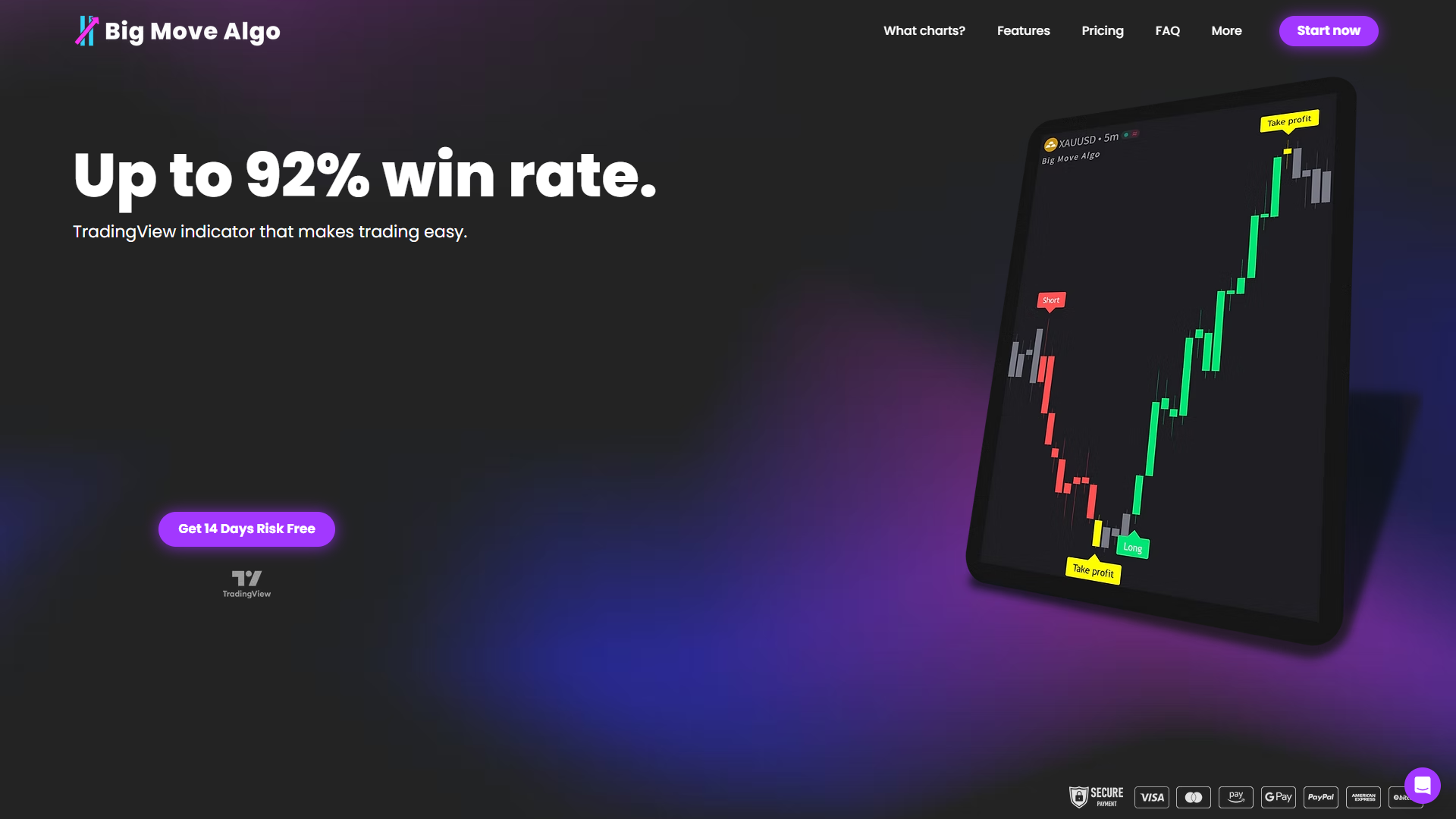
The built-in Fake Trend Detector filters out low-quality market conditions, so you are not trading noise. AUTO Mode gets you running with minimal setup, while Manual Mode gives experienced traders more control. Whether you are new to reading market structures or already active across several asset classes, Big Move Algo turns real-time market analysis into structured trading decisions without the clutter. Access starts immediately after purchase through a straightforward subscription plan.
FAQ
What are the main types of global trading markets?
The main types are stock markets, bond markets, forex markets, commodity markets, derivatives markets, and private markets. Each serves a distinct function and attracts different types of participants.
How large is the global forex market?
The forex market processes roughly $7.5 trillion in daily transactions, making it the largest financial market in the world by daily volume. It operates as a decentralized OTC network, not a single centralized exchange.
What is the difference between OTC and exchange-traded markets?
Exchange-traded markets centralize bid/ask prices through a regulated venue, while OTC markets rely on a network of dealers to provide liquidity and set prices. Forex is the most prominent OTC market.
Are private markets accessible to retail traders?
Private markets have exceeded $10 trillion in assets under management, but they require high investment minimums and tolerance for illiquidity. Most retail traders cannot access them without institutional connections or significant capital.
How do interest rates affect different market types?
Rising interest rates increase borrowing costs, pressure equity valuations, and strengthen currencies. In 2026, Fed rate expectations are simultaneously influencing equities, bonds, forex, and commodities, making rate policy the most watched macro driver across all market types.
Recommended