
How Signals Remove Trading Guesswork for Every Trader

Updated: Jun 5

Trading signals are condition-based alerts that convert raw market data into structured trade plans, specifying asset, direction, entry level, stop-loss, take-profit, and timeframe. Understanding how signals remove trading guesswork is the difference between reacting emotionally to price movement and executing with a repeatable, objective process. Platforms like Big Move Algo and tools built on algorithmic analysis have made signal-based trading accessible to retail traders across crypto, forex, stocks, and commodities. The core promise is not a crystal ball. It is a system that replaces daily uncertainty with predefined rules, giving every trade a clear rationale before you place it.
How signals remove trading guesswork at the structural level
A trading signal only eliminates guesswork when it contains every piece of information you need to act without improvising. Complete signal elements include the asset, trade direction, entry price or zone, stop-loss level, take-profit target, and a validity timeframe. Remove any one of those components and you are back to guessing.
Think of it this way. A signal that says “Bitcoin looks bullish” tells you nothing actionable. A signal that says “Long BTC at $67,400, stop-loss at $66,200, take-profit at $69,800, valid for the next 4-hour candle” tells you exactly what to do, when to do it, and when to walk away. The difference is not subtle. It is the entire gap between a structured decision and a coin flip.

Here is what separates a complete signal from an incomplete one:
Element | Complete signal | Incomplete signal |
Asset | EUR/USD | “Forex pair” |
Direction | Long (Buy) | “Looks good” |
Entry level | 1.0850 | “Near support” |
Stop-loss | 1.0800 | Not specified |
Take-profit | 1.0950 | “Upside potential” |
Validity | 24 hours | Not specified |
Incomplete signals increase uncertainty because traders cannot fully map the alert to their own rules and discipline. The result is a judgment call at every step, which is exactly what signals are supposed to eliminate.
Signals are also probabilistic by design, not guarantees. A well-structured signal improves your odds on a given trade. It does not promise a win. Accepting that distinction is what allows you to follow a signal consistently rather than abandoning it the moment a trade moves against you.
Pro Tip: Before acting on any signal, run a five-second checklist: Is the entry level still valid? Is the stop-loss distance reasonable for your account size? Has the signal’s validity window expired? Three questions, zero guesswork.
How do trading signals eliminate emotional bias and impulsive decisions?
Emotional trading is the single most common reason retail traders underperform. Fear causes early exits. Greed causes traders to hold past take-profit. Herd mentality causes entries at the worst possible moment. Signals enforce objective rules that replace all three of those failure modes with a mechanical yes or no decision.
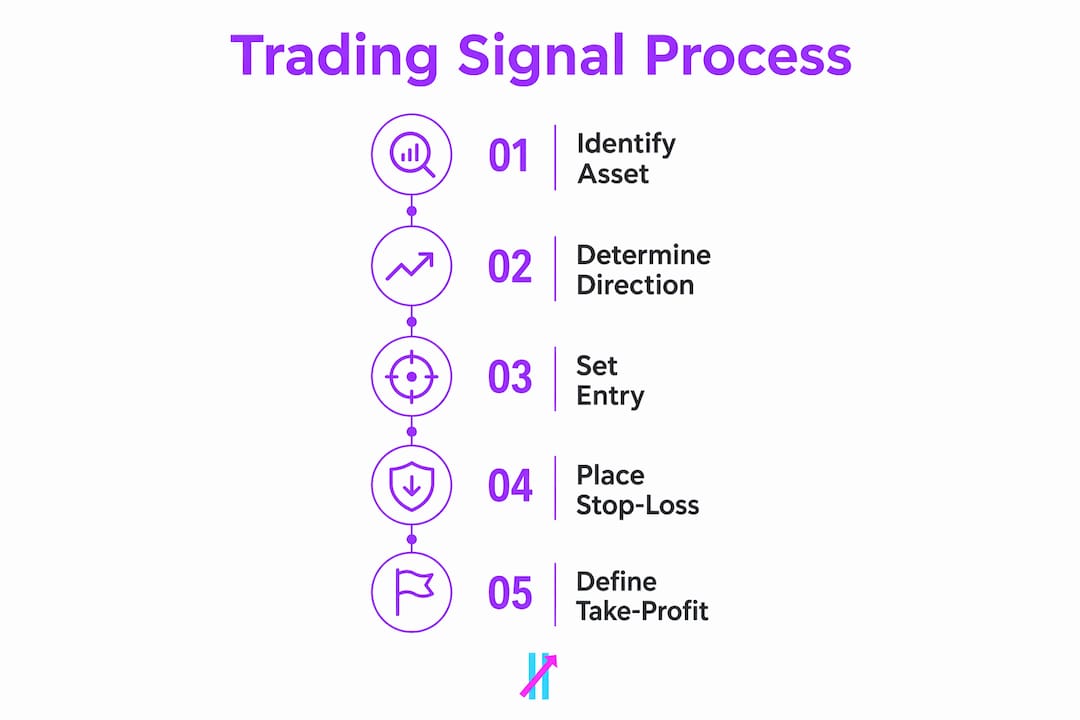
The mechanism is straightforward. When a signal fires, the decision is already made. You do not evaluate whether you “feel” like the trade will work. You check whether the conditions match the signal parameters and execute accordingly. That shift from subjective feeling to objective criteria is where the real value of signal-based trading lives.
Behavioral tools like EmotionShield AI have formalized this concept, treating decision quality separately from signal quantity to help traders reduce impulsiveness. The underlying logic matches what signals already do mechanically: remove the human variable from the execution step.
The benefits of eliminating emotional bias through signals include:
Consistent position sizing because stop-loss levels are predefined, not estimated in the moment
Reduced overtrading because signals only fire when conditions are met, not when you are bored
Faster recovery from losses because a structured signal tells you the next trade is independent of the last one
Discipline under volatility because the rule does not change when the market gets loud
“The goal of a good trading signal is not to make you feel confident. It is to make confidence irrelevant. When the process is sound, you do not need to feel certain to act correctly.” — Mark Douglas’s probabilistic mindset, as applied to structured trading plans
The practical implication for you is this: algo-driven signals do not just improve your entries. They change the psychological experience of trading by removing the moment-to-moment pressure to be right.
What is the role of confluence and risk management in improving signal reliability?
Confluence is the practice of requiring multiple independent signals to align before entering a trade. A single indicator firing is a suggestion. Three independent indicators pointing in the same direction is a high-probability setup. Combining signals through confluence significantly increases trade probability and reduces false entries.
A practical confluence framework might look like this:
A trend-following indicator confirms the overall direction (e.g., price above a 200-period moving average)
A momentum indicator confirms entry timing (e.g., RSI crossing above 50 from oversold territory)
A volume or volatility filter confirms market participation (e.g., above-average volume on the signal candle)
The signal aligns with a key support or resistance level identified through price action
When all four conditions are met, the trade has structural backing from multiple independent sources. When only one fires, you wait. That waiting is not missed opportunity. It is guesswork prevention.
Risk management is the second pillar of signal reliability. Stop-loss and take-profit levels are not optional add-ons. They are what make a signal executable. Without them, you are left deciding in real time how much loss is acceptable, which is a decision that fear and greed will always corrupt.
Layering multiple timeframe filters also reduces false signals. The FMZ Wave Strategy demonstrates this directly: layering signal constraints across multiple timeframes reduces false breakout probability by approximately 30%. That is a meaningful improvement in signal quality achieved purely through structural filtering, not by predicting the market better.
Pro Tip: Treat your confluence checklist as a gate, not a suggestion. If a signal does not pass every condition on your list, it does not get traded. “Almost” is the word that reintroduces guesswork into an otherwise clean system.
Key practical steps for validating signals before execution:
Confirm the signal aligns with the higher timeframe trend
Check that volume supports the move, not contradicts it
Verify the risk-to-reward ratio meets your minimum threshold (typically 1:2 or better)
Confirm the signal has not expired based on its stated validity window
How can traders use signals within their own strategies to reduce guesswork?
There is a critical distinction between signal generation and signal execution. Generating a signal is the algorithm’s job. Executing it correctly is yours. Most trading errors at the execution stage happen because traders reintroduce discretionary judgment at the last moment, second-guessing a signal that already passed every structural test.
Experienced traders validate signals against a personal confluence framework and avoid treating “almost matches” as valid entries. An almost match is not a signal. It is an invitation to guess, and guessing is what you are trying to eliminate.
The Big Move Algo how-to guide outlines a practical execution framework: check whether price is still within the entry zone, confirm the stop-loss level has not been invalidated by recent volatility, and verify the signal has not exceeded its validity window. Those three checks take seconds and eliminate the most common execution errors.
Advanced signal pipelines take this further. Gating mechanisms in signal systems remove signals generated during low-liquidity sessions or when confirmation indicators contradict each other. This means the signal you receive has already been filtered for market conditions that would make execution unreliable.
Here is a practical execution checklist for using signals without reintroducing guesswork:
Is price still in the entry zone? If price has moved significantly past the entry level, the signal’s risk-to-reward ratio has changed. Do not chase it.
Is the stop-loss level still structurally valid? If a key level has been broken since the signal fired, the premise may no longer hold.
Is the signal within its validity window? Signals have expiration logic for a reason. An expired signal is not a trade.
Does the session timing support execution? Trading a forex signal during low-liquidity hours increases slippage and reduces reliability.
Does any contradictory data invalidate the setup? A scalping signal algorithm that fires against a major news event is a signal to skip, not execute.
The traders who get the most from signal-based systems are those who treat the signal as the decision and the checklist as the filter. They do not override signals because of a gut feeling. They only skip signals when a predefined condition on their checklist is not met. That is the discipline that turns signals from interesting alerts into a repeatable trading edge.
Pro Tip: Keep a signal log for 30 days. Record every signal you received, whether you took it, and why you skipped it if you did not. Patterns will emerge quickly. Most traders discover they skip winning signals for emotional reasons and take losing ones impulsively.
Key takeaways
Trading signals remove guesswork by replacing subjective judgment with predefined, objective rules covering entry, stop-loss, take-profit, and timeframe at every stage of the trade.
Point | Details |
Complete signal structure | Every signal must include asset, direction, entry, stop-loss, take-profit, and validity to eliminate guesswork. |
Emotional bias removal | Predefined rules replace fear and greed with mechanical yes-or-no execution decisions. |
Confluence improves reliability | Requiring multiple independent signals to align reduces false entries and improves trade probability. |
Execution discipline matters | Validating price zone, stop-loss validity, and signal expiry before entry prevents last-minute guesswork. |
Risk management is non-negotiable | Stop-loss and take-profit levels embedded in signals protect capital and remove in-trade emotional decisions. |
Why I think most traders underuse the power of signals
I have watched traders receive a perfectly structured signal, complete with entry, stop-loss, and take-profit, and then spend 20 minutes talking themselves out of it. They check one more indicator. They wait for “confirmation.” They decide the market “feels different today.” And then they either miss the trade entirely or enter late with a worse risk-to-reward ratio.
The uncomfortable truth is that signals do not fail traders as often as traders fail signals. The structure is there. The edge is defined. The only variable that breaks the system is the human who decides their intuition is more reliable than a tested, rule-based process.
That said, I am not arguing for blind execution. Signals are tools that empower structured decision-making. They do not remove all risk, and they do not replace the need to understand why a signal fires. A trader who understands the logic behind a signal, whether it is trend alignment, momentum confirmation, or a volatility filter, will execute it with more consistency than one who treats it as a black box.
The most effective approach I have seen combines signal discipline with ongoing education. You follow the signal. You also study what conditions produced it. Over time, you build a mental model that makes you a better trader even when the signals are not running. That combination of structured execution and genuine understanding is where trading stops feeling like guesswork and starts feeling like a craft.
Combine signals with personal analysis. Trust the process. And always, always respect the stop-loss.
— James
Start trading with signals that do the heavy lifting
Big Move Algo is a TradingView indicator built specifically to give retail traders clear, objective signals across crypto, forex, stocks, indices, and commodities. Every alert includes a defined direction, entry zone, and exit logic, so you spend your time executing rather than analyzing.

The built-in Fake Trend Detector filters out low-quality market conditions before a signal ever reaches you, which means fewer false setups and more confidence in the trades you do take. Big Move Algo’s up to 92% win rate signals are backed by real-time algorithmic analysis, and the Big Move Guard feature adds an additional layer of risk management to every position. Whether you start with AUTO Mode for instant setup or explore Manual Mode for customization, the goal is the same: trading decisions without guesswork.
FAQ
What are trading signals in simple terms?
Trading signals are condition-based alerts that tell you when to buy, sell, or exit a trade based on predefined market criteria. A complete signal includes the asset, direction, entry level, stop-loss, take-profit, and validity timeframe.
How do signals reduce emotional trading decisions?
Signals replace subjective judgment with objective, rule-based execution. Because the decision criteria are predefined, fear, greed, and impulsive reactions are removed from the equation at the moment of execution.
What is confluence in signal-based trading?
Confluence means requiring multiple independent signals to align before entering a trade. When a trading entry signal is confirmed by two or more independent indicators, the probability of a successful trade increases significantly.
Can signals guarantee profitable trades?
No. Signals are probabilistic tools designed to improve your odds, not guarantee outcomes. The goal is consistent execution of high-probability setups, not certainty on any individual trade.
How do I know if a signal is still valid before I execute it?
Check three things: whether price is still within the entry zone, whether the stop-loss level remains structurally intact, and whether the signal is within its stated validity window. If any condition fails, the signal is no longer actionable.
Recommended
Comments