
Why Simplicity Wins in Trading Systems: A Clear Guide


Why simplicity in trading systems determines your results
Simple trading systems outperform complex ones. Not occasionally, not in theory. Consistently, across markets, timeframes, and trader skill levels. The role of simplicity in trading systems comes down to one core truth: a system you can execute without hesitation will always beat one you can only execute perfectly.
The traders who last are not the ones with the most indicators. They are the ones who clarity beats complexity in every live session, because their rules are clear enough to follow when the market is moving fast and their emotions are running hot.
Here is what simplicity actually delivers:
Faster execution. Fewer decisions in real time means less hesitation and fewer missed entries.
Lower cognitive load. Your brain processes a clean chart far more reliably than one covered in overlapping signals.
Reduced overfitting risk. Systems with fewer parameters are harder to accidentally curve-fit to historical noise.
Easier debugging. When something goes wrong, you can diagnose it quickly because the logic is transparent.
Greater consistency. Clear rules produce repeatable behavior, which is what lets an edge compound over time.
Stronger confidence in drawdowns. You know what your system is supposed to do, so a losing streak does not feel like a system failure.
Simplicity is not the absence of sophistication. It is the minimum complexity needed to capture a real market effect, and nothing more.
Table of Contents
How complexity breaks traders psychologically
Cognitive overload is the most common reason traders underperform their own systems. When a setup requires checking five indicators, two timeframes, and a macro filter before pulling the trigger, the decision is no longer mechanical. It becomes a negotiation with yourself, and that negotiation happens under pressure, in real time, with money on the line.
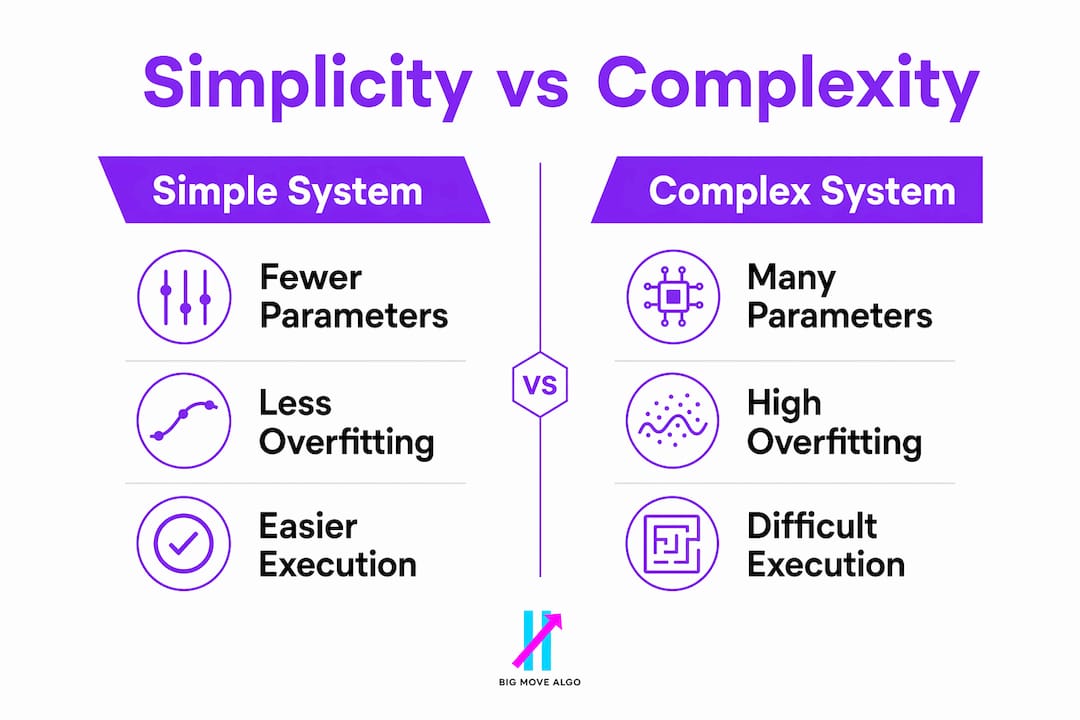
Professional traders reduce decision fatigue by focusing on fewer setups and clean charts. The result is less hesitation and more consistent execution. That is not a soft benefit. It is the difference between a system that works in backtesting and one that works in your account.

Pro Tip: Cut your active setups to one or two patterns you know deeply. Mastery of a single clean setup produces better results than surface familiarity with a dozen.
Complex systems create a specific set of psychological traps:
Analysis paralysis. Too many conditions to check means the opportunity passes while you are still deciding.
Second-guessing. Multiple conflicting signals give your doubts something to grab onto.
Inconsistent execution. When rules are ambiguous, you apply them differently each time, destroying any statistical edge.
Emotional override. Complex systems are harder to trust, so traders start overriding signals based on gut feel.
Strategy hopping. After a drawdown in a system you do not fully understand, the temptation to switch is almost irresistible.
A trading system must be explainable and executable under stress to avoid emotional interference. If you cannot run your system calmly during a volatile session, the system is too complex for live trading, regardless of how well it backtested.
Principles for designing a simple, reliable trading system
Good system design starts with a question, not an indicator: why should this effect exist? If you can answer that in plain English, you can usually build a simple model to capture it. If the answer is “the MACD crossed,” you are probably modeling noise.
Experienced traders apply simple principles consistently rather than chasing complexity, because robustness lives in repeatable patterns like trend following or mean reversion, not in stacked conditions. The core design principles:
Start with the mechanism. Identify the real market force driving the pattern before writing a single rule.
Use the minimum viable rule set. Your first version should be the bare minimum to test the idea. If a stripped-down model shows no signal at all, the edge probably does not exist.
Test parameter sensitivity. A robust system produces roughly stable results across a reasonable range of parameter values. If it only works at one specific setting, that is a curve-fitting warning.
Audit regularly. Periodically ask whether every rule still earns its place. Remove anything that does not have a clear answer.
Prefer interpretable logic. Every signal should be explainable in plain language. A system you can describe to someone who does not trade is a system you can actually audit.
Simple models stabilize behavior across market regimes and perform better out of sample. Low-parameter systems resist curve fitting and allow easier auditing. That stability is not a consolation prize for keeping things simple. It is the actual goal.
Characteristic | Complex system | Simple system |
Parameter count | High | Low (2–5) |
Overfitting risk | High | Low |
Execution under stress | Unreliable | Consistent |
Drawdown diagnosis | Difficult | Straightforward |
Cross-market portability | Limited | High |
Maintenance burden | Heavy | Light |
Trader confidence | Fragile | Durable |
Complexity causes more bugs, more monitoring, and greater maintenance effort, reducing overall system stability. Simple systems are easier to maintain, debug, and trust during live trading. That operational advantage compounds quietly over months and years.
Psychological benefits of keeping your trading system simple
Discipline is easier when there are fewer moving parts. When your rules are crystal clear, there is no hesitation about whether a setup qualifies. You execute, manage the trade according to the plan, and review. That cycle builds confidence and emotional resilience in a way that juggling multiple systems with different triggers never can.
Simple, interpretable models allow quick diagnosis and maintain trader confidence during drawdowns. When you understand exactly what your system is doing, a losing streak feels like variance, not failure. That distinction keeps you in the game long enough for your edge to play out.
Using one simple trading system enables meaningful journaling and performance tracking. Tracking key metrics over many trades builds confidence and improves discipline. Without a fixed framework, your journal becomes a record of scattered experiments. With one method, win rate, average win/loss, and expectancy become real numbers you can act on.
Psychological advantages of a simple system:
Reduced stress. Fewer variables to monitor means fewer sources of anxiety during a session.
Predefined decisions. Entry, stop, and target are set before the market opens, removing real-time negotiation.
Consistent self-assessment. You can evaluate your execution honestly because the rules do not change.
Resilience in volatility. When markets move fast, clarity matters more than precision.
Compounding discipline. Discipline compounds and is easier to maintain when trading systems have fewer moving parts.
What the research says about clarity versus complexity
The edge in trading lies in clarity of execution, not in complex indicators or settings, as explored in this performance optimization for fintech apps analysis. That observation from 2026 industry analysis cuts against the instinct most traders have when their system stops working. The instinct says: add a filter, tune a parameter, refine the entry. The evidence says the opposite.
Operational risk grows exponentially with complexity. Complex systems require more monitoring, more failover logic, and more debugging time. When a complex system hits a drawdown, you cannot tell whether one of your fifteen rules is broken, whether the edge is gone, or whether this is normal variance. That uncertainty is what causes traders to abandon good systems at exactly the wrong moment.
The most effective test for simplicity: Can your future self, under stress, quickly understand and execute the system without ambiguity? If the answer is no, the system has too many moving parts.
Feature engineering and data quality often contribute more to alpha than sophisticated algorithms, making simple but well-crafted indicators more sustainable than complex ones. The implication for individual traders is direct: a clean, well-defined signal on reliable data will outperform a sophisticated model built on ambiguous inputs.
Big Move Algo applies this principle directly. Its TradingView indicator delivers Long, Short, and Exit signals without requiring traders to interpret multiple conflicting data streams. The built-in Fake Trend Detector filters out low-quality market conditions automatically, so traders act only when the setup is clear. AUTO Mode requires minimal setup, which means you can get clear trading signals from the first session without spending hours configuring parameters.
Examples of effective simple trading systems
The most durable trading approaches share one feature: they are built on a single, well-understood market behavior. Trend following, mean reversion, and momentum have worked across decades and asset classes not because they are clever, but because they reflect how markets actually move.
Trend following with a moving average crossover. A fast moving average crossing above a slow one signals an uptrend entry; crossing below signals an exit or short. Two parameters, one rule, applicable to stocks, forex, commodities, and crypto. The logic is transparent and the signal is unambiguous.

Overnight momentum. Buy strong stocks on the close, short weak ones, hold overnight for follow-through into the next session. One entry trigger, one stop level (VWAP closing print), one exit rule. The entire system fits in a paragraph, which means anyone can execute it consistently.
Breakout from consolidation. Price breaking above a defined range on expanding volume signals a long entry. The setup captures volatility expansion, one of the most persistent behaviors in markets. No stacked conditions, no regime filter required at the core level.
Mean reversion to a key level. Price pulling back to a well-defined support level in a confirmed uptrend provides a long entry. The underlying logic, that markets overshoot and correct, has existed for as long as markets have. A simple moving average or prior swing high defines the level.
What these systems share is that you can replace complicated trading tools with a single clear signal and lose nothing of substance. The complexity that gets stripped away was never producing the edge. It was just producing the illusion of one.
Pro Tip: Before adding any indicator to your system, ask whether it changes your decision in a specific, definable way. If the answer is “it confirms what I already see,” remove it.
How to simplify an existing complex trading strategy
Most traders do not need to build a new system. They need to strip their current one down to what is actually working. The process is methodical, not creative.
Start by identifying the core mechanism. What market behavior is the system trying to capture? Write it in one sentence. If you cannot, the system has too many competing ideas inside it. Pick the one with the clearest logic and build from there.
List every rule and parameter, then challenge each one. For every rule, ask: does removing this change the system’s behavior in a meaningful way? If the answer is no, remove it. Many traders mistakenly think adding complexity improves precision, but more indicators and conditions increase the risk of overfitting and analysis paralysis. Fewer rules mean fewer conflicts and fewer execution errors.
Run parameter sensitivity tests. Vary each parameter across a reasonable range and observe how results change. A parameter that only works at one specific value is almost certainly curve-fitted to historical noise. Widen it or remove it.
Test the stripped-down version first. Before adding anything back, run the bare-bones system. If the core idea has merit, even a minimal version should show some positive signal. If it only works with eight rules in place, the edge is probably in the noise, not the mechanism.
Apply the stress test. Imagine running this system during a volatile session when you are tired and the market is moving against you. Can you execute every rule without ambiguity? If not, simplify further. The complexity sweet spot exists, and most discretionary traders overshoot it significantly.
Simplifying an existing strategy is not about making it dumber. It is about making it honest. A system with the minimum complexity needed to capture a real effect, and nothing more, is what understanding trading system design actually points toward at every level of experience.
Key Takeaways
Simple trading systems outperform complex ones because fewer parameters reduce overfitting risk, lower cognitive load, and produce consistent execution that compounds over time.
Point | Details |
Simplicity beats complexity | Simple systems resist overfitting, are easier to execute under stress, and maintain trader confidence in drawdowns. |
Cognitive load drives execution | Fewer decisions in real time means less hesitation, fewer errors, and more consistent trade outcomes. |
Design from the mechanism | Start with why an effect should exist, then build the minimum rule set to capture it. |
Discipline compounds | Maintaining discipline is easier with fewer moving parts, and that consistency is what lets an edge play out. |
Audit and strip regularly | Periodically remove rules that no longer earn their place; less complexity means less room for fragility. |
Try a simpler approach with Big Move Algo

Big Move Algo is built on exactly the principles covered here. The TradingView indicator delivers Long, Short, and Exit signals in real time, across crypto, forex, stocks, indices, and commodities. AUTO Mode requires minimal setup so you can start trading with clear signals immediately. The Fake Trend Detector filters out low-quality conditions automatically, so you are not second-guessing whether a signal is worth taking.
If your current setup feels like too much to manage, Big Move Algo shows what a genuinely simple system looks like in practice.
Recommended
Comments