
What Is Pre-Market Trading? A Retail Trader's Guide
- Steven Hartwell

- 12 minutes ago
- 13 min read

Pre-market trading is buying and selling U.S. stocks during the electronic session that runs from 4:00 AM to 9:30 AM ET, before the NYSE and Nasdaq open for regular business. For retail traders, it’s worth using when you need to react to a major overnight catalyst — an earnings surprise, a Fed announcement, a geopolitical shock — and worth skipping when you’re trading a quiet, low-volume name with no news driver.
A few things to know before you go further:
Pre-market volume accounts for roughly 6% of daily U.S. stock volume, about 1.02 billion shares each morning before 9:30 AM ET (NYSE Research, Q1 2025). That sounds like a lot until you realize the regular session handles the other 94%.
The SEC defines regular trading hours as 9:30 AM to 4:00 PM ET; anything outside that window is extended hours.
Always use limit orders. Expect wide bid-ask spreads. Start with smaller position sizes than you’d use during regular hours.
Table of Contents
What is pre-market trading, and how does it fit into extended hours?
When do U.S. pre-market hours run, and how do brokers differ?
How does pre-market trading work: order types, execution, and liquidity
Does pre-market trading actually affect the regular-session opening price?
Who can trade pre-market, and what broker settings do you need?
Research snapshot: what the data says about U.S. pre-market volume
What is pre-market trading, and how does it fit into extended hours?
Pre-market trading is one half of what brokers call “extended hours trading” — the other half is the after-hours session that runs from 4:00 PM to 8:00 PM ET. Together, they let retail traders place orders outside the NYSE and Nasdaq’s standard 9:30 AM to 4:00 PM ET window.
The key structural difference from regular hours is how orders get matched. During the regular session, trades flow through exchange floors and market makers who provide continuous two-sided quotes. Pre-market trades route through Electronic Communication Networks (ECNs) and Alternative Trading Systems (ATSs) — automated platforms that match buy and sell orders electronically without a market maker standing in the middle. That matters because ECNs only match orders that are already in the system. If there’s no seller at your price, your order sits unfilled.
Price discovery in pre-market is real but fragile. Prices move on actual transactions, but with a fraction of the participants, a single large order can push a stock several percent in either direction. That’s not manipulation — it’s just thin order books doing what thin order books do.
Pre-market activity has grown meaningfully since 2019, driven by retail platform access and the rise of overnight news cycles. Still, even at roughly 6% of daily volume, it remains a structurally different environment from the regular session — one where the rules of execution, liquidity, and price stability all work differently.
When do U.S. pre-market hours run, and how do brokers differ?
The standard U.S. pre-market trading hours run from 4:00 AM to 9:30 AM ET. That’s the technical window. In practice, most retail activity clusters between 7:00 AM and 9:30 AM ET, when volume picks up and spreads tighten enough to make execution more predictable.

The 4:00–7:00 AM stretch is extremely thin. Institutional desks and algorithmic systems dominate that window, and retail traders who venture in early often find themselves trading against participants with far better information and infrastructure. Watching that window rather than trading it is usually the smarter move.
Broker windows vary more than most traders expect. Some platforms open pre-market access as early as 4:00 AM; others don’t unlock it until 7:00 AM or even 8:00 AM. A few restrict pre-market trading to specific account types — margin accounts, for instance, or accounts above a certain balance. Before you assume you have access, check your broker’s specific hours.
Pro Tip: Most brokers require you to actively enable extended hours trading in your account settings and sign a risk disclosure before your first pre-market order goes through. If your order isn’t routing, that’s the first place to look.
Which assets can you actually trade pre-market?
Not everything you can trade during regular hours is available pre-market. Here’s how it typically breaks down:
Usually tradable pre-market:
U.S.-listed common stocks (NYSE and Nasdaq)
Many broad-market ETFs (SPY, QQQ, IWM)
Single-stock ETFs on major names
Some sector ETFs with sufficient liquidity
Usually not tradable or restricted:
Options contracts — most brokers do not allow options trading during extended hours
Mutual funds — priced once daily at NAV, so pre-market orders don’t apply
OTC and pink-sheet stocks — many brokers block these during extended hours due to liquidity risk
Futures — these trade on separate exchanges (CME, CBOT) with their own extended-hours schedules, not through standard equity pre-market
A practical note on ETFs: broad-market funds like SPY tend to have reasonable pre-market liquidity because they track widely followed indices. A niche sector ETF with $50 million in assets might technically be tradable pre-market but carry spreads wide enough to make the trade economically pointless. Always check the pre-market bid-ask before sizing in.
How does pre-market trading work: order types, execution, and liquidity
The single most important rule: market orders are typically disabled during pre-market. Most retail brokers enforce limit-only order types to protect clients from extreme fills in a thin market. If you try to place a market order and your broker allows it, that’s a red flag about the platform’s risk controls.

Order types at a glance
Order Type | Allowed Pre-Market? | Execution Risk | Typical Pre-Market Use |
Limit order | Yes — standard | Low to moderate | Primary order type; set your price ceiling/floor |
Market order | Usually disabled | Extreme | Avoid; most brokers block it |
Stop order | Often disabled | High if triggered | Not reliable pre-market; triggers may not execute |
GTC (Good Till Canceled) | Varies by broker | Moderate | Can carry over from prior session; check settings |
IOC (Immediate or Cancel) | Sometimes available | Low | Useful for avoiding partial fills in thin markets |
Order routing in pre-market goes directly to ECNs. Because ECNs only match existing orders, partial fills are common — you might get 200 shares of a 500-share order filled at your limit price, with the rest sitting open. That’s not a malfunction; it’s the order book telling you there weren’t enough sellers at that price.
Execution scenarios worth knowing:
Scenario 1 — Earnings gap: A stock closes at $50, reports strong earnings after hours, and opens pre-market at $58. You place a limit buy at $58.50. The spread is $57.80 bid / $59.20 ask. Your order sits unfilled because no seller is willing to go below $59.20. You either adjust your limit up (and accept more risk) or wait.
Scenario 2 — Slippage on a thin name: You place a limit buy at $22.00 on a mid-cap stock. The order fills at $22.00, but the next trade prints at $21.40 because your order absorbed the only available sellers at that level. The stock then drifts lower before the open. Small size and a tighter limit would have reduced the damage.
Pro Tip: Set your limit price inside the pre-market spread, not at the ask. A simple heuristic: if the spread is $0.40 wide, place your limit $0.10–$0.15 above the current bid for a buy order. You’ll get filled less often, but when you do, you’re not paying the full spread penalty.
For traders who want a rules-based framework for entries, a mechanical trading strategy approach works well here — predefined entry criteria, a fixed limit offset, and a maximum slippage tolerance before you cancel and wait for the open.
What are the real benefits of pre-market trading?
The primary benefit is timing. Retail traders use pre-market primarily to react to overnight news — earnings releases, economic data prints, central bank decisions, or geopolitical developments — before the regular session opens and prices fully adjust.
Consider a concrete example: a company reports earnings at 7:00 AM ET, beating estimates by 20%. By 7:15 AM, the stock is up 12% in pre-market on moderate volume. A trader who had a thesis on that stock can act on the news before the 9:30 AM open, potentially entering at a better price than what the regular session will offer once the full retail crowd piles in. That’s a real, tangible edge — conditional on the pre-market move holding, which it doesn’t always do.
Two other benefits that don’t get enough attention: scheduling flexibility and position management. Traders in non-Eastern time zones sometimes find pre-market hours more convenient than the regular session. And traders who already hold a position can use pre-market to adjust size or add a hedge before a major catalyst hits at the open.
The caveat is real, though. Every benefit above depends on having enough liquidity to execute at a reasonable price. In a thin pre-market, the “advantage” of acting early can evaporate in a wide spread or a partial fill.
What are the risks of pre-market trading?
Low liquidity is the root cause of most pre-market problems, and it cascades into several specific risks:
Wide bid-ask spreads: Pre-market spreads can be several times wider than regular-session spreads. Wide spreads effectively raise transaction costs, meaning you need a larger favorable move just to break even — before commissions.
Thin depth of book: A few hundred shares might be all that’s available at the best bid or ask. A modest order can move the price against you before it’s fully filled.
Price reversals at the open: Pre-market trends frequently reverse once regular-session liquidity arrives at 9:30 AM ET. A stock up 8% pre-market on thin volume can open flat or lower when real two-sided order flow hits.
Greater slippage: Because ECN-only execution lacks market makers providing continuous quotes, even limit orders can result in partial fills at prices worse than expected.
Price divergence across ECNs: Different ECNs may show slightly different prices for the same stock simultaneously. The “pre-market price” you see on one platform might not be the price you get on another.
The worst-case outcomes are worth naming plainly. You can get filled at an extreme price if your limit is set too loosely during a fast-moving pre-market. Or you can get no fill at all — your limit order sits open, the news event plays out, and you miss the move entirely. Neither outcome is catastrophic if you size appropriately, but both sting when you’re not expecting them.
Pre-market volume has grown substantially since 2019, yet it remains a small fraction of regular-session liquidity. That gap is exactly why even large pre-market moves can be fragile.
Does pre-market trading actually affect the regular-session opening price?
Pre-market activity influences the opening price but doesn’t reliably set it. The opening price at 9:30 AM ET is determined by the exchange’s opening auction, which incorporates all orders queued for the open — including those from participants who weren’t active pre-market at all. That’s a fundamentally different pool of liquidity.
Here’s why pre-market trends often reverse: thin pre-market volume means prices move on relatively few transactions. When the regular session opens and order flow surges — institutional desks, index funds, market makers all entering simultaneously — the price often finds a different equilibrium than where pre-market left it.
A concrete example: a stock gaps up 10% pre-market after a strong earnings report. Pre-market volume is 400,000 shares. At 9:30 AM, the opening auction processes 3 million shares in seconds. Sellers who were waiting for the open — including pre-market buyers taking profits — push the price back down. By 10:00 AM, the stock is up only 4%. The pre-market signal was directionally correct but overstated the magnitude.
This doesn’t mean pre-market moves are meaningless. They’re informative. They just aren’t a reliable forecast of where the stock will trade an hour into the regular session.
Who can trade pre-market, and what broker settings do you need?
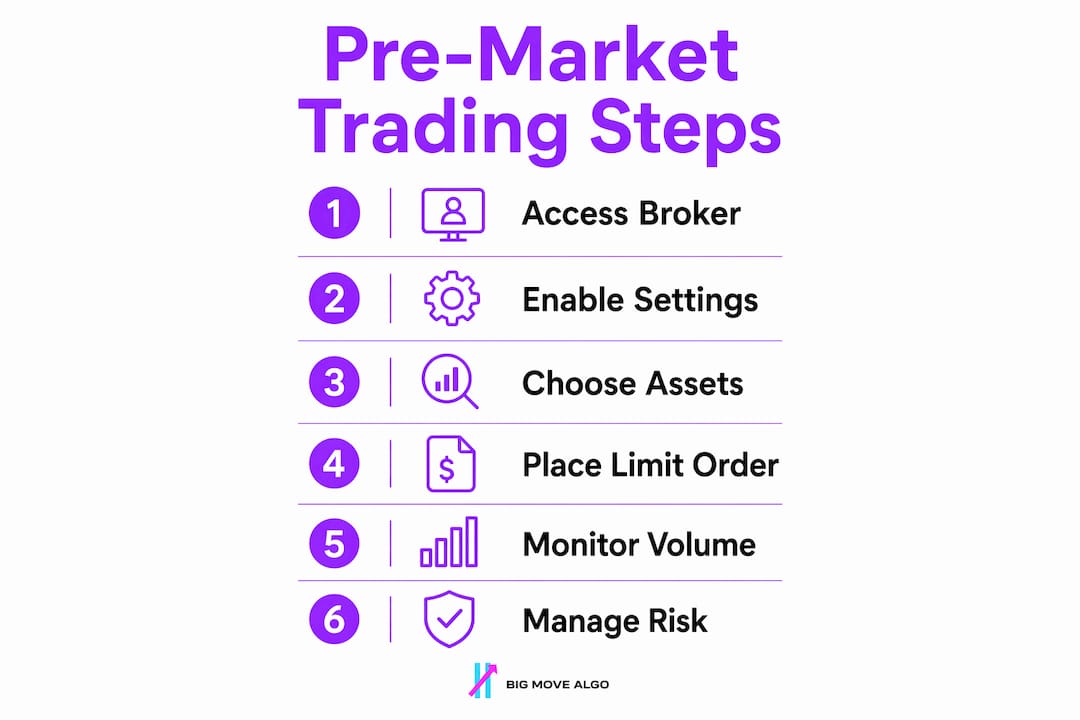
Most U.S. brokers offer pre-market access, but your account usually needs extended hours trading enabled and a risk disclosure accepted before your first order routes. Here’s a practical checklist:
Account setup:
Log into your broker and locate the “extended hours” or “after-hours trading” setting
Accept the broker’s extended-hours risk disclosure (required by most platforms)
Confirm your account type qualifies — some brokers restrict extended hours to margin accounts
Order and execution checks:
Verify which order types your broker allows pre-market (limit orders are standard; market orders are usually blocked)
Check whether your broker supports Good Till Canceled orders that carry over into pre-market, or whether you need to place fresh orders each session
Review the security eligibility list — not every stock your broker offers during regular hours will be tradable pre-market
Questions to ask your broker directly:
What are your exact pre-market hours? (4:00 AM vs. 7:00 AM matters)
Do you route to multiple ECNs, or a single one?
Are there incremental fees for extended-hours orders?
Which tickers are blocked from pre-market trading?
Using a trading platform checklist before you commit to a broker is worth the 20 minutes it takes — extended-hours support varies more than most comparison sites acknowledge.
How to trade pre-market safely: a step-by-step approach
Start by observing, not trading. Spend a few sessions watching pre-market price action on stocks you know well before placing a single order. You’ll quickly see how spreads behave, how volume clusters, and how often pre-market moves reverse at the open.
When you’re ready to trade:
Identify a clear catalyst. Only trade pre-market when there’s a specific, verifiable news event driving the move — an earnings release, a major economic print, a merger announcement. Avoid trading pre-market on “vibes” or technical setups alone.
Check pre-market liquidity first. Pull up the level 2 quote or at minimum the bid-ask spread. If the spread is more than 1–2% of the stock price, the execution cost alone may make the trade unprofitable.
Set a limit price, not a market order. Place your limit inside the spread — not at the ask for a buy, not at the bid for a sell. Accept that you may not get filled.
Size down. Use 25–50% of your normal position size. Pre-market moves can reverse sharply, and smaller size keeps a bad fill from becoming a bad day.
Define your exit before you enter. Decide in advance: if the stock reverses X% against you pre-market, you exit. If it reaches your target, you exit. Don’t improvise.
Plan for the open. Know what you’ll do at 9:30 AM ET if your position is still open. Will you hold through the opening auction? Add? Cut? Have the answer before the bell rings.
Pro Tip: Focus your active pre-market trades in the 7:00–9:30 AM ET window, where volume is meaningfully higher and spreads are tighter. The 4:00–7:00 AM stretch is better used for reading news and watching price action than for placing orders.
For real-time trading signals that help you identify which pre-market moves have momentum behind them versus which are noise, a structured signal tool can cut the guesswork considerably.
Research snapshot: what the data says about U.S. pre-market volume
Pre-market trading accounts for roughly 6% of daily U.S. stock volume — approximately 1.02 billion shares traded before 9:30 AM ET each morning (NYSE Research, Q1 2025). That figure has grown substantially since 2019, driven by retail platform access and algorithmic participation. But 6% of daily volume spread across a 5.5-hour window means the per-minute liquidity is a fraction of what the regular session delivers.
Metric | Data Point | Source |
Pre-market share of daily U.S. volume | ~6% | NYSE Research, Q1 2025 |
Estimated pre-market shares traded daily | ~1.02 billion | NYSE Research, Q1 2025 |
Standard pre-market window | 4:00 AM–9:30 AM ET | TradingSim / Investopedia |
Peak retail activity cluster | 7:00–9:30 AM ET | TradingSim |
Volume growth trend | Substantial growth since 2019 | Markets.com |
The practical implication of 6%: if a stock trades 10 million shares on a typical day, roughly 600,000 of those shares trade pre-market. On a high-news day, that number rises — but it’s still a fraction of the regular-session depth. A 10,000-share pre-market order in a mid-cap stock can represent a meaningful chunk of available liquidity, which is exactly why slippage and partial fills are so common.
For traders who want to backtest pre-market strategies against historical price data before risking real capital, working with a large-scale price snapshot dataset is the most rigorous way to validate whether a specific approach has an edge.
Key Takeaways
Pre-market trading gives retail traders early access to U.S. stocks before the 9:30 AM ET open, but thin volume and wide spreads make limit orders, small position sizes, and clear catalysts non-negotiable for safe participation.
Point | Details |
Pre-market hours | The U.S. window runs 4:00 AM–9:30 AM ET; most retail activity clusters 7:00–9:30 AM ET. |
Volume context | Pre-market accounts for roughly 6% of daily U.S. stock volume (~1.02B shares), per NYSE Research Q1 2025. |
Order type rule | Market orders are typically disabled; always use limit orders to control your fill price. |
Main risk | Low liquidity causes wide spreads, partial fills, and price reversals at the 9:30 AM open. |
Big Move Algo | Big Move Algo’s signal tool helps filter noisy pre-market moves and highlights liquidity-backed setups before the open. |
The part most guides skip about pre-market trading
Most articles on pre-market trading treat accessibility as the story. Retail traders can now trade at 4:00 AM — isn’t that great? But accessibility and usability are different things, and conflating them is where new traders get hurt.
The structural reality is this: pre-market is an ECN-only environment where the participants with the best data, the fastest infrastructure, and the most experience are most active in the earliest hours. A retail trader placing a limit order at 5:30 AM on a stock that just moved on news is competing against algorithmic systems that processed that news in milliseconds. That’s not a reason to avoid pre-market entirely — it’s a reason to be selective about when and how you participate.
The 7:00–9:30 AM window is genuinely different. Volume is higher, spreads are tighter, and the price action is more reflective of where the stock is actually likely to open. Professional traders often treat the early hours as observation-only for exactly this reason. Retail traders who adopt the same discipline — watch early, act late — tend to have better outcomes than those who chase the first pre-market print.
One more thing worth saying plainly: pre-market price moves are informative, not predictive. A stock up 8% at 6:00 AM is telling you something about sentiment. It is not telling you where the stock will be at 10:00 AM. Treating pre-market signals as directional guides rather than confirmed entries is the mental shift that separates traders who use extended hours well from those who get burned by it.
How Big Move Algo helps you cut through pre-market noise
Pre-market is where signal and noise are hardest to separate. A stock moving 6% on thin volume might be a genuine opportunity or a head-fake that reverses the moment real liquidity arrives. Big Move Algo’s TradingView indicator gives you a structured way to evaluate those moves — generating Long, Short, and Exit signals based on real-time market analysis, with a built-in Fake Trend Detector that flags low-quality setups where the conditions don’t support a trade.
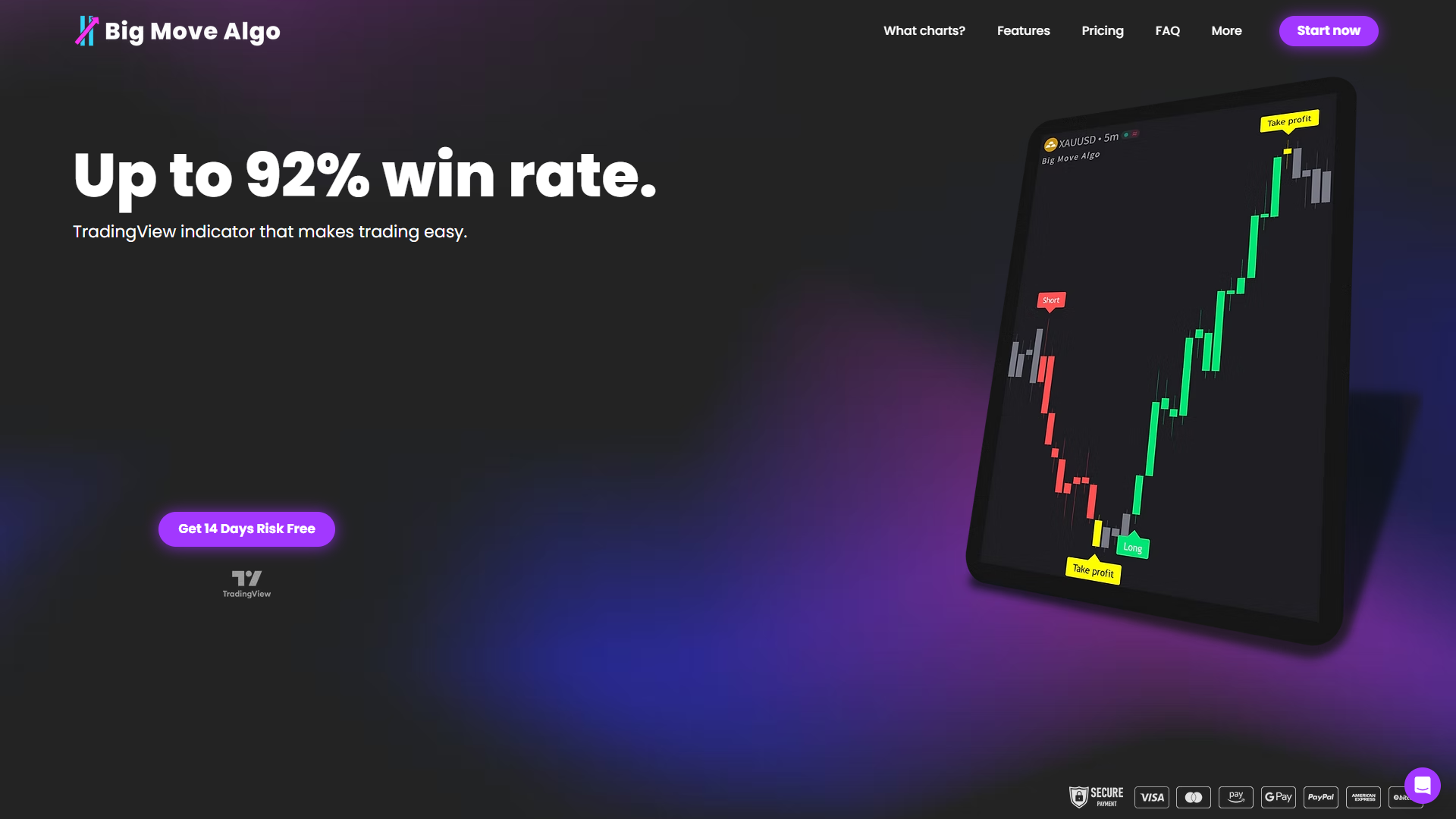
For retail traders who want to use pre-market hours more deliberately, Big Move Algo works across stocks, ETFs, crypto, forex, and indices — the same markets where extended-hours activity matters most. AUTO Mode gets you running with minimal setup; Manual Mode lets you dial in parameters as you build experience. This is not investment advice, and any signal tool should be verified against your own account conditions and risk tolerance before live use.
Ready to see how it works? Explore Big Move Algo and start filtering the noise before the open.
Useful sources and further reading
The sources below are the primary references used throughout this article. Each covers a specific angle of pre-market trading:
TradingSim — Detailed breakdown of pre-market mechanics, volume data, and strategy considerations for retail traders.
Investopedia — Clear definitional coverage of pre-market trading, ECN execution, and liquidity risks.
NerdWallet — Practical broker-level guidance on order types, account settings, and risk disclosures.
IG — Strategy-focused coverage of why traders use pre-market and how to approach overnight news catalysts.
Markets.com — Growth context and risk framework for pre-market participation.
FINRA BrokerCheck — Use this to verify your broker’s registration and check for any regulatory disclosures before enabling extended-hours trading.
“Pre-market trading volume has grown substantially since 2019, yet it remains a small fraction of regular-session liquidity — which explains why even large pre-market moves can be fragile.” — Markets.com
For Big Move Algo resources on signal-based trading and market open strategies, the US stock market open signals guide and the Big Move Algo blog are good starting points.
This article is general educational information, not investment advice. Confirm current broker rules, order-type restrictions, and extended-hours policies directly with your broker or a qualified financial professional before trading.
Recommended
Comments