
Beginners: Start Day Trading First, Scalping Eats 40–70%

Scalping means firing off dozens of trades a session for tiny gains held seconds to minutes; day trading means taking a handful of setups and holding minutes to hours for bigger intraday moves. For most beginners, day trading is the more forgiving starting point because the cost structure and infrastructure demands are far less punishing. Start there, build a track record, then decide if scalping’s pace suits you.
TL;DR:
Scalping involves executing over 30 quick trades per session with extremely tight risk and requires ultra-low latency platforms, often costing a significant profit percentage.
Day trading involves fewer trades, typically between one and five, with broader stops and moderate fees, making it more accessible for beginners with less technical infrastructure.
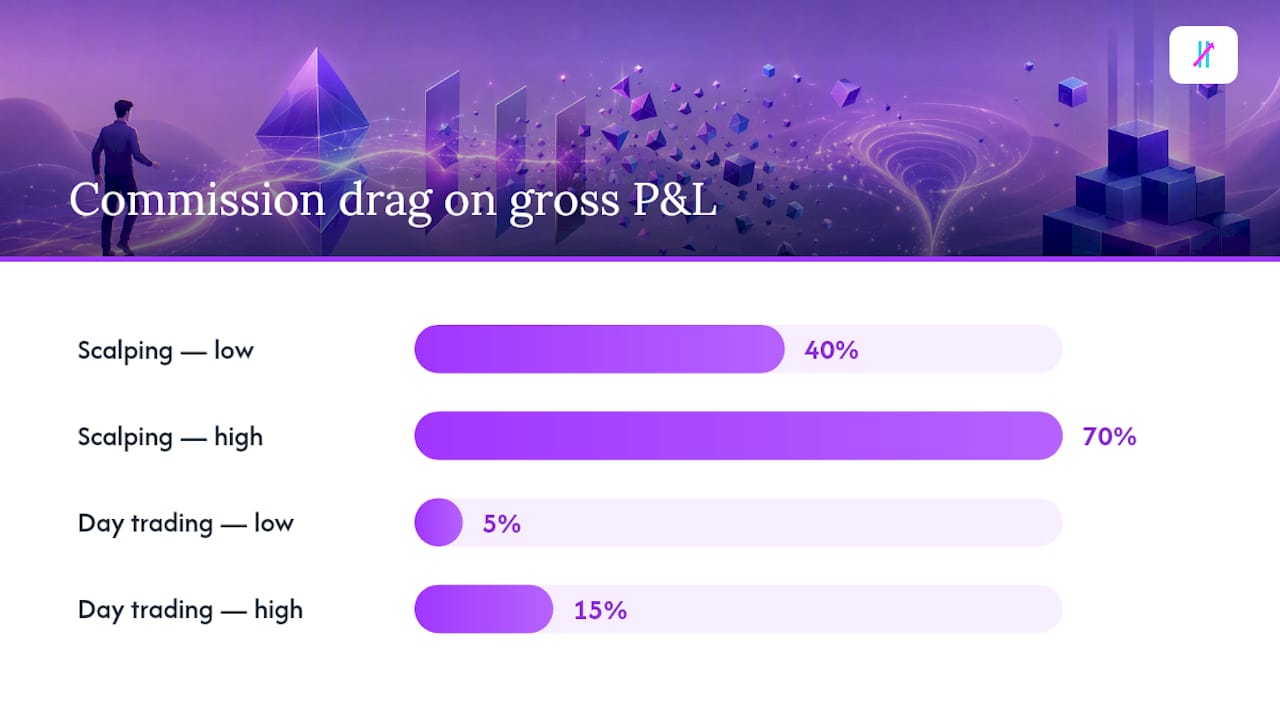
Cost and commission drag can consume up to 70 percent of gross profit for scalpers, whereas day traders usually face just 5 to 15 percent in fees, heavily impacting net returns.
Beginners should prioritize mastering day trading setups with a consistent edge over micro accounts before attempting scalping, which demands advanced skills and substantial technology.
Automation tools can support both styles, but they do not eliminate the fundamental issues of latency and fees inherent to scalping.
Table of Contents
Scalping vs Day Trading: The Core Differences at a Glance
The two styles look similar from a distance, both close positions before the market closes, but the mechanics diverge sharply once you look at frequency, cost, and setup requirements.
Factor | Scalping | Day Trading |
Holding time | Seconds to minutes | Minutes to hours |
Trades per day | a high number of | 1 to 5 |
Typical target per trade | A few ticks or points | Larger intraday swing |
Stop size / risk per trade | Very tight | Wider, proportional to swing |
Infrastructure needs | Tick data, low-latency execution, hotkeys | Standard charting platform, 5 to 15 minute data |
Cost sensitivity | Extremely high | Moderate |
Trade frequency and holding times split cleanly along these lines: scalpers run 30 or more trades in a session while day traders often take fewer than five setups. That gap alone explains why the two styles feel like different jobs even though both fall under “day trading” in the broad sense. A scalper who treats one bad tick like a day trader treats a bad hour will blow through risk limits before lunch.
What Is Scalping? Mechanics, Tactics, and Platform Demands
Scalping is the practice of opening and closing positions within seconds to a few minutes, chasing small, repeatable profits dozens or even a hundred times per session. It is less a strategy than a discipline built around speed.
Three tactics dominate retail scalping:
Tape and DOM reading: watching order flow on the depth of market to catch imbalances before price moves.
Momentum scalps: jumping on a sudden burst of volume and riding it for a few ticks.
Mean-reversion scalps: fading small overextensions back toward a short-term average.
None of this works without the right plumbing. Scalping depends on tick-by-tick data and execution fast enough to matter, often sub-100 millisecond order entry, because a scalper’s edge lives in a window that closes almost as fast as it opens. Retail platforms running on 15-second consolidated feeds simply cannot support this style. Hotkeys aren’t a convenience here; they’re the difference between catching the move and watching it happen.
Statistic Callout: At retail commission structures, scalping can consume 40 to 70 percent of gross profit and loss before you even account for spread. That’s not a rounding error. That’s the difference between a winning system on paper and a losing one in your account.
Scalping tends to reward traders who already have fast reflexes, low-latency brokers, and enough screen time to treat the tape like a second language. It is a specialist skill, not a weekend hobby.
What Is Day Trading? Setups, Timeframes, and Why It’s Friendlier for Beginners
Day trading means opening and closing positions within a single session, typically holding for minutes to a few hours, and taking far fewer trades than a scalper. The pace gives you time to think, which matters enormously when you’re still learning to read a chart under pressure.
Common day trading setups include:
Opening-range breakout: trading the break above or below the first 15 to 30 minutes of range.
VWAP reversion or continuation: using the volume-weighted average price as a magnet or a launchpad.
Momentum and gap-and-go: riding a stock that gapped on news and keeps pushing in one direction.
Most of these setups run on 5 to 15 minute charts, and traders typically develop working competency in this style within months of consistent practice. That’s a realistic timeline, not a guarantee, but it’s far more attainable than the years of tape-reading experience scalping tends to demand.
Cost sensitivity is the real dividing line. Day trading typically carries a moderate percentage commission drag on gross profit and loss, compared to scalping’s much steeper toll. Fewer trades mean fewer chances for fees and spread to eat your edge alive. Day trading suits someone with a few hours of focused attention per session, a standard broker platform, and the patience to let a setup develop instead of forcing an entry every ninety seconds.
The Differences That Actually Change Your Outcomes
Cost math is where theory meets your account balance, and it’s the single biggest reason beginners should think twice before scalping.
Consider a trader targeting a $10 gross profit per trade. If round-trip commission and spread cost $4, the trade needs to clear $14 gross just to net $10. Now multiply that by 60 trades a day instead of three. At retail commission levels, scalping’s cost drag runs 40 to 70 percent of gross P&L versus day trading’s 5 to 15 percent, and that gap compounds every single session. A scalper needs a bigger, more consistent edge just to break even, while a day trader’s occasional losing trade doesn’t get amplified sixty times over.
Cost driver | Scalping impact | Day Trading impact |
Commission drag on gross P&L | 40 to 70% | 5 to 15% |
Data feed requirement | Tick-level, often paid | Standard 5 to 15 minute delayed or real-time |
Execution latency tolerance | Sub-100ms needed | Seconds are fine |
Skill ramp | Years of screen time | Roughly several months |
Platform costs stack on top of commissions. A serious scalper often pays for a professional data feed and a low-latency broker connection, expenses a day trader on a standard retail platform can skip entirely. Retail accounts frequently lack the capital or rebate structure to make scalping’s expected value positive once every fee is counted, which is the quiet reason so many scalping accounts fail even when the strategy “worked” on the chart.
Pro Tip: Before you risk real money on either style, calculate your breakeven gross profit per trade by adding your commission, spread, and slippage together. If that number is close to your typical target, the strategy isn’t viable at your current size.
How to Decide Which Style Fits You
Run through these questions honestly before choosing a lane:
How many uninterrupted hours can you trade per day? Scalping demands full attention for the entire window; day trading tolerates checking in periodically.
How does your body react to fast losses? If a string of quick red trades makes you chase revenge entries, scalping will punish you.
What’s your account size? Smaller accounts get hit harder by scalping’s fee drag in percentage terms.
What execution speed does your broker actually offer? If you don’t know, you’re not ready to scalp.
Once you’ve answered those, run a simple four-step test: simulate the strategy on paper for two weeks, then trade it at micro position size for another two to four weeks, journaling every entry and exit. Only scale up once your journal shows a real, repeatable edge, not a lucky streak. If your win rate or average trade collapses the moment you increase size, stop and go back to micro sizing.
Pro Tip: Set a hard rule before you start: if you lose three trades in a row outside your plan’s stop parameters, you stop trading for the day. No exceptions, no “just one more.”
Two Simple Setups You Can Practice Today
Concrete examples beat theory. Here’s one of each style, stripped down to the essentials.
One-minute scalp: Wait for a 1-minute candle to close above a recent short-term high on rising volume. Enter on the break, set a stop 2 to 3 ticks below entry, and take profit at a fixed 4 to 6 ticks or exit immediately if momentum stalls. Size the position so the stop represents no more than 0.25% of account equity.
Fifteen-minute day trade: Wait for price to reclaim VWAP after a pullback, confirmed by the 9-period EMA turning up on the 15-minute chart. Enter on the confirming candle close, place your stop below the pullback low, and target a 2:1 reward-to-risk ratio, scaling out a third of the position at the first target.
Journal every outcome: Log entry, exit, reason for the trade, and whether you followed your rules exactly. After 20 to 30 trades, calculate your win rate and average win versus average loss to see if you have a real edge.
Sahi’s research on session timing notes that opening and closing hours often favor scalping while the middle of the session favors intraday holds, so if you’re testing both, decide your approach for the session window before you place the first trade, not after.
Risk Management and the Cost Math You Can’t Skip
Position sizing has to match the style you’re actually trading, not the style you wish you were trading.
Work out your cost-per-round-trip in dollars, then divide it by your typical target to see what percentage of every winning trade goes to fees alone.
Never let a scalp become an accidental intraday hold just because it moved against you; that’s how a defined 2-tick risk turns into a 2% account drawdown.
Track slippage separately from commission; a platform’s reported fill price and your actual fill are rarely identical during fast moves.
Set a maximum number of trades per session and stop when you hit it, regardless of how the day is going.
The Investopedia research on scalping notes that scalpers frequently rely on algorithmic systems and automation to manage speed and emotion, which is a strong hint that manual scalping without technological support is fighting an uphill battle from day one.
Where Automation Fits: Big Move Algo as an Automation Option
Automation earns its place when it removes guesswork, not when it adds another layer of settings to babysit. Clear entry and exit signals help both scalpers and day traders execute the plan they wrote on paper instead of the plan their emotions write in real time.
A trading indicator built around that idea can help. Some products offer an AUTO Mode for beginners and a Manual Mode for experienced traders to adjust parameters. Such indicators generate Long, Short, and Exit signals directly on charts across crypto, forex, stocks, indices, and commodities, and some include features to flag conditions where a breakout is more likely noise than a real move.
Used responsibly, automation like this supports either trading style without replacing sound judgment:
Set position limits before you turn on any automated signal, not after a losing streak.
Backtest and simulate any new signal setup before risking live capital.
Treat automation as a discipline tool for consistent exits, not a substitute for understanding why a trade worked or failed.
Automation and clear signal rules can support both scalping and day trading, but no indicator changes the underlying latency and commission math scalping requires at retail size.
A Straight Answer on Progression and the Mistakes That Sink Beginners
Start with day trading setups, not scalping, and keep a written journal from trade one. Beginners who jump straight into scalping usually aren’t beaten by bad technical skills. They’re beaten by cost drag they never calculated and a psychology built for boredom, not for sixty decisions an hour.
The three traps that show up again and again are stop-chasing, overtrading, and revenge trading after a loss. The fix for all three is boring on purpose: a hard daily trade limit, a stop that never moves once set, and a mandatory walk-away rule after two consecutive losses outside your plan.
Measure progress by whether your edge holds up over 50 trades, not whether today was green. A single lucky day tells you nothing; a journal spanning a month tells you everything. Scalping is worth attempting only after day trading has proven you can follow your own rules under pressure, not before.
— Steven Hartwell
Sources
Key sources include Investopedia’s scalping guide, SmartAsset’s comparison of scalping and day trading, IG’s day trading and scalping overview, and Sahi’s breakdown of scalping versus intraday trading. For a scalping primer with market-specific context, see Tickerly’s trader’s guide to scalping. Explore how to apply signal-based automation through Big Move Algo’s guide to automation.
Recommended
Comments