
Cut Bad Fills: 7 Priority Fixes for Retail Traders
- Steven Hartwell

- 2 days ago
- 12 min read

Slippage in trading is the gap between the price you expected on an order and the price you actually got, and it can cut either way. Negative slippage eats into your edge; positive slippage pads it. It shows up more in fast, thin, or news-driven markets, and while you can’t eliminate it, you can measure it, budget for it, and shrink it with a handful of concrete habits covered below.
TL;DR:
Negative slippage can cost traders hundreds of dollars on large or volatile trades, especially during news events or in low-liquidity markets.
Using limit orders, splitting large trades, and trading during peak liquidity hours significantly reduce the risk of unfavorable slippage.
AMM pools and order-book venues respond differently to trade size and liquidity, so understanding the platform’s mechanics helps manage slippage effectively.
Monitoring actual slippage through logs and adjusting assumptions in backtests ensures more accurate performance expectations.
Automated trading signals can minimize hesitation-related slippage, especially during fast-moving markets or major scheduled news releases.
Table of Contents
What Slippage Looks Like in Real Trades
You place a market order to buy at $50.00, and it fills at a slightly higher price, reflecting negative slippage. Fill at a slightly lower price instead, and you got positive slippage, sometimes called reverse slippage, because the market moved in your favor between click and execution. Slippage is caused by price movement during that gap, not by a widening bid-ask spread, which is a separate, related annoyance.
People confuse the two constantly. Spread is the built-in cost of crossing from bid to ask, quoted before you even click. Slippage is what happens after you click, when the market moves before your order reaches the book.
Negative slippage: buy order fills above your requested price, or a sell fills below it.
Positive slippage: the market moves in your favor between order submission and fill.
Reverse slippage: the formal term for that favorable outcome, noted in academic treatments of execution measurement).
Spread widening: a broker or venue quoting a wider bid-ask gap, usually during low liquidity, which is not the same mechanism as slippage.
Why Slippage Happens: Liquidity, Volatility, Order Type, Latency
Four forces drive most bad fills, and diagnosing which one hit you tells you exactly what to fix next time.
Thin order books. When there aren’t enough resting orders near your price, your order “walks the book,” filling at progressively worse prices until it’s complete.
AMM pool depth. On decentralized exchanges, price impact scales directly with your trade size relative to the pool’s liquidity, a mechanical formula rather than an order-book queue, as MetaMask’s slippage explainer lays out.
Volatility spikes. Scheduled news releases, surprise headlines, or liquidation cascades in leveraged crypto markets can move price several ticks in the milliseconds it takes your order to route.
Latency and routing. Distance to the server, broker execution model, and practices like “last look” (where a liquidity provider gets a final glance before confirming your fill) all add delay, and delay is where slippage lives.
Most bad fills trace to one dominant cause. A stop-loss that slipped badly during a news spike is a volatility problem. A market order on a low-volume altcoin that ate through five price levels is a liquidity problem.
How to Measure Slippage: A Worked Example
The formula is simple: slippage = executed price minus expected price, expressed in ticks, dollars, or percent, with the sign telling you the direction. A positive number on a buy means you paid more than planned; on a sell, it means you got less.
Worked example: Say you want to buy 3 BTC when the quoted price is $85,000. The order walks the book because the top of it only has 1 BTC available at that level, so your average fill lands at $85,100. Your per-BTC slippage is $100, or roughly 0.12% of the position, and on 3 BTC that’s a few hundred dollars in immediate cost before the trade has even moved.
Aggregating it matters more than any single fill. Log slippage per instrument and per session, then average it weekly. A strategy showing $0.03 average slippage per share on a stock traded 200 times a month has bled roughly $600 that never shows up in your win rate, only in your account balance.
Order-Book Venues vs. AMM-Based Exchanges
Centralized exchanges and decentralized AMM pools handle slippage in fundamentally different ways, and applying the wrong mental model to the wrong venue is a common beginner mistake.
On order-book venues, depth is the whole story: more resting orders near your price means less walking the book, and Level 2 data shows you that depth before you click.
On AMM-based decentralized exchanges, there’s no order book at all. Price impact follows a constant-product formula, so slippage grows with trade size relative to pool liquidity, and setting a slippage tolerance caps how much price movement you’ll accept before the transaction reverts.
Set that tolerance too loose and you’re exposed to sandwich bots, which front-run your pending transaction and profit from the price impact you’re about to cause.
DEX aggregators split a single trade across multiple pools to reduce the price impact any one pool absorbs, often producing a materially better average fill than routing through one venue directly.
The practical checks before trading either venue: look at order-book depth or the platform’s displayed price-impact estimate, and never trade size that represents a large share of visible liquidity.
How to Reduce Slippage: A Priority-Ordered Playbook
Not every fix carries equal weight. Here’s the order that matters most for a retail account.
Use limit orders for non-urgent entries. A limit order eliminates slippage entirely because it fills at your price or not at all, though a stop-limit trades fill certainty for price control, so weigh that against a stop-market when you need a guaranteed exit.
Split large orders. Breaking one big order into several smaller ones reduces how far you walk the book on any single clip, though for small retail size, this often matters less than simply picking a better time to trade.
Trade during peak liquidity hours. The overlap between major forex sessions, or the first and last hour of the stock market’s regular session, consistently shows tighter fills than the lunch lull or overnight crypto chop.
Set conservative slippage tolerance on AMMs and route through aggregators rather than accepting a wide default tolerance that invites front-running.
Adjust your platform’s deviation setting. Most trading platforms let you cap the maximum acceptable slippage per order. A tight cap protects you from outlier fills but increases the odds an order gets rejected during a fast market.
Consider a VPS or wired connection only if latency is the demonstrable bottleneck. A dedicated server can shave routing delay, but it does nothing for a liquidity problem, so diagnose before you spend on hardware, a point echoed in OANDA’s execution risk guidance. Traders running latency-sensitive setups sometimes also look at execution-focused hardware built specifically for fast order entry.
Size positions relative to liquidity, not just account balance, and set stop distances based on the instrument’s typical volatility rather than a flat number of ticks.
Pro Tip: Keep a simple execution log for 30 trades: requested price, fill price, and time of day. You’ll usually spot a pattern, like every bad fill happening in the first five minutes after the open, that a single bad trade never reveals.
Accounting for Slippage in Backtests and Live Logs
A backtest with zero slippage assumption is a fantasy. Model it one of three ways: a fixed number of ticks per trade, a percent of price that scales with position size, or an empirical distribution built from your own historical fills, which is more work but far more honest.
Your trade log needs specific fields to make this analysis possible. OANDA recommends capturing requested price, executed price, timestamp, symbol, order size, platform ping, and whether the trade occurred during a news release or session change.
Log every fill with those seven fields, even on winning trades.
Compare your TradingView strategy tester results against a version with realistic slippage assumptions built in.
Recalculate expectancy after slippage before you trust any backtest number, and revisit it through forward testing on a live account with small size.
Even a small average slippage cost, compounded across hundreds of trades, can be the difference between a strategy that looks profitable on paper and one that actually is.
Can Automated Signals Cut Timing-Related Slippage?
Hesitation is a slippage multiplier. The three seconds a trader spends second-guessing a setup is exactly the window where price runs away and a market order fills worse than planned. Algorithmic execution removes that hesitation by acting the instant a condition triggers, rather than after a human re-reads the chart twice.
Big Move Algo’s AUTO Mode applies this logic directly: it issues Long, Short, and Exit signals the moment its criteria are met, trading speed for the manual discretion some traders prefer in MANUAL Mode. Neither is universally better, it’s a genuine trade-off between reaction time and control.
Automation removes the variance introduced by human reaction time, which matters most in fast-moving crypto and futures markets.
The Fake Trend Detector filters out setups where liquidity or trend quality looks poor, avoiding entries into exactly the thin, choppy conditions where slippage runs highest.
Clearer, structured signals reduce the back-and-forth deliberation that often causes traders to chase a price after it has already moved.
How News and Scheduled Events Widen Slippage
Every experienced trader has a story about getting run over by a headline. Central bank rate decisions, nonfarm payrolls, CPI prints, and earnings releases are the predictable culprits, and the mechanism is straightforward: dozens of large orders hit the market simultaneously, liquidity providers pull their quotes to avoid getting picked off, and the book that looked deep a second ago suddenly isn’t.
This is where “last look” and requote behavior show up most often in forex. A broker’s liquidity provider sees your order, checks the current price against their own feed, and either fills you or rejects and requotes at a worse level, a practice tied directly to volatility around scheduled data. Crypto has its own version: a surprise regulatory headline or exchange outage can trigger cascading liquidations, where forced selling by over-leveraged positions pushes price through several levels in seconds, and every market order caught in that cascade slips badly.
Unscheduled news is worse than scheduled news, precisely because you can’t plan around it. You can choose to sit out the ten minutes before a rate decision. You can’t sit out a surprise headline that breaks mid-session. The practical response isn’t to avoid news trading altogether, plenty of traders build strategies specifically around it, but to widen your expected slippage tolerance and reduce size going into any known catalyst, and to recognize that a stop-loss placed too close to current price during a scheduled release is more likely to be the trade that teaches you this lesson the hard way.
Slippage Across Stocks, Forex, Crypto, and Futures
Slippage isn’t a single, uniform tax. It behaves differently depending on what you’re trading, and lumping all four asset classes together is how traders build unrealistic expectations.
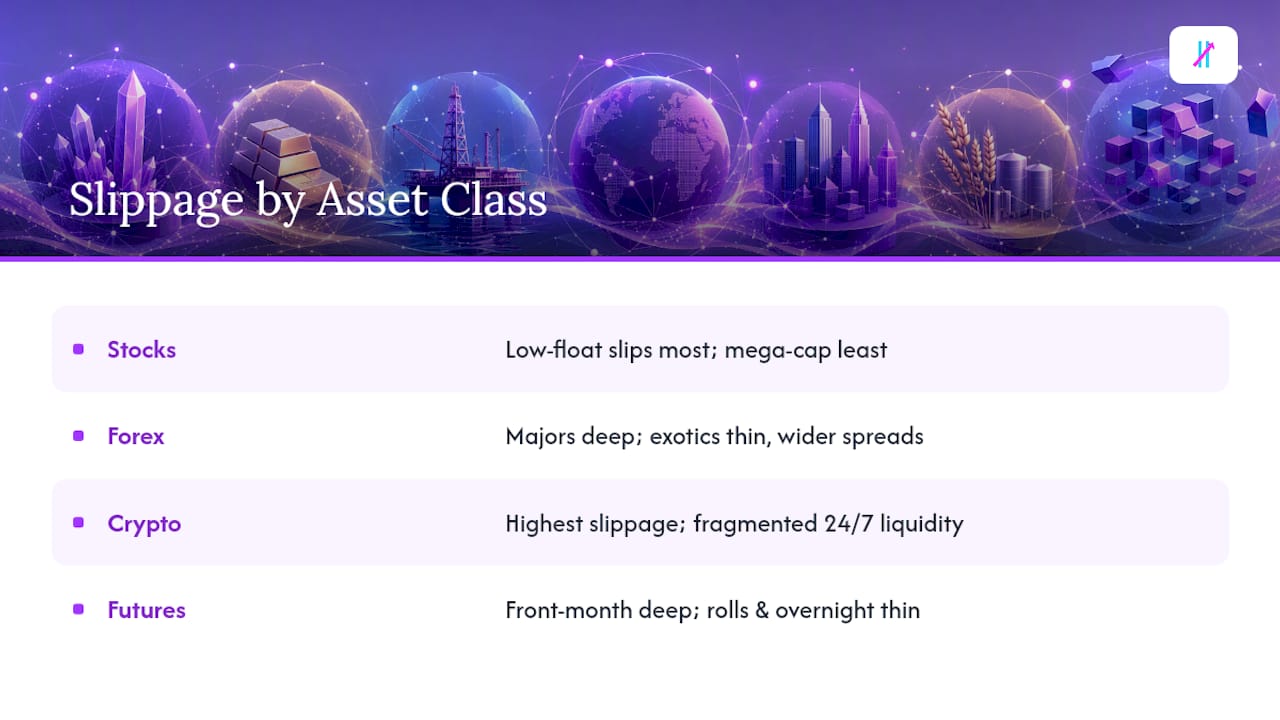
Stocks slip most in low-float or low-volume names, and least in mega-cap names during regular hours. A market order on a major index constituent barely moves the tape; the same order size on a thinly traded small-cap can walk through several price levels.
Forex majors like EUR/USD trade with enormous depth most of the day, so slippage is usually minor outside news windows. Exotic pairs are a different story, with wider spreads and thinner books that make slippage a near-constant companion rather than an occasional surprise.
Crypto slips the hardest of the four, for two structural reasons: fragmented liquidity across dozens of exchanges and pools, and 24/7 trading with no circuit breakers or opening bells to reset the order flow after a shock. A leveraged position on a mid-cap altcoin can see double-digit percentage slippage during a liquidation cascade, something that would be almost unthinkable in a large-cap stock.
Futures sit somewhere in between. Front-month contracts on major indices or commodities are deep and liquid, but roll periods and less-traded contract months thin out fast, and overnight sessions carry noticeably wider gaps than the regular trading day.
The lesson across all four: match your order type and size to the actual depth of the specific instrument you’re trading, not to the asset class’s reputation in general.
Why Your Broker or Platform Changes the Slippage Math
Not all execution is created equal, and the fine print in your broker’s order execution policy often explains fills that otherwise look inexplicable. Market makers who take the other side of your trade have a structural incentive that differs from an ECN broker who simply routes your order to the deepest available liquidity, and that difference shows up in your fill quality over hundreds of trades.
Look specifically at three things. First, the execution model: dealing desk versus ECN/STP routing changes who is filling your order and why. Second, the platform’s deviation or maximum-slippage setting, which lets you cap how far price can move before your order gets rejected instead of filled at a bad price. Third, server location and API reliability. A broker whose servers sit far from the exchange’s matching engine adds latency regardless of how good your own internet connection is.
Pro Tip: Test a new broker’s execution quality with small, disposable trades during both quiet and volatile hours before committing serious size, and log the fills exactly as you would your own strategy’s trades.
Reading a broker’s execution policy is not the most exciting homework, but the traders who skip it are also the ones most surprised when a “guaranteed” stop turns out to only be guaranteed under normal market conditions, a caveat buried in nearly every retail forex contract.
How Order Type Shapes Your Exposure to Slippage
The order types beginners learn first, market and limit, are only part of the picture once size and urgency enter the equation.
A market order prioritizes speed over price and is where most negative slippage originates, since it accepts whatever price the book offers rather than naming one.
A stop-loss order, once triggered, typically converts into a market order, which means it inherits every weakness a market order has, plus the added risk that stops often cluster at obvious technical levels, making that exact price zone more likely to see a liquidity air pocket the moment enough traders’ stops fire at once.
An iceberg order hides the true size of a large order by displaying only a small visible portion at a time, refreshing as each slice fills. It’s designed specifically to reduce the market-impact style of slippage that a single giant visible order would cause, since other participants can’t see the full size and front-run it, but it takes longer to fill completely and works best on venues with continuous, steady liquidity rather than a thin book.
A limit order caps your price but offers no fill guarantee. It converts price risk into execution risk, which is a fair trade for most non-urgent entries and a poor one for a stop-loss you need to guarantee will trigger.
Understanding which category your order falls into, speed-priority or price-priority, tells you upfront whether slippage is even possible on that specific order.
Three Fills That Show Slippage in Action
Numbers make the concept concrete faster than definitions do. Three scenarios cover most of what retail traders actually encounter.
The earnings gap. A trader places a market buy on a stock the instant a strong earnings report drops after hours. The stock opens the next session 4% above the prior close, and the market order fills at the open price rather than anywhere near the previous day’s quote, because there was no continuous market between the report and the open for the order to interact with.
The crypto liquidation cascade. A leveraged long position on a mid-cap token sits near its liquidation price when a broader market selloff begins. As liquidations trigger in sequence, each forced sale pushes price lower, feeding the next liquidation, and a trader trying to exit manually during that cascade can see their market sell fill several percentage points below the price they saw when they clicked.
The forex news spike. A trader holds a position through a central bank rate decision, expecting a modest move. The actual announcement contains a surprise policy shift, price gaps instantly, and the stop-loss that was supposed to cap losses at 20 pips instead fills 60 pips worse, because the broker’s liquidity provider requoted through the spike rather than filling at the exact stop level.
None of these three examples required a exotic instrument or a rare setup. They’re the ordinary cost of trading through moments when liquidity temporarily disappears, and they’re precisely why measuring and budgeting for slippage matters more than hoping to avoid it entirely.
Treat Slippage Like a Line Item, Not a Grievance
Slippage is a cost of doing business, not an injustice done to you. Budget for it the way you’d budget for commissions, and the emotional sting mostly disappears. The real danger isn’t the $0.08 you lost on one fill, it’s the hesitation or revenge trading that follows a bad one, which tends to cost far more than the slippage itself. Build the habit of reviewing your execution log every week, not just your P&L, and you’ll catch the pattern before it becomes a costly one.
— Steven Hartwell
A Practical Way to Cut Timing-Driven Slippage
A lot of negative slippage traces back to hesitation, that extra second or two spent deciding whether to click, while the market keeps moving. Big Move Algo addresses that gap directly with a real-time TradingView indicator that issues clear Long, Short, and Exit signals the moment its criteria trigger, rather than leaving you to react manually after the fact.
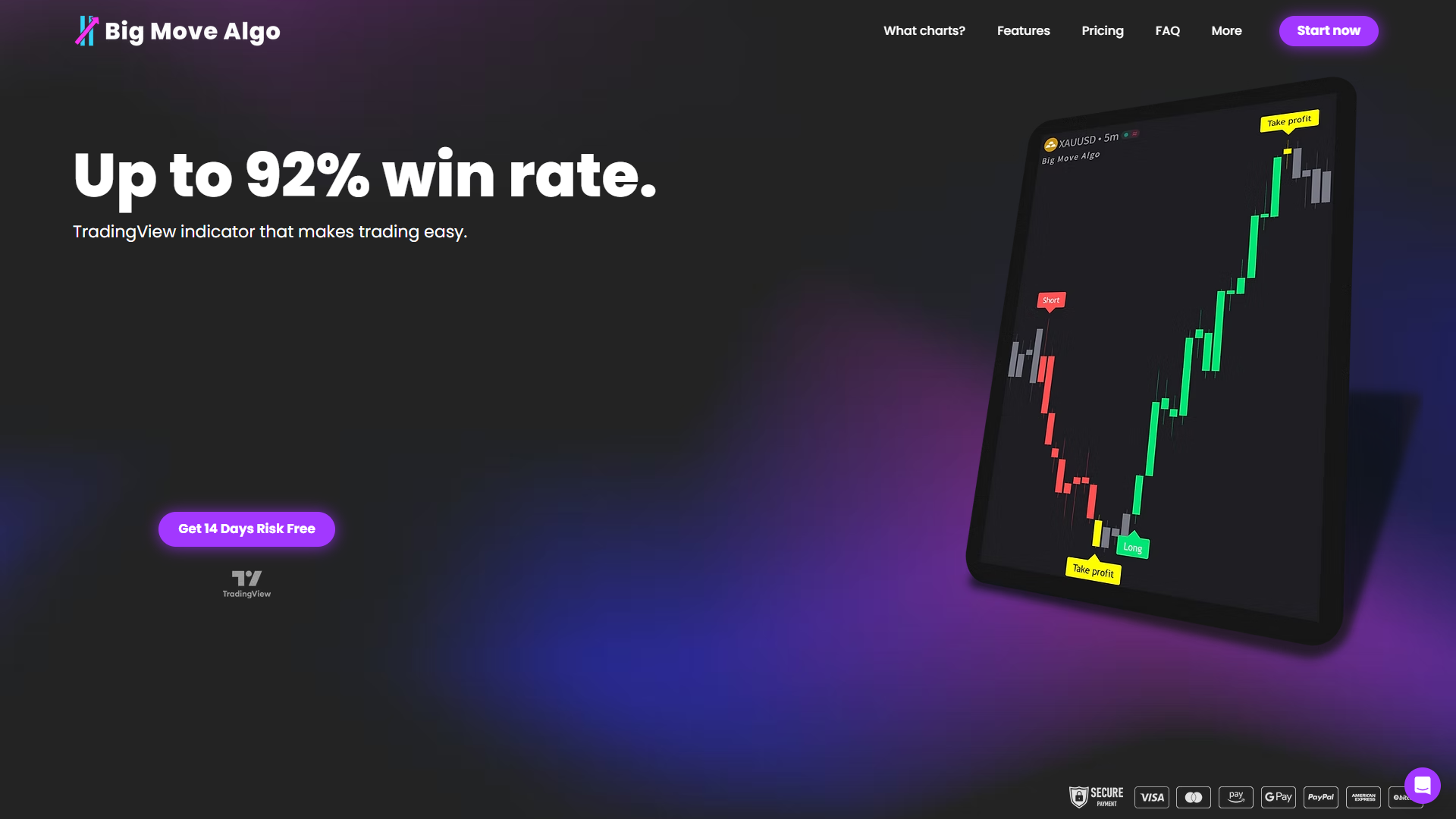
AUTO Mode handles the entries and exits with minimal setup, which suits traders who want the timing decision made consistently rather than emotionally. MANUAL Mode keeps you in control while still surfacing the same structured signals, and the built-in Fake Trend Detector helps filter out the thin, choppy conditions where slippage tends to run highest in the first place. It works across crypto, forex, stocks, indices, and commodities, on unlimited devices, with alerts delivered to the platforms you already use.
If timing errors have been quietly costing you fills, it’s worth seeing the signals in action. Set up your TradingView account with Big Move Algo and start trading with a clearer, faster decision process today.
Sources
Recommended
Comments