
How to Avoid Whipsaw Trades That Stop You Out Before the Real Move
- Steven Hartwell

- 19 hours ago
- 7 min read

A whipsaw trade happens when price triggers your entry or stop, then reverses hard enough to run you over on the way out. Short-term traders get hit hardest because they’re closest to the noise. The fix that works immediately: require confirmation before you enter, and cut your position size when the setup looks shaky.
TL;DR:
Confirm breakouts with retests or full candle closes to reduce false signals caused by rapid reversals.
Avoid trading during scheduled news releases, thin liquidity periods, and in choppy, range-bound markets to minimize whipsaw risks.
Use volatility-based stop distances, set at multiples of ATR, to keep risk consistent across different market conditions.
Size down or skip trades when technical conditions are weak, such as low ADX, overlapping candles, or absence of clear swing points.
Refrain from trading immediately after major events or during thin sessions, and prioritize waiting for clear confirmation signals to prevent losses.
Table of Contents
What Whipsaw Trades Actually Look Like
The term borrows from the old two-person crosscut saw, where the blade snaps back and forth with each stroke. In markets, a whipsaw follows the same rhythm: a rapid move triggers a signal or a stop, then reverses fast enough to trap traders on both sides of the trade.
Picture a stock breaking above resistance at a key level. Buyers pile in on the breakout, stops get set just under $50, and twenty minutes later the price is back at $48.50. Everyone who bought the breakout is stopped out, and the “breakdown” traders who shorted the reversal often get squeezed right back up. Nobody wins except whoever was on the other side of both moves.
The damage varies by how you trade:
Day traders feel it most because they’re in and out fast, often using tight stops that sit right where the noise lives.
Swing traders get hurt less often but harder, since a wider stop that finally breaks usually means a real reversal, not noise.
Long-term investors mostly shrug it off, since their holding period outlasts the reversal entirely.
Conditions That Set Up a Whipsaw
Certain environments make whipsaw trades far more likely, and recognizing them ahead of time is half the battle.
Scheduled news and event risk. Jobs reports, central bank decisions, and earnings releases spike volatility in both directions within seconds.
Thin liquidity windows. Overnight sessions, holiday trading, and the minutes right after the open can turn a normal-sized order into an outsized price swing.
Range-bound, choppy markets. When price bounces between well-known support and resistance, every touch of the boundary looks like a breakout until it isn’t.
Stop clustering. Whipsaws concentrate around scheduled releases, thin sessions, and crowded technical levels, and algorithmic flow often targets exactly where retail stops sit, running the level before reversing.
Spotting a Whipsaw Before It Traps You
Price action gives you clues before the reversal happens. A long wick that pokes past a level and closes back inside it is the classic sign, often called a sweep-and-reject. If price fails to hold beyond a boundary for more than a candle or two, treat that as a warning, not confirmation.
Indicators help sharpen the read:
ATR (Average True Range) tells you how much noise is normal right now, so you can judge whether a move is meaningful or just volatility.
ADX below roughly 20 signals a weak or absent trend, meaning breakouts are less trustworthy.
Volume on the breakout candle should expand, not shrink, if the move has real conviction behind it.
Bollinger Bands squeezing tight before a breakout suggest energy building, but a quick tag-and-return through the band often flags a fake-out.
Parabolic SAR works well as a secondary filter to confirm trend direction rather than as a standalone trigger.
Overlapping candles, low-volume breakouts, and high ATR readings paired with low ADX are the combination most associated with failed signals. Cross-check your entry timeframe against the next one up. A breakout on the 15-minute chart that contradicts the 4-hour trend deserves extra skepticism.
None of this comes free; for tips on spotting low-quality signals, check out this practical guide to recognize ineffective trading systems. Every added confirmation step delays your entry and cuts trade frequency, trading missed opportunities for fewer false signals. That trade-off is the whole game.
Rules That Cut Whipsaw Losses Without Killing Your Edge
Confirmation frameworks are the backbone of avoiding whipsaw trades, and you have three basic choices, each with a different cost.
First-touch entry gets you in earliest but eats the most false signals.
Retest entry waits for price to break a level, pull back, and hold it, cutting a meaningful chunk of fake-outs at the cost of a slightly worse average entry.
Close-beyond entry waits for a full candle to close past the level on your chosen timeframe, the most conservative option and the one that misses fast, clean breakouts entirely.
Grizzly Parrot Trading’s framework for handling whipsaws centers on defining your acceptance and invalidation evidence in advance, closes, retests, and volume, then sizing your position from a dollar-risk figure you’ve already tested. Stops belong where your trade thesis is actually wrong, not at a round number that a hundred other traders are also watching.
When the structure looks weak (low ADX, overlapping candles, no clean prior swing point), size down instead of skipping the trade entirely. Half your normal size on a marginal setup keeps you in the game without betting full weight on a coin flip.
Pro Tip: Set your stop beyond the last swing high or low, not at the nearest round number. Stop-hunt algorithms love round numbers; they’re far less interested in a swing point three ticks below the crowd.
For entries in fast-moving conditions, a limit or stop-limit order controls your fill price better than a market order, which can slip badly during a spike. And if you expect a genuine two-way move around a known event, a straddle or strangle options position lets you profit from volatility itself rather than guessing direction, though cost and liquidity need checking first. Some traders also fade the rejection once a sweep-and-reject confirms, effectively trading the whipsaw instead of getting caught by it.
For a cleaner read on entry timing, a signal verification checklist can help you standardize which confirmations you require before pulling the trigger.
Turning Rules Into Execution Math
Risk math is where good intentions either hold up or fall apart. The formula is simple: stop distance times unit value times contracts equals your planned dollar loss. Flip it around and you get your maximum contract count for a given risk budget.
A volatility-normalized stop, set as a multiple of ATR on your timeframe, keeps that math consistent across different instruments instead of guessing at a fixed dollar or point value each time.
Input | Example value | Role in the calculation |
Stop distance | multiple of ATR | Sets how far price must move to invalidate the trade |
Unit value | Contract or share multiplier | Converts price movement into dollars |
Risk budget | Fixed dollar amount per trade | Caps your worst-case loss |
Contracts | Risk budget ÷ (stop distance × unit value) | Position size that respects the budget |
Order type matters here too. Stop-limit orders guarantee your fill price but can leave you unfilled during a violent spike, while market orders fill you but risk slippage. Pick based on how much you fear a missed exit versus a bad one.
Define an event blackout window around scheduled releases and backtest whether trades inside that window produce more stop hits than you can tolerate.
Widen the blackout window until your tested numbers match your risk budget.
Run the same backtest across your instrument and timeframe periodically, since whipsaw frequency shifts with volatility regimes.
Big Move Algo’s own backtesting approach walks through measuring false-entry frequency this way, which is worth reviewing if you want a structured method for testing your own rules.
When Standing Aside Beats Trading
Sometimes the best trade is no trade. Skip new positions around major macro prints (jobs data, CPI, central bank statements) and especially in the first sixty to ninety seconds after release, when spreads widen and price can gap through both directions.
Avoid thin sessions: pre-market, post-close, and holiday-thinned trading all raise slippage risk.
Check liquidity directly. If bid-ask spreads are unusually wide, that’s your answer.
Apply a regime filter: flat moving averages, ADX under 20, or several candles overlapping in a tight range all signal a market not worth forcing a trade in.
Checking an official event calendar before your session starts takes two minutes and prevents most of the damage these rules are designed to avoid.
What I’ve Learned Trading Around Whipsaws
Whipsaws aren’t a flaw in the market. They’re a recurring cost baked into trend-following strategies, and the traders who survive them long-term are the ones who budget for the cost instead of pretending it won’t happen to them.
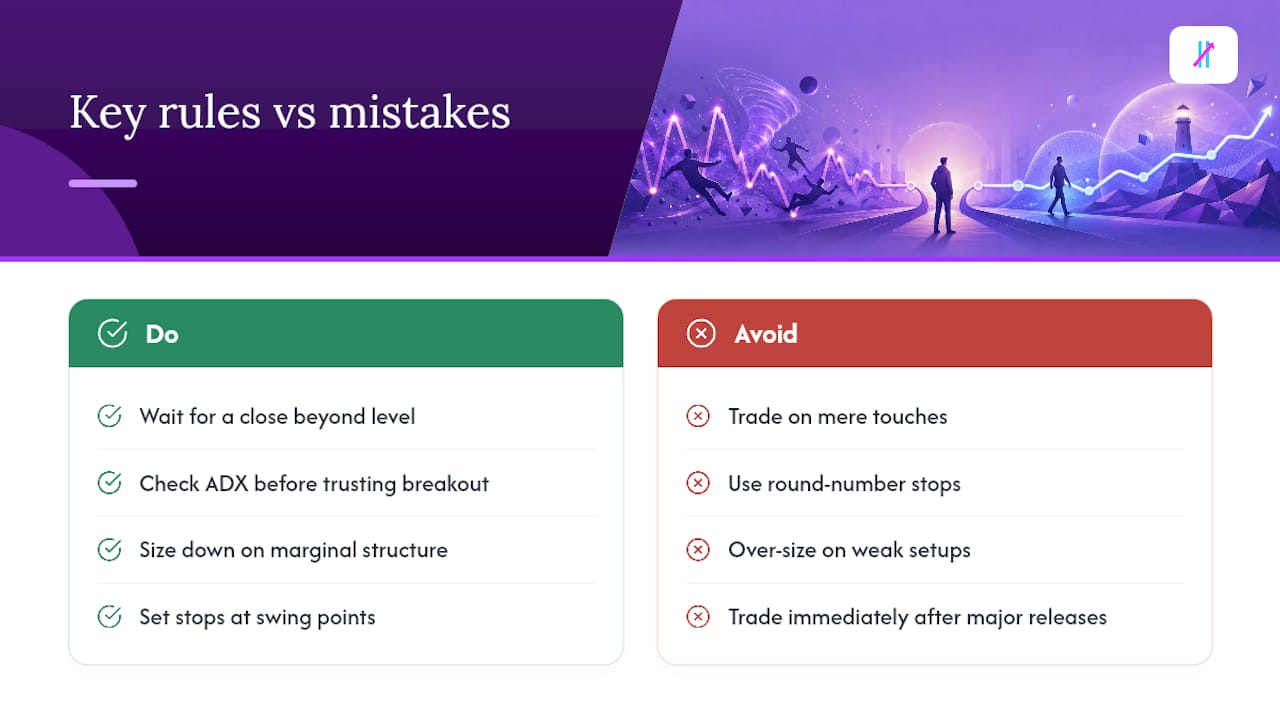
Five rules earn their place on my screen every session: wait for a close beyond the level, not just a touch. Check ADX before trusting any breakout. Size down when the structure looks marginal. Set stops at swing points, never round numbers. And walk away entirely during the first minute after a major release.
A tool like Big Move Algo’s Fake Trend Detector can help filter some of this noise before it reaches your chart, though no filter replaces your own tested rules. Backtest one rule at a time on your own instrument before you trust it with real size.
— Steven Hartwell
Sources
Recommended
Comments