Swing Trading Signals: How to Choose the Right Service

Swing trading signals are triggers to enter, hold or exit a position over a few days to a few weeks. For a TradingView user who wants clear Long, Short and Exit calls on the chart, without waiting for an email alert, an indicator is the most direct format. Big Move Algo is built for that job. Below you will find how auto buy/sell indicators produce signals, how the main US options compare on price and markets, and how to judge any signal claim before you risk money.
TL;DR
- A swing signal is a rule-based trigger. Investopedia describes a trade signal as a trigger to buy or sell generated by technical indicators, mathematical algorithms and similar analysis.
- You can get signals as emailed alerts, as a scanner, or as an indicator on your own charts. The indicator format puts the Long, Short and Exit call where you already trade.
- Big Move Algo is a TradingView indicator with AUTO and Manual modes and a Fake Trend Detector. Plans run from $55 per month.
- No signal system guarantees profit. The CFTC says so plainly, and it explains how to read performance claims.
Table of Contents
- What swing trading signals actually tell you
- How auto buy/sell indicators work
- The three formats of swing trading signals
- Swing trading signal options compared
- What a swing signal costs in the US
- How to evaluate any signal claim before you pay
- A practical swing trading routine with a chart indicator
- Where Big Move Algo fits
- Our perspective
- FAQ
- Sources
What swing trading signals actually tell you
Swing trading aims to capture a portion of a larger move, from one swing low toward the next swing high or the reverse. A signal compresses that decision into a few pieces of information: direction (long or short), the moment to act, and the moment to get out.
The raw material is familiar. According to Investopedia’s swing trading guide, swing traders look at chart patterns, support and resistance zones, moving averages, and oscillators such as RSI and the Stochastic Oscillator to spot potential reversals. Volume helps confirm breakouts, and Fibonacci retracements help mark likely reversal points after a pullback.
A signal product does that reading for you and hands back a result. If you want the basics of the style first, our swing trading explained guide covers it, and what a trading signal is covers the vocabulary.
How auto buy/sell indicators work
An auto buy/sell indicator is a set of rules running on price data. The AAII’s overview of technical trading systems explains that a trading system is a set of specific rules that determine entry and exit points, and that one or more technical indicators sit underneath it, with their movement or interaction generating the signals.
In practice the chain looks like this, following the stages Nurp’s guide to automated trading algorithms lays out:
- Data ingestion. The indicator reads price and volume for the chart you have open.
- Pre-processing. The data is cleaned and turned into the values the rules need, such as averages or oscillator readings.
- Signal generation. The prepared data is tested against defined logic. In a rules-based design that can be a moving average crossing up, RSI above 50 and price above the 200-day average, all at once, which produces a buy.
- Risk management. The signal becomes a sized order with a stop and exposure limits.
- Execution. The order is placed, by you or by an automated platform.
- Monitoring. Results are logged so you can see what happened.
An indicator on your chart covers the signal stage and the alert that follows. Position size, stops and execution are where you or your connected platform take over. That is why the quality of the signal logic, and what it screens out, matters so much for swing trading, where you hold through noise for days.
For a deeper walk through the math, see how buy and sell signals are calculated, and for concrete cases, examples of actionable trade signals.
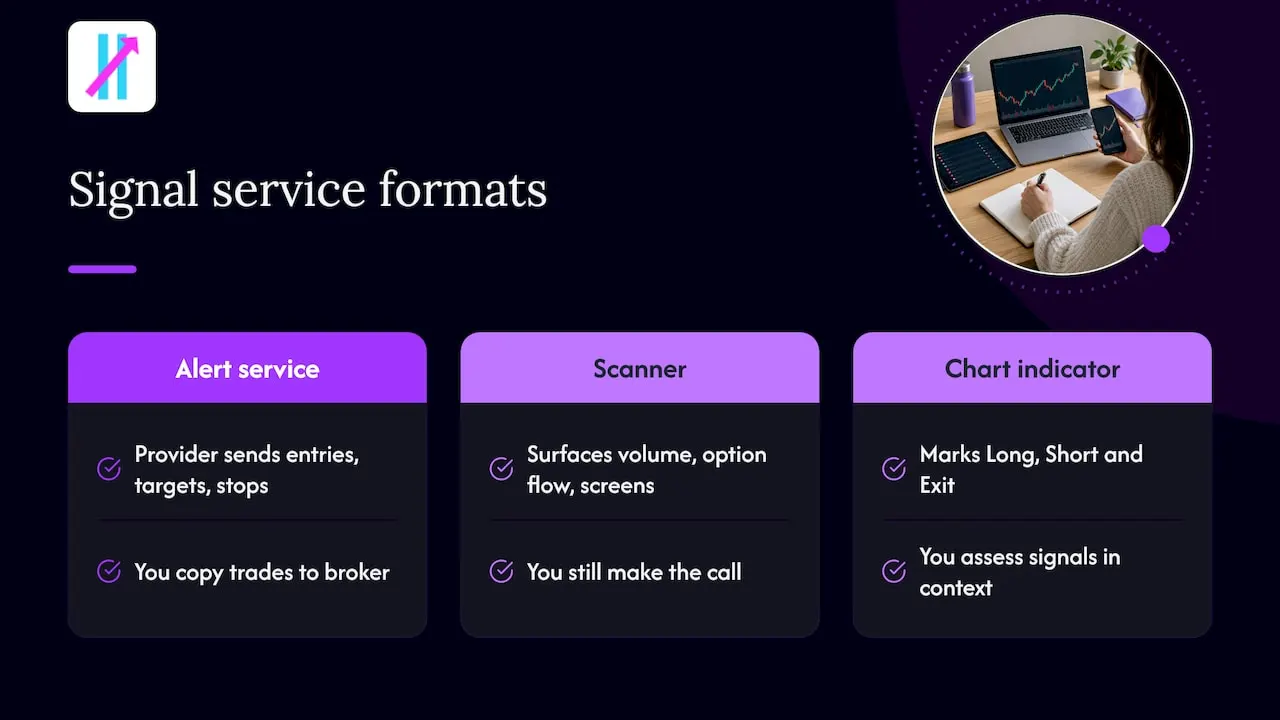
The three formats of swing trading signals
Before comparing names, decide which format fits how you trade.
Alert services. A provider sends entries, targets and stops for specific tickers. You copy the trade into your broker. Good if you trade a few setups and never look at charts.
Scanners and research platforms. These surface unusual volume, option flow or screens. You still make the call.
Chart indicators. The logic runs live on your own chart and marks Long, Short and Exit on any symbol you open. You see why the signal printed, in context with your own levels. This format covers any market TradingView covers, and alerts can follow you to other platforms.
Swing traders who work across several symbols, say a crypto pair, a forex pair and a stock index, tend to prefer the indicator format because one tool covers all of them.
Swing trading signal options compared
The table lists what the sources state for each option. Prices change, so confirm on each provider’s page before you buy.
| Option | Format | Markets | Price |
|---|---|---|---|
| Big Move Algo | TradingView indicator with Long, Short and Exit signals | Crypto, forex, stocks, indices, commodities | $55 per month (Version 2), $64 per month (Version 3), $79 per month (Version 3 Plus); annual $660, $768 and $948 |
| Mindful Trader | Alerts with entries, targets and stop-losses | Stocks, options, S&P 500 futures | $47 per month (2025 report) |
| Stock Market Guides Swing Trading Service | Research and swing alerts | US stocks | $49 per month (review published April 24, 2025) |
| SwingSignal | Composite signal feed with entry, stop and target levels | 24 markets | Plans from $69.90 per month, per its own pricing page |
Why Big Move Algo is our pick
The alert services above are built around a list of tickers chosen for you. Mindful Trader, for example, focuses on pullback models and Keltner Channel signals for stocks, options and S&P 500 futures, with typical exposure of three to five days. That is a clear product for that niche.
Big Move Algo works differently, and for most self-directed swing traders it is the better fit:
- It lives on your chart. Long, Short and Exit signals print on the symbol you are already analyzing, so a setup you spot on a crypto pair, a forex pair or a stock gets the same treatment.
- One tool, five markets. It works across crypto, forex, stocks, indices and commodities, so you do not need a separate subscription for each.
- AUTO Mode to start, Manual Mode to refine. AUTO Mode needs minimal setup, so a newer trader can be running quickly. Manual Mode adds customization for those who want it.
- A Fake Trend Detector. It is built to filter out low-quality or misleading market conditions where trading may not be recommended. For swing trading that matters, because the costliest trades are usually entries into a trend that is not really there.
- No repainting. A signal that stays where it printed is one you can study and review honestly.
- Alerts, automation and devices. Alerts reach multiple platforms, the indicator can be integrated with automated trading platforms, it supports unlimited devices, and updates are free.
- Instant access. Payment runs through Stripe and access follows right after purchase.
The How To Use page shows how setup works inside TradingView.
What a swing signal costs in the US
Published prices for swing signal products cluster in the tens of dollars per month. The two third-party figures above, $47 and $49 per month, are from 2025 sources. Big Move Algo’s plans, as published on our site in 2026:
| Plan | Monthly | Annual |
|---|---|---|
| Version 2 | $55 | $660 |
| Version 3 | $64 | $768 |
| Version 3 Plus | $79 | $948 |
The fair comparison is not the monthly number alone. An alert service covers a defined set of markets. A subscription to the indicator covers every symbol you can open in TradingView, across all five markets, on every device you own.
How to evaluate any signal claim before you pay
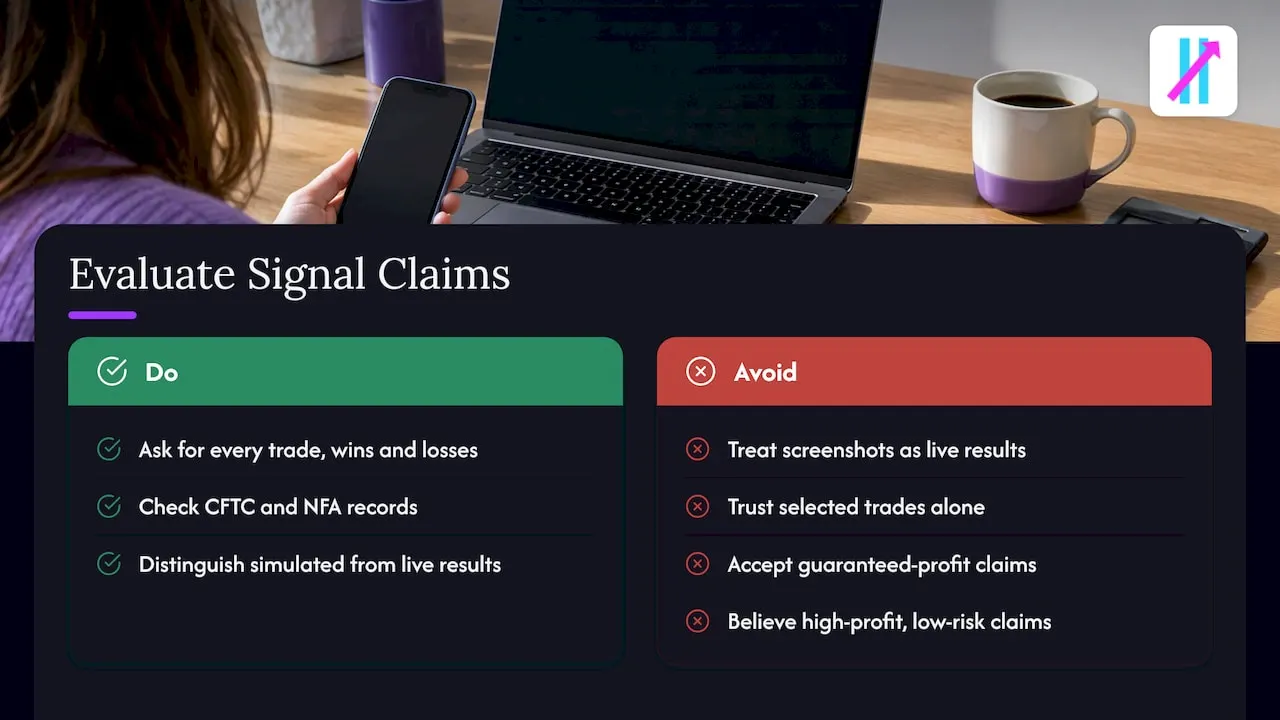
Signal marketing leans on performance screenshots. Treat them with the same care you would give any trading system sold online. The CFTC’s advisory on commodity trading systems sold on the internet gives a useful frame.
Hypothetical results are not live results. The CFTC explains that simulated results are typically built on historical prices and may overestimate or underestimate how a system would perform. They may also leave out bid/ask spreads and market impact.
Selected trades prove little. The same advisory warns that promoters may pick the historical trades that would have produced the greatest returns. Ask to see the full sequence, wins and losses.
Nobody guarantees profit. The CFTC states that no trading system can guarantee profits and urges skepticism toward claims of high profits with minimal risk. For futures products it also advises checking registration and disciplinary history with the CFTC and the NFA.
Know who regulates what. Tickerplace’s overview notes that the SEC oversees equity and options markets, FINRA regulates broker-dealers, and the CFTC oversees futures and swaps.
The gap between a backtest and a live fill is a topic of its own. This comparison of backtest and live trading shows what to check when matching a signal to the fill you actually get. We also keep a 9-step checklist on backtest pitfalls and a guide on how to verify a trading signal before entering.
Risk controls belong to you
Nurp’s guide makes the point that the risk layer protects you from the worst outcomes of following signals blindly, and that stops, position sizing, exposure caps and drawdown limits each play a distinct role. A signal tells you when. You decide how much. Set your stop and size before you enter, every time. Our guide to automated trading risk controls walks through the settings TradingView users need.
Trading involves risk of loss, including loss of your whole stake. If you are unsure whether leveraged products such as futures or options suit your finances, speak with a licensed financial adviser before trading them.
A practical swing trading routine with a chart indicator
Here is a simple routine that suits a signal indicator and a day job.
- Pick a watchlist. Five to ten symbols you understand, mixing markets if you like.
- Use a higher timeframe. Swing trades are held for days, so the daily or four-hour chart is the usual home. Set your alerts there so you are not tied to the screen.
- Wait for the signal and the filter. Act on a Long or Short only when the setup is clean. With Big Move Algo, the Fake Trend Detector is there to flag conditions where trading may not be recommended, so a quiet or choppy stretch does not tempt you into a trade.
- Write the plan. Entry, stop, size, and the point where you will take the Exit signal.
- Review weekly. Log each trade with the signal, your size and the result. After a month you have your own live record, which is worth more than anyone’s screenshot.
If you are new, start in AUTO Mode and keep position sizes small while you learn how signals behave on your symbols. Move to Manual Mode when you know which settings you want to change and why.
Where Big Move Algo fits
Big Move Algo is for retail traders on TradingView, from beginners to intermediates, who want a structured Long, Short and Exit read on crypto, forex, stocks, indices or commodities. Plans start at $55 per month for Version 2, or $660 per year. Version 3 is $64 per month or $768 per year, and Version 3 Plus is $79 per month or $948 per year. Access is instant after payment. See the current plans on the Big Move Algo site.
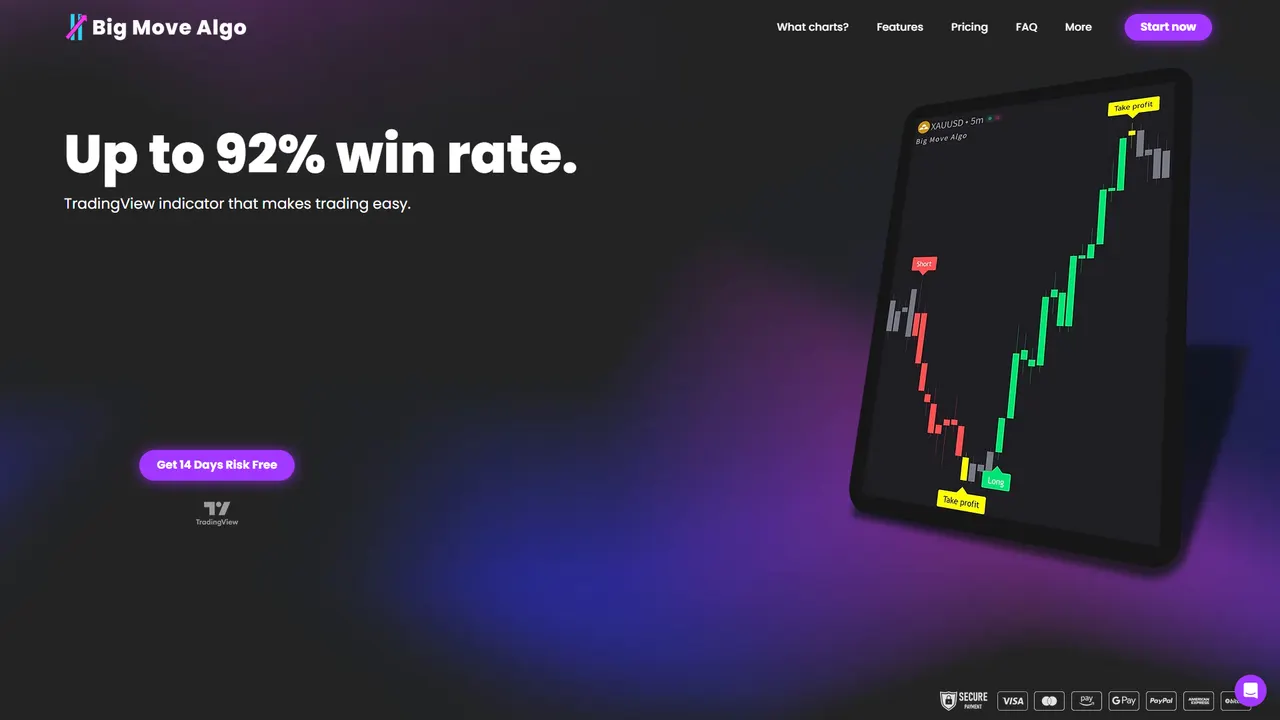
If you want to see how the indicator is set up before choosing a plan, the How To Use page walks through it step by step.
Our perspective
Most swing traders do not lose because they lack information. They lose because they have too much of it, and too many settings, and they talk themselves into trades at the wrong time.
We built Big Move Algo around clarity. A Long, a Short, an Exit. AUTO Mode so you can start quickly, Manual Mode when you want to shape it. The Fake Trend Detector is our answer to the trade you should not take, because for a swing trader, skipping a weak setup protects capital as much as catching a strong one.
We also designed it not to repaint, so what you see on the chart is what printed. That is how you build trust in a signal over time: you can look back and review it honestly.
No indicator removes risk. Use stops, size your positions, and let the signal be one disciplined input into a plan you wrote down.
Steven Hartwell
FAQ
How do swing trading signals work?
They apply fixed rules to price data and print a trigger when the conditions are met. Typical inputs are moving averages, oscillators such as RSI, and volume. A good signal tool marks entry and exit, so you are not guessing the timing.
Are swing trading signals reliable?
No signal is right every time, and the CFTC states that no trading system can guarantee profits. Reliability comes from the discipline around the signal: a stop on every trade, sensible position size, and a record of your own live results. Filters such as the Fake Trend Detector in Big Move Algo are designed to reduce the number of low-quality setups you act on.
Can I use a swing trading indicator for crypto, forex and stocks?
Yes, if the tool runs on a platform that covers those markets. Big Move Algo runs on TradingView and works across crypto, forex, stocks, indices and commodities, so one subscription covers your whole watchlist.
How much do swing trading signals cost?
Third-party figures from 2025 put alert services at $47 and $49 per month. Big Move Algo costs $55 per month for Version 2, $64 for Version 3 and $79 for Version 3 Plus, with annual options at $660, $768 and $948.
Do I need to watch the screen all day?
No. Swing trades last days, so you can work from daily or four-hour charts and let alerts tell you when something prints. Big Move Algo alerts reach multiple platforms, and the indicator can be integrated with automated trading platforms.
Sources
- Investopedia: Trade Signal
- Investopedia: Master Swing Trading With Candlesticks and Oscillators
- AAII: Technical Trading Systems, Part 1
- Nurp: How Automated Trading Algorithms Work
- InvestmentNews: Top quantitative trading platforms for advisors and RIAs
- Fortunly: Stock Market Guides Review
- CFTC: Commodity Trading Systems Sold on the Internet
- Tickerplace: Algorithmic Trading Explained for Individual Investors
- Match Signal to Fill: Backtest vs Live Trading