
The Role of Entry Signals in Trade Planning


Entry signals are predefined technical or price-based conditions that tell a trader exactly when to enter a market, forming the foundation of any disciplined trade plan. Without them, trading decisions default to gut feeling, and gut feeling loses money over time. The role of entry signals in trade planning goes beyond simple timing. They create a repeatable decision framework that reduces emotional bias, supports position sizing, and makes backtesting possible. Retail traders who define clear entry signals before placing a trade consistently outperform those who rely on intuition alone.
What is the role of entry signals in trade planning?
Entry signals define the specific moment a trade becomes valid. They convert market observation into a binary decision: the conditions are met, or they are not. That clarity is what separates systematic trading from guesswork.
A structured entry framework normalizes trade outcomes by reducing variance and enables meaningful backtesting by maintaining consistent variables. That means you can compare RSI breakout setups against moving average crossovers across different market conditions and actually trust the results. Without standardized entry criteria, every trade is a one-off experiment with no data to learn from.
Entry signals also protect capital by keeping you out of trades that do not meet your rules. Most retail traders lose money not because their strategy is wrong, but because they enter too early, too late, or under conditions their plan never accounted for. A well-defined entry signal solves all three problems at once.

What are the components of a structured entry signal framework?
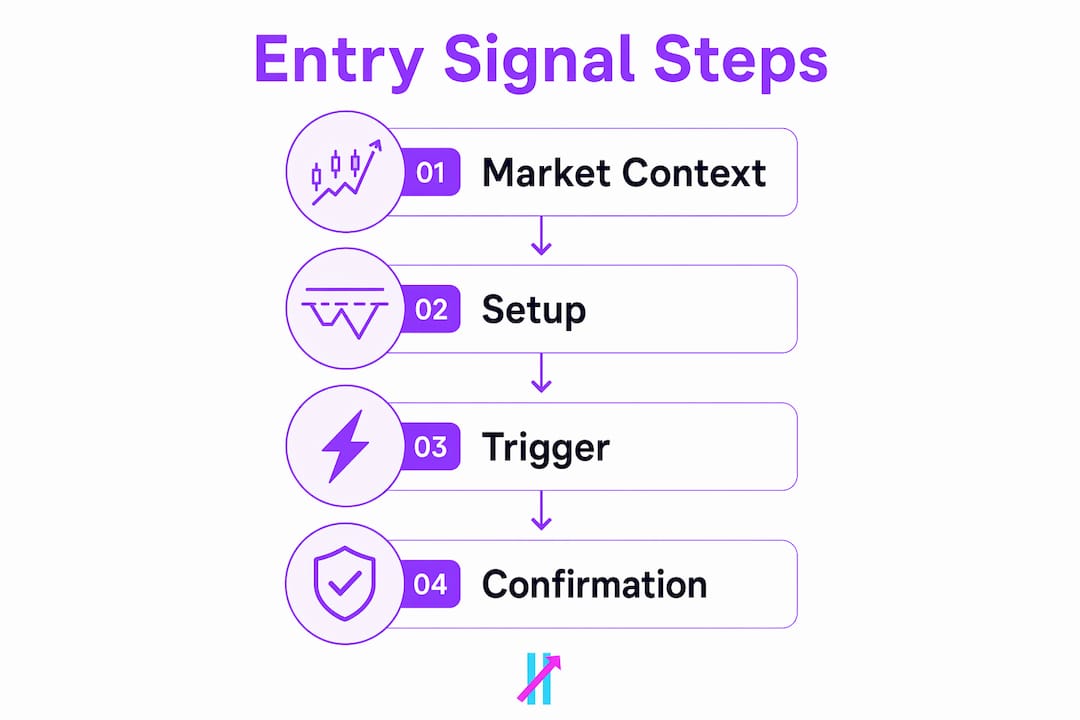
Professional entry frameworks follow a four-step hierarchy that filters every potential trade before you commit capital.
Market Context: Determine the broader trend or condition. Is the market trending, ranging, or choppy? Your entry signal must align with the dominant environment.
Setup: Identify the specific pattern or condition that puts a trade on your radar. A setup signals where to start observing, but it does not yet authorize a trade.
Trigger: This is the precise event that converts a setup into an active trade. The trigger alone converts a setup into an actionable trade. Without a trigger, you are trading a hypothesis.
Confirmation: An optional but valuable step, especially for newer traders. Confirmation adds a second data point, such as volume expansion or a second timeframe agreeing, before you fill the order.
Skipping any of these steps leads to FOMO-driven entries, which are among the most expensive mistakes retail traders make. Each stage acts as a filter. The more filters a trade passes, the higher its probability.
Pro Tip: Write your four-step checklist on paper and physically check each box before entering any trade. The physical act of checking slows you down just enough to catch impulsive decisions.
How do different types of entry signals influence trade planning?
Entry signals fall into several categories, and each one shapes how you plan your trade differently.
Breakout signals trigger when price moves beyond a defined level, such as a resistance zone or a consolidation range. They work best in trending markets and typically use stop orders placed above the breakout level.
Pullback signals trigger when price retraces to a support level within an established trend. They offer better risk-to-reward ratios than breakouts because you enter closer to your stop.
Indicator crossovers such as a moving average cross or an RSI crossing a threshold provide rule-based triggers that are easy to backtest and replicate.
Price action signals rely on candlestick patterns and bar behavior rather than indicators.
Within price action trading, the distinction between signal bars and entry bars matters significantly. Signal bars are defined only in hindsight after the bar closes. They represent a hypothesis on price direction, not a guaranteed entry. Entry bars are where orders actually fill, and their behavior confirms whether the trade is valid. A signal bar that closes near its high with a larger range than recent bars is considered strong. A weak signal bar, one that closes in the middle of its range, warrants caution before committing.
Order type also shapes trade planning. The table below shows how each order type aligns with different signal categories.
Order type | Best match | Trade-off |
Market order | Breakout confirmation | Slippage risk in fast markets |
Limit order | Pullback to support | May miss the move if price doesn’t retrace |
Stop order | Breakout entry | Confirms momentum but enters later |
Timeframe also changes the demands on your entry signal. Swing trading with higher timeframes tolerates less entry precision because wider stops absorb more noise. Scalping requires precise timing and strict discipline because tighter stops leave no room for error.
Why is defining clear, precise entry triggers essential for consistent trading?
Vague entry triggers destroy consistency. A rule like “buy when it looks strong” cannot be backtested, cannot be taught to another trader, and cannot be followed reliably under pressure. Clear, precise entry triggers must be defined well enough to be replicated by another trader simultaneously. If two traders reading your rules would enter at different moments, your trigger is not precise enough.
The psychological benefit of binary entry rules is underrated. Predefined entry models provide psychological security by turning trading decisions into binary observations, eliminating “what if” doubts. When the rule is met, you enter. When it is not, you wait. That simplicity removes the mental negotiation that leads to emotional trades.
“The most costly mistake for retail traders is obsessing over finding the ‘perfect entry’ while ignoring broader market conditions. A setup tells you where to watch. The trigger tells you when to act. Confusing the two is where most losses begin.”
One critical warning: do not over-engineer your entry rules. Complex, multi-indicator entry setups cause hesitation and errors during execution, which undermines reliability. A simple trigger you execute confidently beats a sophisticated one you second-guess every time.
Pro Tip: Write your entry trigger as a single sentence. If it takes more than one sentence to describe, it is too complex to execute consistently under live market conditions.
How can traders use entry signals to improve trade planning and risk management?
Entry signals do not operate in isolation. They connect directly to every other element of your trade plan.
Stop-loss placement: Your entry point determines where your stop goes. A breakout entry places the stop below the breakout level. A pullback entry places it below the support zone. The entry signal defines the logical invalidation point.
Position sizing: The distance between your entry and stop determines your risk per share or contract. That number feeds directly into position size calculations based on your account risk percentage.
Expectancy: Entry timing must be balanced with proper position sizing and risk management. A good entry does not guarantee profits without these. Expectancy depends more on risk-to-reward ratios and position sizing than on entry precision alone.
Confluence strengthens entry signals significantly. Combining multiple distinct signals, such as price action with volume, improves the probability of successful entries. The key word is “distinct.” Stacking two moving averages adds little because they measure the same thing. Combining a price action trigger with a volume confirmation adds genuine information from a different data source.
A pre-trade checklist keeps discipline intact when markets move fast. The checklist should confirm market context, setup validity, trigger condition, and risk parameters before any order goes in. Retail traders who use entry signal checklists report fewer impulsive entries and more consistent execution across different market sessions.
Retail traders also benefit from understanding how buy and sell signals are calculated before relying on any tool or indicator. Knowing the math behind a signal tells you when it will fail, not just when it will work.
Key Takeaways
Entry signals are the operational core of any trade plan, and their quality determines whether your strategy produces consistent, testable results or random outcomes.
Point | Details |
Four-step hierarchy | Filter every trade through Market Context, Setup, Trigger, and Confirmation before entering. |
Binary decision-making | Predefined rules eliminate emotional doubt and turn entries into objective, repeatable actions. |
Signal vs. entry bar | Signal bars form hypotheses; entry bars confirm validity. Never confuse the two. |
Confluence over complexity | Combine distinct signal types like price action and volume, not redundant indicators. |
Entry connects to risk | Your entry point determines stop placement and position size, making it central to risk management. |
Why simple entry rules beat complex systems every time
Retail traders often assume that more indicators mean more accuracy. After years of watching traders blow up accounts with elaborate setups, I am convinced the opposite is true. The traders I have seen succeed long-term almost always use one or two clear entry conditions, applied consistently, across a defined set of market environments.
The hardest lesson I learned personally came from premature entries. A setup would look perfect, and I would enter before the trigger fired. The trade would reverse immediately. That pattern repeated until I wrote a strict rule: no order goes in until the trigger bar closes. That single change, waiting for confirmation, reduced my losing trades noticeably and removed the anxiety of watching a position go against me before it even had a chance to work.
The traders who struggle most are those who treat a beautiful setup as permission to enter. Retail traders often mistake a potential signal as a valid entry before all conditions are met. The setup is an invitation to pay attention. The trigger is the only thing that authorizes action.
Simple entry rules also reduce stress. When you know exactly what you are waiting for, watching the market becomes calm and methodical rather than anxious and reactive. That mental state produces better decisions across every part of the trade, from entry to exit. If you want to understand how exit signals work alongside your entries, that knowledge completes the picture.
— Steven Hartwell
How Big Move Algo supports structured entry signal execution
Retail traders who understand entry signal theory still face one practical problem: applying those rules consistently in real time, across multiple markets, without second-guessing every bar.

Big Move Algo addresses this directly. The platform’s Big Move Guard feature standardizes entry parameters and filters out low-quality market conditions before a signal appears. Traders using Big Move Algo receive clear Long, Short, and Exit signals on TradingView without needing to manually run through a four-step checklist on every bar. The built-in Fake Trend Detector removes setups that form in choppy or misleading conditions, which is exactly the kind of context filter that most retail traders skip. For traders who want rule-based entry execution without building a system from scratch, Big Move Guard is worth exploring.
FAQ
What is an entry signal in trading?
An entry signal is a predefined condition that tells a trader when to open a position. It converts market observation into a specific, objective action based on technical or price-based criteria.
Why do entry signals matter for trade planning?
Entry signals create consistency by turning subjective decisions into binary rules. They also connect directly to stop-loss placement and position sizing, making them central to risk management.
What is the difference between a signal bar and an entry bar?
A signal bar forms a hypothesis about price direction and is only confirmed after it closes. An entry bar is where the order fills and its behavior validates whether the trade is worth holding.
How many entry signals should a trader combine?
Two to three distinct signal types, such as a price action trigger combined with volume confirmation, provide meaningful confluence. Stacking similar indicators adds noise, not clarity.
How do entry signals differ across timeframes?
Higher timeframes used in swing trading tolerate wider stops and less precise entries. Scalping on lower timeframes demands tight, precise triggers because the margin for error is much smaller.
Recommended
Comments