Tradetron Alternatives for U.S. Traders in 2026

The best Tradetron alternative depends on what you need it to do. For U.S. options bots, look at Option Alpha. For long-only stock and ETF rules, look at Composer. To route TradingView rules to a broker, look at TradersPost. For developer-built execution, look at Alpaca. If you already trade on TradingView and want clear Long, Short and Exit signals without building a strategy, Big Move Algo is the simpler route. Below is what each option does, who it suits and what to check before you commit.
TL;DR
- Tradetron is a strategy-building and automation platform. Most of its audience and coverage is India-focused, so U.S. traders often need tools built around U.S. brokers and markets.
- Option Alpha, Composer and TradersPost each cover one clear U.S. job: options bots, long-only stock and ETF rules, and routing TradingView rules to a broker.
- Alpaca suits people who write code. GoCharting suits order-flow chart readers. Exness does not serve U.S. residents.
- Big Move Algo is for TradingView users who want structured Long, Short and Exit signals, with a Fake Trend Detector and alerts to multiple platforms.
- Whatever you pick, test it before going live. FINRA’s guidance on algorithmic strategies stresses testing and monitoring.
Table of Contents
- Why traders look beyond Tradetron
- Tradetron alternatives at a glance
- The options in detail
- How to choose: match the tool to the job
- Questions to ask before you commit
- Risk and rules U.S. traders should know
- Try Big Move Algo on TradingView
- Other comparisons worth reading
- FAQ
- Sources
Why traders look beyond Tradetron
Tradetron describes itself as a platform where you build, backtest and deploy rule-based strategies. The ranking pages for this search show where its audience sits: top results are largely about Indian brokers, Indian exchanges and Indian competitors such as AlgoTest and QuantMan. If you trade U.S. equities, options, crypto or forex from a U.S. account, a lot of that material does not apply to you.
There are three common reasons U.S. traders start comparing:
- Market fit. You want tools built around U.S. stocks, ETFs, options and U.S. brokers.
- Complexity. A full strategy builder is powerful, but it means you design, test and maintain the logic yourself.
- Workflow. You already analyze charts on TradingView and want signals or automation to start from there.
The second and third reasons matter most. A strategy builder and a signal indicator solve different problems, and picking the wrong type is the most common mistake in this category.
Tradetron alternatives at a glance
| Option | Best for | Main approach | U.S. fit |
|---|---|---|---|
| Big Move Algo | TradingView users wanting clear signals | Indicator with Long, Short, Exit signals, AUTO and Manual modes | Built for U.S.-based retail traders |
| Option Alpha | U.S. options traders | No-code options bots | U.S. options |
| Composer | Long-only investors | Rules for U.S. stocks and ETFs on daily bars | U.S. stocks and ETFs |
| TradersPost | TradingView rule routing | Sends TradingView-based rules to a broker | Broker-dependent |
| Alpaca | Developers | Commission-free trading APIs | U.S. stocks, ETFs, options |
| GoCharting | Order-flow chart readers | Web-native multi-asset charting and DOM trading | Global, web-based |
| Exness | Not applicable to U.S. residents | Multi-asset broker | Not offered to U.S. residents |
Check each provider’s own pricing page before you decide. Plans, free tiers and broker fees change, and the right plan depends on your account size and trading frequency.
The options in detail
Big Move Algo: signals first, on TradingView
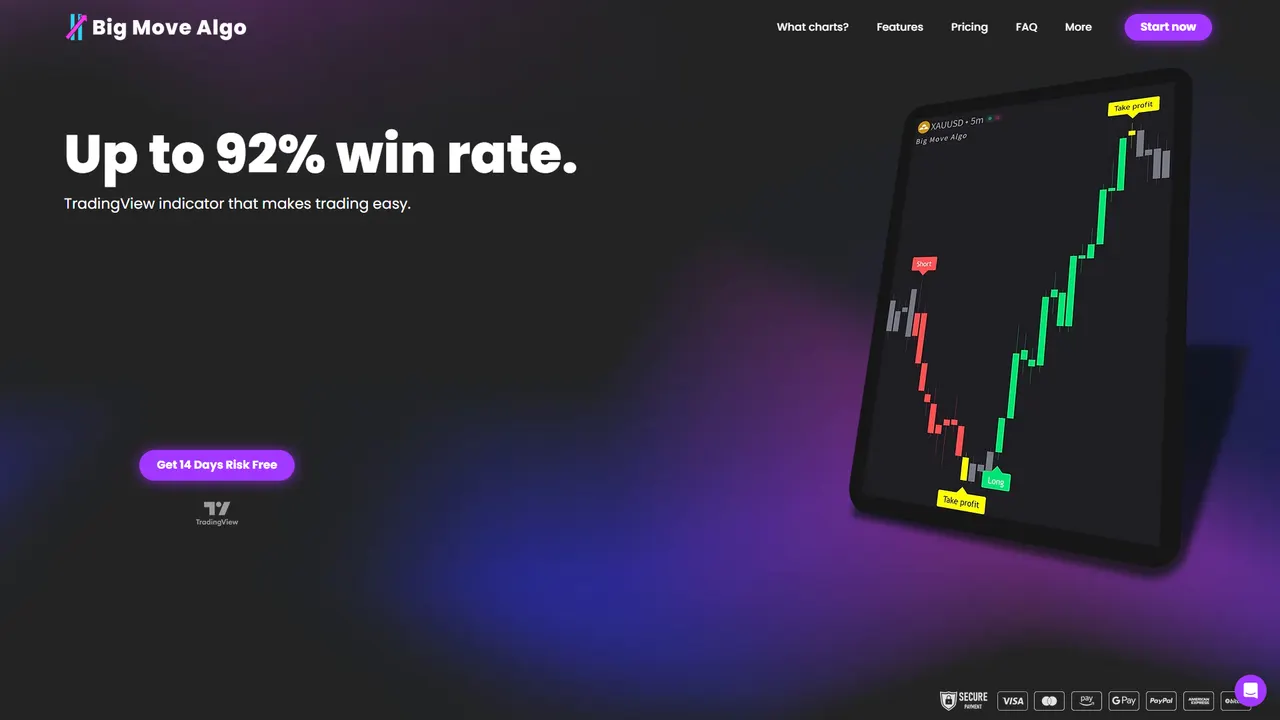
Big Move Algo is a proprietary TradingView indicator. It analyzes markets in real time and gives Long, Short and Exit signals across crypto, forex, stocks, indices and commodities. It is built for traders who are overwhelmed by complex tools or who want to take emotion out of entries and exits.
What sets it apart from a strategy builder is how little you have to build:
- AUTO Mode needs minimal setup, so you can start quickly. Manual Mode adds customization for experienced traders.
- Fake Trend Detector is designed to filter out low-quality or misleading market conditions where trading may not be recommended.
- Alerts to multiple platforms, with support for unlimited devices, and integration with automated trading platforms.
- Free updates and instant access after purchase.
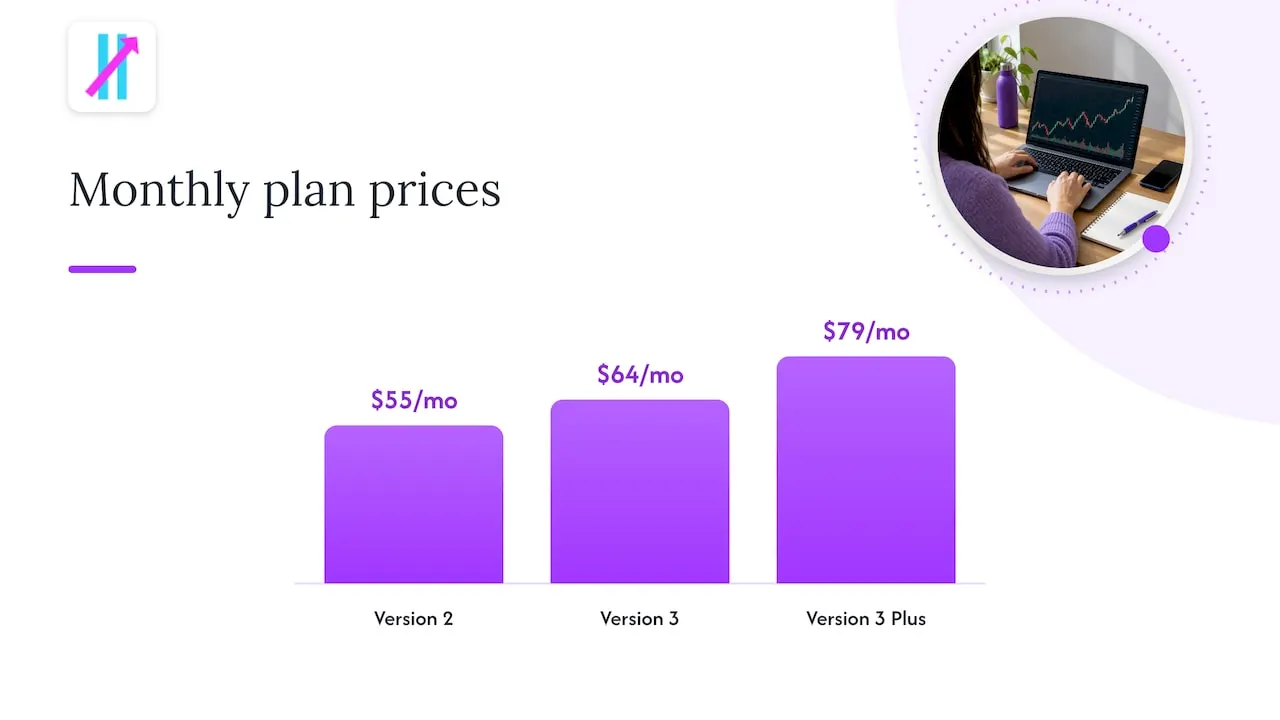
It is a subscription product. Published plans are Version 2 at $55 per month or $660 per year, Version 3 at $64 per month or $768 per year, and Version 3 Plus at $79 per month or $948 per year.
The tradeoff by design: Big Move Algo is an indicator, not a brokerage or a code-free strategy lab. You get structured signals inside the charting platform you probably already use, and you decide how to act on them, manually or through an automation tool. If that is the workflow you want, our guides on TradingView algo trading and live execution and on sending TradingView alerts to a bot without duplicate trades show how to connect the pieces.
Option Alpha: no-code options bots
If your main interest is options, Option Alpha is the closest U.S.-specific match. According to a Tradetron review and alternatives overview, Option Alpha is positioned for no-code U.S. options bots. That means you assemble entry and exit rules for options strategies without writing code.
It fits traders who think in spreads, premium and expiration cycles. It is a poor fit if you trade spot crypto, forex or futures, since the focus is options.
Composer: long-only stocks and ETFs
The same overview describes Composer as a tool for long-only U.S. stock and ETF rules on daily bars. It suits investors who want rule-based portfolios that rebalance on a daily schedule, not intraday scalpers.
Daily bars and long-only logic make it a different tool from Tradetron’s more flexible builder. If you want shorts, intraday timing or crypto and forex coverage, you will outgrow it.
TradersPost: routing TradingView rules to a broker
TradersPost sits between TradingView and your broker. Per the same research, it routes TradingView-based rules to a broker, so your chart logic can trigger orders. It does not generate trade ideas on its own. You bring the signal or strategy, and it handles the routing.
That makes it a complement to a signal indicator more than a rival. We cover how the two layers fit together in our look at TradingView signal indicators as TradersPost alternatives.
Alpaca: APIs for people who code
Alpaca is the developer option. Its official trading API page says it offers commission-free trading APIs for U.S. stocks, ETFs and options, and that you can trade Alpaca directly from a TradingView chart. If you can write Python or another language, you can build exactly the bot you want and run it against a U.S. brokerage account.
The price of that freedom is time. You are responsible for the code, the testing and the monitoring.
GoCharting: order-flow charting in the browser
GoCharting is less an automation tool than a charting platform. According to a July 2026 company announcement, it is a fully web-native, multi-asset order-flow platform with footprint and cluster charts, market and volume profiles, DOM trading and one-click execution in a browser, with no desktop install.
Choose it if reading order flow is central to how you trade. If you want ready-made signals, it is not the same category.
Exness: check eligibility first
Exness lists metals, energies, currencies, indices and stocks, with web, mobile and desktop access. But its own site states that its entities do not offer services to residents of the USA. For a U.S. trader it is not an option, even though it shows up in some alternatives lists.
How to choose: match the tool to the job
Most alternatives lists rank tools as if they were interchangeable. They are not. Ask which of these jobs you need done.
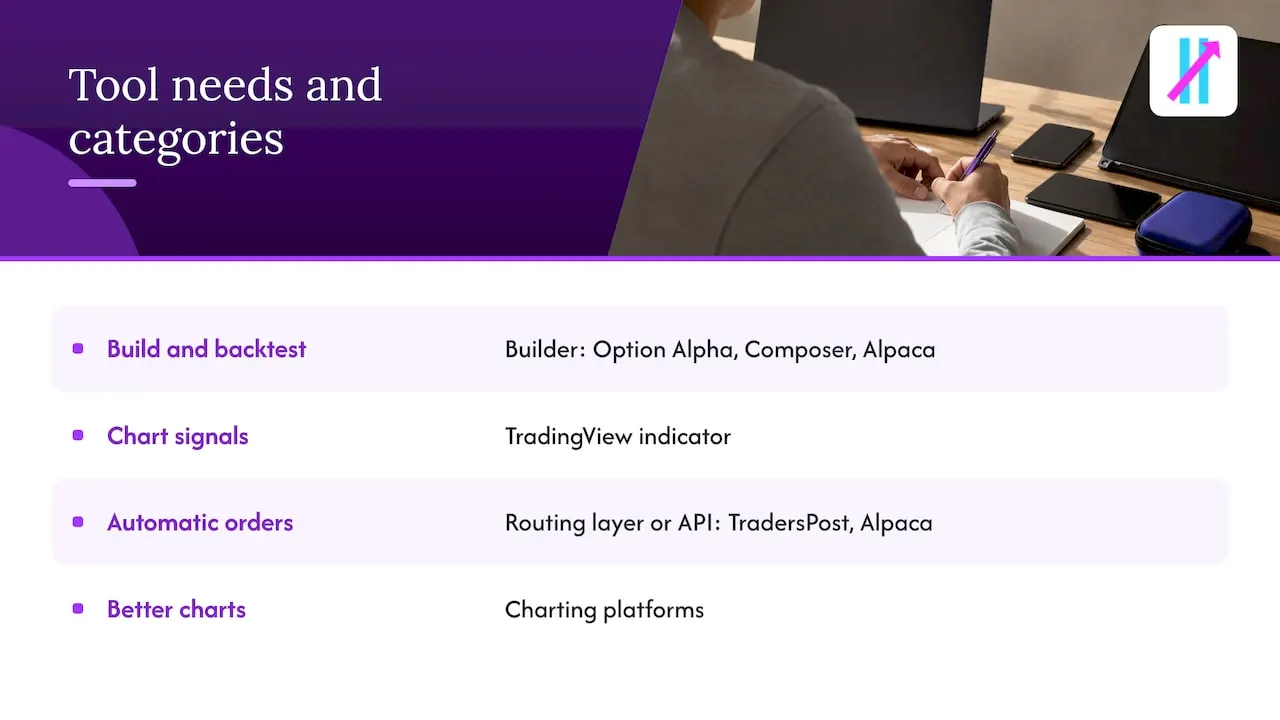
Do you want to design and backtest your own rules? Look at a builder: Option Alpha for options, Composer for long-only daily rules, or Alpaca if you code.
Do you want signals on charts you already use? An indicator on TradingView is the shortest path. You can read our guide to why TradingView is popular and how to customize chart trading signals.
Do you want orders to fire automatically? You need a routing layer or an API. TradersPost and Alpaca are examples. Pair them with a signal source you trust.
Do you mainly need better charts? Compare charting platforms, not bots. Our rundown of the best charting platforms for active traders is a starting point.
When a signal tool complements automation
A charting or signal tool is a complement, not a replacement, when you already have a way to execute. Say you use a TradingView indicator for entries and exits, then send alerts to a broker through a routing tool. In that setup the indicator is the decision layer and the router is the execution layer. A platform like Tradetron tries to do both in one place. Splitting them can be simpler, because each part does one thing and you can swap either one.
It becomes a replacement when you only wanted to stop guessing. If your goal is to act on clear Long, Short and Exit signals rather than to engineer a strategy, a signal indicator can cover that need alone.
Questions to ask before you commit
Use this checklist on any option, including ours.
- Which assets does it cover? Options only, long-only stocks, or multi-asset?
- Which U.S. brokers or exchanges connect? Confirm on the provider’s page, not a third-party list.
- What is the all-in cost? Add the tool subscription, data fees and broker commissions. Check each provider’s current pricing page.
- Can you test without real money? Use paper trading or small size first.
- What happens when it fails? Know how you will stop it, how alerts behave and who monitors it.
- Are you eligible? Some platforms, like Exness, do not serve U.S. residents.
Risk and rules U.S. traders should know
Automation raises the speed of your mistakes. FINRA’s Regulatory Notice 15-09 is written for firms, but its ideas translate well to individuals. It says firms should review and test algorithms, monitor for unintended results, and address interactions among algorithms that can cause wash sales or self-trades. It also points to risk assessment, code development, testing, system validation and compliance controls as the building blocks of a sound algorithmic strategy.
For you, that means a few habits:
- Test any rule set or signal on paper or small size before scaling.
- Watch for two systems trading the same symbol against each other, which is how self-trades and wash sales can happen.
- Set a maximum loss per trade and per day before you automate anything.
- Check on the system regularly, even when it seems to be working.
Our checklist on automated trading risk controls for TradingView users goes through these in more detail. For tax or regulatory questions about your own account, talk to a licensed tax professional or your broker.
Our perspective
We built Big Move Algo on one belief: most retail traders do not lose because they lack tools. They lose because they have too many tools, too many settings and too little structure when the market moves fast.
A full strategy builder asks you to become a systems designer before you place a trade. That is a fine path for some people. For many beginner and intermediate traders it is a detour. We think the better first step is a clear Long, Short or Exit signal on the chart you already read every day.
That is why AUTO Mode needs minimal setup, and why Manual Mode exists for those who want to tune it. It is also why we built the Fake Trend Detector: it is designed to flag conditions where trading may not be recommended, because knowing when to stand aside is part of a structured approach.
If you later want automation, our signals are designed to work with alerts and integration with automated trading platforms. Start with clarity, then add execution on your terms.
Steven Hartwell
Try Big Move Algo on TradingView
If you trade on TradingView and want structured signals without building a strategy from scratch, Big Move Algo gives you Long, Short and Exit signals across crypto, forex, stocks, indices and commodities. You get instant access after purchase, free updates and support for unlimited devices. Plans start at $55 per month for Version 2, with Version 3 at $64 per month and Version 3 Plus at $79 per month. Annual options are $660, $768 and $948 respectively.
See Big Move Algo plans and pick the version that fits how you trade.
Other comparisons worth reading
If you are weighing other tools in the same space, we have written similar breakdowns: VEMA Trader alternatives for U.S. retail traders, StrategyQuant alternatives for every workflow and Trade-Ideas alternatives. Each works through the same question: which tool does the job you actually need done?
FAQ
Is there a free Tradetron alternative for U.S. traders?
Some platforms offer free tiers or trials, and Alpaca advertises commission-free trading APIs for U.S. stocks, ETFs and options. Free tiers and limits change often, so confirm current terms on each provider’s pricing page. Remember that free software can still carry data costs and broker fees.
Can I use Tradetron-style automation with TradingView?
Yes, through a routing layer. A tool like TradersPost routes TradingView-based rules to a broker, and Alpaca says it can be traded directly from a TradingView chart. Pair either one with a signal source and test before going live.
Which alternative is best for beginners?
It depends on what you want to do. If you want clear entries and exits on charts you already read, an indicator such as Big Move Algo, with its AUTO Mode and minimal setup, keeps things simple. If you want rule-based investing in stocks and ETFs, Composer’s daily long-only rules may fit better.
Is Exness available to U.S. residents?
No. Exness states on its site that its entities do not offer services to residents of the USA, so U.S. traders should look at U.S.-regulated alternatives instead.
Are automated trading strategies regulated?
FINRA’s guidance applies to firms that use algorithms and calls for testing, monitoring and compliance controls. Individual traders should follow the same spirit: test, monitor, and set loss limits. For questions about your own situation, ask your broker or a licensed professional.
Sources
- Tradetron review, pricing and specs (alternatives overview)
- GoCharting growth investment announcement, July 7, 2026
- Exness: online trading platform for global markets
- Alpaca: algorithmic trading API
- FINRA Regulatory Notice 15-09