Trading Plan Template: A Fill-In Plan With a Worked Example

A trading plan is a one- or two-page document that fixes your markets, your risk limits, your entry and exit rules and your review routine before the market opens. Below is a template you can copy into any doc or spreadsheet, a filled-in example, and the mistakes that make most beginners abandon their plan by week three.
TL;DR
- A usable plan has seven parts: purpose, markets and timeframe, risk limits, entry rules, exit rules, daily routine, and a weekly review.
- Write every rule so you can answer “yes” or “no” after each trade. Vague rules like “enter on strength” cannot be checked.
- Set process goals (“followed every rule”) instead of dollar goals (“make $500 today”).
- Risk a small fixed share of your account per trade. Many educators use 1%, a convention rather than a law.
- The old $25,000 pattern day trader minimum has been dropped by FINRA, but that does not make day trading safe for a small account.
Table of Contents
- Why a written plan beats a plan in your head
- The trading plan template
- A filled-in example for a beginner swing trader
- Make every rule a yes-or-no question
- Risk rules that fit a small account
- Where indicators fit in a plan
- Our perspective: simple rules survive
- Putting the signals in your plan with Big Move Algo
- Common mistakes when writing a plan
- FAQ
- Sources
Why a written plan beats a plan in your head
Most traders have a plan until the first fast candle. Then the stop moves, the size doubles and the trade becomes an argument with the market. Charles Schwab’s educators put the idea in a maxim: plan your trade, trade your plan. Writing entry, stop and target levels before the open removes the temptation to guess when prices move.
There is also a sobering reason to be structured. FINRA’s day-trading risk disclosure rule says day trading is extremely risky and generally unsuitable for people with limited resources. It cites regulator data showing most retail customers lose money. A plan will not remove that risk. It does stop you from adding avoidable mistakes on top of it.
If you want the emotional side in more depth, our 30-day plan for replacing emotional trading with written rules pairs well with this template.
The trading plan template
Copy this outline. Each heading is a field you fill in. The example in the next section shows what “filled in” looks like.
1. Purpose and process goals
Write why you trade and what success means this quarter. Keep it measurable, but measure behavior, not profit. A good process goal is “zero rule breaks this week” or “journal entry for every trade.” Dollar targets push people into overtrading on slow days, which is why process goals are favored over daily profit goals.
Also state your capital limit: the amount you can lose entirely without changing your life. Everything else in the plan scales from that number.
2. Markets and timeframe
Pick a short list. For example: two crypto pairs, one index and three large-cap stocks. Name the chart timeframe you trade (say 15-minute entries with a 4-hour trend filter) and the hours you will be at the screen. A plan that covers “everything” covers nothing.
3. Risk rules
This is the section that keeps you in the game. Fill in:
- Maximum risk per trade, as a percentage of account equity.
- Maximum daily loss. When it is hit, you stop for the day.
- Maximum weekly loss, and what you do when it is hit (reduce size, pause, review).
- Maximum number of open positions.
- Minimum reward-to-risk ratio you will accept, such as 1:2 or 1:3. IG lists risk-reward ratios among the standard components of a plan.
- Leverage ceiling.
Position size is derived, never guessed: dollars at risk divided by the distance from entry to stop.
4. Entry rules
List the conditions that must all be true before you click. Each should be checkable on the chart: trend direction, a level or signal, a volatility condition, a time window. If one box is empty, no trade.
5. Exit rules
Define three exits before you enter: the stop (where you are wrong), the target (where you take profit) and the time stop (when the trade has gone nowhere). Decide in advance whether you trail the stop and by what method.
6. Daily routine
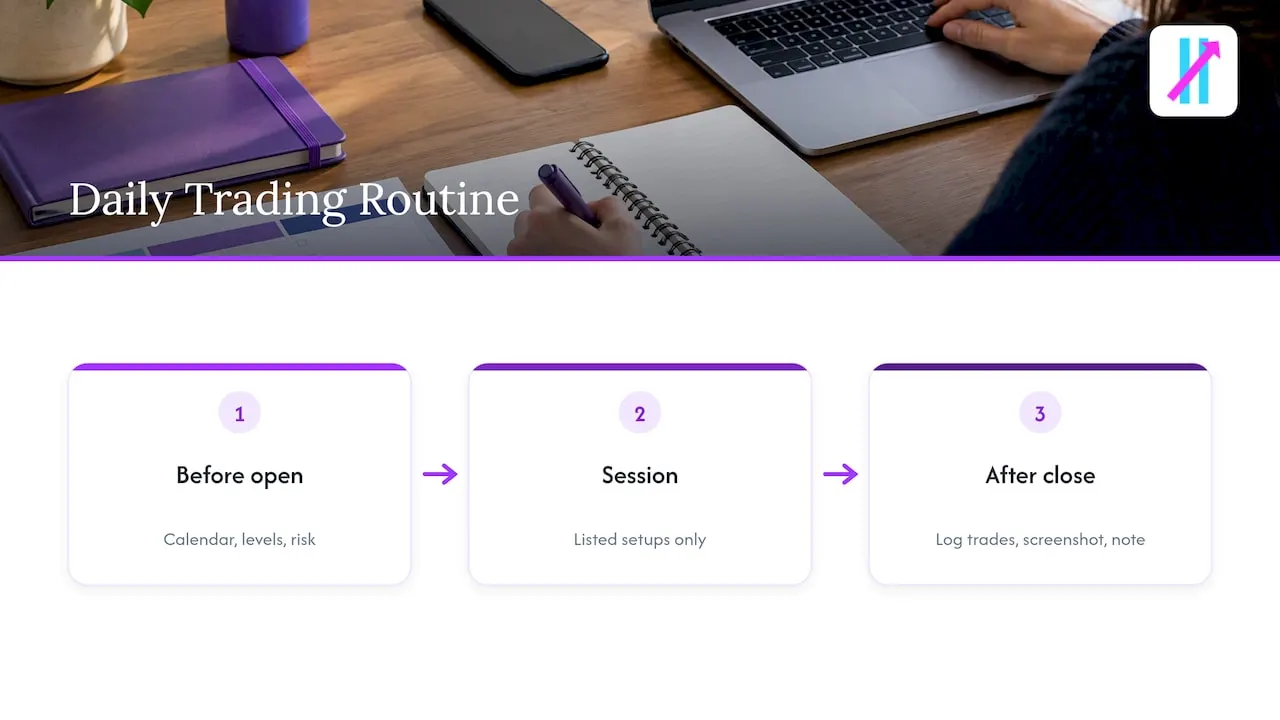
Before the open: check the economic calendar, mark levels, confirm your risk numbers for the day. During the session: only trade setups on your list. After the close: log every trade with a screenshot and a one-line note.
7. Weekly review
Once a week, count trades taken, rules followed, rules broken and net result in R multiples (profit divided by the amount risked). Change one thing at most, and only after enough trades to mean something.
A filled-in example for a beginner swing trader
This is an illustration, not a recommendation. Numbers are placeholders to show format. Substitute your own.
| Field | Example entry |
|---|---|
| Purpose | Learn to execute a simple trend-following setup consistently for 90 days |
| Process goal | 100% of trades logged, no more than 1 rule break per week |
| Account | $5,000 in a cash account, money I can afford to lose |
| Markets | SPY, QQQ, BTC/USD, EUR/USD |
| Timeframe | Daily chart for trend, 1-hour chart for entry |
| Risk per trade | 1% ($50) |
| Daily loss limit | 2% ($100), then done for the day |
| Weekly loss limit | 4% ($200), then paper trade for the rest of the week |
| Max open positions | 2 |
| Minimum reward-to-risk | 1:2 |
| Entry | Daily trend up (price above 50-day average), pullback to a marked level, 1-hour bullish close, no major news within two hours |
| Stop | Below the pullback low |
| Target | At least 2x the stop distance, or the next marked level |
| Time stop | Close if flat after five trading days |
| Routine | 20 minutes before the session: calendar, levels, today’s risk in dollars |
| Review | Sunday, 30 minutes: tally R multiples and rule breaks |
Notice the position-size math. With $50 at risk and a stop $2.50 below entry, you buy 20 shares. If the stop is $5 away, you buy 10. The risk stays at $50 either way.
Make every rule a yes-or-no question
The most useful test for any line in your plan: can you answer it “yes” or “no” after the trade? IG’s guidance on plans says rules should be written so they can be checked objectively after a trade.
- Weak: “Enter when momentum looks strong.”
- Checkable: “Enter only after a 1-hour close above the prior swing high with volume above its 20-bar average.”
- Weak: “Don’t risk too much.”
- Checkable: “Risk is 1% or less of equity, calculated before entry.”
For options traders, entry and exit rules need extra fields such as expiration and strike. This breakdown of pre-market entry and exit rule templates for active options traders shows how to document them before the session begins. Our own guide to clear entry signal templates covers the same discipline for chart-based signals.
Risk rules that fit a small account
Beginners often ask whether $100 or $1,000 is enough to start. Two facts matter.
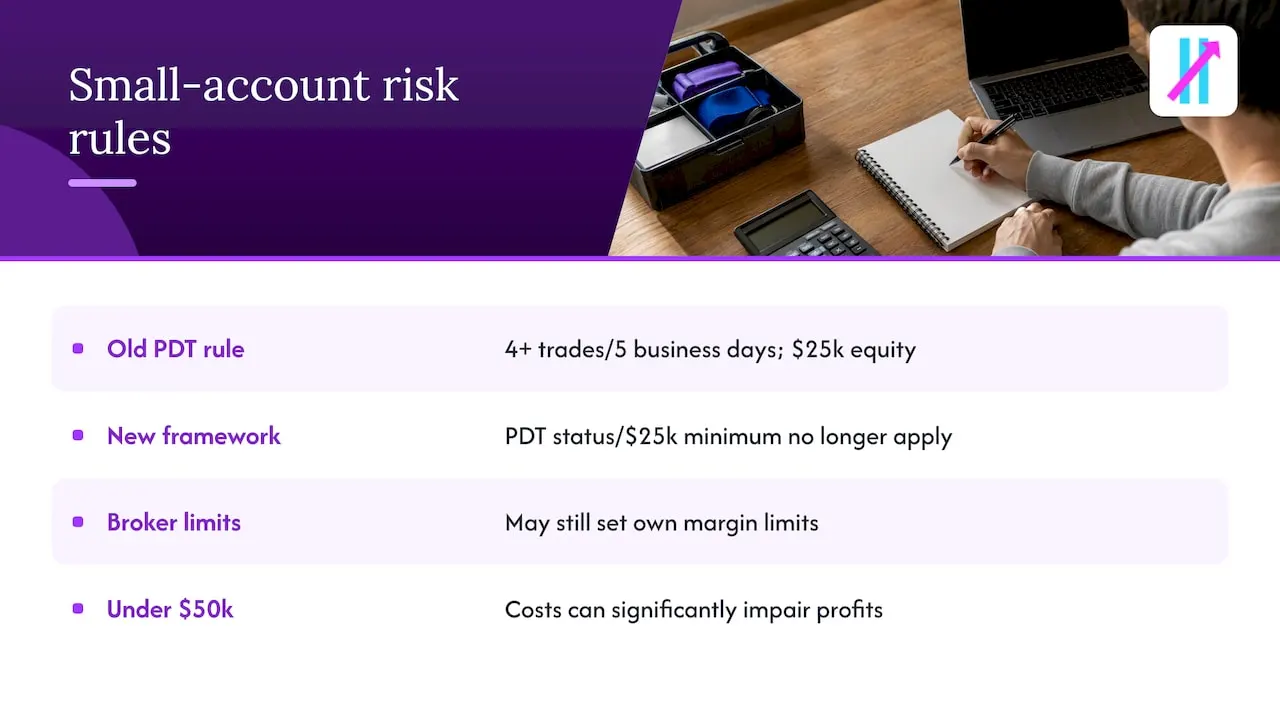
First, the rule. For years, anyone making four or more day trades in five business days in a margin account was labeled a pattern day trader and needed $25,000 in equity. That has changed: the SEC approved amendments to FINRA Rule 4210, and brokers such as E*TRADE report that the pattern day trader designation and the $25,000 minimum no longer apply under the new framework, which they implemented in June 2026. Brokers may still set their own margin limits, so read your own broker’s current terms before relying on this.
Second, the economics. Removing the minimum does not remove the risk. FINRA’s disclosure statement warns that an investment under $50,000 can significantly impair a day trader’s ability to profit because commissions and margin costs accumulate. If you are starting small, that is an argument for swing trading with fewer, larger-timeframe trades and a strict per-trade risk cap, not for more activity.
If you trade forex, understand the odds before you set targets. The CFTC and NASAA warn that off-exchange retail forex is at best extremely risky and at worst fraud. Verify that any dealer is registered before you deposit.
For automated or alert-driven setups, add a controls block to your plan. We cover the specifics in automated trading risk controls every TradingView user needs.
Where indicators fit in a plan
An indicator is a tool inside your entry rules, not a replacement for the plan. The plan decides whether you trade, how big and where you exit. The indicator supplies one of the conditions. Two practical rules:
- Define in advance what the indicator must say and what else must be true. A signal alone is one box on the checklist.
- Add a filter for conditions you should not trade. Choppy, low-quality markets generate most false signals, and a volatility filter is one way to write that rule down.
Choosing between tools is a separate question. Whether you compare ChartPrime, AlgoAlpha or anything else, test on the markets and timeframe in your plan, check whether signals repaint, and judge by your logged results over a meaningful sample, not by screenshots.
If you want examples of how rules and signals combine, see our examples of systematic trading frameworks and the piece on confirmation versus anticipation with 1% to 2% risk.
Our perspective: simple rules survive
We build a TradingView indicator for retail traders, and the pattern we see is consistent: people rarely fail because they lacked one more indicator. They fail because the rules lived in their head and changed with their mood after a loss.
That is why we designed Big Move Algo around clarity. The signals are Long, Short and Exit, so the three decisions in your plan, whether to enter, in which direction and when to leave, each map to one visible event. AUTO Mode keeps setup minimal for newer traders, and Manual Mode lets experienced traders adjust settings. The Fake Trend Detector flags low-quality conditions where trading is not recommended, which fits naturally as a “do not trade” line in your plan.
But a signal tool does not write your risk rules. You still decide your percentage risk, your daily loss limit and your market list. Treat the indicator as one checklist item, log every trade, and let the journal tell you whether the system works for you. Our guide on what a trading journal is and why it matters shows what to record.
— Steven Hartwell
Putting the signals in your plan with Big Move Algo
If you trade on TradingView and want your entry and exit conditions to come from a structured signal, Big Move Algo works across crypto, forex, stocks, indices and commodities, with instant access after purchase. Current plans:
| Plan | Monthly | Annual |
|---|---|---|
| Version 2 | 55 USD per month | 660 USD per year |
| Version 3 | 64 USD per month | 768 USD per year |
| Version 3 Plus | 79 USD per month | 948 USD per year |
See the plans and pricing page for what each version includes, or start from bigmovealgo.com. Whatever you pick, paste the signal conditions into section 4 and 5 of your template first, so you know exactly how you will use it.
Common mistakes when writing a plan
- Copying someone else’s numbers. A plan from a forum post may not match your account size, schedule or temperament. Use it as a draft and edit it.
- Setting income targets. “Make $1,000 a day” is not a plan. It is the thing that causes oversized trades on slow days.
- Skipping the “no trade” rules. Half of good trading is a list of conditions under which you stay out.
- Changing rules mid-week. Edit only at the weekly review, never right after a loss.
- Never reviewing. A plan with no review is a wish. Put the review in your calendar.
- Ignoring costs. Commissions, spreads and funding fees belong in your expected results.
FAQ
Can I make $1,000 a day day trading?
Some traders may have such days, but a daily dollar target is a poor goal and no outcome is promised. Regulator data cited by FINRA shows most retail customers lose money, and a fixed target tends to push you into oversized trades. Set process goals and risk limits instead, and let results follow from many consistent trades.
Is $100 enough for day trading?
Technically you can open a small account with many brokers, but a $100 account makes 1% risk just $1, and fees can consume that. FINRA’s disclosure notes that accounts under $50,000 face a hard time profiting after costs. A smaller account is better used for learning with tiny size or paper trading.
Do I still need $25,000 to day trade in the US?
The SEC approved changes to FINRA Rule 4210, and at least some brokers say the pattern day trader label and $25,000 minimum are gone. Your broker may still apply its own margin and buying-power limits, so check its current policy before you rely on the change.
What should a trading plan for beginners include?
At minimum: your markets, timeframe, risk per trade, daily loss limit, entry and exit rules, and a weekly review. Keep it to one page. Add detail only after you have logged enough trades to know what needs fixing.
What is the 3-5-7 rule in trading?
It is a popular rule of thumb among some educators about capping risk per trade, total open risk and the reward target, though versions differ and it is not an official standard. If you use it, write your exact numbers into your risk section so there is no ambiguity.
Sources
- Charles Schwab: 5 Elements of a Smart Trade Plan
- FINRA Rule 2270: Day-Trading Risk Disclosure Statement
- Clear Tape: Trading Plan Template
- IG: How to Create a Successful Trading Plan
- Morning Options: Entry and Exit Rule Templates
- SEC: Margin Rules for Day Trading
- E*TRADE: Pattern Day Trader Rule Change
- CFTC/NASAA: Foreign Exchange Currency Fraud Alert