
What Is a Trading Session? A Trader's Complete Guide


A trading session is defined as the specific window of time when a financial market is open, actively matching buy and sell orders, and enabling price discovery. Every market on earth operates within these windows, and understanding them separates traders who time their entries well from those who wonder why their fills are poor. The concept applies across forex, stocks, crypto, indices, and commodities. Knowing when a session starts, how long it runs, and what happens inside it gives you a structural edge before you place a single trade.
What is a trading session and how does it work?
A trading session is the operational window when a market matches orders, concentrates liquidity, and sets reference prices through continuous trading and closing auctions. Most sessions follow a three-phase structure: a pre-open routine where orders queue up, a continuous trading phase where prices move freely, and a closing auction that sets the official reference price for the day. Each phase behaves differently, and treating them as one uniform block is a common beginner error.
Liquidity is not evenly distributed across a session. It spikes at the open when institutional desks activate, thins out during midday lulls, and picks up again near the close. Price discovery, the process by which buyers and sellers agree on fair value, happens most efficiently when liquidity is high. Thin liquidity periods produce wider spreads and erratic price behavior that can punish traders who ignore session structure.

For retail traders, the practical takeaway is simple. The session defines the conditions you are trading in. A trade placed during peak liquidity behaves very differently from the same setup placed during a low-volume window. Session awareness is not optional knowledge. It is foundational.
What are the major types of trading sessions globally?
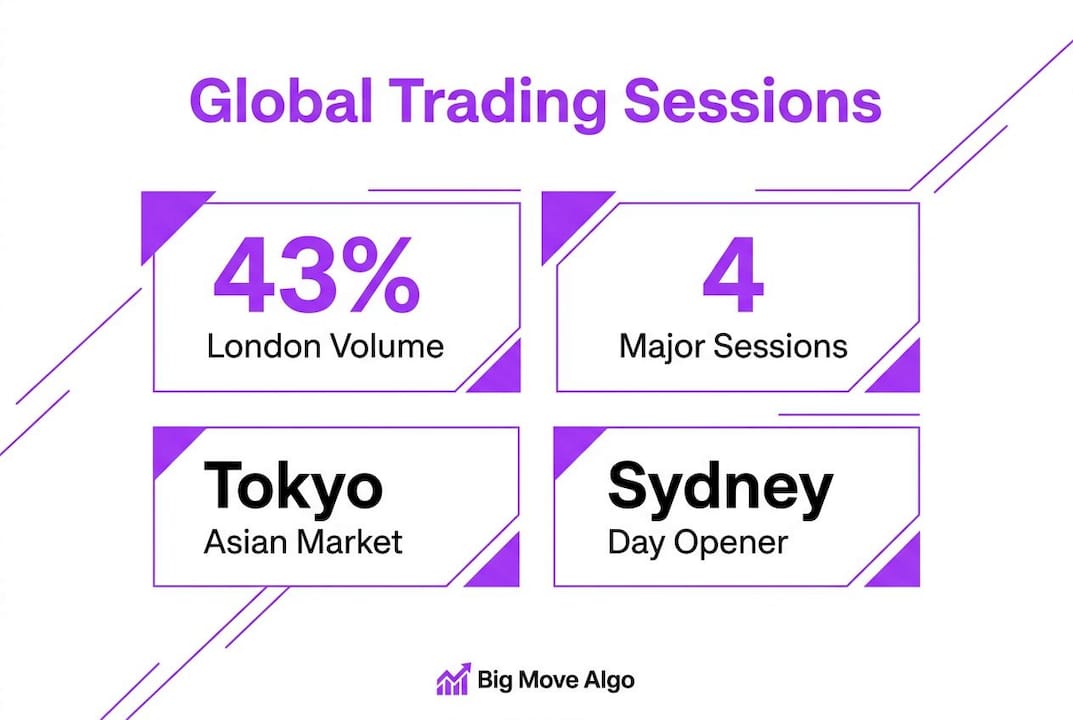
Four major sessions divide the global forex trading day: Sydney, Tokyo (Asian), London (European), and New York (American). Each runs on a distinct schedule and carries its own liquidity profile, volatility character, and regional currency focus.
Session | UTC Hours | Key Pairs | Volatility Level |
Sydney | 10 PM – 7 AM | AUD, NZD | Low |
Tokyo / Asian | 12 AM – 9 AM | JPY, AUD | Low to moderate |
London / European | 8 AM – 5 PM | EUR, GBP | High |
New York / American | 1 PM – 10 PM | USD, CAD | High |
London and European hubs account for over 43% of forex turnover, making the London session the single most liquid window in global currency markets. New York contributes roughly 19–25% of daily volume. Together, these two sessions drive the majority of meaningful price movement each day.
The Asian session behaves differently. JPY and AUD pairs are most active during Tokyo hours, while EUR and GBP pairs tend to drift in narrow ranges. Volatility on EUR/USD is 2–3 times lower during the Asian session compared to London hours. That is not a flaw in the market. It is a feature that traders can use deliberately.
The Sydney session opens the global trading day but carries the lightest volume. It matters most for AUD and NZD pairs and sets the tone for Asian price action. Traders who focus on major USD pairs often find little reason to be active during Sydney hours.
How do trading session overlaps impact liquidity and volatility?
Session overlaps occur when two major markets are open simultaneously, and they produce the highest liquidity and tightest spreads of the trading day. The most significant overlap is the London and New York window, which runs from approximately 1:00 PM to 5:00 PM UTC. During this period, two of the world’s largest financial centers are both active, and volume spikes sharply.
The benefits and risks of trading during overlaps include:
Tighter spreads: Competing liquidity providers compress bid-ask spreads, reducing execution costs.
Higher volume: More participants mean faster order fills and less slippage.
Stronger trends: Directional moves initiated in London often accelerate when New York opens.
Sharper reversals: Major economic data releases during overlaps can produce fast, violent price swings.
Increased noise: More participants also mean more conflicting signals and false breakouts.
The Tokyo and London overlap, running from roughly 7:00 AM to 9:00 AM UTC, is shorter and less dramatic but still produces a meaningful pickup in EUR and GBP activity. Many traders use this window to watch for breakouts from the Asian range.
Pro Tip: During the London and New York overlap, reduce your position size if a major economic release is scheduled. Liquidity is high, but a surprise print on a Fed or ECB announcement can move price 50–100 pips in seconds. Tighter spreads do not protect you from directional risk.
Building a solid forex trading routine around overlap windows is one of the most practical ways to improve execution quality without changing your strategy at all.
What are the key features of trading sessions traders must understand?
The most misunderstood feature of a trading session is the open. Professional traders do not treat a session opening as a trade signal. They treat it as a liquidity sweep event that often produces fakeouts before the real directional move begins. Entering a trade the moment London opens, for example, frequently means buying into a stop hunt rather than a genuine breakout.
Spread behavior is another critical feature. Spreads compress at session openings as liquidity providers compete for order flow, then widen significantly during low-volume periods like the London lunch hour between roughly 12:00 PM and 1:00 PM UTC. Ignoring this spread variance creates hidden trading costs that compound over time.
The Asian Range is a concept institutional traders watch closely. Price tends to consolidate in a defined range during Tokyo hours. When the London session opens, institutions often sweep the highs or lows of that range to trigger stop orders before initiating the real move. Entries inside the Asian range carry a higher risk of stop-outs at the London open.
Key session features every trader should track:
Liquidity pools: Form at session opens and near key technical levels; dissolve quickly after major moves.
Spread windows: Tightest at open, widest at lunch and session close.
Volatility clusters: Concentrated around economic data releases and session transitions.
Regional data influence: BOJ releases move JPY pairs in Asia; ECB and UK data move EUR and GBP in London; Fed releases dominate New York.
Pro Tip: Mark the Asian session high and low on your chart before the London open. If price sweeps one of those levels in the first 30 minutes of London trading without follow-through, treat it as a potential reversal setup rather than a breakout.
How can traders apply session knowledge to improve strategy?
Session knowledge works best as a risk management filter, not a trade trigger. Trading sessions are context windows that tell you what kind of market behavior to expect, and your strategy should adapt accordingly. Here is a practical framework for applying session awareness:
Match your strategy to the session type. Range-bound strategies perform better during the Asian session when EUR/USD moves in tight bands. Trend-following strategies suit the London and New York sessions where directional momentum is stronger.
Overlay your economic calendar. High-impact data releases like Fed decisions, NFP reports, and BOJ announcements can override normal session behavior entirely. Check the calendar before every session, not just on major news days.
Calibrate stop losses to session liquidity. Stops placed too tightly during the London open frequently get swept by the initial liquidity hunt. Wider stops during high-volatility windows, combined with smaller position sizes, protect capital without sacrificing the trade idea.
Avoid low-liquidity windows for execution. The Sydney session and the London lunch hour both carry wider spreads and thinner order books. Entering trades during these windows increases slippage and reduces fill quality, even when the setup looks clean.
Use session timing to manage open positions. A trade entered in the Asian session may behave very differently once London opens. Knowing that volatility is about to increase lets you decide in advance whether to tighten your stop, take partial profits, or hold through the transition.
Session awareness also complements algorithmic trading directly. Automated systems that ignore session context often perform well in backtests but fail live because they execute during low-liquidity windows where slippage erodes their edge. Filtering trade execution to high-liquidity sessions is one of the simplest improvements you can make to any automated strategy.
Avoiding beginner trading mistakes often comes down to respecting session structure. Traders who enter during low-volume windows, ignore spread widening, or treat session opens as automatic buy signals consistently underperform those who treat sessions as the structural backbone of their plan.
Key Takeaways
Trading sessions are the structural foundation of every market, and aligning your strategy to session characteristics is the single most reliable way to improve execution quality and risk control.
Point | Details |
Session definition | A trading session is the active window when a market matches orders and enables price discovery. |
Four global sessions | Sydney, Tokyo, London, and New York each carry distinct liquidity profiles and volatility patterns. |
London dominates volume | London accounts for over 43% of forex turnover, making it the highest-liquidity session globally. |
Overlaps amplify conditions | The London and New York overlap produces the tightest spreads and strongest directional moves of the day. |
Sessions are context, not signals | Use session timing to calibrate risk and strategy, not as a direct buy or sell trigger. |
Sessions changed how I think about risk
The biggest shift in my own trading came when I stopped asking “what should I trade?” and started asking “when should I be in the market at all?” For years, I treated every hour of the trading day as roughly equal. I would enter setups during the London lunch hour, get chopped up by wide spreads, and blame my analysis. The analysis was fine. The timing was wrong.
The London and New York overlap is where I do most of my active trading now. The conditions are simply better: tighter spreads, cleaner moves, and more follow-through on breakouts. The Asian session still has value, but I use it for planning and watching, not for chasing setups on major USD pairs.
The Asian Range concept genuinely changed my London open approach. Watching for a sweep of the overnight high or low in the first 30 minutes of London trading has saved me from more bad entries than any indicator I have ever used. The market is not random at the session open. It is hunting stops, and knowing that keeps you on the right side of the initial move.
My honest advice: treat session structure as the first filter in your trading plan, not an afterthought. Pair it with crypto risk management principles if you trade digital assets across sessions, because the same liquidity dynamics apply. Session awareness does not guarantee winning trades. It does guarantee you are trading in conditions where your edge has the best chance to work.
— Steven Hartwell
How Big Move Algo fits into your session-based trading
Understanding session timing gives you the structural context. Acting on it quickly and clearly is where most traders still struggle.
Big Move Algo is a TradingView indicator built for exactly this situation. It analyzes markets in real time and delivers clear Long, Short, and Exit signals across forex, crypto, stocks, indices, and commodities. The built-in Fake Trend Detector filters out low-quality setups that often appear during thin-liquidity windows, so you are not chasing signals during the London lunch hour or the Sydney session when conditions do not support clean execution. Whether you use AUTO Mode for a fast start or Manual Mode for deeper customization, Big Move Algo gives you real-time trading signals that work with session structure, not against it. Visit Big Move Algo to see subscription options and get instant access.
FAQ
What is a trading session in simple terms?
A trading session is the period when a financial market is open and actively processing buy and sell orders. It sets the conditions for price discovery, liquidity, and volatility during that window.
When does the most active trading session start?
The London session starts at 8:00 AM UTC and is the most active, accounting for over 43% of global forex turnover. The London and New York overlap from 1:00 PM to 5:00 PM UTC is the single most liquid window of the day.
How many global trading sessions are there?
There are four major global trading sessions: Sydney, Tokyo (Asian), London (European), and New York (American). Each runs in a different time zone and specializes in different currency pairs and asset classes.
Do trading sessions affect spreads?
Yes. Spreads compress at session opens when liquidity is high and widen during low-volume periods like the London lunch hour. Ignoring spread variance creates hidden costs that reduce profitability over time.
Can I trade during any session?
You can, but not every session suits every strategy. Range-bound strategies work better during the Asian session, while trend-following strategies perform best during the London and New York sessions where directional momentum is strongest.
Recommended
Comments