
What Is a Trading System? A Trader's Complete Guide


A trading system is a defined set of rules that tells you exactly when to enter a trade, when to exit, and how much capital to risk on each position. Every professional trader operates within some version of this framework, whether they call it a system or not. Without one, trading becomes reactive and emotional, two qualities that destroy long-term profitability. Big Move Algo is built on this exact principle: structure your decisions before the market opens, not during the heat of a trade.
What is a trading system, and why does it matter?
A trading system is the complete framework governing every decision you make in the market. It goes beyond a single indicator or gut feeling. The system defines your entry signal, your exit rules, your position size, and the market conditions where you will and will not trade.
Trading systems transform trading from emotional gambling into a disciplined process by creating positive expectancy over many trades. Positive expectancy means that, on average, your wins outweigh your losses after accounting for all costs. Without a system, the default is negative expectancy. The market’s transaction costs and spreads work against you every time you trade without a defined edge.

The importance of trading systems shows up clearly when you compare two traders with the same strategy. One follows strict rules for every trade. The other adjusts entries based on how they feel that morning. Over 100 trades, the disciplined trader produces consistent, measurable results. The other produces noise. A system is what separates the two.
What are the main components of a trading system?
Every functional trading system contains three core components: entry signals, exit rules, and risk management parameters. Remove any one of them and the system breaks down.
Entry signals
Entry signals define the exact conditions that must be met before you open a position. These conditions are based on price action, technical indicators, volume patterns, or a combination. A buy or sell signal is only valid when all conditions align. Vague entries like “when the chart looks good” are not signals. They are opinions, and opinions are inconsistent.
Exit rules
Exit rules cover two scenarios: when the trade goes wrong and when it goes right. A stop-loss defines the maximum loss you will accept before closing the position. A take-profit locks in gains at a predetermined level. A typical risk-to-reward ratio targets at least 1:2, meaning you aim to make twice what you risk on each trade. This ratio allows you to be wrong more than half the time and still come out ahead.
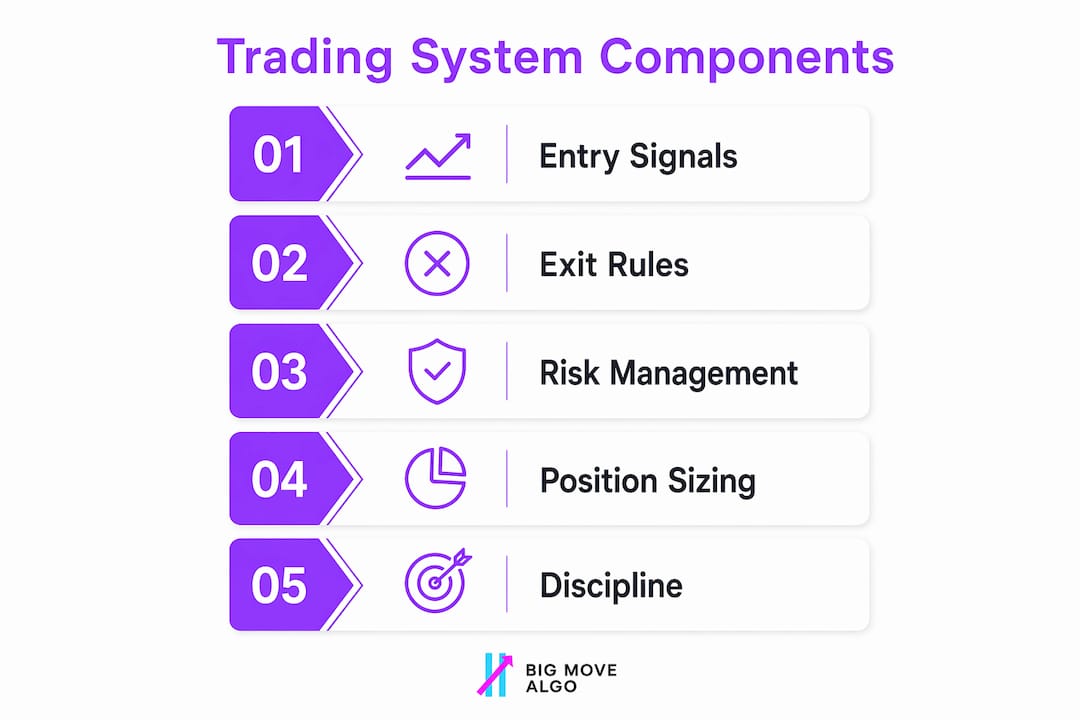
Risk management parameters
Risk management rules determine how much of your capital goes into each trade. The standard guideline is to risk 1–2% of your total account on any single position. This prevents one bad trade from causing serious damage. Position sizing, combined with a defined stop-loss, gives you full control over your downside before you ever click the buy button.
Pro Tip: Write your entry and exit rules in plain language before you code or apply them. If you cannot explain the rule to someone else in one sentence, it is not specific enough to trade.
How do trading systems differ from trading strategies?
Traders often use “system” and “strategy” interchangeably. They are not the same thing, and the difference matters more than most beginners realize.
A trading strategy answers “when” to trade. It is the signal-generation method. A moving average crossover, a breakout above resistance, or an RSI reading below 30 are all strategies. They tell you a trade opportunity may exist.
A trading system answers “how much,” “where,” and “under what conditions.” It wraps the strategy inside a complete decision-making framework that includes:
Capital allocation: How much of your account goes into this trade?
Risk controls: Where does the stop-loss sit, and what is the maximum loss per day or week?
Trade management: Do you move the stop to breakeven after a certain gain? Do you scale out at multiple targets?
Market filters: Does the system only trade trending markets? Does it pause during high-impact news events?
Without risk and position management, a strategy alone cannot deliver consistent profits. You might have a signal that is right 60% of the time, but if you size positions randomly and move stop-losses on emotion, the 40% of losing trades will erase your gains. The system is what makes the strategy work at scale.
What are the types of trading systems?
Trading systems fall into two broad categories: manual and automated. Within those categories, they specialize by market behavior.
Manual versus automated systems
A manual system gives you the rules, but you execute every trade yourself. You watch the chart, wait for the signal, and place the order. This works well for traders who want full control and trade a small number of setups per day.
Automated trading systems use software to execute trades the moment predefined conditions are met. The program monitors price, time, and quantity rules simultaneously across multiple markets. Speed is the primary advantage. Algorithmic systems can generate profits of 20–80 basis points per event such as index rebalancing, gains that are impossible to capture manually because the window is measured in milliseconds.
Automated systems do not predict price movements. They execute rules. That distinction is critical. A system that claims to predict the market is a red flag. A system that reacts to defined conditions with speed and consistency is a genuine edge.
Common system types by market behavior
System type | Core logic | Best market condition |
Trend following | Buys strength, sells weakness | Trending markets |
Mean reversion | Fades extremes back to average | Range-bound markets |
Scalping | Captures small moves, high frequency | Liquid, low-spread markets |
Swing trading | Holds positions for days to weeks | Moderate trend or range |
No single system works in all market conditions. A trend-following system will bleed in a choppy, sideways market. A mean-reversion system will get destroyed in a strong trend. Knowing when your system is and is not suited to current conditions is as important as the system itself.
Pro Tip: Build a “no-trade” rule into your system. Define the market conditions where your edge disappears, and commit to sitting out. Protecting capital during bad conditions is a skill, not a weakness.
How to create a trading system: a step-by-step approach
Building a trading system from scratch is a structured process. Rushing any step produces a system that looks good on paper but fails in live markets.
Choose your market and timeframe. Pick one market you understand well, whether that is forex, stocks, crypto, or commodities. Match the timeframe to your schedule. Day traders work on 5-minute or 15-minute charts. Swing traders use daily or 4-hour charts. Starting with one market and one timeframe prevents overcomplication.
Define the market conditions your system targets. Decide whether your system trades trends, ranges, or breakouts. Write this down explicitly. This becomes your filter for when to activate the system and when to wait.
Develop clear, objective entry rules. Every entry condition must be testable. “Price closes above the 20-period moving average with volume above the 10-day average” is testable. “The chart looks bullish” is not. Use trading signals that produce a binary yes or no answer.
Set your exit rules before you enter. Define your stop-loss level and take-profit target for every trade type. Write these numbers down before you open the position. Changing them mid-trade is how discipline breaks down.
Establish position sizing and risk parameters. Decide the maximum percentage of your account you will risk per trade. Apply this rule to every single trade, regardless of how confident you feel. Consistency here is what keeps you in the game during losing streaks.
Backtest the system on historical data. Run your rules against past price data across at least 100 trade samples. Backtesting over large samples validates whether the system has positive expectancy before you risk real money. A system that fails in backtesting will fail in live markets.
Paper trade before going live. Execute the system in a simulated environment for at least two to four weeks. This reveals execution problems and psychological challenges that backtesting cannot show.
Start small and refine. When you go live, start with small positions and track every trade in a journal. Review performance weekly. Refine rules based on data, not emotion.
Key Takeaways
A trading system is the single most important structure a trader can build, because it converts a strategy into a repeatable, risk-controlled process that performs consistently over time.
Point | Details |
System vs. strategy | A strategy signals when to trade; a system adds risk rules, sizing, and trade management. |
Core components | Every system needs entry signals, exit rules, and position sizing to function. |
Automated systems | Algorithmic systems execute rules instantly, removing emotion and capturing time-sensitive opportunities. |
System specialization | No system works in all conditions; define when your system sits out as clearly as when it trades. |
Build and validate | Backtest over 100+ trades and paper trade before committing real capital to any new system. |
Why I think most traders fail before they even place a trade
Most traders I have observed fail not because they lack a good strategy. They fail because they never build a system around it. They find a setup that works, trade it inconsistently, size positions based on confidence rather than rules, and then blame the market when results are poor.
The uncomfortable truth is that discipline is not a personality trait you either have or do not have. It is a product of structure. When the rules are written down and the position size is calculated before the trade opens, discipline becomes the default. Without that structure, every trade becomes a fresh negotiation with your emotions.
The traders I have seen succeed long-term share one habit: they treat their system as a business process, not a creative exercise. They review it regularly, update it when market conditions shift, and never deviate from the rules mid-trade. They also know exactly when their system does not apply and they sit on their hands without guilt.
If you are building your first system, start simpler than you think you need to. One entry condition, one exit rule, one risk parameter. Master that before adding complexity. A simple system executed with discipline beats a complex system executed inconsistently every single time.
— Steven Hartwell
How Big Move Algo fits into a structured trading approach
Applying a trading system requires clear, reliable signals as the foundation. Big Move Algo provides exactly that through its TradingView indicator, which delivers real-time Long, Short, and Exit signals across crypto, forex, stocks, indices, and commodities.

The built-in Fake Trend Detector filters out low-quality market conditions automatically, which directly addresses one of the hardest parts of system-building: knowing when not to trade. Traders can start with AUTO Mode for immediate structure, or switch to Manual Mode for deeper customization as their system matures. Visit Big Move Algo to see how its signals can serve as the entry and exit layer of your trading system, backed by up to 92% win rate performance.
FAQ
What is the simplest trading system definition?
A trading system is a complete set of predefined rules covering when to enter, when to exit, and how much to risk on every trade. It removes discretion and emotion from the decision-making process.
How do automated trading systems work?
Automated trading systems use software to monitor markets and execute trades the moment predefined conditions are met, based on price, timing, and quantity rules, without manual input.
What makes a good trading system?
A good trading system has clear, testable entry and exit rules, strict risk management with 1–2% risk per trade, and defined conditions for when the system does not apply.
How long does it take to create a trading system?
Building and validating a trading system properly takes weeks to months. Backtesting, paper trading, and small live testing are all required steps before committing full capital.
Can beginners use a trading system?
Beginners benefit most from trading systems because the rules replace guesswork. Starting with a simple, rule-based approach and learning the basics of algorithmic trading builds the discipline needed for long-term success.
Recommended
Comments