
What Is Overtrading Explained: Causes, Risks, and Fixes


What overtrading means in trading and business
Overtrading happens when you trade more than your strategy or capital supports, or when a business expands faster than its working capital can handle. Both versions share the same core problem: activity outpaces available resources, and the gap creates financial risk.
In financial markets, overtrading means executing too many trades, often driven by emotion rather than a clear plan. In business, overtrading means expanding operations so fast that cash flow can’t keep up, even when revenue looks healthy on paper. A company can be profitable and still collapse because it ran out of cash to pay suppliers and staff.
Both contexts share these defining traits:
Activity exceeds the capacity of available resources (capital, cash flow, or mental bandwidth)
Short-term momentum masks growing underlying risk
Negative outcomes compound quickly once the imbalance tips
Understanding overtrading in both contexts matters because the warning signs often look like success right up until they don’t.
What causes overtrading in trading and business?
Trading causes
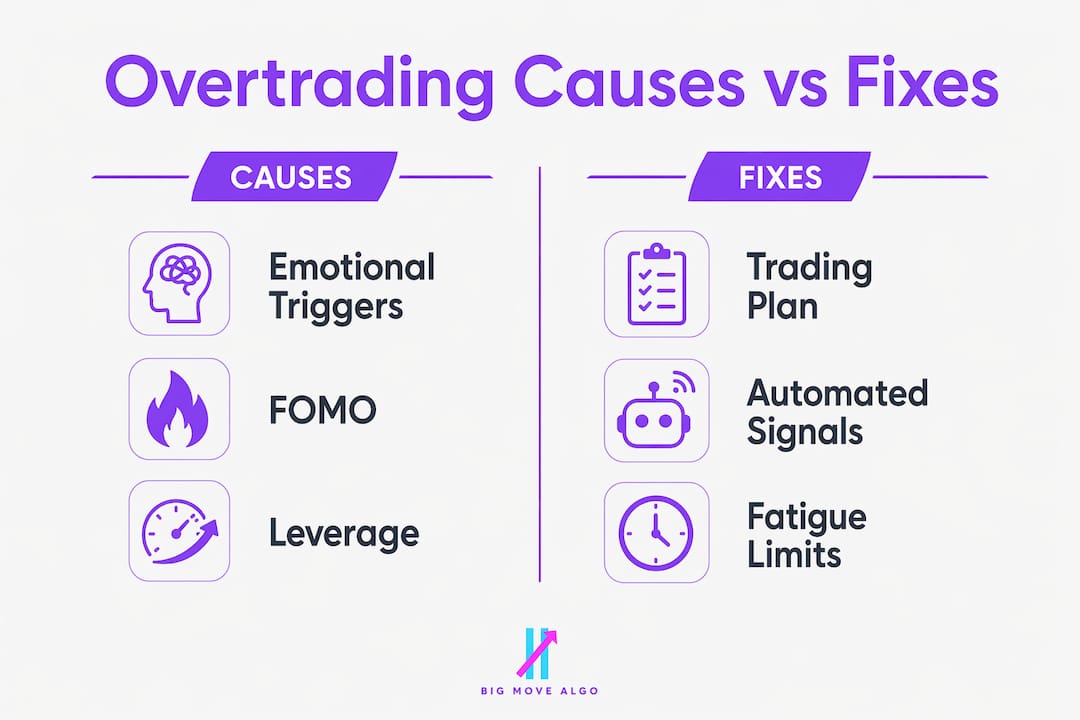
Emotional triggers drive most overtrading in financial markets. Greed, fear, and excitement push traders to act without a clear signal, while overconfidence after a winning streak leads to oversized positions. Revenge trading, where a trader tries to recover a loss by immediately placing another trade, is one of the most destructive patterns.

FOMO (fear of missing out) is another major driver. When a market moves sharply, traders without a defined plan often jump in late, chasing a move that has already played out. Patience is a genuine edge here. More trades don’t produce better results; the urge to always be in the market is what erodes accounts over time.
Leverage makes everything worse. Leveraged products accelerate capital depletion on even small errors, turning a string of mediocre trades into a serious loss.
Business causes
On the business side, the triggers are operational rather than emotional. Rapid growth is the most common culprit. A company wins a large contract, ramps up production, hires staff, and orders inventory, all before the customer has paid a single invoice. The result is a cash crunch that can threaten the whole operation.
Overtrading in business often looks like success from the outside. Revenue is climbing, orders are coming in, and the team is busy. The problem is invisible until the bank account runs dry and suppliers stop extending credit.
Other business causes include:
Aggressive expansion funded by short-term credit rather than retained earnings
Seasonal demand spikes that strain working capital without adequate reserves
Poor cash flow forecasting that underestimates the gap between invoicing and payment
Real examples of overtrading in action
Business scenario
A mid-sized manufacturer lands a contract three times larger than its usual order volume. To fulfill it, the company hires additional workers, buys raw materials upfront, and runs its production line at full capacity. The customer’s payment terms are net-60. By the time the invoice is due, the manufacturer has already spent cash it hasn’t received yet, and it can’t pay its own suppliers on time.
Key effects visible in this example:
Cash flow gap widens despite strong revenue
Supplier relationships deteriorate due to late payments
Credit lines get maxed out to cover operational shortfalls
Trading scenario
A retail trader has a bad morning, losing on two consecutive trades. Instead of stepping back, they place four more trades in quick succession, trying to recover the loss before the session ends. Each trade is larger than the last. Commission costs stack up, spreads widen the effective loss on each entry, and emotional decision-making produces entries with no real edge. By midday, the account is down far more than the original two losses combined.
Revenge trading amplifies the initial loss rather than recovering it
Overtrading leads to financial stress, decision fatigue, and deteriorated performance
Transaction costs compound quickly when trade frequency spikes
Risks and financial consequences of overtrading
The financial damage from overtrading is rarely a single catastrophic event. It accumulates. For traders, the most immediate hit comes from transaction costs. Even on platforms advertising zero commissions, spread and tax costs erode capital rapidly when trade frequency climbs. A trader who executes 20 trades a day on a thin edge is paying far more in hidden costs than one who executes five well-selected trades.
For businesses, the danger is a liquidity crisis that appears without warning. A company can show strong profits on its income statement while simultaneously being unable to meet payroll. That gap between accounting profit and actual cash is exactly where overtrading creates insolvency risk.
Consequences across both contexts:
Traders: Rapid capital depletion, especially with leverage; increased commission and spread costs; emotional fatigue that degrades future decisions
Businesses: Cash flow gaps despite paper profits; strained supplier and creditor relationships; potential insolvency if credit lines close
Both: Decision quality drops as stress and fatigue accumulate, creating a feedback loop that makes the problem worse
How to avoid overtrading: strategies that actually work
Prevention comes down to structure and self-awareness, not willpower alone.
Build a written plan and follow it. A written trading plan with clear entry and exit rules removes the in-the-moment decisions that lead to overtrading. For businesses, a cash flow forecast with defined expansion thresholds does the same job. The plan doesn’t have to be complex; it has to be specific enough that you can’t rationalize around it.
Set hard limits on risk. Cap the maximum risk per trade at a fixed percentage of your account. For businesses, define the maximum credit exposure before new orders trigger a cash flow review. Smaller, consistent position sizing supports long-term survival far better than swinging for outsized gains.
Recognize your emotional triggers. Overtrading is mainly emotional, and revenge trading after a loss is one of the clearest signs that discipline has broken down. When you notice the urge to “make it back,” that’s the moment to stop, not to trade more.
Use a pre-trade checklist: does this setup meet your written criteria?
Set a daily loss limit and stop trading when you hit it
Track which market conditions or times of day produce your worst decisions
For businesses, review cash flow weekly rather than monthly so problems surface early
Use technology to enforce discipline. Automated trade signals reduce guesswork by giving you a clear, rules-based reason to act or stay out. Monitoring tools that flag unusual trade frequency or cash flow deviations add a second layer of protection.
Pro Tip: Track your personal fatigue threshold. Decision quality declines after a certain number of trades or hours at the screen. Set a hard stop for the day based on that number, not on whether the market is still moving.
How Big Move Algo can help reduce overtrading risks
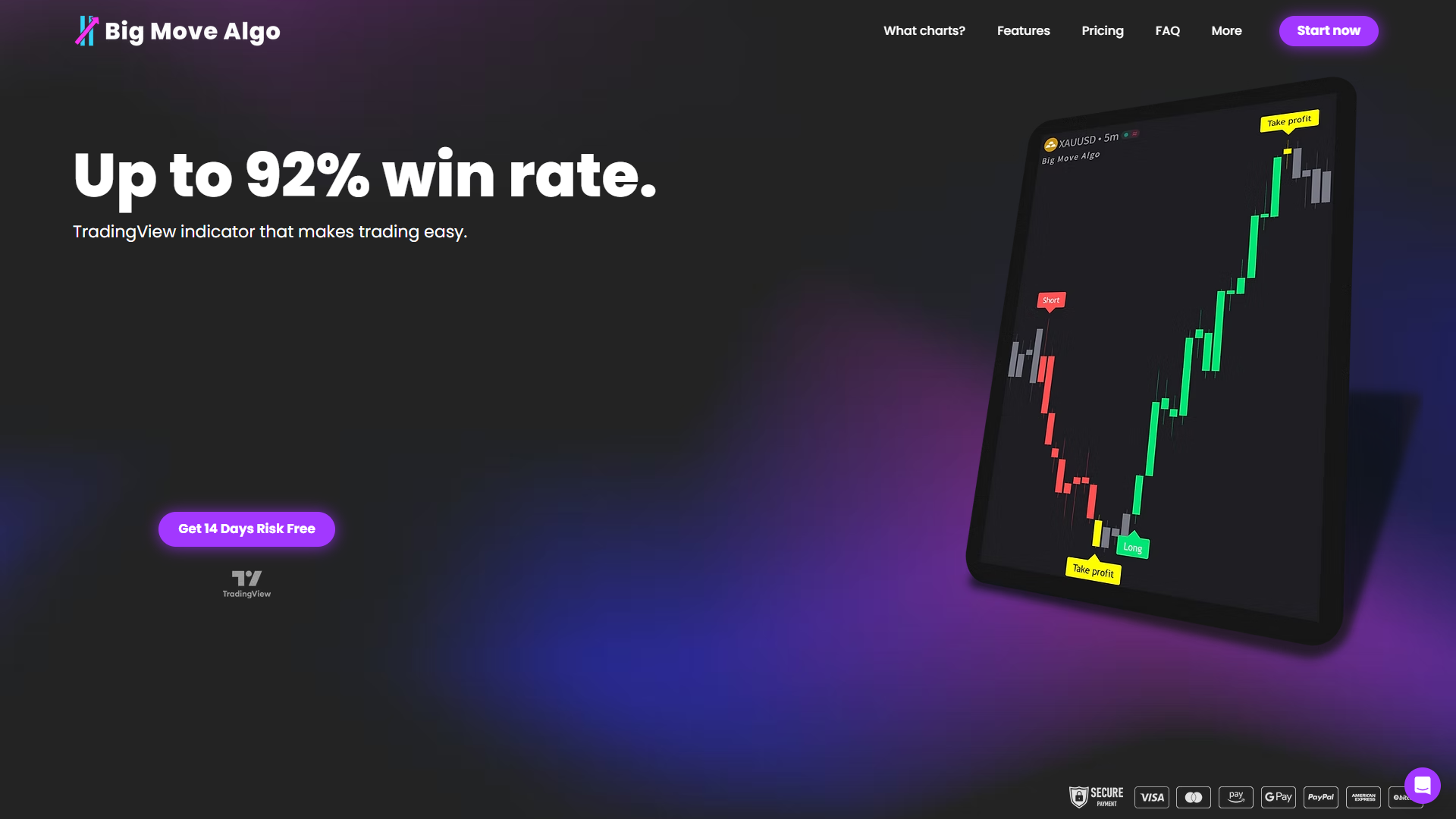
Big Move Algo is a TradingView indicator that delivers real-time Long, Short, and Exit signals across crypto, forex, stocks, indices, and commodities. Its design directly addresses the conditions that produce overtrading: too much ambiguity, too many decisions, and no clear filter for low-quality setups.
The built-in Fake Trend Detector identifies market conditions where trading is not recommended, which is exactly the kind of filter that prevents impulsive entries during choppy or misleading price action. Instead of staring at a chart and debating whether a move is real, you get a clear signal or you wait.
Benefits relevant to overtrading prevention:
Clear Long, Short, and Exit signals replace subjective judgment calls
AUTO Mode minimizes setup friction so traders follow the system rather than improvise
Fake Trend Detector filters out low-quality conditions that invite overtrading
Works across multiple asset classes, so you’re not chasing setups in unfamiliar markets
Reduces emotional decision-making by giving a structured, rules-based framework
Pro Tip: Use Big Move Algo’s signal output as your trade checklist. If the indicator hasn’t generated a signal, there’s no trade. That single rule eliminates most overtrading scenarios before they start.
Traders who want a structured approach to reducing excessive trading can explore Big Move Algo’s plans at bigmovealgo.com.
Signs and symptoms of overtrading to watch for
Overtrading rarely announces itself. You notice it in patterns, not single events.
In trading:
You’re placing trades without a clear setup that meets your written criteria
Your trade frequency spikes after a loss
You feel anxious or restless when you’re not in a position
Your win rate is dropping even though you’re trading more
Commission and spread costs are eating a disproportionate share of your gains
In business:
Revenue is growing but cash is consistently tight
You’re regularly using credit lines to cover operating expenses
Supplier payment terms are stretching because you can’t pay on time
New orders feel like a problem rather than an opportunity
The common thread is a mismatch between activity level and available resources. Catching these signs early, before they compound, is the difference between a correctable problem and a serious one. Traders who recognize beginner trading mistakes early tend to course-correct faster than those who rationalize the pattern.
How overtrading differs between markets and business operations
The word “overtrading” covers two genuinely different problems, and conflating them leads to the wrong fix.
In financial markets, overtrading is primarily a behavioral and psychological problem. The capital is there; the issue is that the trader is deploying it too frequently, without sufficient edge on each trade. The solution is discipline, a written plan, and tools that reduce the number of discretionary decisions.
In business, overtrading is a structural and financial problem. The company may be executing perfectly well operationally; the issue is that growth has outrun the cash available to fund it. The solution involves financial planning, working capital management, and sometimes slowing growth deliberately until the balance sheet can support the next expansion.
Dimension | Trading markets | Business operations |
Core problem | Excessive trade frequency, emotional decisions | Growth outpacing available cash flow |
Primary driver | Psychology, lack of plan, leverage | Rapid expansion, delayed receivables |
Main risk | Capital depletion, transaction costs | Liquidity crisis, insolvency |
Fix | Written plan, signal-based tools, loss limits | Cash flow forecasting, credit management |
One useful overlap: both forms respond well to hard limits set in advance. A trader’s daily loss cap and a business’s credit exposure ceiling serve the same function, which is removing the in-the-moment decision that tends to go wrong under pressure.
Case studies of overtrading in real companies and traders
The Cambridge Dictionary’s broker example
The Cambridge Dictionary’s entry on overtrading cites a broker who executed excessive trades to generate higher commissions, a textbook conflict of interest that harms the client’s account through unnecessary transaction costs. The client’s capital erodes not because of bad market calls but because of sheer trade volume. This pattern, sometimes called “churning,” has been the basis of regulatory action by the SEC and FINRA against brokers in the United States.
The overextended manufacturer
The business case described earlier, a manufacturer ramping production ahead of customer payments, mirrors documented patterns in small business insolvency. The company’s books show profit. The bank account tells a different story. This is why cash flow management guides from local government economic development offices consistently flag overtrading as one of the leading causes of small business failure in the United States, even among companies with strong order books.
The retail trader revenge cycle
A retail trader who ignores emotional triggers and trades through a losing streak typically ends the session with losses far larger than the initial drawdown. The pattern is well-documented in trading psychology literature: each additional trade placed in recovery mode carries worse risk-adjusted odds because the decision is driven by the need to break even, not by market conditions. The fix is mechanical, not motivational. A hard daily loss limit, enforced by a rule rather than willpower, stops the cycle before it compounds.
Key Takeaways
Overtrading destroys capital and cash flow by pushing activity beyond what your resources, plan, or market conditions can support.
Point | Details |
Two distinct contexts | Overtrading in trading is behavioral; in business, it is a structural cash flow problem requiring different fixes. |
Emotional triggers dominate trading | Revenge trading, FOMO, and overconfidence are the primary causes of excessive trade frequency. |
Hidden costs compound fast | Spread and tax costs erode capital rapidly with high trade frequency, even on zero-commission platforms. |
Hard limits prevent most damage | A written plan with daily loss caps and position size rules stops overtrading before it starts. |
Technology enforces discipline | Signal-based tools like Big Move Algo filter low-quality setups and reduce discretionary decision-making. |
Recommended
Comments