
Avoid FOMO Trading: 5 Step Checklist for Traders Using Brain Science
- Steven Hartwell

- 5 hours ago
- 8 min read

Trade only when your pre-defined rules give you the green light, not when your gut screams that the market is leaving without you. To avoid FOMO trading, run three controls before every entry: a five-item pre-trade checklist, fixed position sizing, and a delay rule for any setup you already missed. The rest of this guide breaks down that checklist, the tools that enforce it, and the journal process that makes it stick.
TL;DR:
FOMO trades often occur immediately after social proof triggers, such as seeing winning trades shared or price alerts, without proper validation.
Using a pre-trade checklist ensures traders only act on setups that meet specific criteria, preventing impulsive entry decisions.
Implementing fixed position sizing based on risk caps and enforcing delay rules for missed setups can effectively reduce emotional trading.
Tracking impulsive trades and their costs clearly demonstrates FOMO’s negative impact, encouraging better discipline over time.
In-the-moment recovery strategies like affect labeling and brief breaks can help reset emotional reactions and build resilience against impulsive trading.
Table of Contents
What does a FOMO trade actually look like?
FOMO rarely announces itself. It shows up disguised as conviction, and by the time you notice, you’ve often already clicked “buy.”
Behaviorally, it looks like chasing a candle that moved significantly past your planned entry, sizing a position bigger than your usual trades, or entering a “revenge” trade minutes after a stop-out to win back the loss. Physically, your heart rate spikes, you click refresh on the chart every few seconds, and your field of vision narrows to a single price level while everything else on the screen goes blurry. That tunnel vision is the tell most traders miss until it’s too late.
Trade design gives away the rest. A FOMO trade almost never has a written invalidation level before entry. Stop-loss and position size get decided after the order fills, not before, and profit targets are usually vague, like “I’ll sell when it feels right” instead of a number.
Watch for these signs together, since any one alone can be a false alarm:
You entered within seconds of seeing a price alert, a chart on social media, or a friend’s trade screenshot.
Your position size is noticeably bigger than your average trade that week.
You can’t state your invalidation price out loud, right now, without checking the chart.
You feel a jolt of urgency, like the trade will vanish if you wait sixty seconds.
You skipped your normal checklist “just this once.”
Two or more of these at once means the trade came from your amygdala, not your plan. That distinction is exactly what the next section explains.
Why does FOMO happen? The triggers and the brain science behind it
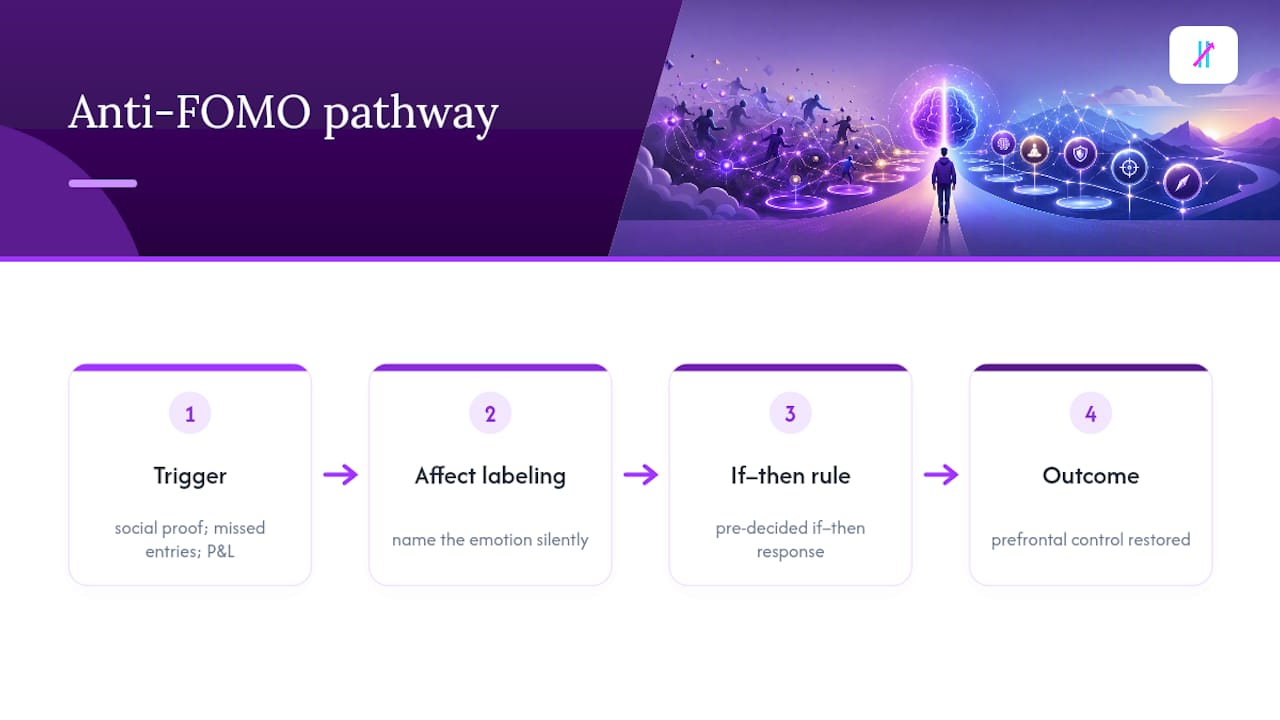
FOMO has predictable triggers. Social proof tops the list: seeing someone else’s winning trade posted in real time activates the same fear circuitry as watching a train pull away from the platform. Missed entries compound it. Once a setup runs without you, every subsequent bounce looks like a “last chance.” Add a daily P&L target you’re chasing, a spike in volatility that makes every candle look explosive, and the decision fatigue that builds after your third or fourth trade of the session, and you have the full trigger stack.
The neuroscience behind this is specific, not vague. A 2007 UCLA study published in Psychological Science found that affect labeling, simply naming an emotion in your head or out loud, dampens amygdala activity within seconds and helps restore control to the prefrontal cortex, the part of your brain responsible for weighing risk instead of reacting to it. Saying “this is FOMO” silently before you click buy is not a soft mindfulness trick. It’s a measurable neurological brake.
That’s also why implementation intentions, pre-decided “if this happens, then I do that” rules, outperform willpower alone. Deciding your response before the trigger hits removes the decision from the exact moment your brain is least equipped to make it well.
The anti-FOMO system: checklist, sizing, and delay rules
This is the part you copy and use today. It works because every rule gets decided in advance, when you’re calm, not in the middle of a chart move when your pulse is climbing.
1. The five-item pre-trade checklist. Before any entry, answer yes or no to each:
Is this setup on my watchlist from before the session started?
Do I have a written invalidation price, not an approximate one?
Is my position size calculated from my risk rule, not from how confident I feel?
Have I gone at least sixty seconds without refreshing the chart before clicking buy?
Would I take this trade if I’d seen the setup with no urgency at all?
Any single “no” means you don’t take the trade. Not “size down.” Not “wait a minute and reconsider.” No.
2. Fixed sizing tied to account risk. Risk-first guidance consistently points to capping risk at 1% to 3% of account equity per trade. On a $10,000 account with a 1% risk rule, that’s $100 at risk per position. If your stop is $2 away from entry, your max size is 50 shares or contracts, full stop, regardless of how strong the setup feels. Fixed sizing is the single most effective brake on FOMO because it removes the “just this once, bigger” decision entirely.
3. The delay rule for missed setups. If price already moved and you weren’t in, you don’t chase. You either wait for a defined re-entry level (a pullback to a specific price, not “somewhere near here”) or you tag it as missed and move on. Structured anti-FOMO frameworks treat a missed move as data to log, not a wound to chase.
4. Daily loss cap and max-trades limit. Set a dollar or percentage loss that ends your trading day, and a maximum number of trades (commonly three to five for retail accounts). Hit either one and you’re done, no exceptions, no “one more to make it back.”
Pro Tip: Write your daily loss cap on a sticky note next to your monitor. The physical reminder works better than a mental one once adrenaline is running the show.
A checklist and a signal source that pre-defines entries work well together. Tools like clear entry signal templates reduce the discretionary decision even further, since the entry criteria are set before you ever see the live chart.
How do you enforce these rules with tools and automation?
Willpower fails under pressure. Platform features don’t. The goal is to build a setup where the software enforces your rules even on the days your discipline is running low.
Set price alerts tied to your specific checklist conditions instead of watching charts continuously. If your setup requires a break above a level with volume confirmation, alert on the price, not on “getting close.”
Use bracket orders that attach your stop-loss and profit target the moment you enter, so exits are never a live decision made under stress.
Add trailing stops on trending positions to lock in gains without needing to watch the position tick by tick.
Build position-size templates or order presets in your platform that cap share or contract count automatically, so an oversized entry takes deliberate extra steps instead of one click.
Automate the mechanical parts (stop placement, size calculation, alert triggers) but keep discretion over which setups qualify in the first place. Full automation without judgment just moves the risk somewhere else.
Automated risk controls built into your charting platform can handle most of this without extra software. Signal-based approaches that provide Long, Short, and Exit alerts along with trend quality indicators work on the same principle: they flag conditions worth acting on so you’re reacting to a defined signal instead of a feeling. Pair that with verified signal checks before entry, and the emotional decision gets replaced by a mechanical one almost entirely.
What should you journal to reduce FOMO trades?
Rules alone change behavior slowly. Data changes it fast, because a number is harder to argue with than a feeling. Tagging impulsive trades and tracking their measured cost over 30 days shows traders exactly what FOMO is costing them, which tends to work faster than willpower alone.
Log every trade, and every setup you skipped, with these fields:
Field | What to record |
Trigger | Social media, missed entry, P&L pressure, volatility spike |
Setup valid? | Yes/no against your pre-trade checklist |
Urgency level | 1 to 5, how strong the “act now” feeling was |
Rule followed | Yes/no, and which rule if broken |
Outcome in R-multiples | Result relative to planned risk (+1R, negative 0.8R, etc.) |
At month end, pull three numbers: how often FOMO tags appear, the average R-multiple cost of those trades, and your rule-compliance rate. If FOMO trades show up ten times in a month and average negative 0.8R each, you have a concrete case, not a vague sense, that the impulse is bleeding your account. Tracking skipped trades alongside executed ones also cuts hindsight bias, since you’ll see how many “missed” moves actually would have failed your checklist anyway.
How do you recover after a FOMO trade and build lasting resilience?
In the moment, two tools work fast. Affect labeling, silently naming the emotion (“this is FOMO” or “this is fear”), measurably dampens amygdala reactivity within seconds. Pair it with a physical reset: a few cyclic sighs (long inhale, double inhale, long exhale) or simply stepping away from the screen for 60 to 120 seconds. Short breathing resets and brief breaks reliably lower the physiological arousal that fuels impulsive clicks.

If you notice repeated rule breaks across a week, don’t just try harder. Cut your position size in half until compliance improves, enforce a mandatory pause after any FOMO-tagged trade, and run a quick pre-mortem before your next session: write down exactly how you’d sabotage today’s plan, then watch for it.
Pro Tip: If FOMO trades show up in your journal three or more weeks running, that’s a pattern, not a bad day. Consider a short trading break or a conversation with a trading coach or therapist before your account absorbs more damage.
Reframe every result, win or loss, as process data instead of a verdict on your ability. A rule-following loss is a success. A rule-breaking win is still a failure waiting to repeat itself.
A beginner’s honest starting point with FOMO controls
Start in paper trading, or with your smallest real size, and run the five-item checklist on every single entry, even the ones you’re sure about. Automate your stops the day you open a position, not after you’ve already watched it move against you. Tag every urge to chase, whether or not you act on it, since the urges you resist are the ones that prove the system is working.
Pick one rule this week. Enforce it without exception for two weeks straight. Fixed sizing is usually the highest-leverage place to start, since it caps the damage while you’re still building the habit of checking the other four boxes. Review your journal at the two-week mark, not your account balance. The behavior change comes first; the equity curve follows it.
— Steven Hartwell
This article is general information, not a substitute for advice from a qualified financial advisor. Consult a qualified financial professional about your own circumstances before acting on anything here.
Sources
Recommended
Comments