
Beginner Trading Mistakes to Avoid in 2026


Most beginner traders lose money not because markets are unfair, but because avoidable behavioral errors destroy their accounts before they develop real skill. Studies show 70–90% of retail traders lose money primarily due to these repetitive mistakes, not lack of opportunity. That statistic means the market is not the problem. You are. The beginner trading mistakes to avoid are well documented: no written plan, poor risk management, emotional decisions, and zero performance review. Fix those four areas and your odds shift dramatically.
1. Trading without a written plan
Trading without a written plan causes random trades and destroys any chance of consistent results. A trading plan is a written document that defines exactly when you enter, when you exit, how much you risk, which assets you trade, and which timeframes you use. Without it, every trade is a guess.
Gut feeling is not a strategy. Traders who rely on intuition skip the structure that separates professionals from gamblers. A plan forces you to define your edge before you put money on the line.

Backtesting is the proof of concept for any plan. Backtesting on 100–200 historical trades validates your strategy’s expectancy, win rate, and maximum drawdown before you risk real capital. Skipping this step is the equivalent of opening a restaurant without ever cooking the menu.
Your plan should cover these core elements:
Asset selection: Which markets you trade (stocks, forex, crypto, indices)
Entry rules: The exact conditions that trigger a trade
Exit rules: Both profit targets and stop-loss levels
Position sizing: How much capital you risk per trade
Timeframe: Which chart intervals you use and why
Pro Tip: Write your plan in a simple document and review it before every trading session. If a trade does not match your written rules, do not take it.
2. Ignoring risk management rules
Poor risk management is the fastest way to blow up a trading account. Professional risk management standards recommend risking no more than 1–2% of your account equity per single trade. That limit exists because losing streaks are inevitable, and staying in the game requires surviving them.
Most beginners ignore this rule. They risk 10%, 20%, or even more on a single trade because they are confident in the setup. One bad trade then wipes out weeks of gains.
Stop-loss orders are non-negotiable. Ignoring stop-losses can cost $500 to $2,000 per trade on a $25,000 account. That is not a theoretical risk. That is a documented outcome from traders who let losing positions run without a defined exit.
Apply these risk controls consistently:
Set a stop-loss on every single trade before you enter
Risk no more than 1–2% of your account per trade
Define a daily loss limit and stop trading when you hit it
Never add to a losing position to “average down”
Review your position sizes weekly to confirm they match your account balance
Pro Tip: Use your trading platform’s built-in risk tools. A first trading platform checklist helps you confirm your platform supports stop-loss orders, position sizing calculators, and daily loss alerts before you fund it.
3. Letting emotions drive decisions
Emotional responses like fear and greed cause premature exits, moved stop-losses, and impulsive trade entries. These are not personality flaws. They are predictable psychological patterns that hit every trader who lacks a written system.
Revenge trading is one of the most destructive forms of emotional trading. After a loss, you feel the urge to win it back immediately. You take a trade outside your plan, risk too much, and often lose again. The cycle compounds the damage.
FOMO (fear of missing out) pushes beginners into trades after the move has already happened. You see a stock up 15% and jump in at the top, hoping for more. That entry has the worst possible risk-to-reward ratio.
“Successful traders rely on written rules and structural discipline, not intuition or luck, to navigate market volatility.”
Practical ways to control emotional trading:
Stop trading immediately after hitting your daily loss limit
Take a 15-minute break after any losing trade before placing another
Write down your emotional state in your trade journal alongside each entry
Never change a stop-loss after you have placed it
Setting a daily loss limit and taking breaks after losses directly reduces revenge trading and emotional impairment. The rule is simple. The discipline to follow it is what separates consistent traders from those who blow up.
4. Skipping trade journaling and performance review
A trade journal is the single most underused tool in a beginner’s arsenal. Most traders skip it because it feels tedious. The traders who use it consistently are the ones who improve.
Your journal should record every trade with the following details:
Date and time of entry and exit
Asset traded and the timeframe used
Entry and exit prices with the stop-loss level
Reason for the trade based on your plan
Emotional state before, during, and after the trade
Outcome in dollars and as a percentage of account
Tracking performance by specific trade setup distinguishes good strategies from poor ones and can add hundreds of dollars monthly by eliminating bad setups. You cannot fix what you cannot measure.
Schedule a weekly review session. Look at which setups produced profits and which produced losses. Cut the setups that consistently lose. Double down on the ones that work. This is how professionals refine their edge over time.
Review frequency | Primary benefit |
Daily | Catch emotional patterns before they compound |
Weekly | Identify setup-level performance trends |
Monthly | Adjust overall strategy based on P&L data |
Implementing weekly performance reviews alongside stop-loss adherence improves trading P&L consistency rapidly. Traders who apply just 3–4 corrective actions see measurable profit improvements within 30 days.
5. Chasing trades, misusing leverage, and ignoring market conditions
Chasing a trade means entering after the price has already moved significantly in your direction. Impulsive entries after missing a big move have the worst win rate of any trade type and frequently result in losses. The move you missed was the opportunity. The chase is a new, lower-quality trade.
Leverage is the other major pitfall. Leverage amplifies both gains and losses proportionally. A 10:1 leverage ratio on a 5% adverse move wipes out 50% of your capital. Beginners treat leverage as a way to get rich faster. Professionals treat it as a tool that requires strict position sizing to use safely.
Market conditions matter too. Trading a momentum strategy in a choppy, sideways market produces losses even if the strategy is sound. You need to recognize when conditions do not favor your approach and sit out. Not every day requires a trade.
Avoid these common pitfalls:
Chasing entries: If you missed the setup, wait for the next one
Overleveraging: Start with the lowest leverage available until your strategy is proven
Ignoring news: Major economic releases (Federal Reserve decisions, earnings reports) create unpredictable volatility
Overtrading: More trades do not mean more profit. Fewer, higher-quality trades outperform
Algorithmic tools reduce these errors by removing the human impulse to act. Big Move Algo’s built-in Fake Trend Detector, for example, filters out low-quality market conditions automatically, so you are not tempted to trade setups that do not meet the required criteria. Automated trade signals remove the guesswork from entry and exit timing, which is where most beginners lose their edge.
Key takeaways
Avoiding the most common beginner trading mistakes requires a written plan, strict risk controls, emotional discipline, and consistent performance review applied together, not in isolation.
Point | Details |
Write a trading plan | Define entry, exit, risk, timeframe, and asset rules before placing any trade. |
Apply the 1–2% risk rule | Never risk more than 2% of your account on a single trade to survive losing streaks. |
Use stop-losses every time | A stop-loss on every trade prevents the large, account-damaging losses that end careers. |
Journal and review weekly | Setup-level tracking identifies which strategies work and which ones to cut. |
Avoid chasing and overleveraging | Wait for quality setups and use minimum leverage until your strategy is proven. |
What I learned from making every mistake on this list
By Steven Hartwell
I spent my first year trading the way most beginners do. I had no written plan, I moved my stop-losses when trades went against me, and I doubled down on losing positions because I was convinced the market would turn. It did not turn. It just kept going against me until I had nothing left to defend.
The shift happened when I stopped treating trading like a game of prediction and started treating it like a business with rules. I wrote a plan. I backtested it. I journaled every trade, including the ones I was embarrassed about. Within two months, I could see patterns in my losses that I had been blind to before. Most of them came from the same two or three setups I kept taking in the wrong market conditions.
The uncomfortable truth is that discipline is the product, not the trade. The trade is just the output of a disciplined process. Beginners who focus on finding the “perfect setup” are solving the wrong problem. The real problem is the behavior around the setup: the premature exit, the moved stop, the revenge trade after a loss.
If I could give one piece of advice to every new trader, it would be this: track everything and review it weekly. The data in your journal will tell you exactly what to fix. You do not need to be smarter. You need to be more honest about what your numbers are actually showing you.
— Steven Hartwell
Big Move Algo: structured signals for beginners
Knowing the mistakes is one thing. Having a system that prevents them is another.
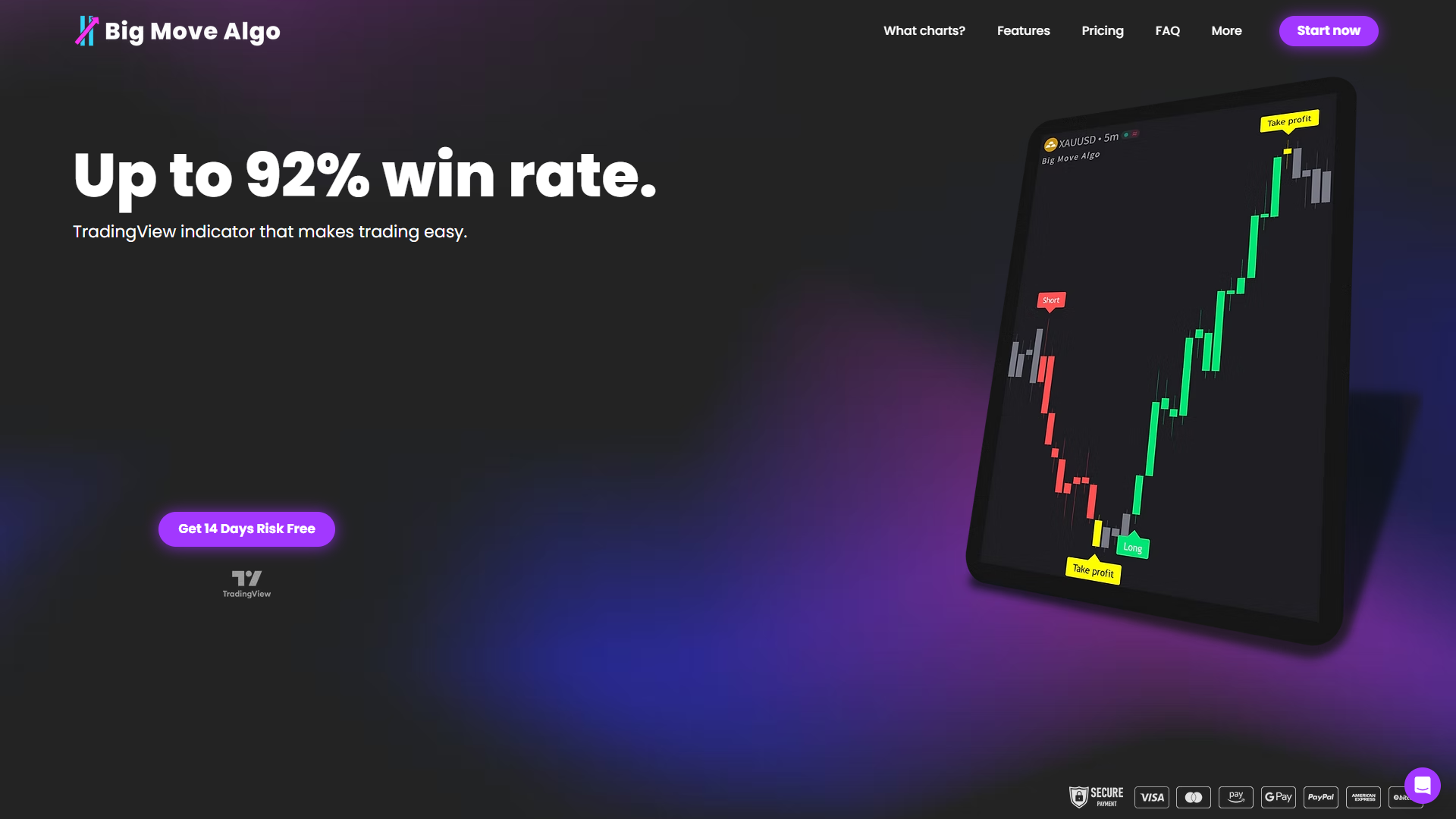
Big Move Algo is a TradingView indicator that delivers clear Long, Short, and Exit signals across crypto, forex, stocks, indices, and commodities. Its AUTO Mode requires minimal setup, making it accessible for traders who are still building their plan. The built-in Fake Trend Detector filters out low-quality market conditions automatically, so you are not pushed into trades that do not meet the criteria. For beginners who want structure without complexity, Big Move Algo’s trading signals provide a clear, rules-based framework that replaces guesswork with objective data.
FAQ
What is the number one beginner trading mistake?
Trading without a written plan is the most common and costly beginner error. Without defined entry, exit, and risk rules, every trade becomes a random decision that ignores risk management.
How much should a beginner risk per trade?
Professional risk management standards recommend risking no more than 1–2% of your account equity per trade. This limit protects your capital during inevitable losing streaks.
Why do most beginner traders lose money?
Studies show 70–90% of retail traders lose money primarily due to behavioral errors, including emotional trading, poor risk management, and lack of a structured plan, not lack of market opportunity.
What is revenge trading and how do you stop it?
Revenge trading is placing an impulsive trade immediately after a loss to recover money quickly. Stop it by setting a daily loss limit and taking a mandatory break after any losing trade.
How does backtesting help new traders?
Backtesting a strategy on 100–200 historical trades validates its win rate, expectancy, and drawdown before you risk real capital. It turns a theory into a tested system with known performance characteristics.
Recommended
Comments