
Partial Profit Taking for Active Traders: Tranche Rules & P&L


Partial profit taking means selling a portion of a winning position, commonly between one-quarter and one-half, while letting the rest ride toward a bigger target. It locks in real money on the table and cuts your risk on what’s left, but only when you set the split, the levels, and the runner rule before you ever click buy. Do it on the fly and you’re not managing a trade anymore. You’re just guessing with extra steps.
TL;DR:
Partial profit taking is most effective on open-ended trades, breakouts, and trending names where the move could extend significantly.
Using predefined tranche sizes and price levels before entry, along with a clear runner rule, ensures disciplined execution of partial exits.
Moving stops to breakeven or trailing with ATR-based stops after partial fills optimizes risk management and captures longer-term moves.
Automation tools like Big Move Algo help enforce consistent partial exit rules and reduce human hesitation during volatile market conditions.
Tracking and backtesting your partial exit performance over at least 50 trades provides data to confirm whether scaling improves your results.
Table of Contents
What Partial Profit Taking Actually Means
Traders call this “scaling out,” and the piece you keep after selling part of the position is the “runner.” The core trade-off is simple: you bank certainty now in exchange for capping how much of the eventual move you capture. Sell a portion of a stock at your first target and you’ve guaranteed a profit on that slice no matter what happens next, even if the stock reverses hard an hour later.
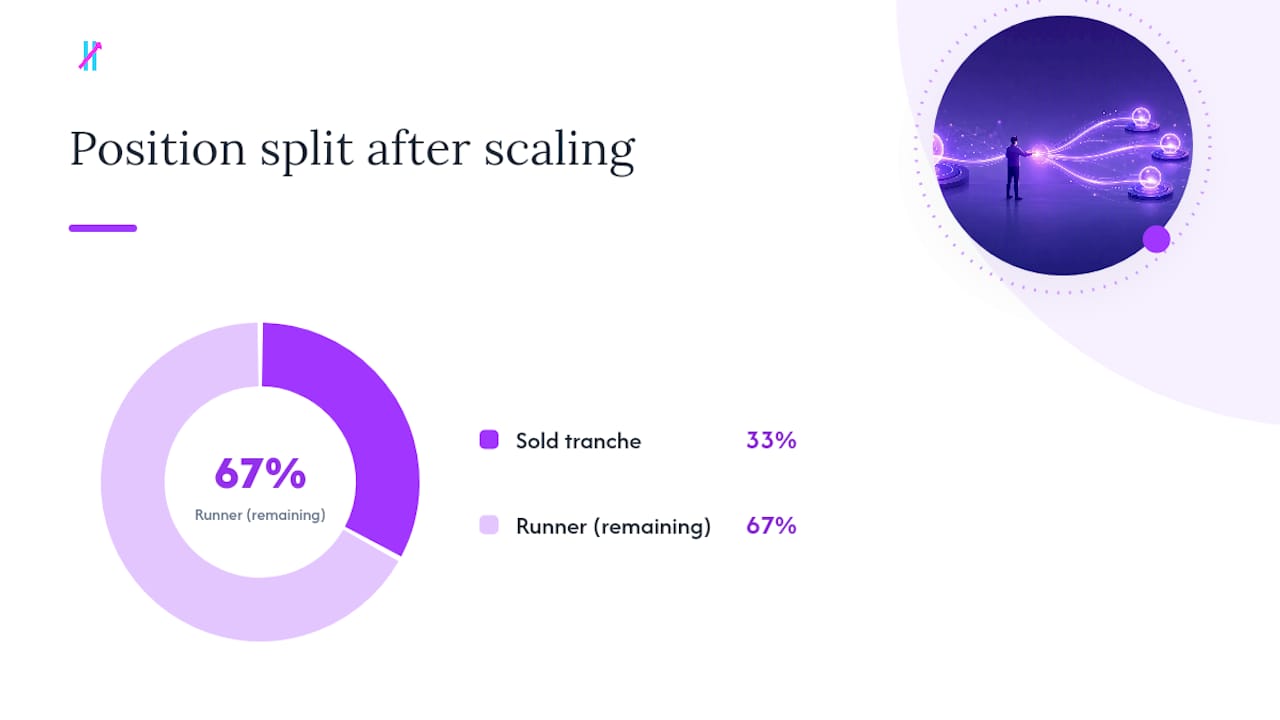
The catch is dilution. If the remaining shares hit your big target, your blended average win is lower than if you’d held the full size the whole way. That’s the price of insurance, and it’s worth paying on the right setups.
The distinction that separates professionals from everyone else is when the decision gets made:
Planned scaling: tranche sizes and exit levels are written down before entry
Emotional scaling: you sell “some” because the position feels uncomfortable or you’re scared of giving profit back
Planned scaling banks gains and reduces risk on the remainder specifically because the levels are set in advance, not because the trader got nervous at a random moment. A trade entered at $50 with a $45 stop and a plan to sell one-third at $55 is a system. Selling one-third at $52 because the position “felt good enough” is a coin flip wearing a strategy costume.
When Partials Help and When They Hurt
Partial exits aren’t universally correct. They fit some setups and actively damage others.
Open-ended upside trades. Breakouts, trend continuations, and anything without a hard ceiling reward scaling out because you don’t know how far the move goes.
Choppy or news-driven markets. Locking some gain during volatility protects you from round-trips when price whips back before your full target prints.
Multi-leg theses. If your trade idea has separate catalysts (an earnings beat, then a sector rotation, then a breakout), sizing your exit to whichever leg has actually resolved keeps your remaining exposure matched to remaining uncertainty.
Options positions with multiple contracts. Scaling works cleanly when you can split the position at all.
Partials hurt on precise, single-target setups where the whole thesis is “price reaches X, then reverses.” They also fail on tiny position sizes. You can’t meaningfully scale one share of stock or a single options contract, so full exit becomes the only honest choice. The fix is deciding before entry: mark every trade as either “partial candidate” or “full exit only” on your trade ticket, so you’re never negotiating with yourself mid trade.
Building a Tranche Framework That Actually Repeats
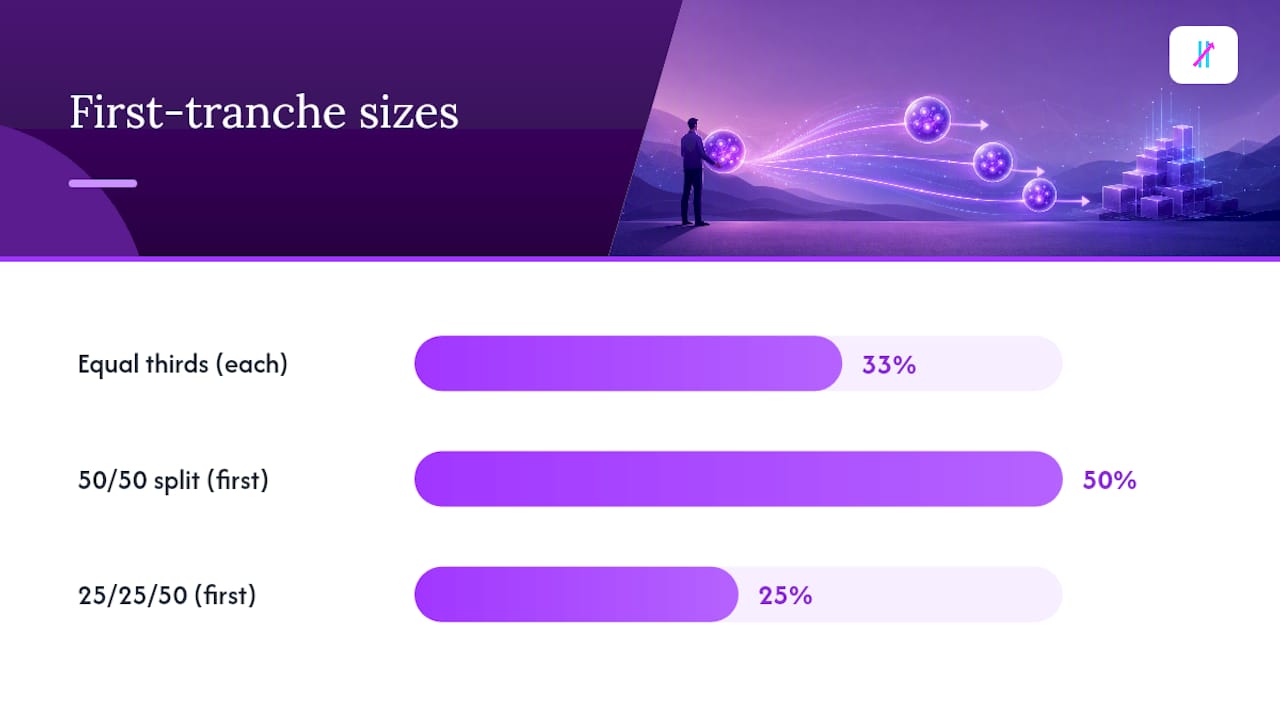
Most durable frameworks use one of three splits. Equal thirds (a third off at each of three targets) suits trending names with room to run. A straight 50/50 split fits faster, choppier trades where you want to bank half quickly and let the other half work. A 25/25/50 weighting, taking small pieces early and holding the bulk for a bigger move, suits high-conviction setups where you’re willing to give the position more room.
Setting the actual price levels matters more than picking a split. Three methods work well:
Risk multiples: sell the first tranche at 1.5R to 2R (one and a half to two times your initial risk), a level Cabot Wealth Network’s rules for booking partial profits treat as a practical default
Chart structure: prior swing highs, resistance zones, or measured moves
Momentum confirmation: scale out when an indicator shows the move losing steam, rather than at a fixed price
Here’s the math that makes the trade-off concrete. Say you buy 300 shares at $50 with a stop at $47 (a $3 risk per share, or $900 total risk). At $56 (2R), you sell 100 shares, banking $600. The remaining 200 shares run to $62 before you exit, adding $2,400. Total profit: $3,000. Had you held all 300 shares to $62 with no partial, you’d have made $3,600. But if the stock had instead reversed back to your stop after touching $56, the full-exit version loses $900 while the partial version still nets $600. That asymmetry, giving up some upside to remove downside, is the entire point.
Write the plan on the trade ticket before entry. A framework you invent after the position moves against you isn’t a framework.
Protecting the Runner After You Scale Out
Selling part of a position doesn’t retire your stop-loss. It’s tempting to feel “safe” after locking in the first tranche, but the shares you’re still holding can still lose money, and partial profits were never meant to replace a stop.
Three common approaches to protecting the runner:
Move to breakeven immediately. As soon as the first tranche fills, raise the stop on the remainder to your entry price. The trade is now risk-free.
Trail a fixed distance. Move the stop up by a set dollar amount or percentage as price advances, giving the runner room to breathe.
Use an ATR-based trailing stop. Set the stop at a multiple of average true range below price, which adapts automatically to how volatile the instrument is. A structured ATR stop-loss approach tends to outperform a fixed dollar trail in fast-moving names because it widens during volatility instead of getting stopped out on normal noise.
Trailing stops fit trending markets where you want to capture an extended move. A fixed higher target fits when you have a clear resistance level or measured objective in mind and don’t expect the trade to keep extending past it.
Pro Tip: After your first tranche fills, set a hard alert at your breakeven stop level immediately, don’t wait until you’re “not busy.” The five minutes between the fill and the stop adjustment is exactly when undisciplined traders get burned by a snapback.
A Checklist to Run Before Every Trade
Treat this as a pre-trade gate, not a nice-to-have.
Set tranche sizes and price levels in writing before entry.
Define the runner rule: what happens to the remaining position if it hits target, and what happens if it doesn’t.
Set the stop-adjustment rule (breakeven, trail, or ATR-based) and the exact trigger for moving it.
Log the plan on the trade ticket so you can review intent versus outcome later, not just profit and loss.
Then track it. Record the percentage of the position locked at each tranche, how the runner actually performed, and your average win with partials versus without. Compare R-multiples across both approaches over time. Backtesting across a meaningful sample, 50 trades or more, or forward-testing on a demo account tells you whether scaling out is actually improving your results or just making losses feel smaller. Adjusting your position sizing alongside your scaling rules gives you a cleaner read on which variable is driving the change.
How Automation Enforces the Plan You Actually Wrote
The gap between a good partial-exit plan and a good outcome is almost always execution, not strategy. Rule-based automation removes the moment where a trader hesitates, second-guesses a level, or lets a target slide past because they were watching something else. Automated alerts or tranche orders execute at the exact level you set weeks earlier, with no negotiation.
Big Move Algo’s TradingView indicator issues structured Long, Short, and Exit signals, and its AUTO Mode is built to apply consistent rules without manual guesswork on every candle. That kind of structure matters most when a trader has already defined tranche levels and a runner rule and simply needs the discipline to execute them without flinching.
Automated alerts fire at pre-set price levels instead of relying on the trader to notice
A rules-based system applies the same logic every time, removing the “just this once” exception
Human override still matters around news events, earnings, or anything an algorithm wasn’t built to interpret
Regulators including FINRA and the CFTC stress disciplined trade management for retail traders, and scaling techniques should never become a workaround for ignoring stop rules or margin requirements.
Discipline Beats a Clever Split
The specific tranche ratio you pick matters far less than whether you actually follow it. A written plan reviewed against real outcomes will beat a theoretically perfect split that gets abandoned the first time a trade feels scary. Journal every partial exit, measure it against full-exit alternatives over a real sample size, and let the data, not the moment, decide your next adjustment.
— Steven Hartwell
Automating Your Partial Exits With Big Move Algo
Writing the perfect tranche plan is one thing. Executing it the same way on trade forty as you did on trade one is the actual challenge, and it’s where most retail traders lose the edge they built on paper. Big Move Algo removes that gap by pairing structured Long, Short, and Exit signals with an AUTO Mode that applies your rules consistently, so a pre-set target doesn’t quietly become a “let’s see what happens” moment.
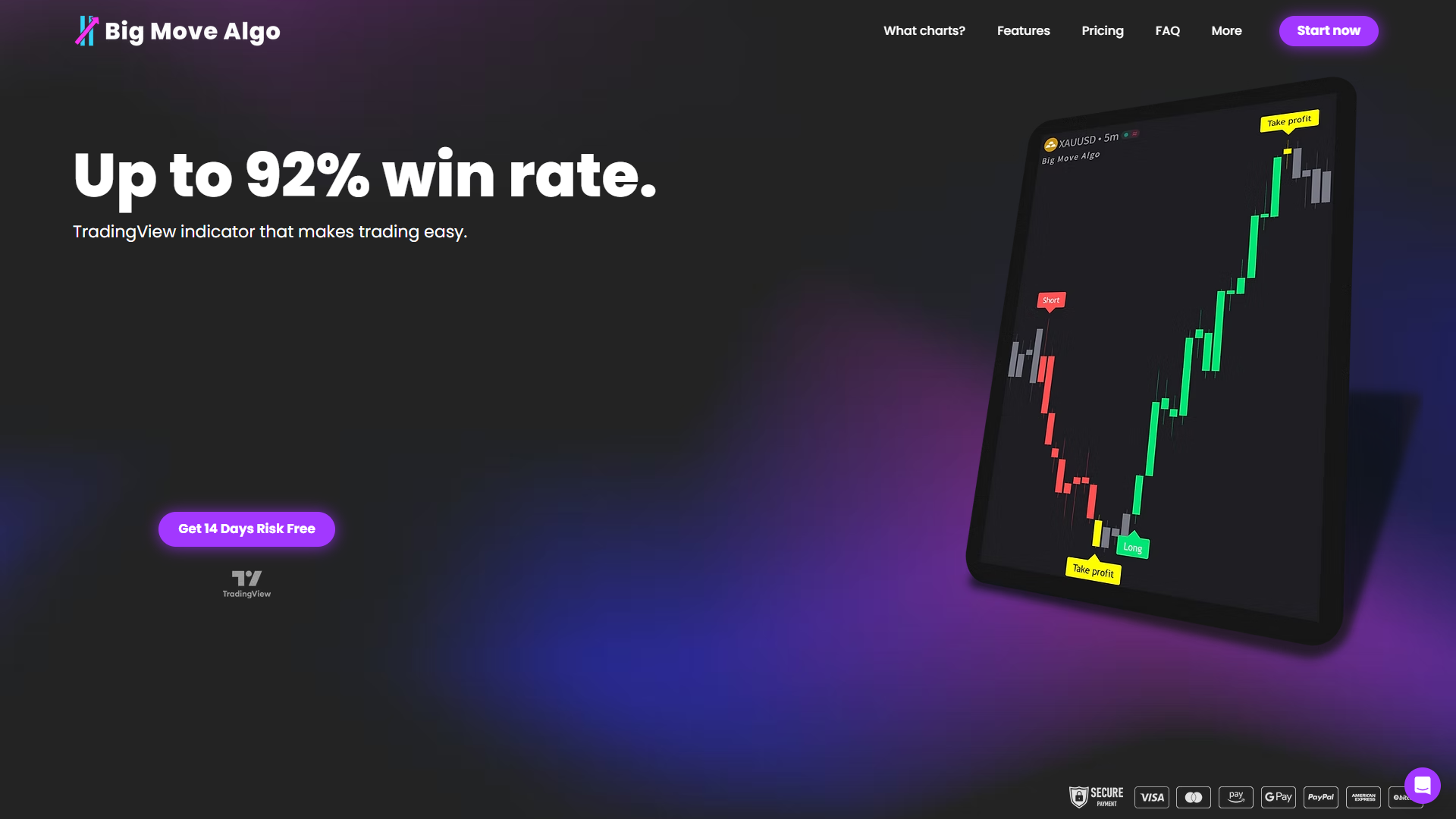
The indicator works across crypto, forex, stocks, indices, and commodities, and its Fake Trend Detector filters out the low-quality setups where scaling rules tend to break down anyway. If you want your exit alerts firing at the exact levels you planned instead of the levels you remembered under pressure, the setup guide for automating alerts and execution walks through the process step by step. Plans start at Version 2 for $55 per month, with instant access after signup, so you can start testing whether structured signals actually improve your partial-exit discipline on your very next trade.
This article is general information, not a substitute for advice from a qualified financial advisor. Consult a qualified financial professional about your own circumstances before acting on anything here.
Sources
FAQ
What Is Partial Profit Taking?
Partial profit taking is selling a portion of a winning position, commonly one-third to one-half, while holding the remainder as a runner toward a larger target. It locks in some realized gain and reduces the dollar risk on what’s left, provided the split and levels were decided before entry.
Is It Better to Use a Take-Profit Order Instead of Scaling Out?
A single take-profit order guarantees an exit at one price and works well for precise, single-target setups. Scaling out with multiple partial exits fits open-ended trends better, since it captures some profit early while leaving room to catch a bigger move on the remaining shares or contracts.
Can You Make $100 a Day Day Trading With Partial Exits?
Daily results depend entirely on account size, position sizing, and market conditions, so there’s no universal answer tied to a technique alone. Partial profit taking can improve consistency by reducing the odds of a full round-trip loss, but it doesn’t guarantee any specific daily dollar outcome.
What Is the 7% Rule in Trading?
It’s a risk-control rule, not a profit-taking rule, and it works alongside, not instead of, a partial-exit plan on the profitable side of a trade.
How Do I Know if Partial Profit Taking Is Improving My Results?
Track your average win, runner outcomes, and R-multiples for trades where you scaled out versus trades where you held full size to one target. Reviewing at least 50 trades, either through backtesting or demo forward-testing, gives a large enough sample to tell whether the technique is genuinely helping or just making individual losses feel smaller.
Recommended
Comments