
Best Time to Trade Crypto: A US Trader's Playbook
- Steven Hartwell

- Aug 13
- 11 min read

The best time to trade crypto is the US–Europe session overlap, running from 1:00 PM to 5:00 PM ET (13:00–17:00 UTC), with Tuesday through Thursday delivering the cleanest liquidity and tightest spreads of the week. Here’s what that looks like in practice:
Best execution window: 1:00 PM–5:00 PM ET (13:00–17:00 UTC) — use limit orders, size normally, and expect fast fills
Secondary windows: European morning 3:00 AM–8:00 AM ET (08:00–13:00 UTC); US session 8:00 AM–5:00 PM ET (13:00–22:00 UTC); Asian session 7:00 PM–3:00 AM ET (00:00–08:00 UTC)
Avoid or size down: weekends and Friday after 5:00 PM ET — books thin out, wicks exaggerate, and reversals are common
Thin-hour rule: cut position size by at least half outside peak windows and switch to limit orders only
Key Takeaways
The US–Europe overlap (1:00 PM–5:00 PM ET / 13:00–17:00 UTC) on Tuesday through Thursday is the highest-probability execution window for retail crypto traders, combining peak liquidity, tight spreads, and the deepest order books of the week.
Point | Details |
Best execution window | US–Europe overlap, 13:00–17:00 UTC (1:00 PM–5:00 PM ET), delivers tightest spreads and fastest fills. |
Best days of the week | Tuesday through Thursday offer the most consistent liquidity; avoid large positions on weekends. |
Off-peak sizing rule | Cut position size by at least half outside peak windows and use limit orders only. |
Large order execution | Split orders across a 10–15 minute VWAP window during 11:00–13:00 UTC to reduce market impact. |
Exchange calendar check | Verify maintenance windows and CME holiday closures before any large or overnight position. |
Next step: Block the US–Europe overlap (1:00 PM–5:00 PM ET) in your calendar this week, then run your last 20 trades through a session filter to see where your execution costs are actually coming from.
Table of Contents
Why the best time to trade crypto isn’t just about the clock
Crypto trades 24 hours a day, 7 days a week. No closing bell, no circuit breakers, no mandatory lunch break. That sounds like a pure advantage, but it creates a trap: the assumption that all hours are equally good for executing a trade.
They are not. Human traders, institutional desks, and algorithmic systems all cluster their activity around business hours in their home regions. When those regions overlap, order books deepen, spreads compress, and price discovery becomes more efficient. When those regions go quiet, the same market turns thin, erratic, and expensive to trade.
The practical result is a predictable intraday rhythm. Academic analysis of 1,940 trading pairs across 38 exchanges found consistent peaks in activity and volatility between 16:00 and 17:00 UTC, which maps directly to the US–Europe overlap. That pattern repeats because it is driven by scheduled human behavior, not randomness.
Scheduled macro releases amplify this further. US CPI prints, FOMC updates, and NFP reports all drop inside overlap windows, and those events reliably drive the largest intraday liquidity and volatility spikes in crypto. The market is not reacting randomly; it is reacting to a calendar.
Pro Tip: Treat session timing as a filter, not a strategy. Your edge comes from your setup. Timing just determines whether the market will cooperate when you pull the trigger.
The three global sessions you need to know
Crypto market activity divides into three regional sessions that largely mirror traditional financial market hours. Session definitions used by market educators and brokers segment the day as follows:
Session | UTC Range | ET Range (Standard) | ET Range (DST) | Liquidity Profile |
Asian | 00:00–08:00 UTC | 7:00 PM–3:00 AM ET | 8:00 PM–4:00 AM ET | Lower volume, tighter ranges, BTC/stablecoin pairs most active |
European | 08:00–17:00 UTC | 3:00 AM–8:00 AM ET | 4:00 AM–1:00 PM ET | Rising volume, EUR/GBP pairs active, macro data releases |
US | 13:00–22:00 UTC | 8:00 AM–5:00 PM ET | 9:00 AM–6:00 PM ET | High volume, derivatives active, CME futures overlap |

The Asian session tends to be range-bound. BTC/USDT and stablecoin pairs dominate, and the main drivers are regional exchange activity and funding rate resets on perpetual futures. Moves happen, but they are often smaller and less sustained than what the overlap produces.
European morning picks up quickly. Frankfurt and London equity opens bring institutional participation, and macro data from the EU and UK can trigger sharp moves. By the time European traders are at full capacity, volume has already climbed well above Asian-session levels.
The US session is where derivatives volume concentrates. CME Bitcoin futures trade Sunday through Friday with a daily break from 5:00 PM to 6:00 PM ET, and their settlement windows influence spot price behavior. When both European and US desks are active simultaneously, that is the overlap window where execution quality peaks.
DST note: The US shifts between Eastern Standard Time (UTC-5) and Eastern Daylight Time (UTC-4) twice a year. Europe shifts on a slightly different schedule. During the transition weeks in March and November, the overlap window can shift by an hour. The simplest fix: add UTC as a second time zone in your phone’s clock app and schedule alerts in UTC so they never drift.
Practical windows for timing your trades each day
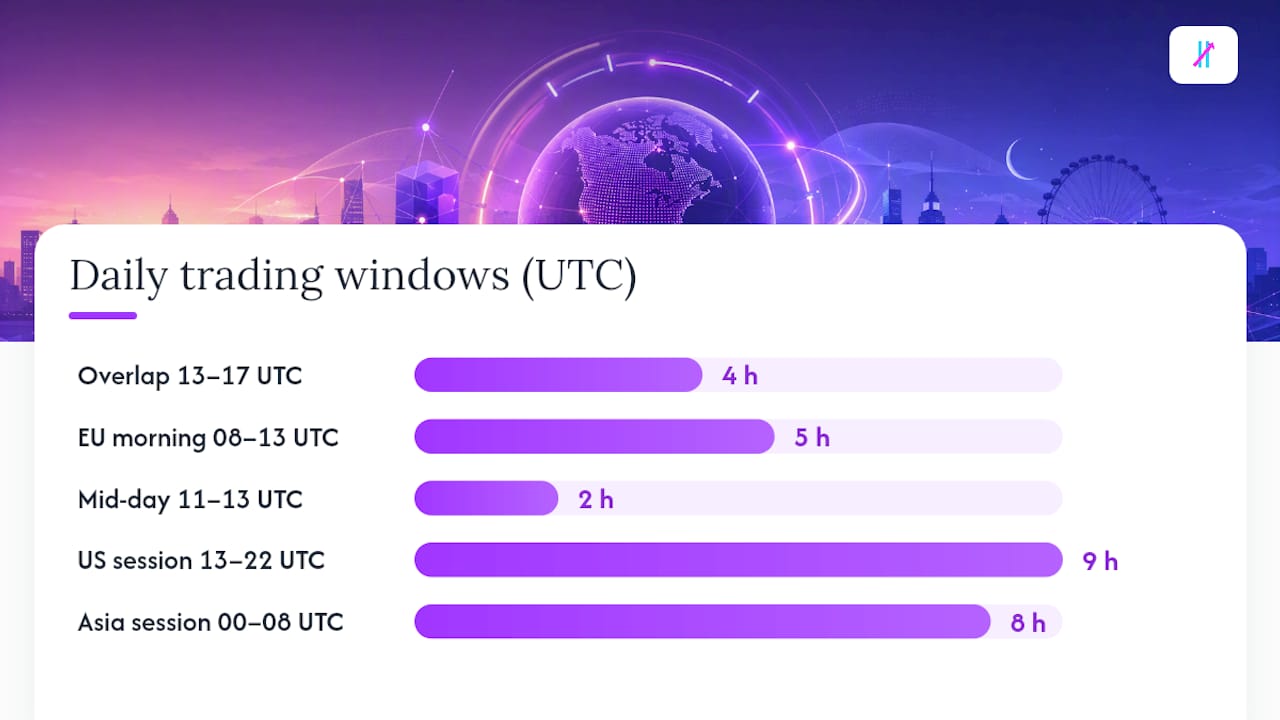
The US–Europe overlap from 13:00–17:00 UTC (1:00 PM–5:00 PM ET) is the single best execution window for most retail traders. Industry analysis consistently ranks it as the highest-liquidity window, with the tightest spreads and fastest fills of the day. If you can only be active during one window, make it this one.
Beyond the overlap, here are the supplemental windows worth knowing:
European morning, 08:00–13:00 UTC (3:00 AM–8:00 AM ET): Volume is building but not yet at peak. Good for swing entries where you want a fill before the overlap rush. Momentum strategies tend to work better here than mean-reversion plays.
Mid-day UTC sweet spot, 11:00–13:00 UTC (6:00 AM–8:00 AM ET): Simulation-based analysis of BTC orders found that market impact for larger trades is often lowest around 11:00–13:00 UTC, just before the overlap kicks in. If you are building a larger position, this window lets you accumulate with less price disturbance.
US session, 13:00–22:00 UTC (8:00 AM–5:00 PM ET): Overlaps with the European afternoon for the first four hours, then continues as a standalone US session. The tail end (after 17:00 UTC) sees European desks closing, so volume gradually tapers. Still solid for active trading, but watch for the step-down in liquidity after 5:00 PM ET.
Asian session, 00:00–08:00 UTC (7:00 PM–3:00 AM ET): Thinner books, wider spreads, and slower price discovery. Scalping is harder here. Range-based strategies and swing holds work better than aggressive directional plays.
Pro Tip: Set your trading platform to display UTC alongside your local time. Most charting tools, including TradingView, let you add a second clock. This removes the mental math on DST shifts and keeps your session blocks accurate year-round.
Which days of the week give you the best execution
Tuesday through Thursday are the strongest days for execution-focused crypto trading. Midweek brings full institutional participation, consistent order-book depth, and the most reliable spread compression during overlap hours. Monday can be choppy as the market reprices weekend moves, and Friday starts to taper after the European close.
Weekend trading is a different environment entirely. Bloomberg’s market coverage notes that professional traders frequently reduce exposure or avoid initiating large directional positions over weekends, while less experienced traders tend to be more active. The result is a thinner order book dominated by retail flow, which produces exaggerated wicks and reversals that look significant on a chart but often snap back by Monday morning.
Friday deserves its own note. The European close at roughly 17:00 UTC on Friday marks the beginning of a liquidity slide that continues through Sunday. If you are holding a position into Friday evening, you are accepting weekend spread risk. That is not always wrong, but it should be a deliberate choice, not an oversight.
Practical day-of-week rules:
Tuesday–Thursday: trade full size during overlap, normal risk parameters
Monday: wait for the first hour of European trading before sizing up; let the market absorb weekend positioning
Friday: reduce size after 17:00 UTC; avoid new large directional entries heading into the weekend
Saturday–Sunday: limit orders only if you trade at all; cut size by at least half; widen stops to account for exaggerated wicks
How timing changes your execution quality
Timing does not just affect whether a trade works. It affects what the trade costs you before it even has a chance to work. Spreads and slippage are the two mechanisms, and both move predictably with session timing.
During the US–Europe overlap, bid-ask spreads on major pairs like BTC/USDT compress to their daily minimum. A market order fills close to the quoted price. Outside peak hours, that same market order can push through multiple price levels before completing, especially on a large size. The difference between a well-timed and a poorly timed execution can easily exceed what most traders think of as “acceptable slippage.”
Here is a practical order-type framework matched to session conditions:
Overlap window (13:00–17:00 UTC): Market orders are acceptable for standard retail sizes. Limit orders still preferred for anything above your typical size.
European morning (08:00–13:00 UTC): Use limit orders. Volume is building but not yet deep enough to absorb aggressive market orders cleanly.
Mid-day UTC (11:00–13:00 UTC) for larger orders: Talos’ execution analysis recommends a 10–15 minute VWAP duration for larger BTC orders during this window to minimize market impact. Split the order into child orders across that window rather than hitting the book all at once.
Asian session or weekends: Limit orders only. Never use market orders on thin books. If your platform supports passive TWAP execution, use it.
Any off-peak window: Reduce size. A position that would be routine during the overlap can move the market against you at 2:00 AM ET on a Sunday.
The narrative version: imagine placing a $50,000 BTC market order at 2:00 AM ET on a Saturday. The order book is thin, the spread is wide, and your order walks up through several price levels before filling. Now place the same order at 2:00 PM ET on a Wednesday. The book is deep, the spread is tight, and the fill comes back within a few cents of the quoted price. Same trade, same size, very different cost.
Pro Tip: For algorithmic execution and larger orders, always check whether your platform supports VWAP or TWAP child-order splitting. Passive execution during the mid-day UTC window consistently outperforms a single aggressive fill.
Exchange maintenance, holidays, and the CME calendar
Always check your exchange’s maintenance schedule and the CME derivatives calendar before planning a large or overnight position. This is not optional housekeeping. A maintenance window can pull your exchange offline mid-trade, and a US holiday can drain liquidity from futures markets in ways that ripple into spot prices.
Kraken’s trading hours documentation explains that spot exchanges generally operate 24/7 but schedule periodic maintenance windows, often on Friday evenings or over weekends, that can temporarily halt trading or reduce available pairs. CME Bitcoin futures follow a Sunday–Friday schedule with a daily break from 5:00 PM to 6:00 PM ET and full closures on US federal holidays.
Common US holiday effects on crypto liquidity:
Holiday | Typical Effect |
New Year’s Day | CME closed; spot liquidity thin; wider spreads across major pairs |
Martin Luther King Jr. Day | CME closed; moderate spot volume reduction |
Memorial Day | CME closed; US desk participation drops sharply |
Independence Day | CME closed; afternoon liquidity thins significantly |
Labor Day | CME closed; similar to Memorial Day pattern |
Thanksgiving | CME closed Thursday; reduced Friday; weekend-like conditions |
Christmas Day | CME closed; some of the thinnest spot liquidity of the year |
Action steps when your exchange posts a maintenance window:
Pause any automated strategies that rely on continuous execution
Close or reduce large overnight positions before the window opens
Check the exchange’s live status page (most major venues publish one) the morning of any planned large trade
Verify CME settlement dates if you hold futures or products that reference CME settlement prices
How to build session timing into your trading plan
Converting timing knowledge into a repeatable workflow takes about 30 minutes of setup and a commitment to running it consistently. Here is the checklist:
Pick your primary window. For most US traders, the overlap (1:00 PM–5:00 PM ET) is the default. Choose one or two supplemental windows if your schedule allows.
Block the calendar. Create recurring calendar events in UTC for each active window. Label them with the session name and your size tier (full size vs. reduced).
Set timezone-safe alerts. Configure your trading platform or TradingView alerts to fire at session open/close times in UTC. This survives DST shifts without manual adjustment.
Backtest your setups by session. Run your existing strategy’s historical trades through a filter: did it perform differently during overlap vs. Asian session? Measure slippage, realized spread, and fill rate separately for each window.
Set size caps for off-peak hours. Decide in advance what percentage of your normal size you will trade outside peak windows. Write it down. Fifty percent is a reasonable starting point.
Configure exchange maintenance alerts. Subscribe to your exchange’s status page or Telegram channel for maintenance announcements. Check it every Friday before the weekend.
Check the CME and exchange calendars before US holidays. Mark holiday dates in your trading calendar at the start of each quarter.
Use entry signal templates for overlap entries. Pairing session timing with clear entry signal templates reduces the chance of entering on a false breakout during the high-volume overlap window.
Run simulated fills before going live with a new size tier. Most platforms let you replay historical data. Run your intended order size through a simulated fill during both peak and off-peak windows to see the cost difference before it costs you real money.
Review monthly. Once a month, pull your trade log and filter by session. If your off-peak trades are consistently underperforming, tighten the size cap or remove that window entirely.
One-sentence backtest prompt: for each historical trade, record the UTC entry time, the session it fell in, the realized spread at fill, and the slippage versus the quoted price at signal trigger.
What Big Move Algo’s signal data shows about timing
The methodology behind Big Move Algo’s signal generation tracks volume spikes, spread compression, and signal density across sessions in real time. What that monitoring consistently shows is qualitative but clear: Long and Short signals cluster more densely during overlap windows, and the Fake Trend Detector flags a higher proportion of low-quality setups during Asian-session and weekend hours when order-book depth is thin.
During overlap windows, signal density increases and the proportion of signals that pass the Fake Trend Detector’s quality filter rises noticeably. During thin-book hours, the same price action that would generate a clean signal in peak conditions often gets flagged as a low-confidence setup. The pattern is consistent enough that session timing has become a built-in consideration in how the indicator is calibrated.
This is a qualitative observation from ongoing monitoring, not a guarantee of future performance. Backtest your own setups against session windows before drawing conclusions about your specific strategy. Indicator-based timing methods work best when paired with the kind of session-aware scheduling this article describes.
A trader’s honest take on session timing
Most traders know session timing matters in theory. Far fewer actually schedule their active hours and stick to the schedule. The gap between knowing and doing is where most execution costs live.
The habit that makes the biggest difference is simple: decide your active windows before the week starts, block them in your calendar, and treat off-peak hours as read-only time. You can watch the market. You can plan. You do not execute. That single constraint removes a large category of impulsive, thin-book trades that look reasonable in the moment and look terrible on the monthly review.
The benefits of signal-based trading compound when you pair them with session discipline. A good signal during the overlap is a different proposition than the same signal at 3:00 AM ET on a Sunday. The setup may look identical on the chart. The execution environment is not.
Sources
Check your exchange’s live status page and the CME Group holiday calendar at the start of each quarter to confirm current maintenance schedules and holiday-adjusted hours.
Ready to trade the overlap with clearer signals? Big Move Algo’s TradingView indicator fires Long, Short, and Exit signals in real time, with a built-in Fake Trend Detector that filters out low-quality setups during thin-book hours. AUTO Mode gets you running in minutes. Set up your Big Move Algo account and start trading the overlap with structure.
Recommended
Comments