
Crypto Trading Pairs Explained: A Beginner's Guide
- Steven Hartwell
- a few seconds ago
- 8 min read

A crypto trading pair is defined as two assets listed together on a cryptocurrency exchange, where you trade one asset directly against the other. The first asset is the base asset, and the second is the quote asset that prices it. Every trade you place on a crypto exchange involves selecting a pair, which means you are always buying or selling the base asset using the quote asset as the measuring currency. Understanding this structure is the foundation of understanding crypto trading pairs and making confident decisions in any market.
What is a crypto trading pair and how does it work?
A crypto trading pair combines two assets where the first, the base, is bought or sold, and the second, the quote, functions as the denominator in the price equation. In BTC/USDT, Bitcoin is the base asset and USDT is the quote currency pricing it. The price you see on the exchange tells you how many units of the quote asset you need to buy one unit of the base asset. If BTC/USDT shows 65,000, you need 65,000 USDT to purchase one Bitcoin.
When you place an order, you specify the quantity in base asset units, and the exchange calculates the total cost in the quote asset. This structure applies to every pair, whether you are trading ETH/BTC, SOL/USDC, or any other combination. The pair format is not just a label. It defines the entire logic of your transaction.

The bid-ask spread: the cost most beginners miss
Every trading pair carries two prices at any moment: the bid and the ask. The bid is the highest price a buyer will pay, and the ask is the lowest price a seller will accept. The difference between them is the spread, and it is a real cost you pay on every trade. A bid of 64,990 USDT and an ask of 65,010 USDT on BTC/USDT produces a 20 USDT spread, which directly reduces your profit on each transaction.
Price Component | Example Value (BTC/USDT) |
Bid price | 64,990 USDT |
Ask price | 65,010 USDT |
Spread | 20 USDT |
Exchange fee (typical) | 0.1% of trade value |
Beyond the spread, multiple hidden costs such as slippage, withdrawal fees, and tax obligations can cumulatively reduce profitability. These costs are easy to overlook when you are focused on price direction alone.
Pro Tip: Always check the spread before entering a trade. A wide spread on a low-volume pair can cost you more than the exchange fee itself.
What types of crypto trading pairs exist?
Crypto trading pairs fall into three main categories: crypto-to-fiat, crypto-to-stablecoin, and crypto-to-crypto. Each category carries a different risk profile, liquidity level, and level of complexity for the trader.
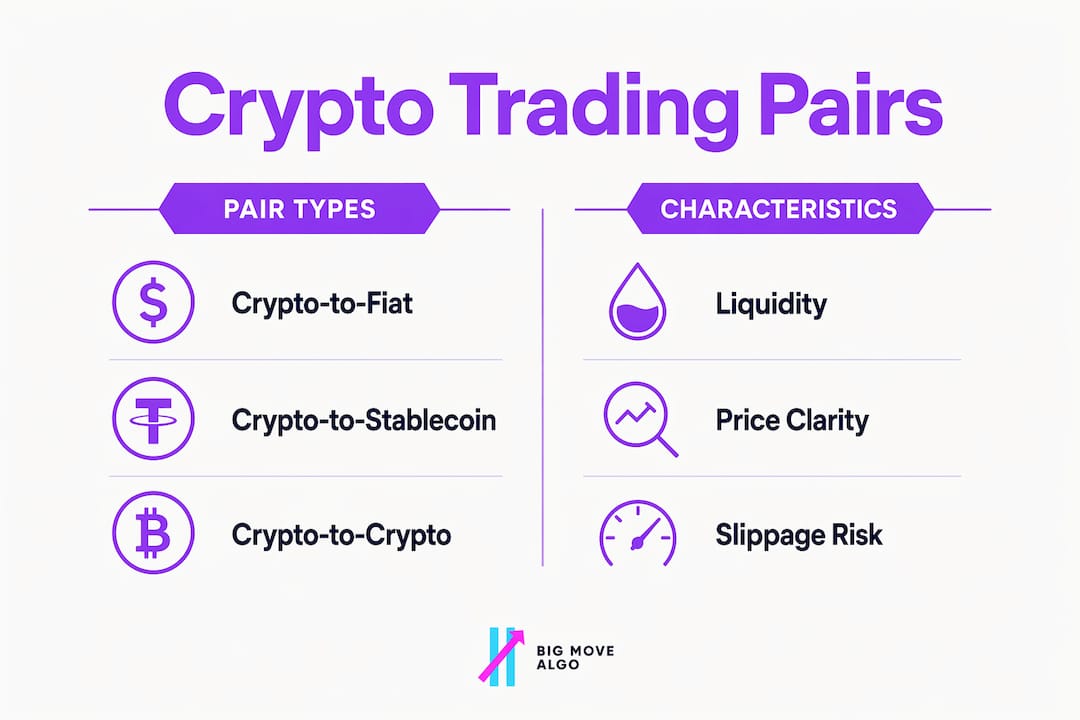
Crypto-to-fiat pairs such as BTC/USD or ETH/EUR connect a cryptocurrency directly to a government-issued currency. These pairs are straightforward to interpret because the price maps directly to real-world dollar or euro values. They are common on regulated exchanges that hold banking licenses.
Crypto-to-stablecoin pairs such as BTC/USDT or ETH/USDC behave similarly to fiat pairs because stablecoins are pegged to the US dollar. Stablecoin pairs provide a dollar-equivalent price that is easier for beginners to interpret compared to crypto-to-crypto pairs. BTC/USDT is simpler to understand than ETH/BTC because it maps neatly to real-world values. This makes stablecoin pairs the most practical starting point for new traders.
Crypto-to-crypto pairs such as ETH/BTC or SOL/ETH involve two volatile assets priced against each other. The price you see does not directly tell you the dollar value of your position. You need to calculate the fiat equivalent of both assets to understand your actual exposure.
Pair type | Typical liquidity | Price clarity | Slippage risk |
Crypto-to-fiat | High | High | Low |
Crypto-to-stablecoin | Very high | High | Low |
Crypto-to-crypto (major) | Medium | Medium | Medium |
Crypto-to-crypto (altcoin) | Low | Low | High |
Experts advise beginners to avoid volatile altcoin pairs and focus on stablecoin pairs with high liquidity for smoother trade entries and exits. Thin liquidity in low-volume pairs leads to significant price slippage, meaning your order fills at a worse price than expected.
Pro Tip: Filter pairs by 24-hour trading volume before you trade. A pair with consistently high volume gives you tighter spreads and faster order fills.
Common misconceptions about trading pairs that cost beginners money
The most damaging misconception is that an asset has one universal price across all pairs. Bitcoin does not have a single price. It has a different price in every pair it appears in, because each trading pair is its own market with a unique order book, liquidity pool, and fee schedule. BTC/USDT and BTC/ETH are entirely separate markets, and the implied Bitcoin price in each can differ.
Here are the most common mistakes beginners make with trading pairs:
Ignoring pair order. The sequence of base and quote assets is functional, not decorative. Misreading pair order causes traders to unintentionally spend entire balances or place orders for the wrong asset. Always confirm which asset is the base before entering an order quantity.
Assuming equal liquidity across pairs. An asset may be liquid in one pair and illiquid in another. Trading a low-volume pair for the same asset can result in slippage that wipes out your expected profit.
Overlooking tax complexity in crypto-to-crypto trades. Calculating profit and loss in crypto-to-crypto pairs requires mapping the fiat value of both assets at the exact time of the trade. This creates significantly more tax-reporting effort compared to stablecoin pairs, where one side of the trade already has a stable dollar value.
Skipping pair verification before trading. Each pair on an exchange has its own fee tier, minimum order size, and withdrawal rules. Assuming these are identical across pairs leads to unexpected costs.
The practical fix is simple: before placing any trade, confirm the pair name, check the order book depth, review the fee schedule, and verify the 24-hour volume. This takes under two minutes and prevents the most common and costly errors.
How do you choose the best crypto trading pairs for your goals?
Selecting the right pair depends on your trading goal, risk tolerance, and experience level. The following framework applies whether you are trading for the first time or refining an existing strategy.
Start with stablecoin pairs. BTC/USDT and ETH/USDC offer high liquidity, clear dollar pricing, and straightforward tax tracking. They are the right starting point for any beginner. Over 260 crypto exchanges operate globally, but regulated platforms with stablecoin pairs reduce the risks that come with obscure or unregulated markets.
Match the pair to your goal. If your goal is value preservation, stablecoin pairs reduce your exposure to double-sided volatility. If your goal is growth through volatility, major crypto-to-crypto pairs like ETH/BTC offer that exposure while maintaining reasonable liquidity.
Check volume and spread together. High volume alone does not guarantee a tight spread. Always look at both metrics before committing to a pair. A pair with $500 million in daily volume but a wide spread still costs you more per trade than a pair with $100 million in volume and a tight spread.
Use a reputable, regulated exchange. The platform you trade on affects the pairs available to you, the fee structure, and the quality of the order book. A first trading platform checklist helps you evaluate what to look for before you deposit funds.
Progress gradually to complex pairs. Once you are comfortable with stablecoin pairs, you can explore signal-based crypto trading strategies that incorporate more volatile pairs with defined entry and exit criteria.
Mapping trading pairs to individual financial goals helps traders choose pairs for value preservation versus volatility exposure. This is not a one-time decision. As your skills grow, your pair selection should evolve with them.
Key Takeaways
A crypto trading pair is a distinct market listing with its own price, liquidity, fees, and order book, making pair selection one of the most consequential decisions a trader makes.
Point | Details |
Base and quote roles | The base asset is bought or sold; the quote asset prices it in every transaction. |
Spread is a real cost | The bid-ask spread on BTC/USDT can reach 20 USDT per trade, reducing profit on every order. |
Stablecoin pairs for beginners | BTC/USDT and ETH/USDC offer clear dollar pricing, high liquidity, and simpler tax tracking. |
Each pair is its own market | Liquidity, fees, and price differ across pairs even for the same base asset. |
Goal-based pair selection | Match your pair to your objective: stablecoins for preservation, volatile pairs for growth exposure. |
Why most beginners get trading pairs wrong from the start
Most traders I have worked with or spoken to made the same early mistake: they picked a pair based on name recognition, not market quality. They saw a coin they had heard of, found a pair that included it, and traded without checking volume, spread, or liquidity. The result was slippage they did not expect and fees they did not account for.
The part that surprises people most is the tax angle. When you trade ETH/BTC, you are not just buying Ethereum. You are simultaneously disposing of Bitcoin. Both sides of that trade have a taxable cost basis at the exact moment of execution. Stablecoin pairs eliminate half of that complexity because one side of the trade holds a stable dollar value. For anyone just starting out, that simplification alone is worth choosing BTC/USDT over ETH/BTC.
My honest view is that the spread and liquidity differences between pairs matter far more than most beginner guides acknowledge. A pair that looks attractive because of a trending coin can quietly cost you 1–2% per round trip in spread and slippage alone. That adds up fast. Start with the boring, liquid pairs. Learn the mechanics. Then expand your pair selection as your understanding of order books and market depth grows.
— Steven Hartwell
How Big Move Algo helps you trade crypto pairs with clarity
Understanding trading pairs is one thing. Knowing when to act on them is another.

Big Move Algo is a TradingView indicator built for traders who want clear signals without the noise. It analyzes crypto markets in real time and delivers Long, Short, and Exit signals directly on your chart. The built-in Fake Trend Detector filters out low-quality market conditions, so you are not trading a pair when the setup does not support it. Whether you prefer the simplicity of AUTO Mode or the control of Manual Mode, Big Move Algo works across crypto, forex, stocks, and more. Visit Big Move Algo to see how it fits your trading approach.
FAQ
What is a crypto trading pair in simple terms?
A crypto trading pair is two assets listed together on an exchange so you can trade one for the other. The first asset is the base, and the second is the quote currency that prices it.
What does BTC/USDT mean as a trading pair?
BTC/USDT means Bitcoin is the base asset and USDT is the quote currency. The price shown tells you how many USDT you need to buy one Bitcoin.
Why do beginners prefer stablecoin trading pairs?
Stablecoin pairs like BTC/USDT map directly to dollar values, making them easier to interpret and track for tax purposes compared to crypto-to-crypto pairs involving two volatile assets.
How does the bid-ask spread affect my trades?
The spread is the difference between the buy price and the sell price on a pair. On BTC/USDT, a 20 USDT spread means you pay that cost on every trade, reducing your net profit.
Can the same asset have different prices in different pairs?
Yes. Each trading pair is a separate market with its own order book and liquidity. Bitcoin’s implied price in BTC/USDT and BTC/ETH can differ because they are distinct markets with independent supply and demand.
Recommended