
Traders: 6 Filter Checklist That Makes High Probability Setups Work


A high probability setup is a trade idea where context, location, trigger, invalidation, liquidity, and timing all line up before you click the buy or sell button, not a pattern that guarantees a win. Probability is stacked, the way a Sharpe ratio stacks return against risk rather than judging return alone. Tools like Big Move Algo exist to help you spot that alignment faster, but the checklist underneath it is what actually separates a strong trade from a lucky guess.
TL;DR:
A high probability trade setup requires passing six specific filters—context, location, trigger, invalidation, liquidity, and timing—before risking any capital.
The most reliable setups are breakouts with retests, wick rejections at key levels, and trend continuations off pullbacks, each graded on a five-filter scale.
Trade mechanics vary for futures, forex, and stocks, with each market needing tailored entry tactics and awareness of liquidity and session hours.
Proper risk management involves sizing positions to a fixed percentage, placing stops at invalidation points, and targeting at least 2R, regardless of the setup’s visual appeal.
Using tools like Big Move Algo can help traders identify and act on qualified setups faster by providing real-time signals and filtering low-quality conditions.
Table of Contents
What Qualifies as a High Probability Trading Setup?
A candidate trade earns the label only after it survives a specific checklist, not because it looks clean on a chart. The practical framework used by active traders breaks qualification into six filters, and skipping even one turns a decent idea into a coin flip.
Run every setup through this sequence before risking a dollar:
Context: What does the higher timeframe say? A 5-minute breakout against a daily downtrend carries far less weight than one riding with it.
Location: Is price at a level that actually matters, like a prior swing high, a session’s opening range, or a well-tested support zone, not just a random spot on the chart?
Trigger: Is there a defined confirmation, such as a candle close beyond a level or a retest that holds, rather than an anticipatory guess?
Invalidation: Where exactly does the idea stop being true? This is your stop, decided before entry, not after.
Liquidity: Is the instrument trading with enough volume that your stop and target are realistic, not vulnerable to a thin-book spike?
Timing: Are you trading during a session or hour when this setup historically has room to work, or during a dead lunch-hour lull?
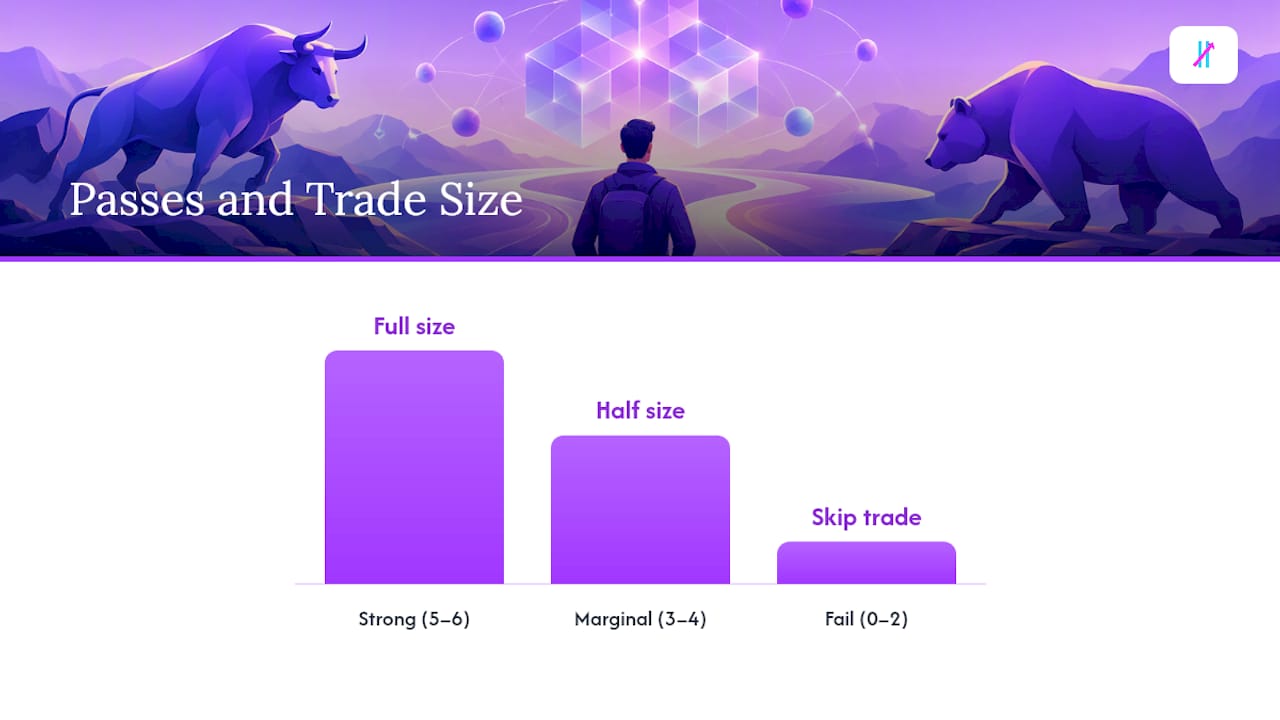
A simple pass/fail scoring model works better than a complicated point system. Count how many of the six filters are clearly satisfied. Five or six is a strong setup worth full size. Three or four is marginal and worth half size at most. Anything below three should get skipped entirely, no matter how good the pattern looks.
For your trade log, capture at minimum: setup type, which filters passed, entry price, stop price, target, actual outcome, and a one-line note on what you’d do differently. That log is what eventually tells you whether a setup you like is actually one you should be trading.
Pro Tip: Grade the setup before you know the outcome. Writing your grade after the trade closes lets hindsight quietly rewrite your standards.
Three High Probability Setups Worth Practicing
Every experienced trader leans on a small handful of repeatable patterns rather than chasing something new every session. The three-setup framework popular among discretionary traders covers most of what shows up across futures, forex, and stocks.
Breakout and retest at a higher-timeframe level. Identify a level that matters on the daily or 4-hour chart: a prior high, a round number, or a well-respected trendline. Wait for a decisive close beyond it, then wait again for price to pull back and hold above (or below, for shorts) that same level. Enter on the retest hold, place your stop just beyond the level on the wrong side, and target at least 2R. A five-filter grade here usually means the breakout came with strong volume and the retest was shallow and quick.
Higher-timeframe rejection, or wick rejection. Watch for a long wick forming at a key level on the 1-hour or 4-hour chart, showing that buyers or sellers got overwhelmed and reversed hard. The trigger is the candle close back inside the range, confirming rejection rather than a fake wick with no follow-through. Enter on that close, stop beyond the wick’s extreme, and target the nearest structure on the other side. This setup grades well when the wick appears at a level with a history of reacting, not in the middle of nowhere.
Trend continuation off a pullback. In an established trend, measure the pullback against a moving average or a Fibonacci retracement zone, then look for confluence: a bounce off the average, a bullish or bearish engulfing candle, or a momentum reset on the RSI. Enter as price resumes in the trend direction, stop below the pullback low (or above the high for shorts), target the prior swing extreme or beyond. This setup tends to grade highest in strongly trending markets and weakest in choppy, range-bound conditions.
Size each one relative to its grade, not its story. A textbook breakout and retest that only scores four out of six filters, maybe because volume was light, deserves smaller size than a messier-looking pullback that checks every box.
How Setups Change Across Futures, Forex, and Stocks
The same six-filter checklist applies everywhere, but the mechanics shift depending on what you trade. Market-specific research on day trading setups points out that ignoring these differences is one of the fastest ways to turn a good idea into a bad trade.
Futures run on structured hours, which makes opening-range breakout (ORB) tactics reliable. A 15 or 30-minute opening range on index futures like the E-mini S&P gives you a clean level, and the “second break” (the range’s edge failing once, then breaking again with conviction) tends to outperform the first attempt.
Forex has no centralized open, so session-anchor tips matter more. Use the London or New York session open as your reference range, and treat the London/New York overlap as prime time for retest confirmation since liquidity peaks and false breaks get punished less.
Stocks carry premarket gap context that futures and forex don’t. Check the premarket range and gap size before trusting an opening-range breakout, and remember that single-name stocks can have thinner books than index futures, so widen your stop assumptions and check the spread before sizing up.
Avoid trading any of these setups in the last hour before a major report, during holiday-thinned sessions, or in the dead zone between the New York close and the Asia open, when liquidity dries up and false signals multiply.
Risk Rules That Keep a Good Setup From Becoming a Bad Trade
A five-filter setup still loses money if your stop is unrealistic or your size is wrong. Standard trading strategy guidance treats risk-adjusted performance, not raw win rate, as the real measure of whether a strategy is sound.
Size positions off a fixed percentage of account risk (commonly 0.5% to 1% per trade) or a fixed dollar amount, calculated from stop distance, not from how confident you feel.
Place stops at the price where your trade idea is actually wrong, often anchored to the invalidation level plus a buffer measured in average true range (ATR), never at a round arbitrary number.
Target at least 2R (twice your risk) on qualified setups, since that ratio is what lets a strategy stay profitable even with a win rate under 50%.
Use bracket orders whenever your platform allows it, so stop and target are locked in the instant you enter and you’re not managing the trade emotionally in real time.
Prefer limit orders for entries at planned levels and avoid market orders when chasing a move that’s already run, which is how slippage quietly eats a winning strategy.
Set a daily loss limit before the session starts, cut size on marginal-grade setups, and take partial profits at 1R on larger positions to reduce the psychological pull toward premature exits.
Pro Tip: If you find yourself moving a stop further away “to give it room,” that’s usually the market telling you the setup already failed its invalidation test.
Turning Qualified Setups Into a Real Trading Edge
A checklist tells you a setup is well-formed. Only a logged sample of real trades tells you whether it’s actually profitable for you, in your market, on your timeframe.
Log every occurrence of a setup, including the ones you skip, with fields for setup type, filter grade, entry, stop, outcome, and a short note on execution quality.
Backtest cautiously. It’s easy to curve-fit a strategy to past data, so test across different market regimes and expect real results to run below what a backtest shows.
Plan on needing dozens to hundreds of trades before you can trust a setup’s true win rate, since a five-trade win streak or a three-trade losing stretch tells you almost nothing statistically.
Start any new setup with a small live sample and grade-based sizing, then scale up only once the log shows a consistent edge over a meaningful number of trades.
Platforms like TradingView’s built-in strategy tester speed up this process, and a signal tool like Big Move Algo, paired with its AUTO and MANUAL modes, can shorten the gap between spotting a qualified setup and actually acting on it.
Why Discipline Beats Prediction in This Business
High probability never means guaranteed. Even a five-filter setup will lose sometimes, and a string of losses doesn’t automatically mean the setup broke. What separates traders who last is logging every trade, grading setups honestly before knowing the result, and sizing up only after the evidence earns it. Curiosity about a new pattern is fine. Patience with your own process is what pays.
— Steven Hartwell
Get From Setup to Signal Faster With Big Move Algo
Spotting a six-filter setup by eye, in real time, across multiple charts is genuinely hard, even for experienced traders. Big Move Algo is built to close that gap: it’s a TradingView indicator that scans price in real time and delivers clear Long, Short, and Exit signals, so you spend less time squinting at candles and more time managing risk on trades that already passed your checklist.
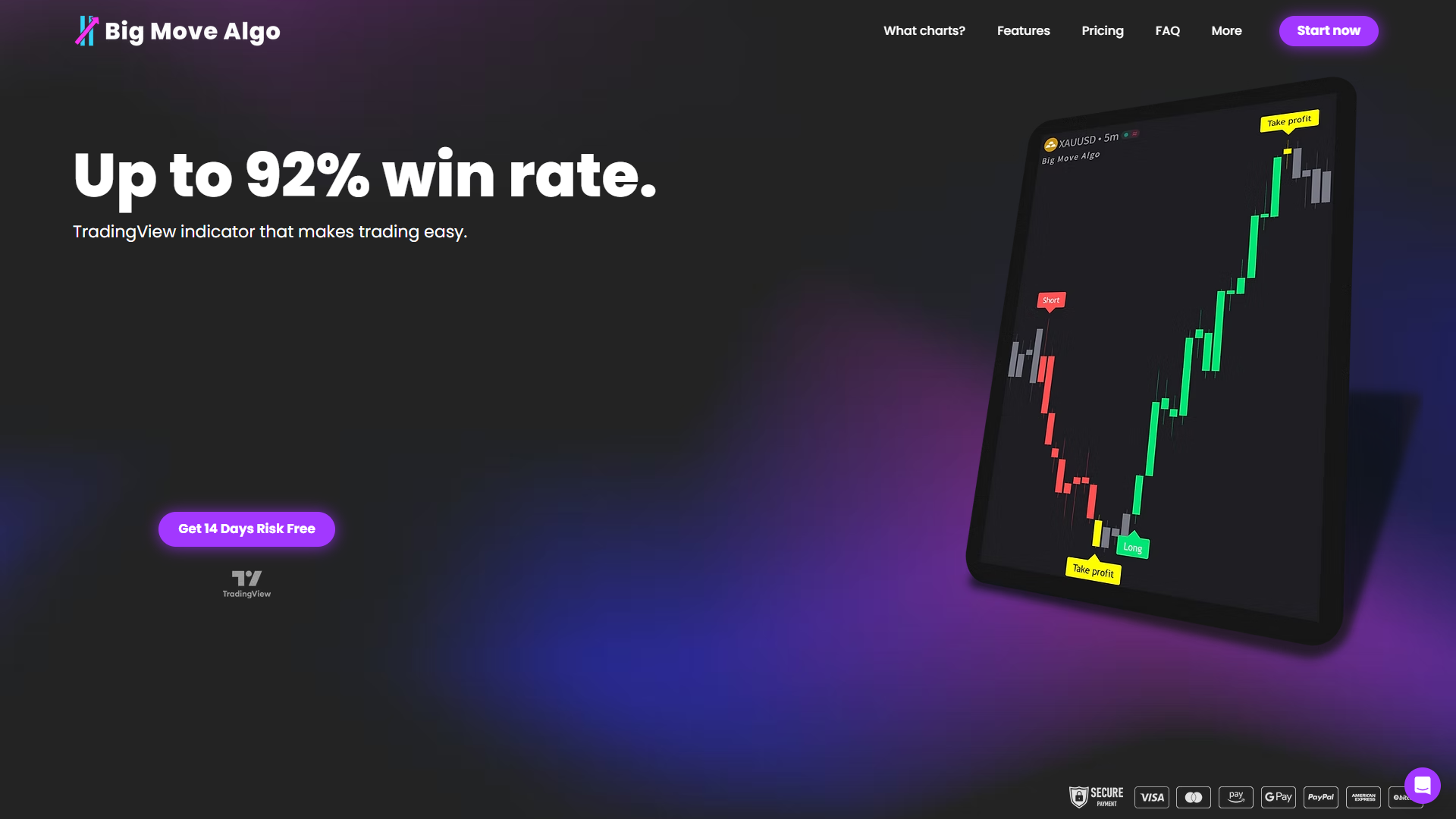
AUTO Mode gets you running with minimal setup if you want the algo handling the heavy lifting, while MANUAL Mode gives experienced traders room to customize. The built-in Fake Trend Detector flags choppy, low-quality conditions where a breakout or rejection setup is statistically weaker, which pairs naturally with the liquidity and timing filters covered earlier. It works across multiple markets, and plans include device access and product updates.
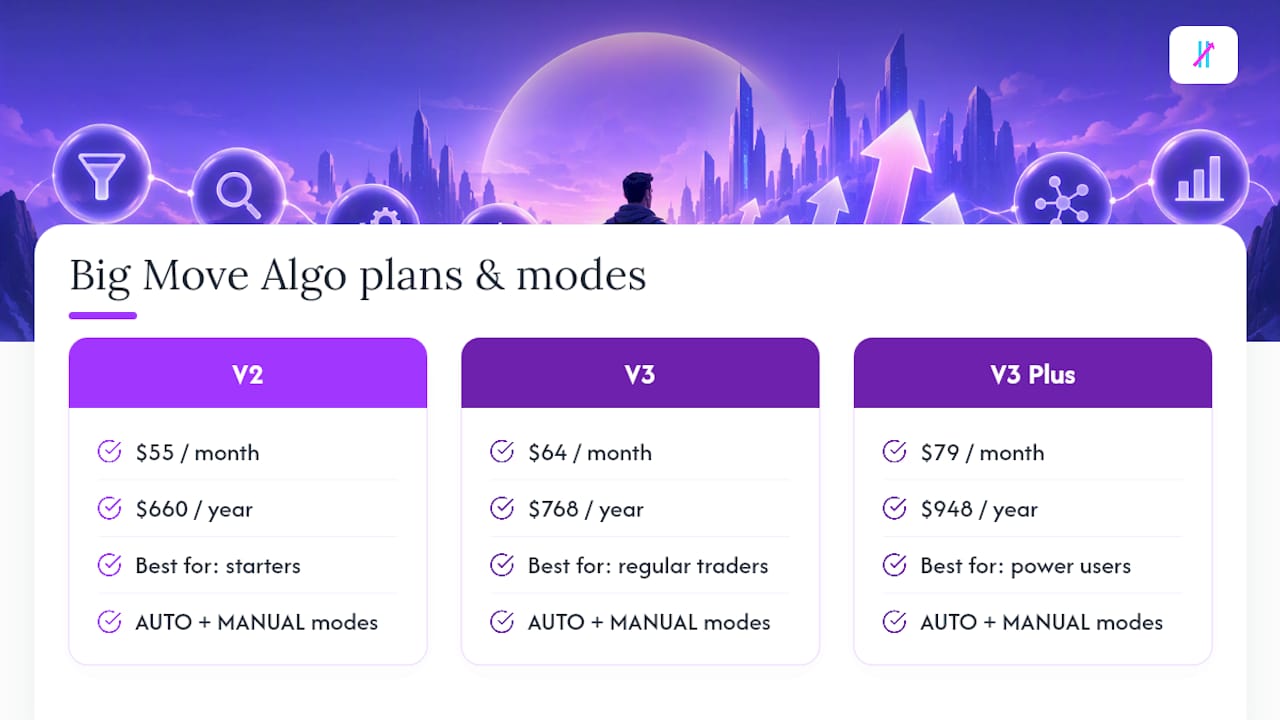
Plans start with Version 2 at $55 per month or $660 per year, with Version 3 at $64 per month or $768 per year, and Version 3 Plus at $79 per month or $948 per year for traders who want the most complete feature set. Visit the Big Move Algo pricing page to compare plans, or head to the main site to get instant access after checkout through Stripe.
This article is general information, not a substitute for advice from a qualified financial advisor. Consult a qualified financial professional about your own circumstances before acting on anything here.
Sources
High probability setup practical guide for active traders — ProTradingInsights
High-Probability Trading Setups: The 3 We Trade + How to Qualify Them — MetaTradingClub
High-Probability Day Trading Setups for Futures, Forex, and Stocks — QuantVPS
How to Identify High-Probability Trade Setups — AdvancedFinance
FAQ
What Are High Probability Setups?
A high probability setup is a trade idea that has passed a checklist covering context, location, trigger, invalidation, liquidity, and timing before entry, not a pattern claimed to guarantee a win. The six-filter framework is what separates a qualified setup from a random chart pattern.
What Is an Example of a High Probability Behavior?
In trading terms, a high probability behavior is a repeatable habit like waiting for a candle close before entering, sizing positions by stop distance instead of gut feeling, and logging every trade whether it wins or loses. These habits are what let a trade idea actually get tested rather than just believed.
What Is the 5-3-1 Rule in Trading?
The 5-3-1 rule is informal trading guidance suggesting a trader focus on five currency pairs or instruments, master three setups, and trade during one consistent time window each day. It’s not a formally documented standard, but the underlying idea, narrowing focus to build real repetition, lines up with the qualification-and-grading approach covered above.
What Is a High Probability System?
A high probability system is a repeatable set of rules for identifying, confirming, and managing trades that has been logged and tested across enough occurrences to show a real, positive expectancy. Building one requires backtesting and risk-adjusted evaluation, not just a handful of lucky trades.
How Does Big Move Algo Help Find These Setups?
Big Move Algo scans markets in real time on TradingView and delivers Long, Short, and Exit signals along with a Fake Trend Detector that flags weak, low-liquidity conditions. It supports crypto, forex, stocks, indices, and commodities, with plans starting at $55 per month for traders who want a faster path from a qualified setup to an executed trade.
Recommended
Comments