
4 Indices Day Trading Setups: Sizing and Live Algo for Beginners

Prioritize four setups: opening-range breakout, VWAP reclaim, momentum continuation, and failed-breakout reversal. Each has objective entry, stop, and target rules you can backtest before risking cash. Tools like TradingView charting and Big Move Algo’s signal system make these setups easier to spot and execute without guessing.
TL;DR:
Trading NQ futures offers more frequent opportunities but requires wider stops and smaller position sizes due to higher volatility.
Confirm breakouts with volume over 1.2 to 1.5 times the 20-bar average and ensure ranges align with ATR filters to improve reliability.
Limit trading around major economic releases and when the VIX exceeds 28 to 30, as volatility spikes distort signals.
Risk no more than 1.5% of your account per trade and adjust position sizes accordingly to avoid blowing up your account.
Backtest setups on at least 20 sessions with replay and strictly follow pre-trade checklists to develop consistency over three to six months.
Table of Contents
[Try a trading indicator that turns the setups above into a real-time signal feed instead of something you’re calculating by hand mid-candle, leveraging AI-driven signal processing for more precise entries. Such software reads price action in real time and delivers clear Long, Short, and Exit signals directly on your TradingView chart, with a feature that flags choppy conditions before you enter a low-quality trade.](#try-a-trading-indicator-that-turns-the-setups-above-into-a-real-time-signal-feed-instead-of-something-youre-calculating-by-hand-mid-candle-leveraging-ai-driven-signal-processinghttpsarosplatformscomuse-casesenergy-trading-ai-for-more-precise-entries-such-software-reads-price-action-in-real-time-and-delivers-clear-long-short-and-exit-signals-directly-on-your-tradingview-chart-with-a-feature-that-flags-choppy-conditions-before-you-enter-a-low-quality-trade)
What Are the Best Indices Day Trading Strategies?
Four setups do most of the heavy lifting for index traders, and each one has a specific reason it works better on futures and ETFs tracking the Nasdaq and S&P than on random stocks. Indices trend more smoothly intraday because they’re baskets, not single names reacting to one headline. That smoothness is exactly what makes rule-based setups reliable.
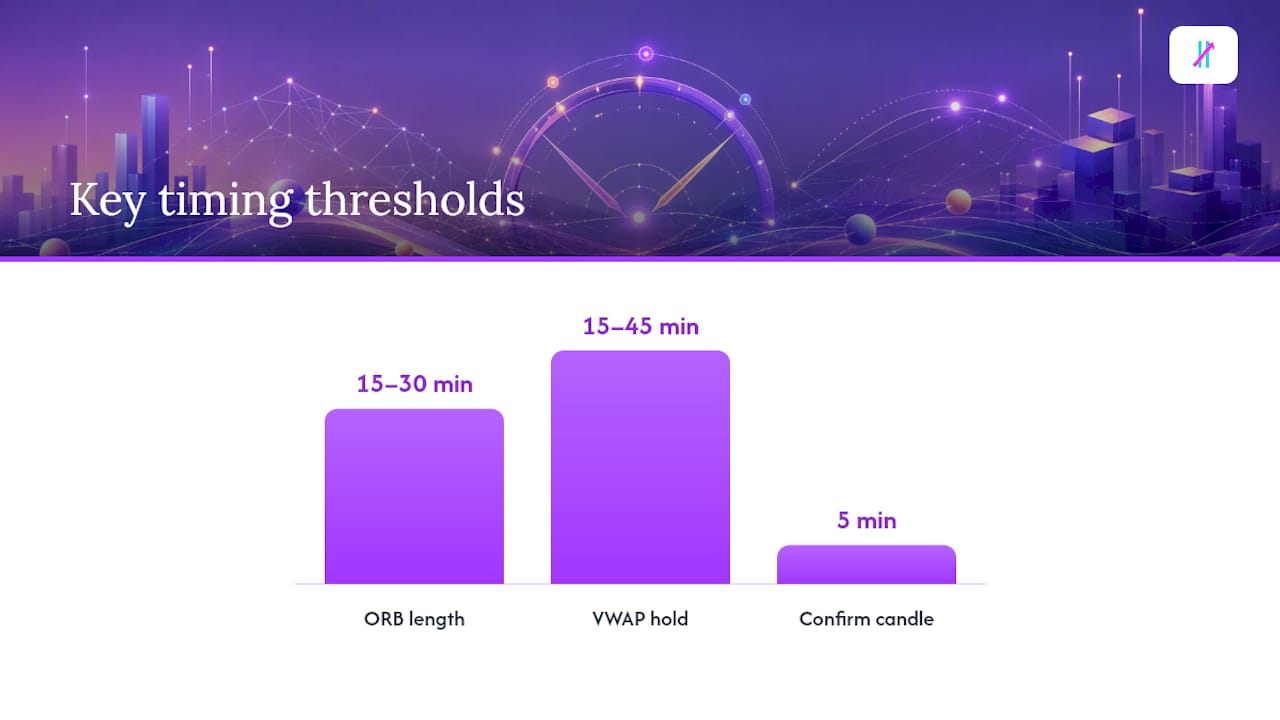
1. Opening-range breakout (ORB). Mark the high and low of the first 15 or 30 minutes after the open. Wait for a 5-minute candle to close beyond that range, then confirm the breakout bar’s volume exceeds the 20-bar average. A validity filter that many traders skip: the opening range itself should measure roughly 30% to 60% of the 14-day average true range (ATR). A range that’s too tight or too wide produces unreliable breakouts. Enter on the confirming 5-minute close, place your stop at the range midpoint, and target 1.5 times the range width.
**2. Price trades below the volume-weighted average price (VWAP) for 15 to 45 minutes, then closes back above it on a 5-minute candle with volume at least 1.5 times the 20-bar average. Stop goes under the most recent swing low. Targets are the prior day’s close or the session high, whichever comes first.
3. Momentum continuation. Establish directional bias using VWAP alongside the 9 EMA on a 5-minute chart. After 10:00 AM, wait for a pullback to the 9 EMA that holds, then enter in the direction of the trend. Stop sits just below the pullback low. Target twice your risk.
4. Failed-breakout reversal. Watch for a wick that runs through an obvious level and stops out the crowd, then snaps back inside the range on the next close. Confirm the failure with a reversal candle backed by real volume, not a thin, low-participation bar. Stops stay tight because your entry is close to the point of failure.
Check the economic calendar. Skip or reduce size around FOMC minutes and NFP releases.
Confirm VIX isn’t spiking above 28 to 30. Elevated volatility breaks these filters.
Draw your ORB range and calculate whether it fits the ATR band.
Wait for candle close confirmation, never enter on a wick alone.
Set stop and target before you click the order.
Pro Tip: Backtest each setup on at least 20 sessions using TradingView’s replay feature before trading it live. A setup that looks obvious in hindsight often fails a third of the time once you test it candle by candle.
Which Indices Should You Trade and When?
Instrument choice changes everything about position sizing and stop distance, so pick one before the session starts, not while you’re already in a trade.
NQ (Nasdaq futures): Higher amplitude and heavier order flow at the open make it the go-to for breakout and momentum setups, but that same amplitude means wider stops and smaller position sizes.
ES (S&P 500 futures): Broader, calmer moves. Better for traders who want fewer whipsaws and don’t need the fastest action.
QQQ and SPY: ETF alternatives if you don’t trade futures. Spreads are wider than futures tick spreads, and execution speed differs, but they’re accessible in a standard brokerage account.
Dow (US30): Fewer, larger-cap components make it move differently than the Nasdaq or S&P, often lagging or diverging during sector-specific news.
Timing matters as much as instrument choice. The first 60 to 90 minutes after the open concentrate the bulk of institutional volume, which is why ORB and VWAP reclaim setups fire most reliably there. The window from 10:00 to 11:30 AM and again from 2:30 to 4:00 PM Eastern produces the next-best setups. Midday, roughly 11:30 to 1:30, is thin and choppy. Skip it unless you already have a position open.
Trade one instrument per session. Running NQ and QQQ trades simultaneously doesn’t diversify anything. They move together, so you’re just doubling exposure to the same risk.
How Do You Set Up Indicators for Cleaner Signals?
Indicator settings only matter if they filter out noise, not add to it. Here’s what to configure and why each piece matters.
VWAP: Add it as a session-anchored overlay in TradingView. Treat a reclaim as valid only when the 5-minute close sits above VWAP with volume confirmation, not just a wick poking through.
9 EMA on the 5-minute chart: Your entry trigger for momentum continuation trades. Price holding above or below it defines the trade you’re allowed to take.
20 and 50 EMA: Trend context. If the 5-minute 9 EMA and the daily 50 EMA disagree, you’re fighting the tape.
Higher-timeframe filter: Check the 1-hour and daily chart before every trade. Prior-day high and low, along with the 50 and 200 EMA, act as reference levels institutional traders watch closely.
ATR: Use the 14-period ATR to size your stop and to validate ORB range width, as covered above.
Volume filter: Require breakout or reclaim candles to clear 1.2 to 1.5 times the 20-bar average volume. This single filter eliminates a large share of false signals.
Backtests on VWAP reclaim strategies with strict volume and ATR filters applied have shown win rates approaching 68% in some sample sets — a reminder that filters aren’t optional extras, they’re what separates a workable edge from a coin flip.
One more regime check: when the VIX pushes past 28 to 30, either sit out or cut your position size in half. Volatility spikes distort every one of these setups, stretching stops and inflating false breakouts. Require two independent confirmations before any entry, meaning price structure plus volume, or an indicator alignment plus a candle close. One signal alone isn’t enough.
How Much Should You Risk Per Trade?
The math is simple, and skipping it is how accounts blow up. Risk dollars equal account size multiplied by your risk percentage.
$10,000 account, 1% risk per trade means $100 at risk. If your stop is 8 points away on NQ (where each point equals $20 per contract), you’re trading a fraction of a contract’s worth. In practice, that means micro contracts (MNQ) or a smaller ETF position sized to match.
$50,000 account, 1.5% risk per trade means $750 at risk. That same 8-point NQ stop now supports roughly 4 to 5 full contracts, depending on your broker’s tick value.
Daily loss limit: Cap losses at 3% to 5% of account value per day. Hitting that limit means you stop trading for the session, no exceptions, no revenge trades.
Place stops based on market structure, meaning beyond the invalidation candle or a clear support/resistance level, never at an arbitrary fixed tick distance. A stop that ignores structure gets you stopped out on noise instead of being wrong about direction.
Watch correlation too. Two long positions in NQ and QQQ that move with roughly 0.8 correlation aren’t two separate risks, they’re nearly one large position wearing two names. Size accordingly.

Pro Tip: If you hit your daily loss limit two days in a row, cut your position size in half for the next week and review your last 15 trades for a pattern. Most drawdowns trace back to one repeated mistake, not bad luck.
What Belongs on Your Pre-Market Checklist?
Set this up before the bell every single day, not just on days you feel like it.
Check the economic calendar for CPI, Fed decisions, or NFP releases that could distort price action.
Note the overnight range and where price sits relative to yesterday’s close.
Confirm current ATR to calibrate your ORB filter and stop sizing.
Pick your instrument for the session and stick with it.
Set your daily risk budget in dollars, not just as a percentage in your head.
For order types, use limit orders for entries so you control your fill price, and bracket orders (or OCO, one-cancels-other) to set stop and target simultaneously the moment you’re filled. Futures traders using fast-moving instruments like NQ often rely on immediate-or-cancel orders to avoid slippage during volatile bursts. Prioritize a platform with low-latency data and reliable alerting, and check out how to set up TradingView indicator alerts so signals reach you the moment conditions align rather than five minutes later. Paper-trade every new setup for two to four weeks and journal the setup type, entry time, confirmation candle, stop distance, and outcome for each trade.
What Changes as You Get More Experience?
A few adjustments separate traders who’ve been at this for a year from those still running beginner rules. Widen your stops and targets during the volatile first hour after the open, then tighten them once price settles into the 10:00 to 11:30 window. Use a volatility band, sometimes called a volatility box, or the prior settlement price to set realistic profit targets and trailing stop bands rather than guessing at round numbers.
Scale into a winning position only after it’s already covered your initial risk.
Cut size by half after two consecutive losing days, and don’t restore it until you’ve had a clean day.
Skip setups entirely around major scheduled releases or when the VIX spikes sharply intraday.
Avoid trading low-liquidity sessions around holidays, when spreads widen and false signals multiply.
A Real Session Example Using Big Move Algo on Tradingview
Here’s what a disciplined pre-market to execution flow looks like in practice.
6:30 AM PT: Scan NQ and QQQ charts on TradingView for a clean VWAP reclaim setup forming near the open.
9:35 AM ET: Big Move Algo flags a Long signal after price reclaims VWAP on strong volume; the Fake Trend Detector shows no warning, confirming the move isn’t a low-quality chop signal.
Entry: Confirmed on the 5-minute close above VWAP. Stop placed under the swing low. Target set at the prior session high.
Outcome: Trade hits target within 25 minutes, logged immediately in the trading journal with entry time, confirmation type, and result.
Mode note: AUTO mode handled the signal detection here; traders who want more control can switch to Manual mode and layer in their own EMA or ATR filters.
This example reflects editorial analysis from Steven Hartwell, drawing on the setup rules and risk framework covered throughout this piece.
What Should New Index Traders Actually Expect?
Give yourself three to six months of demo trading and small live size before you expect consistency. Track your win rate, average reward to risk, and adherence to your own rules, not just your profit and loss.
The most damaging mistake I see isn’t a bad setup. It’s skipping the journal entry after a loss because it stings to look at. Traders who review every trade, win or lose, fix their leaks in weeks. Traders who don’t repeat the same mistake for years. Build a repeatable process, then trust the review routine more than any single trade’s outcome.
— Steven Hartwell
Try a trading indicator that turns the setups above into a real-time signal feed instead of something you’re calculating by hand mid-candle, leveraging AI-driven signal processing for more precise entries. Such software reads price action in real time and delivers clear Long, Short, and Exit signals directly on your TradingView chart, with a feature that flags choppy conditions before you enter a low-quality trade.
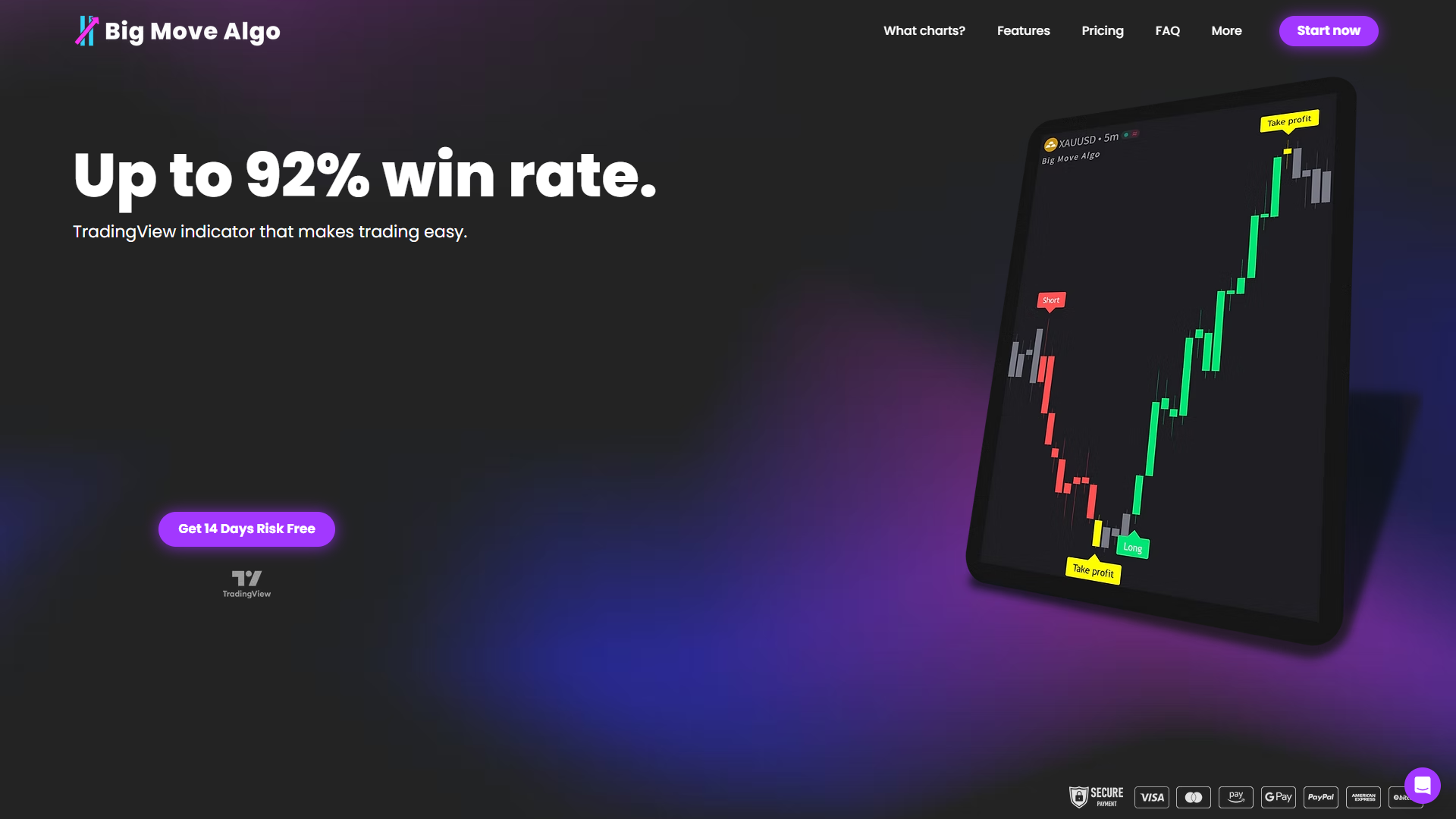
Start by loading it on a chart alongside the ORB or VWAP reclaim rules from this guide, enable AUTO mode for a fast setup, and turn on alerts so you’re not staring at the screen all session. Paper-test the signals for two to four weeks, log every trade the way this guide’s checklist outlines, and compare the results against your own manual analysis. When you’re ready to trade the signals live, visit the Big Move Algo landing page to pick a plan and get instant access.
This article is general information, not a substitute for advice from a qualified financial advisor. Consult a qualified financial professional about your own circumstances before acting on anything here.
Sources
FAQ
Which Indices Are Best for Day Trading?
NQ (Nasdaq futures) and QQQ offer the most frequent intraday opportunities due to higher amplitude and volume, while ES and SPY suit traders who want smoother, less volatile price action.
What Is the 3-5-7 Rule for Day Trading?
It’s a risk guideline suggesting you risk no more than 3% on any single trade, cap total exposure across open positions at 5%, and limit total daily risk to 3% to 5% of account value. Definitions vary by source, so treat it as one framework among several rather than a fixed standard.
What Is the Most Successful Day Trading Strategy?
No single setup wins every session, but opening-range breakout and VWAP reclaim strategies backed by volume and ATR filters consistently produce better results than discretionary entries without rules.
Can I Make $1,000 a Day Day Trading?
It’s possible on larger accounts with proper position sizing, but it’s not guaranteed and depends entirely on account size, risk percentage per trade, and consistent execution rather than any single strategy.
Recommended
Comments