
Copy Paste Session Breakout Strategy: 1.5–2x Targets, 1% Risk

Mark the prior session’s range, then wait for a candle to close beyond it with a small buffer and a volume or volatility filter before entering. Stop at the opposite side of the range or its midpoint, target 1.5 to 2 times the range in profit, and risk a small fixed percentage of the trading account per trade, often around 1%. Trade it on London or New York opens in EURUSD or GBPUSD, and backtest the exact parameters before putting real money behind it.
TL;DR:
Breakouts are more reliable during sessions with high liquidity, like London and New York openings, especially when the Asian session shows clear consolidation.
Accurate range marking relies on selecting the correct session window and adding buffers, with ranges under 15–20 pips often too noisy for effective trading.
Confirmation filters such as volume, ATR, candle body size, and trend direction are essential for avoiding false breakouts and improving win rates.
Using pending stop orders linked as OCO pairs and setting stops at range opposite sides or midpoints helps manage risk and prevents unwanted trades.
Backtest parameters across multiple sessions and validate on demo accounts before live trading to account for market variability and filter effectiveness.
Table of Contents
Why Session Opens Create Real Breakout Opportunities
Currency markets don’t move randomly around the clock. They idle, then they lurch. The Asian session tends to compress price into a tight band while Tokyo desks trade thinner volume, and that compression sets up the release valve that opens when London traders arrive.
London alone handles a dominant share of global daily FX turnover, according to BIS FX turnover statistics. When that much order flow hits the market inside a narrow window, price has to go somewhere, and it usually goes fast. New York’s open does something similar a few hours later, especially when it overlaps with the tail end of London trading.
The mechanism is straightforward: overnight consolidation builds up stacked orders around the range extremes. Institutional desks execute size at the open, retail stops trigger, and momentum-driven algorithms pile in behind the move. That combination is what gives session-open breakouts a repeatable edge that pure indicator signals rarely replicate on their own.
The edge is not constant, though. A few conditions flatten it:
Days with no clear Asian range (choppy, low-volatility overnight sessions) produce breakouts with no real fuel behind them.
High-impact news releases scheduled near the open can invalidate the setup entirely by causing erratic spikes instead of clean directional moves.
Holiday sessions and thin summer liquidity often produce fake breakouts that reverse within minutes.
Knowing when the edge is strong matters as much as knowing the entry rules. A session breakout strategy only works when you’re selective about which sessions actually deserve a trade.
How Do You Mark the Reference Range for a Breakout?
The range you draw determines almost everything downstream, so precision here pays off more than any entry trick. Most session traders use the Asian session as their reference range because it tends to be the tightest, most consolidated window before London opens.
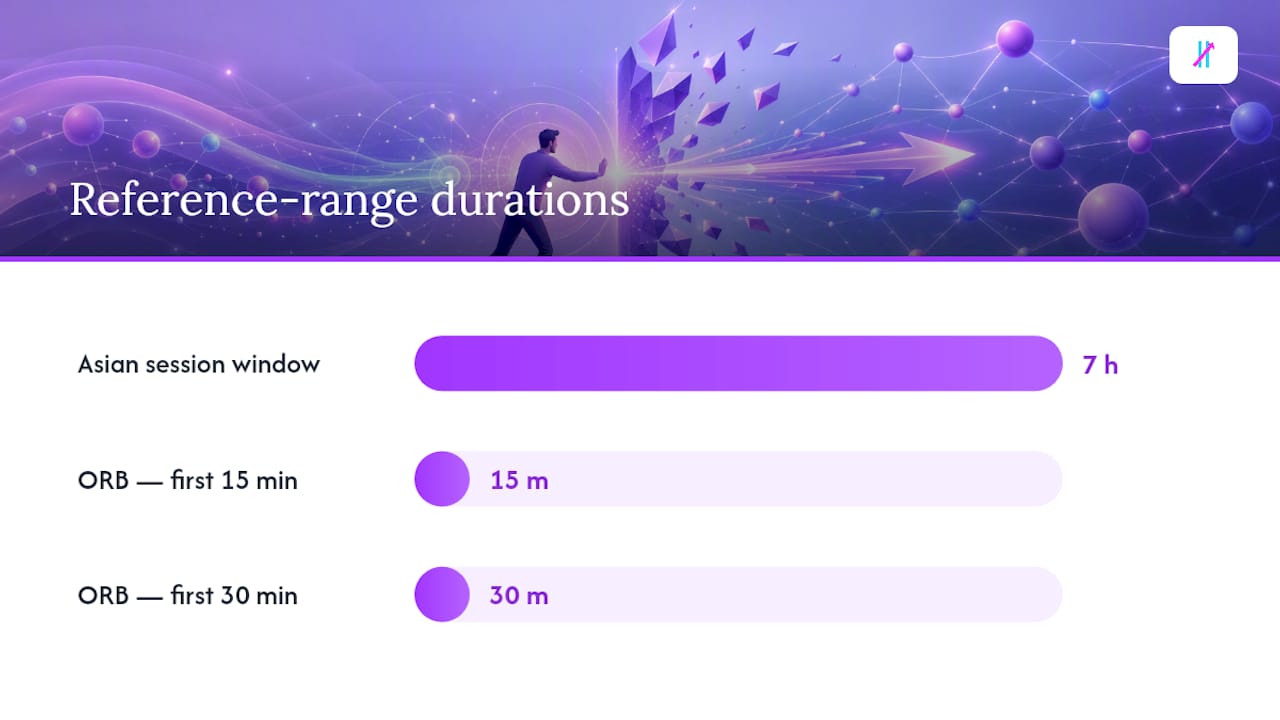
Pick your window. A common default is 00:00 to 07:00 UTC (roughly 7:00 PM to 2:00 AM Eastern) as the Asian range, closing right before London desks come online around 08:00 UTC. If you prefer a tighter opening-range breakout (ORB) approach, use just the first 15 or 30 minutes after your target session opens instead.
Draw the high and low. On your charting platform, plot two horizontal lines at the session’s highest wick and lowest wick during that window. Add a midpoint line halfway between them. Both ORB methodology and standard London-breakout implementations rely on this same high/low/midpoint structure.
Check the range size. A range under roughly 15 to 20 pips on a major pair like EURUSD is often too small to trade cleanly. It gets swept by noise before any real move develops. Skip it or wait for the next session.
Set your buffer. Add a small buffer beyond the high and low, commonly 2 to 5 pips depending on the pair’s typical spread, so the market has to genuinely commit to the breakout rather than just tag the level.
The what-is-a-trading-session guide covers how overlapping session hours shift these windows depending on your broker’s server time, which matters more than most traders realize when they first set this up.
Keep your default settings consistent across weeks of testing. Changing the window or buffer every few days makes it impossible to know whether a losing streak is bad luck or a bad parameter.
What Are the Exact Entry Rules for a Breakout Trade?
Once the range is marked, the entry mechanics decide whether you catch real moves or get chopped up by fakeouts. There are two competing entry philosophies here, and each has a real trade-off.
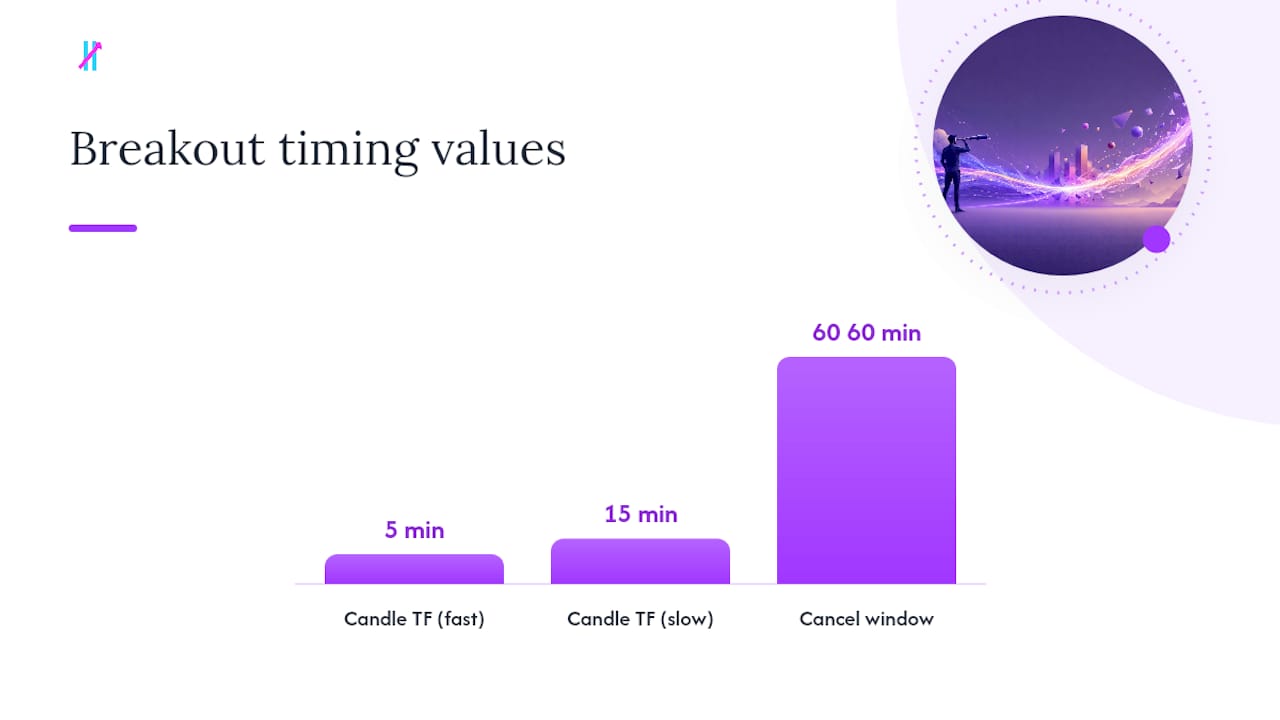
Candle-close confirmation waits for a full candle (typically 5 or 15 minutes) to close beyond the range plus your buffer before entering. This costs you some of the early move but filters out a large share of the wick-only fakeouts that punish impatient entries. Retest entries wait for price to break, then pull back to retest the broken level before entering, which gets you a tighter stop but means missing the trade entirely on strong, no-look breakouts.
For most session breakout strategy setups, candle-close confirmation is the more reliable default, especially for traders who can’t watch every tick.
On the order-placement side:
Use pending stop orders, a buy-stop above the range high plus buffer and a sell-stop below the range low minus buffer, rather than trying to react manually in real time.
Link both orders as an OCO (one-cancels-the-other) pair so that once one triggers, the opposite pending order cancels automatically. This is standard in most session-based breakout implementations and prevents you from accidentally holding both a long and short position.
Require a minimum breakout candle body, not just a wick, sized to a significant portion of average candle size over prior bars. This filters out low-conviction pokes through the level.
Cancel any unfilled pending order after a set window, often 60 to 90 minutes past the session open, if price hasn’t moved decisively either direction.
Skipping the OCO step is one of the more common technical mistakes traders make when they first automate this. Without it, a whipsaw candle can trigger both orders in sequence and leave you holding a position you never intended.
Which Filters Actually Prevent False Breakouts?
False breakouts are the single biggest reason session breakout strategies fail in live trading. Price tags the range, triggers a wave of stops, then snaps back inside within a few candles, and traders left chasing the move eat the loss.
A layered filter approach cuts that risk meaningfully without gutting your trade frequency:
Volume or a volume proxy. True tick volume isn’t reliable in spot forex, but tick count or a volume-proxy indicator above its 20-period average adds real confirmation that the breakout has participation behind it.
ATR threshold. Require the current Average True Range to sit above its recent rolling average before taking the trade. A breakout during compressed volatility is far more likely to fail.
Candle-body filter. As noted above, a real body beating out a long wick separates conviction from a stop-hunt spike.
Moving-average trend filter. Only take breakouts in the direction the 50-period moving average is sloping. Counter-trend breakouts have a noticeably worse hit rate.
Layer these correctly and you get what amounts to a confirmation stack: close beyond range, plus volume or ATR above average, before the entry fires. If price closes back inside the range within two to three bars of your entry, cancel or exit immediately. That kind of quick re-entry is a classic sign of a liquidity sweep rather than a genuine breakout, and holding through it usually turns a small loss into a much bigger one.
There’s a real trade-off buried in all of this. Every filter you add improves your win rate but also cuts your trade count, and an overly strict filter stack can leave you sitting out moves that would have worked fine unfiltered.
Pro Tip: *Track your filtered-out trades in a separate journal column for a month.
For a deeper look at spotting these patterns before they cost you, the false breakout scorecard walks through a faster read on range fakeouts in real time.
Where Should Stops, Targets, and Position Size Go?
Trade management is where most of the money gets made or lost, even when the entry logic is sound. Get this part mechanical and consistent, and the rest of the strategy has room to breathe.
Set your stop first. Place it at the opposite side of the range (if you went long on a breakout above the high, your stop sits below the range low) or at the range midpoint for a tighter, more aggressive stop. Add a few pips beyond either level to account for spread widening at the open.
Choose your take-profit. A fixed multiple of the range itself works well as a starting point, typically 1.5 to 2.5 times the total range size. If the range was 20 pips, a 1.5x target puts your profit objective 30 pips from entry.
Consider scaling out. Taking partial profit at 1x the range and letting the remainder run with a trailing stop captures more of the extended trend days without giving back gains on the choppier ones.
Trail after 1x range. Once price has moved a full range-width in your favor, move your stop to breakeven or trail it behind recent swing lows or highs to lock in progress.
Size the position around fixed risk. Risk exactly 1% of account equity per trade. On a $10,000 account with a 30-pip stop, that means calculating lot size so a 30-pip loss equals $100, not eyeballing a round-number lot size.
Cap your daily loss. Stop trading for the day after two consecutive losses or after hitting a 2% daily drawdown limit, whichever comes first.
This structure mirrors what shows up across most session-based breakout frameworks: defined stop logic, R:R-based targets, and hard limits on both trade count and daily loss. None of it is complicated. The discipline to follow it every single day is the actual hard part.
Which Pairs and Timeframes Work Best for Breakouts?
EURUSD and GBPUSD are the standard choices for London-open breakouts because they carry the tightest spreads and the deepest liquidity during that window, which means cleaner breakouts and less slippage on your fills.
USDJPY works reasonably well for both London and Tokyo-adjacent setups but tends to produce smaller ranges that need a tighter buffer. AUDUSD can work for Asian-session breakouts specifically, given its natural alignment with that trading window. XAUUSD (gold) breaks out aggressively around session opens, but its spreads widen unpredictably during news, which makes stop placement trickier and less forgiving of a loose approach.
On timeframes, the 5-minute and 15-minute charts are the practical sweet spot for marking the range and confirming entries. Drop to a 1-minute chart only if you’re manually watching the exact open and want tighter timing on your entry trigger. Move up to a 30-minute or hourly chart if you’re trading less frequently and want to filter out more of the intraday noise.
Skip the setup entirely when:
The overnight range is unusually tiny, under roughly 15 pips on a major pair.
ATR is sitting well below its 20-day average, signaling a genuinely quiet market.
A high-impact news release, a central bank rate decision, an employment report, or similar, is scheduled within 30 minutes of the session open.
Trading through a scheduled news release inside your entry window is one of the fastest ways to turn a well-tested setup into a coin flip.
A Step-by-Step London-Open EURUSD Trade Walkthrough
Here’s how a full session breakout strategy trade plays out in practice, from range marking to exit.
Mark the Asian range. Between 00:00 and 07:00 UTC, EURUSD trades between 1.0850 and 1.0880, a 30-pip range with a midpoint at 1.0865.
Set pending OCO orders. Buy-stop at 1.0885 (high plus 5-pip buffer), sell-stop at 1.0845 (low minus 5-pip buffer), linked as one-cancels-the-other.
London opens at 08:00 UTC. Price rallies and a 15-minute candle closes at 1.0891, triggering the buy-stop. The sell-stop cancels automatically.
Calculate the stop and size. Stop goes at 1.0845 (30 pips below the midpoint would be tighter, but the full opposite-side stop gives more room here). On a $10,000 account risking 1%, that’s a $100 risk over a 46-pip stop, sizing the position at roughly 0.21 standard lots.
Set the take-profit. At 2x the range (60 pips), the target sits at 1.0951.
Manage the trade. Once price reaches 1.0921 (1x the range in profit), move the stop to breakeven and trail behind each new 15-minute swing low.
Log the trade. Record entry time, range size, buffer used, filter conditions met, R:R achieved, and outcome in a trading journal for later review.
Now picture the failed version of this same trade. Price spikes to 1.0887, barely clears the buffer, and the 15-minute candle closes back at 1.0878, inside the range. Your cancel rule fires: exit or never fill, because price re-entered the range within the confirmation window. That single rule is what separates a strategy with real discipline from a trader chasing every wick that pokes through a line on the chart.
How Do You Automate a Session Breakout Strategy?
Running this manually works, but it demands you sit at the screen for every session open, which isn’t realistic for most traders juggling a job or multiple pairs. Automation closes that gap, provided you build in the right safeguards.
On TradingView, alerts can fire the moment price closes beyond your marked range, and pairing that with an OCO bracket order at your broker keeps entries mechanical rather than emotional. If you’re coding an expert advisor, the core parameters to expose as adjustable inputs are the session window (start and end times), the buffer in pips, the ATR threshold, the moving-average length for your trend filter, and your target R:R ratio, closely matching the structure used in published London-breakout code.
A few execution realities matter here. Slippage tends to spike right at session opens when spreads widen briefly, so your buffer needs to account for that rather than assuming perfect fills. Broker latency can shift your actual fill price by a pip or two versus your backtest assumptions, which compounds over hundreds of trades. For traders copying signals across multiple accounts, a trade copier setup keeps execution synchronized without manual re-entry on each one.
This is exactly where Big Move Algo fits into the picture. Its AUTO Mode applies structured Long, Short, and Exit signals without requiring you to hand-code every filter, while Manual Mode lets experienced traders adjust parameters closer to the ones outlined above. The built-in Fake Trend Detector directly targets the false-breakout problem this whole strategy is built around avoiding.
What Should You Backtest Before Trading Live?
Skipping backtesting on a session breakout strategy is how traders discover, the expensive way, that their parameters only worked on the three trades they eyeballed on a chart.
Grid-test these parameters against several months of historical data:
Session window start and end times (try shifting by 30 to 60 minutes in each direction).
Buffer size in pips (test 2, 3, and 5 pip variants).
Minimum range size threshold.
ATR filter threshold (rolling average multiplier).
Moving-average length for the trend filter (20, 50, 100 period).
Target R:R ratio (1.5x, 2x, 2.5x range).
Run each parameter set across at least 60 to 100 sessions for a meaningful sample, a benchmark echoed in backtested London-breakout rule sets. Track win rate, average R:R achieved, profit factor, and maximum drawdown for every variant, not just net profit, since a strategy can look profitable while carrying drawdowns no real account survives.
Once you land on a parameter set, split your data: optimize on the first two thirds and validate on the untouched final third. Then forward-test on a demo account for several weeks before committing real capital. A volatility filter walkthrough covers ATR threshold tuning in more depth if that’s the parameter giving you trouble.
What Mistakes Wreck a Session Breakout Strategy?
Most losing session breakout traders make the same handful of errors, and every one of them has a straightforward fix.
Entering on wicks instead of closes. A wick poking through the range means nothing on its own. Wait for the candle to close beyond it.
Stops set too tight. Squeezing your stop inside the range to improve R:R just gets you stopped out by normal noise before the real move develops.
Ignoring spread widening. Session opens routinely see spreads double or triple for a few minutes. Build that into your buffer, not just your stop.
Overtrading tiny ranges. A 10-pip range on EURUSD isn’t worth the spread cost. Skip it and wait for the next session.
Pro Tip: If you catch yourself entering before a candle fully closes “because it looks obvious,” that’s the exact habit that erases months of disciplined gains in a single bad week. Set a hard rule: no entry until the close prints, no exceptions.
How I Actually Run Session Breakouts Day to Day
Focusing on one pair, usually EURUSD around the London open, cuts the learning curve dramatically compared to watching five setups at once. You start noticing which fakeouts repeat and which filters actually matter for that specific pair’s behavior, instead of applying generic rules across markets that behave differently.
I lean on AUTO mode when I want confirmation without second-guessing every candle, particularly during weeks when I can’t watch the open live. Manual entries still earn their place around scheduled news, where judgment about volatility beats a fixed rule. Journaling every trade, win or loss, is what turns a decent setup into a strategy you actually trust.
— Steven Hartwell
Turn These Rules Into Automated Signals with Big Move Algo
Everything covered above, the range marking, the confirmation filters, the stop and target logic, works. It also takes real screen time to execute consistently every session, which is where most manually run breakout plans quietly fall apart.
Big Move Algo is built to run that same structure without asking you to babysit every candle close. AUTO Mode applies Long, Short, and Exit signals using the same close-beyond-range logic covered in this guide, while the Fake Trend Detector filters out the low-quality setups that cause most session-breakout losses in the first place. Manual Mode is there if you want to tune parameters closer to your own backtested ranges and buffers. It runs across forex, crypto, indices, and commodities, so the same session-open logic applies whether you’re watching EURUSD at the London open or gold ahead of New York.
Subscription plans are available, with current prices detailed on the Big Move Algo site. Backtest the parameters from this guide, then compare them against a demo run on the indicator before deciding which plan fits your trading volume.
Sources
FAQ
Which Breakout Strategy Is Best?
The London-open range breakout on EURUSD or GBPUSD is generally considered the most reliable starting point because it combines the deepest liquidity with the clearest overnight consolidation range. Results still depend heavily on your filter rules and risk management, not the pair choice alone.
What Is the 3-5-7 Rule in Trading?
Definitions of the 3-5-7 rule vary across trading communities, and it isn’t a standard part of session breakout methodology.
Can You Make $1,000 a Day with Day Trading?
It’s mathematically possible with a large enough account and consistent execution, but it isn’t a realistic baseline expectation. Published breakout guides put typical raw win rates around 40% to 55%, meaning daily results swing significantly and depend on account size, position sizing, and how many valid setups appear that day.
Is a Breakout Strategy Profitable?
Session breakout strategies can be profitable when combined with confirmation filters, since raw breakout entries alone carry a high false-signal rate. Adding volume, ATR, and trend filters, along with disciplined 1% risk per trade, is what separates a workable long-term approach from one that bleeds out on false breaks.
Does Big Move Algo Work for Session Breakout Trading?
Big Move Algo’s AUTO Mode generates Long, Short, and Exit signals aligned with breakout-style confirmation logic, and its Fake Trend Detector is built specifically to filter out the false-breakout conditions covered throughout this guide. It runs on TradingView across forex, crypto, indices, and commodities.
Recommended
Comments