
Replace Complicated Trading Tools With Simple Signals


Simple trading signals are defined as clear, rule-based or AI-generated alerts that tell you exactly when to buy, sell, or exit a trade. Retail traders who replace complicated trading tools with a simple signal approach report fewer emotional decisions and faster execution. The problem with most trading setups is not a lack of data. It is too much of it. Overlapping indicators, conflicting oscillators, and coded strategies create noise instead of clarity. This guide covers what simplified trading signals actually are, which tools deliver them reliably, how to make the switch step by step, and the mistakes that derail most traders during the transition.
How to replace complicated trading tools with a simple signal
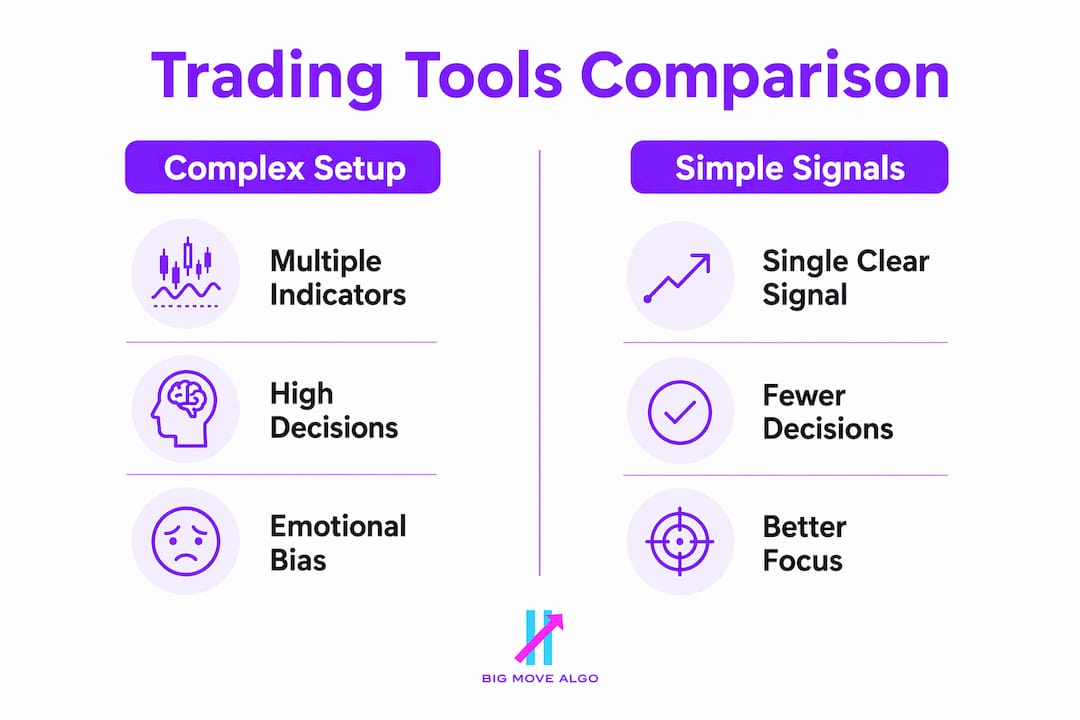
Simple trading signals strip market analysis down to one output: a clear direction. A signal tells you “Long,” “Short,” or “Exit.” That is the entire job. Traditional setups, by contrast, stack RSI, MACD, Bollinger Bands, volume indicators, and custom scripts on top of each other. Each layer adds a decision point, and more decision points mean more room for hesitation and error.
Removing indicators rather than adding them often maintains profitability across different market conditions. Walk-forward and Monte Carlo testing confirm this. Simplification does not weaken a strategy. It makes it more consistent across trending and ranging markets.

The table below compares the two approaches across the factors that matter most to retail traders.
Feature category | Complex multi-indicator setup | Simple signal system |
Number of decisions per trade | 5+ (confirm each indicator) | 1 (follow the signal) |
Required skill level | Intermediate to advanced | Beginner to intermediate |
Transparency | Low (conflicting outputs) | High (single clear output) |
Emotional exposure | High (second-guessing) | Low (rule-based execution) |
Setup time | Hours to days | Minutes |
The core advantage of simple signals is not just speed. It is the reduction of emotional bias. When you have one clear instruction, you either follow it or you do not. That binary structure removes the gray area where most trading mistakes happen.
Key benefits of switching to a signal-based approach include:
Faster decisions: No need to reconcile five indicators before acting.
Auditable logic: You can trace why a signal fired and evaluate it after the trade.
Lower cognitive load: One screen, one signal, one action.
Consistent execution: Rule-based signals apply the same criteria every time.
What tools do you need to start using simplified trading signals?
The right tools make the transition from complex setups to simplified trading signals straightforward. You do not need coding skills, a Bloomberg terminal, or a finance degree. You need three things: a signal source, a charting platform, and a basic risk framework.
AI-powered trading scanners can analyze technical charts across stocks, forex, and crypto to generate buy/sell signals with stop-loss and take-profit levels in under 60 seconds. That speed matters because manual chart scanning is slow and prone to missed setups. An AI scanner removes that bottleneck entirely.
The most important feature to look for in any signal tool is explainability. The trading industry is divided between expensive black-box bots and hyper-technical open-source frameworks that require coding skills. Neither serves the average retail trader well. Explainable AI fills that gap by showing you the reasoning behind each signal, not just the output.
Tool category | Key feature | Skill required |
AI chart scanner | Buy/sell signals with stop-loss and take-profit | None |
No-code signal builder | Drag-and-drop strategy creation | Minimal |
Explainable AI assistant | Transparent reasoning per signal | Minimal |
TradingView indicator | Real-time alerts on existing charts | Basic platform familiarity |
Big Move Algo fits the TradingView indicator category. It runs directly inside TradingView, requires no coding, and outputs Long, Short, and Exit signals in real time. Its AUTO Mode handles setup automatically, so traders can be live within minutes of subscribing.
Pro Tip: Before committing to any signal tool, test it on a paper trading account for at least two weeks. Evaluate how often signals fire, how clear the output is, and whether the tool explains why a signal was generated.
No-code platforms like Build Alpha offer 7,000+ signals across more than 20 categories with drag-and-drop selection and robustness filtering through 12+ tests. That kind of depth without any programming requirement shows how far easy trading tools have come.
How do you switch from complex tools to a simple signal workflow?
Transitioning to a signal-based workflow takes less time than most traders expect. The key is replacing your current decision process one step at a time, not all at once.
Audit your current setup. List every indicator on your charts. Identify which ones you actually use to make decisions versus which ones you added “just in case.” Most traders find they rely on two or three at most.
Choose a signal source. Select a tool that outputs clear buy/sell/exit alerts. Prioritize tools with explainable logic so you understand what drives each signal. Automated signals improve clarity and control compared with complex manual setups.
Set your risk parameters first. Before your first live signal, define your stop-loss distance and position size. A signal tells you direction. Risk management tells you how much to risk. Both are required.
Remove redundant indicators. Strip your chart down to price, the signal overlay, and one optional context layer such as a moving average for trend direction. Anything beyond that is noise.
Run a two-week paper trade. Execute every signal on paper. Track your entries, exits, and the signal’s stated rationale. This builds confidence before real capital is at risk.
Go live with reduced size. Start with 25–50% of your normal position size. This lets you experience real market conditions without full financial exposure while you adjust to the new workflow.
Review weekly, not daily. Evaluate signal performance over a week, not trade by trade. Single-trade outcomes are too noisy to draw conclusions from. Weekly review reveals patterns.
Manual chart scanning is tiring and prone to missed opportunities. Automating that scanning step with an AI tool is the single highest-leverage change most retail traders can make. Big Move Algo’s built-in Fake Trend Detector adds another layer by filtering out low-quality market conditions where signals are less reliable.
Pro Tip: Keep a simple trade journal. Record the signal type, your entry, your exit, and whether you followed the signal exactly. After 20 trades, you will see clearly whether your mistakes come from the signal or from your execution.
What mistakes do traders make when adopting simple signals?
The most common mistake is treating a signal as a guarantee. Trading signals simplify market discovery for beginners but do not substitute for education and personal risk management. A signal is a starting point, not a certainty. Traders who skip risk management and follow signals blindly take the same losses they did with complex tools, just faster.
A second mistake is abandoning a signal system after a losing streak. Every signal system produces losing trades. The question is whether the system is profitable over a statistically meaningful sample, typically 50 or more trades. Quitting after five losses is not evaluation. It is emotional reaction.
Veteran traders recognize that simple, auditable signal systems outperform costly opaque bots because they allow manual verification and reduce emotional pitfalls. The key is not finding a system that never loses. It is finding one you can evaluate, trust, and execute consistently.
False signals are a real challenge, especially in choppy or sideways markets. The best defense is a filter. Big Move Algo’s Fake Trend Detector is one example of a built-in filter. Alternatively, you can add a simple rule: only take signals when the market is trending, defined by price being above or below a 50-period moving average.
Combining signals with fundamental awareness also helps. You do not need to read earnings reports for every trade, but knowing that a major economic announcement is scheduled prevents you from entering a signal right before a volatility spike. Signals are aids, not substitutes for foundational market knowledge.
Ongoing evaluation separates traders who improve from those who stay stuck. Track your signal performance in a journal. Review it weekly. If a signal type consistently underperforms in a specific market condition, note it and adjust your filter rules accordingly.
Key Takeaways
Replacing complex trading tools with a simple signal system works because it reduces decisions, removes emotional bias, and creates auditable, repeatable execution.
Point | Details |
Simple signals outperform complexity | Removing indicators improves strategy robustness across trending and ranging markets. |
Explainability is non-negotiable | Choose signal tools that show you why a signal fired, not just what it says. |
Risk management comes first | Define stop-loss and position size before acting on any signal. |
Paper trade before going live | Two weeks of paper trading builds confidence and reveals execution gaps. |
Evaluate over 50+ trades | Single-trade outcomes are noise; weekly and monthly review reveals real performance. |
Why I think most traders overcomplicate this on purpose
I have spent years watching retail traders add indicators the way some people add apps to a phone. The screen fills up, nothing gets used well, and the real problem never gets solved. The real problem is almost always emotional. Traders add complexity because it feels like control. More lines on a chart feel like more information. They are not.
The shift I have seen work consistently is not finding a better indicator. It is reducing the number of decisions per trade to one. When a clear Long or Short signal appears and your risk parameters are already set, there is nothing left to debate. You execute or you do not. That simplicity is harder to accept than it sounds, because it removes the excuse of “I needed more confirmation.”
Explainable AI signals changed how I think about this. When a tool shows you the reasoning behind a signal, not just the output, you learn faster. You start to internalize the logic. Over time, you develop genuine market intuition rather than dependence on a black box. That is the real value of transparent signal tools for retail traders.
The traders I have seen improve fastest are not the ones who found the best signal. They are the ones who committed to a simple system, tracked their results honestly, and adjusted based on evidence. Big Move Algo’s approach, with its clear Long, Short, and Exit outputs and built-in trend filtering, fits that model well. The tool does the analysis. You do the execution. That division of labor is where real improvement starts.
— Steven Hartwell
Big Move Algo turns market analysis into one clear signal
Retail traders who want to move away from cluttered charts and conflicting indicators now have a direct path forward. Big Move Algo is a TradingView indicator that delivers Long, Short, and Exit signals in real time, across crypto, forex, stocks, indices, and commodities.
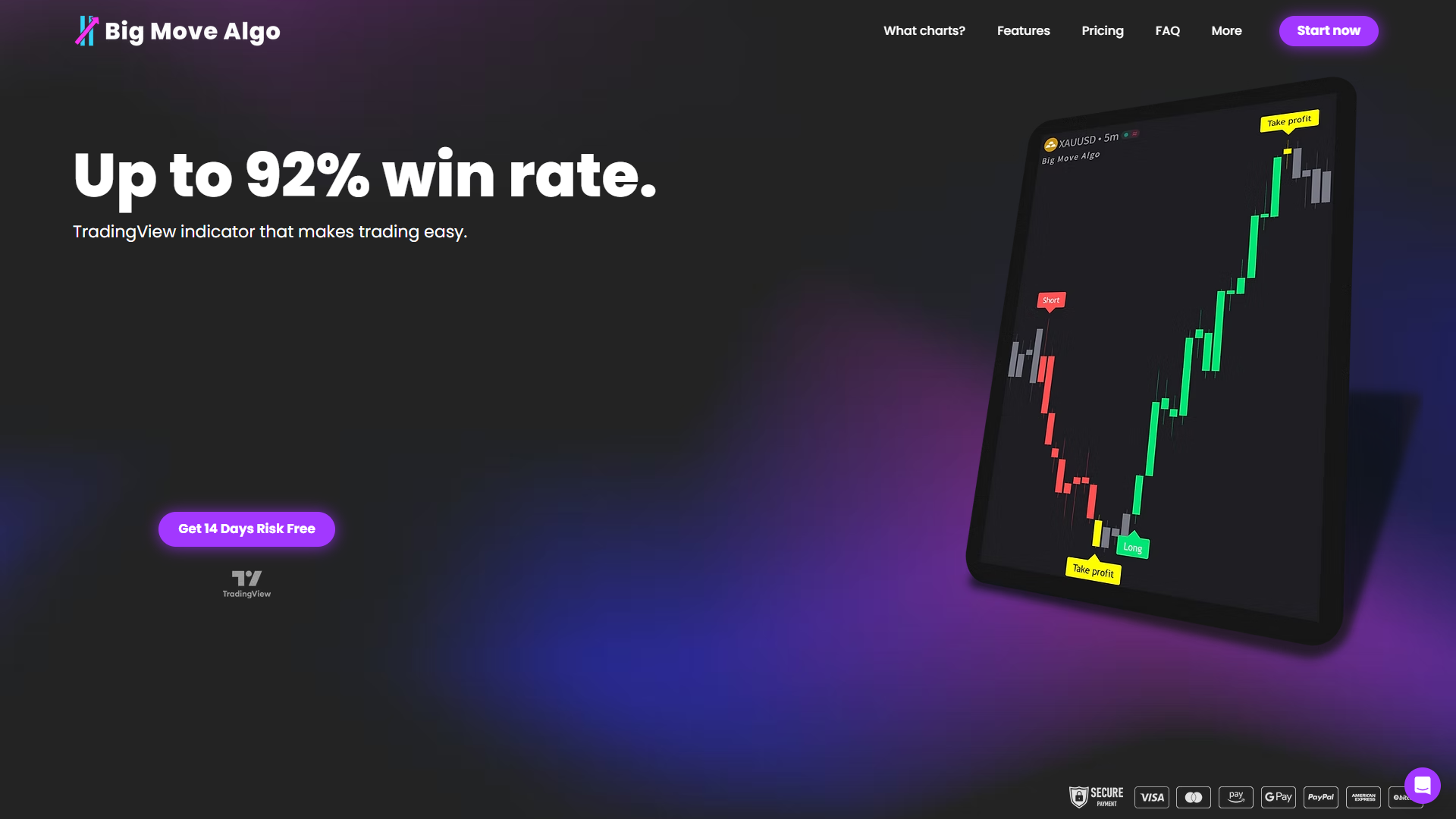
The AUTO Mode requires minimal setup, so you can be live within minutes. The built-in Fake Trend Detector filters out weak market conditions before a signal fires. For traders ready to take the next step, Big Move Algo’s automation guide walks through exactly how to connect signals to your trading workflow without writing a single line of code. If you want to understand how clear Long and Short signals work in practice, that resource covers the full process from chart setup to execution.
FAQ
What is a simple trading signal?
A simple trading signal is a clear buy, sell, or exit alert generated by a rule-based or AI-powered system. It removes the need to interpret multiple indicators manually.
How long does it take to switch to a signal-based workflow?
Most retail traders can complete the transition in two to four weeks, including a paper trading period to build confidence before going live with real capital.
Are simple signals less accurate than complex indicator setups?
Simplification improves strategy robustness across different market conditions, as confirmed by walk-forward and Monte Carlo testing. More indicators do not equal more accuracy.
Do I need coding skills to use AI trading signals?
No coding skills are required. Tools like Big Move Algo run inside TradingView with AUTO Mode, and no-code platforms generate signals through drag-and-drop interfaces.
How do I handle false signals?
Use a built-in filter like Big Move Algo’s Fake Trend Detector, or apply a simple trend rule such as only taking signals when price is above or below a 50-period moving average.
Recommended
Comments