
What Is a Mechanical Trading Strategy? A Clear Guide


What is a mechanical trading strategy?
A mechanical trading strategy is a fully rules-based trading system where every decision follows predefined criteria, with zero room for gut calls or judgment. No discretion, no second-guessing. The rules determine everything.
According to industry definitions, a complete mechanical strategy covers four core components:
Instrument selection: which markets or assets the system trades
Entry and exit rules: exactly when to buy, sell, or close a position
Position sizing: how much capital goes into each trade
Risk management: stop-loss levels, maximum drawdown limits, and exposure controls
The contrast with discretionary trading is stark. A discretionary trader might override a signal because the news feels wrong, or hold a losing trade because they “believe” in it. A mechanical system removes emotional bias entirely. The rule fires, the trade executes. Validation happens through backtesting on historical data and, at a more rigorous level, through stochastic modeling, which generates thousands of simulated performance permutations to confirm a strategy has a real edge before any live capital is at risk.
Common types of mechanical strategies and their timeframes
Mechanical systems are not one-size-fits-all. The strategy type and timeframe you choose shape everything from trade frequency to transaction costs.
The three most widely used strategy types are:
Trend-following: Buys assets showing upward momentum and exits when the trend reverses. A classic example is a moving-average crossover, where a fast average crossing above a slower one triggers a long entry. Typically runs on daily or weekly charts.
Mean-reversion: Assumes prices return to a historical average after extremes. An RSI-based system that buys on low RSI levels and sells on high RSI levels is a typical example. Such systems often work well on shorter timeframes.
Breakout: Enters a trade when price clears a defined threshold, such as a prior high or a consolidation range boundary. Common in forex and futures markets.
Timeframes span the full spectrum. Scalping systems hold positions for seconds or minutes. Day trading systems open and close within a single session. Swing trading systems hold for days to weeks, and position trading systems can stay in a trade for months. Each timeframe carries different cost structures: shorter timeframes generate more trades and higher transaction costs, so the math has to work before you deploy.
All of these strategy types can run as fully automated trading strategies, executing orders without any manual intervention once the rules are coded and live.

Why mechanical strategies outperform discretionary trading
The core advantage is consistency. A discretionary trader under pressure makes different decisions on monday than on friday, after a winning streak versus a losing one. A mechanical system does not.
Key benefits include:
Emotion eliminated: Fear and greed, the two forces that destroy most retail traders, have no influence on a rules-based system.
Backtesting capability: Mechanical systems can be tested across large historical datasets quickly. Discretionary strategies cannot be reliably replicated for testing because human behavior under stress is inconsistent.
Scientific validation: Stochastic modeling produces thousands of performance permutations, giving far greater statistical confidence than a single out-of-sample test.
Execution speed and reliability: Computers place orders faster and more accurately than any human. Full automation eliminates manual entry errors and missed signals.
Clear termination criteria: When a mechanical strategy underperforms, predefined numerical thresholds tell you exactly when to reassess or shut it down. Discretionary strategies offer no such clarity.
Discretionary trading has its place, particularly for macro investors with deep fundamental expertise. But for retail traders managing their own accounts, the behavioral pitfalls of discretionary decision-making tend to compound over time.
Key challenges you need to know before you start
Mechanical trading is not passive. The biggest misconception is that you build a system once and let it run forever.
Overfitting: A system optimized too tightly to historical data looks great on paper and fails in live markets. Curve-fitted systems adapt to noise rather than real patterns, and they break the moment market conditions shift even slightly.
Market regime changes: A trend-following system built during a low-volatility bull market may perform poorly in a choppy, range-bound environment. Ongoing monitoring is required to detect when a strategy has stopped working.
Data quality: Backtesting is only as reliable as the data behind it. Gaps, errors, or survivorship bias in historical data produce misleading results.
Technology requirements: Automated systems need reliable infrastructure. Connectivity issues or platform outages can cause missed trades or unintended positions.
Pro Tip: Simpler rule sets tend to survive market regime changes better than complex ones. A strategy with three clear conditions is easier to diagnose and fix than one with fifteen variables. Start simple, prove it works, then add complexity only if the evidence demands it.
How to get started with a mechanical trading system
Getting started is more accessible than most traders expect, especially with modern tools.
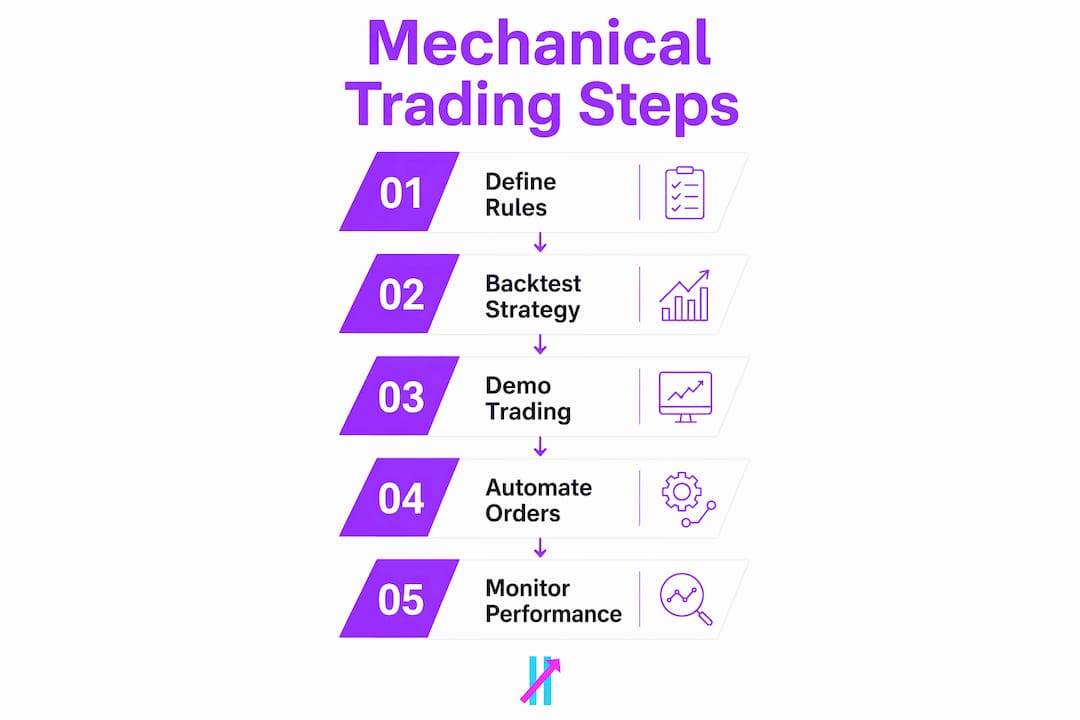
Step-by-step process:
Define your rules in plain language before touching any code. Write out exactly when you enter, when you exit, how much you risk per trade, and what conditions disqualify a setup.
Choose a platform. TradingView’s Pine Script is beginner-friendly and widely used. Tools like Big Move Algo provide ready-built signal logic, letting you skip the coding stage entirely.
Use AI assistance for coding. Free AI models can translate plain-language strategy rules into working code. Provide your parameters and download the output.
Backtest thoroughly. Use the TradingView strategy tester or a platform like QuantConnect to run your system across multiple market conditions and timeframes. Test across different regimes, not just favorable ones.
Validate with out-of-sample data. Reserve a portion of historical data that was never used during development and test on that set separately.
Paper trade before going live. Run the system in a demo environment for at least several weeks to confirm live execution matches backtest behavior.
Set position sizing and stop-loss rules explicitly. Never leave risk management as an afterthought. Define maximum loss per trade and maximum portfolio drawdown before you deploy.
Common early mistakes include over-optimizing during backtesting, skipping the demo phase, and ignoring transaction costs. A strategy that looks profitable before fees can turn negative once spreads and commissions are factored in. For deeper context on how prediction market backtesting works with large datasets, the Assymetrix approach to systematic validation is worth reviewing.
Key Takeaways
A mechanical trading strategy removes human emotion entirely by executing every trade decision through fixed, predefined rules covering entry, exit, position sizing, and risk management.
Point | Details |
Rules govern everything | Entry, exit, sizing, and risk controls are all predefined with no discretion allowed. |
Backtesting validates the edge | Testing on historical data, ideally with stochastic modeling, confirms whether a strategy works before live deployment. |
Overfitting is the top risk | Systems optimized too tightly to past data fail in live markets; test across multiple market regimes. |
Maintenance is ongoing | Market regime changes can break a working strategy; monitor performance and set clear termination thresholds. |
Start simple | Simple rule sets survive market shifts better and are easier to diagnose when performance slips. |
Take the guesswork out of your trading

Big Move Algo translates the principles of mechanical trading into a ready-to-use TradingView indicator. It delivers clear Long, Short, and Exit signals in real time across crypto, forex, stocks, indices, and commodities. The built-in Fake Trend Detector filters out low-quality setups automatically, so you are not trading noise. AUTO Mode gets you running in minutes; Manual Mode gives experienced traders full control over signal parameters.
If you want a structured trading approach without building a system from scratch, Big Move Algo is built exactly for that.
Recommended
Comments