
Trading Income Strategy for Beginners: 2026 Guide
- Steven Hartwell

- 3 days ago
- 5 min read

What is a trading income strategy?
A trading income strategy is a systematic approach to generating regular cash flow from financial markets, primarily by selling options premium or holding dividend-paying assets. The goal is consistent returns, not capital appreciation. You are not trying to catch the next big move. You are building a repeatable process that pays you whether the market drifts sideways or grinds slowly in one direction.
Steven Hartwell, a recognized voice in income trading education, frames it this way: the shift from speculative trading to income trading is fundamentally a shift from prediction to probability. Instead of asking “where will this stock go?” you ask “how much premium can I collect while managing my downside?” That reframe changes everything about how you size positions, pick strikes, and handle losing trades.
Key principles of any income-focused approach:
Prioritize cash flow over price appreciation
Manage probabilities, not predictions
Diversify across strategies and underlying assets
Apply strict position sizing to protect capital
Track performance with measurable metrics, not gut feel
Common methods used in income generation through trading
Options income strategies are trading approaches focused on collecting premium by selling options, generating consistent cash flow through time decay (theta) rather than relying on large directional moves. Options expire worthless roughly 60–70% of the time, which is why selling slightly out-of-the-money options has been profitable historically. You are essentially acting as the insurance company, collecting premiums from traders buying protection.
The four core strategies for trading income methods, ranked by complexity:
Covered calls: You own 100 shares and sell a call option above the current price. You collect premium while agreeing to sell at the strike if the stock rallies past it. Monthly premiums typically run 0.5–2% of stock value. Best for long-term holders who want to extract additional income from existing positions.
Cash-secured puts: You sell a put on a stock you would genuinely buy at a lower price, keeping enough cash to purchase shares if assigned. If the stock stays above your strike, you keep the premium and repeat. Assignment is not a failure; it is part of the plan.
Credit spreads: You sell one option and buy a further out-of-the-money option for protection. Your maximum loss is defined at entry. This is the workhorse of most income portfolios because it scales to smaller accounts.
Iron condors: You combine a put spread and a call spread on the same underlying, profiting when price stays within a range. Best deployed on broad ETFs like SPY or IWM in moderate-to-high implied volatility environments.
A diversified mix of these four strategies can realistically target 1–3% monthly returns with proper risk controls. Dividend investing rounds out the picture for traders who prefer a simpler, lower-maintenance approach: buy quality companies with consistent payout histories and let the dividends compound.
Mindset shift and risk management in income trading

Most retail traders approach options as directional bets. Income traders think differently. Your edge comes from selling premium consistently and letting time decay work in your favor, not from predicting where a stock closes on Friday. That mental shift is harder than it sounds, especially during volatile stretches when every instinct says to do something.
Position sizing is where most accounts blow up. Oversizing is the primary cause of account blow-ups in options income trading, not bad trade selection. Treating your portfolio like a business with strict limits protects you from the one catastrophic loss that wipes out months of accumulated premium.
Core risk management rules:
Keep no single position above 5% of total portfolio risk
Never concentrate more than 10% of total capital in one underlying
Maintain 5–10% cash reserves at all times for adjustments
Use defined-risk strategies (spreads, condors) for at least 30% of positions
If portfolio drawdown hits 15%, cut position sizes by 50% until recovery
Assignment risk on cash-secured puts deserves specific attention. If you get assigned shares, you now own stock at your strike price. The correct response is to immediately begin selling covered calls against those shares, cycling the position into ongoing income. This rotation, sometimes called the wheel strategy, keeps capital working continuously.
Pro Tip: Close winning positions early rather than holding to full expiration. Capturing a large portion of maximum profit and redeploying into a fresh position reduces tail risk and speeds compounding over time.
Practical tools and performance metrics for income traders
Income strategies perform best in range-bound or slowly trending markets, and the timing of your entries matters. Selling premium during elevated implied volatility periods generates higher income for the same level of risk. Scanning for implied volatility rank above 30 before opening new positions gives you a meaningful edge on premium quality.
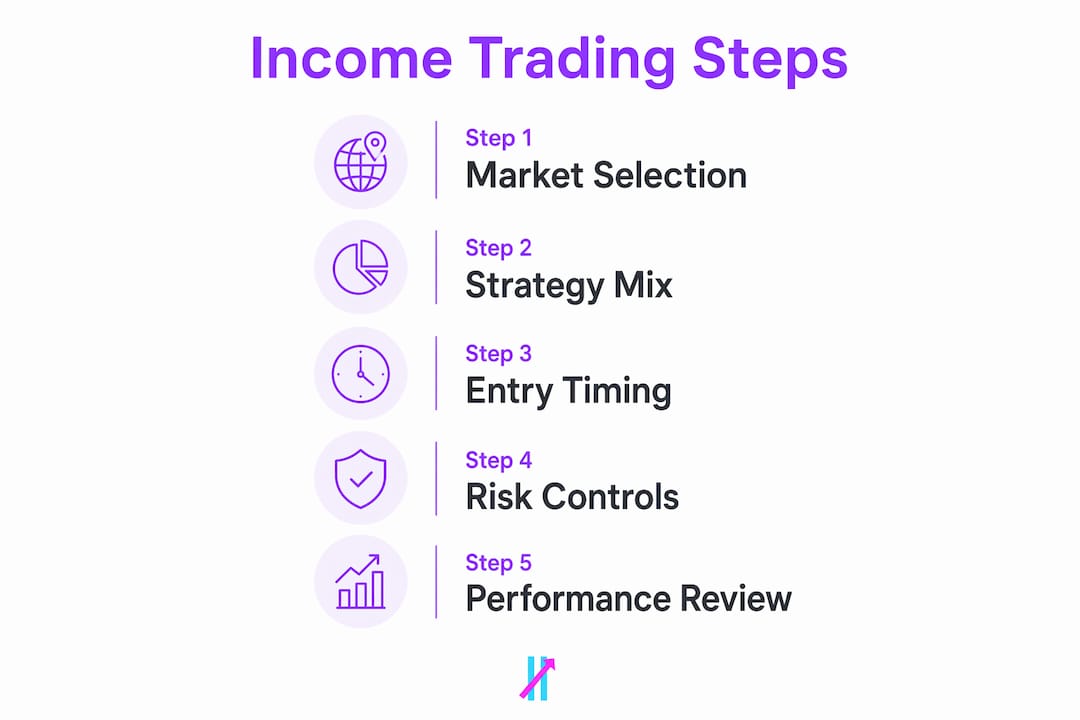
The optimal trade duration for most income strategies sits in the 30–45 days to expiration window. Theta decay accelerates inside 21 days, but gamma risk also spikes, meaning a sudden price move can overwhelm your premium cushion. Opening at 30–45 days and managing or closing at 14–21 days captures the steepest part of the theta curve while leaving time to adjust if a position moves against you.
Big Move Algo’s TradingView indicator helps traders identify high-probability entry points across stocks, crypto, forex, and commodities by generating clear Long, Short, and Exit signals in real time. The built-in Fake Trend Detector filters out low-quality market conditions where premium selling carries elevated risk, which is particularly useful for beginners who have not yet developed the pattern recognition to spot those setups manually. For traders building passive income through signals, having a structured signal layer removes much of the guesswork from entry timing.
Tax treatment matters for income projections. Options income is generally taxed at short-term capital gains rates, meaning premiums collected are taxed as ordinary income. Factor that into your monthly return targets before comparing options income to dividend income, which often qualifies for lower qualified dividend rates.
Performance metrics worth tracking monthly:
Win rate: Target 75–85%. Below 70% consistently signals a problem with strike selection or timing.
Max drawdown: Keep this under 10% in any rolling three-month window.
Monthly return on capital: Your primary benchmark against the 1–3% target.
Theta-to-delta ratio: Higher ratios mean you are earning more time decay relative to directional exposure.
For traders exploring risk management technology to support their income approach, tools that quantify probability and portfolio exposure can sharpen decision-making considerably.
Pro Tip: Balance your income target against your actual risk tolerance. Forcing 3% monthly returns in a low-volatility environment means taking on more risk per dollar of income. Accept 1% in quiet markets and wait for elevated volatility to push for the higher end.
Ready to put your income strategy into action?

Big Move Algo gives retail traders a structured edge with real-time signals, a Fake Trend Detector, and clear Long/Short/Exit alerts across every major market. Whether you are running covered calls on stocks or managing a multi-leg options portfolio, having a reliable signal layer tightens your entries and reduces emotional decision-making.
Big Move Guard adds an advanced risk management layer designed specifically for income-focused portfolios, helping you stay within position limits and protect accumulated premium during volatile stretches.
Key Takeaways
A trading income strategy succeeds through consistent premium collection, strict position sizing, and disciplined trade management, not through predicting market direction.
Point | Details |
Core definition | A trading income strategy generates regular cash flow by selling options premium or holding dividend-paying assets. |
Monthly return target | A diversified mix of covered calls, puts, spreads, and condors can target 1–3% monthly returns with proper risk controls. |
Options expiry rate | Options expire worthless roughly 60–70% of the time, supporting the statistical edge of premium selling. |
Position sizing rule | No single position should exceed 5% of total portfolio risk to avoid catastrophic losses. |
Tax awareness | Options income is generally taxed at short-term capital gains rates, so factor this into net return projections. |
Recommended
Comments