
What Is Trade Management? A Practical Guide for Active Traders


What trade management actually means
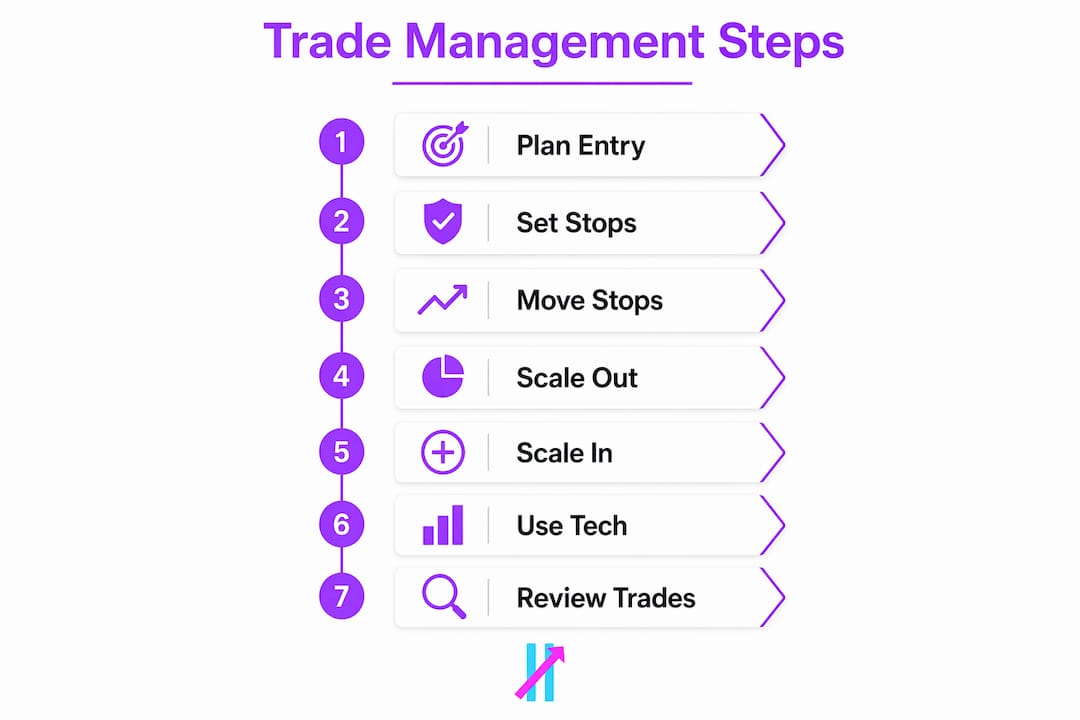
Trade management is everything you do after you enter a position. The entry gets you in. Management determines whether you actually keep the money.
Specifically, trade management covers:
Moving your stop loss to lock in profit or reduce exposure as price moves in your favor
Taking partial profits at key chart levels before the full target is reached
Scaling into a winning position when the market confirms your thesis
Using trailing stops to let a strong trend run without giving back all your gains
Deciding when the original trade rationale no longer holds and exiting cleanly
Most retail traders spend the majority of their time obsessing over entries. That’s the wrong place to focus. Trading success depends far more on managing trades live and making timely exits than on picking the perfect entry point. A great entry with poor management will lose money. A decent entry with disciplined management can be consistently profitable.
The passive “set it and forget it” approach, placing a stop and a target and walking away, works in theory but fails in practice. Markets are dynamic. Price reacts at support and resistance zones, stalls at prior highs, and reverses at levels you can identify in advance. Ignoring that information mid-trade is leaving money on the table.
Key actions that make up active trade management
Moving your stop loss
The most fundamental trade management action is moving your stop loss as the trade develops. You start with an initial stop placed below a key level, then advance it as price moves in your favor. The goal is to reduce your maximum loss first, then eventually move the stop to breakeven, and finally trail it to protect accumulated profit.

The critical mistake here is moving stops in the wrong direction. Widening a stop mid-trade to avoid being stopped out is one of the most destructive habits in trading. It violates your pre-trade risk rules and turns a manageable loss into a catastrophic one.
Scaling out (partial profit-taking)
Scaling out means closing a portion of your position at an intermediate target while letting the rest run. If you’re long 100 shares and price hits your first resistance level, you might sell 50 shares there and trail a stop on the remaining 50. This approach locks in partial profits while keeping exposure to a larger move.
The benefit is psychological as much as financial. Once you’ve secured some profit, you can manage the remaining position with less emotional pressure.
Scaling in (adding to winners)
Scaling in is the opposite: adding to a position that’s already moving in your favor. Done correctly, it increases your exposure when the market is confirming your read. Done impulsively, it inflates risk at exactly the wrong moment. The rule is simple: only add when the original thesis is strengthening, never to average down on a losing trade.

Trailing stops
A trailing stop follows price as it moves in your favor, locking in profit automatically without requiring you to watch every tick. Most charting platforms let you set a trailing stop by a fixed dollar amount, a percentage, or based on a technical level like a moving average. Trailing stops are especially useful in trending markets where you want to ride a move without setting a hard target.
Pro Tip: Set your trailing stop below a structural level, like a prior swing low, rather than a fixed percentage. A percentage-based trail gets hit by normal volatility; a structure-based trail only triggers when the market actually breaks.
Risk management integration
Every stop adjustment and scaling decision should connect back to your original risk parameters. If you risked $200 on a trade, moving your stop to breakeven eliminates that risk entirely. Taking partial profits at the first target reduces your effective risk further. Active trade management is how your theoretical edge in a setup becomes realized profit, because it keeps risk controlled at every stage of the trade.
What trade management looks like in practice
Abstract concepts only go so far. Here’s how these techniques play out in a real trade scenario.
Say you’re trading a stock that just broke above a consolidation zone at $50. Your entry is $50.20, your initial stop is $49.50, and you’re targeting $52.50 based on a prior resistance level. Here’s how active management unfolds:
Price reaches $51.00. This is your first trouble area, a prior swing high. You close 30% of the position here and move your stop from $49.50 to $50.00 (just below the breakout level). You’ve taken some profit and reduced your downside to near zero.
Price consolidates briefly, then pushes to $51.80. You identify the next resistance at $52.00. You close another 30% of the position. Stop moves up to $51.20.
Price breaks $52.00 cleanly. The remaining 40% of the position is now in a strong trend. You switch to a trailing stop set below each new swing low as price climbs.
Price stalls at $53.10 and starts to pull back. Your trailing stop at $52.40 gets hit. You exit the remainder with a solid gain on that final piece.
The key concept here is mapping trouble areas before you enter the trade. You’re not reacting to price in the moment; you’ve already decided what you’ll do at each level. That removes guesswork and keeps emotion out of the equation.
Different asset classes change the specifics but not the logic. In forex, you might use pip-based stops adjusted for average daily range. In crypto, wider stops account for higher volatility. In futures, margin requirements shape how aggressively you scale. The framework stays the same across all of them.
Common mistakes that destroy trade management discipline
Widening stops to avoid a loss
This is the single most destructive trade management error. Price approaches your stop, and instead of accepting the loss, you move the stop further away. Sometimes it works and the trade recovers. More often, a small planned loss becomes a large unplanned one. Professional trade management requires fixed stop levels based on your original market thesis, not emotional adjustments made under pressure.
Ignoring pre-planned levels
You mapped your trouble areas before the trade. Price hits the first one. Then, instead of taking partial profits as planned, you decide to hold because “it looks strong.” This is how planned trades become hope trades. The plan exists for a reason: to remove in-the-moment decision-making from the equation.
Exiting too early out of fear
The flip side of holding too long is bailing too soon. Price dips slightly after entry, and you close the trade for a small loss or tiny gain, only to watch it hit your original target without you. This usually comes from stops placed too tightly, without enough room for normal market fluctuation.
Emotional decision-making at exits
Successful traders treat exits with the same rigor as entries. Exiting because you’re nervous, or holding because you’re greedy, produces inconsistent results regardless of how good your entry signals are. The exit should be determined by the chart, not your mood.
Averaging down on losing trades
Adding to a position that’s moving against you is not trade management. It’s hope masquerading as strategy. Every add-on increases your risk at a moment when the market is telling you the thesis is wrong.
The pattern is consistent: traders who struggle with profitability almost always have a trade management problem, not an entry problem. The setup gets them in. Emotion gets them out at the wrong time.
Advanced best practices for better trade management
Map your trouble areas before you enter
The most effective trade management technique is also the most underused: planning every decision before the trade opens. Identifying the first trouble area on your chart, the first price level where reactive movement is likely, gives you a concrete trigger for your first partial profit and your first stop adjustment. You’re not guessing in the moment; you’re executing a plan.
Mark subsequent support and resistance zones beyond the first trouble area as well. Each one becomes a decision point: take more profit, move the stop again, or let the trailing stop handle it. The entire action plan is laid out before you risk a dollar.
Give your stops room to breathe
Stop placement should respect actual market volatility, not arbitrary round numbers. Stops placed too tightly get hit by normal price fluctuation, especially in sideways or choppy conditions. A good stop sits just beyond a structural level where, if price reaches it, the original trade thesis is genuinely invalidated. That’s not the same as placing a stop at a round number because it feels safe.
Use technology to enforce your rules
The biggest enemy of good trade management is the trader’s own psychology. Automation removes a significant portion of that problem. When your platform executes a trailing stop or a partial profit order automatically, you can’t second-guess it in the moment.
Big Move Algo addresses this directly. As a TradingView indicator, it generates real-time Long, Short, and Exit signals across crypto, forex, stocks, indices, and commodities. The built-in Fake Trend Detector filters out low-quality market conditions where trade management becomes unpredictable, so you’re not trying to manage a position in a market that has no clear direction. AUTO Mode handles signal generation with minimal setup, while Manual Mode gives experienced traders more control over how signals are applied. The result is a system where the rules are enforced by the tool, not by willpower in a volatile moment. Automated trade signals reduce emotional interference and keep management decisions grounded in the original plan.
Pro Tip: Before every trade, write down three things: where your initial stop goes, what your first trouble area is, and what you’ll do when price reaches it. Traders who write this down execute it. Traders who keep it in their heads improvise.
Adapt management style to market conditions
Trending markets favor trailing stops and scaling in. Choppy, range-bound markets favor tighter targets and quicker partial profits. The same management approach applied to both conditions will underperform in at least one of them. Reading the broader market context before deciding how aggressively to trail or how quickly to take profits is part of what separates disciplined traders from reactive ones.
For multiple asset classes, the volatility profile of each market should directly inform stop distance and profit-taking cadence. A forex major pair moves differently than a small-cap stock or a crypto token. Your management framework needs to account for that.
Treat management as a skill, not an afterthought
Trade management is a learnable, improvable skill. Reviewing past trades specifically for management decisions, not just entries, reveals patterns in where you give back profit or exit too early. Most traders review whether their entry was right. The better question is: given that the entry was right, did you manage it well?
Key Takeaways
Effective trade management, not entry selection, is the primary driver of long-term trading performance, requiring disciplined stop adjustments, planned profit-taking, and emotion-free exits.
Point | Details |
Management beats entry | How you manage a trade after entry determines whether your edge becomes realized profit. |
Plan before you enter | Map trouble areas and stop levels before opening a position to remove in-the-moment guessing. |
Widening stops destroys accounts | Moving a stop further away to avoid a loss turns small planned losses into large unplanned ones. |
Trailing stops capture trends | Structure-based trailing stops let winning trades run while protecting accumulated gains. |
Automation enforces discipline | Tools like Big Move Algo enforce pre-planned trade rules and reduce emotional decision-making. |
Recommended
Comments