
What Is a Trading Journal and Why It Matters


A trading journal is a structured record of every trade you take, capturing both the raw data and the reasoning behind each decision. Most traders rely on brokerage statements to review performance, but those statements only show outcomes. A journal adds the context that turns raw results into real insight. Traders who log and review 90%+ of trades show win rates 8 percentage points higher than those who log under 50%. That gap is not luck. It is the direct result of systematic self-review.
What is a trading journal, exactly?
A trading journal is a combined data and narrative record that documents every trade from entry to exit, including the trader’s rationale, emotional state, and post-trade analysis. This definition separates it from a basic trade log or brokerage statement, which only records price, size, and profit or loss. The journal adds the “why” behind each trade, making it a diagnostic tool rather than a passive ledger.

Think of the difference this way. A brokerage statement tells you that you lost $400 on a EUR/USD short. A trading journal tells you that you entered late, ignored your setup criteria, and felt anxious about missing the move. One record shows you what happened. The other shows you why it happened and what to fix.
A journal also differs from a spreadsheet of wins and losses. Broker statements only record outcomes; journals add context to distinguish strategy flaws from execution mistakes. That distinction is where real improvement lives. Without it, traders repeat the same errors without ever identifying the root cause.
What key information should a trading journal capture?
Five core fields form the foundation of any functional trading journal: entry price, exit price, position size, initial risk (1R), and a qualitative post-trade note. Each field serves a specific purpose in performance analysis.
The initial risk field is the one most traders skip, and it is the most critical. Without 1R data, you cannot calculate expectancy, which is the true measure of your trading edge. Win rate alone is a vanity metric. Expectancy and risk-to-reward ratios reveal whether your strategy actually produces positive returns over time, regardless of how many trades you win.
Beyond the numbers, narrative elements make a journal genuinely useful. These include:
Setup tag: The specific pattern or signal that triggered the trade (e.g., breakout, pullback, trend continuation)
Trade rationale: A one-to-three sentence explanation of why you took the trade
Emotional state: A brief note on your mindset before and after the trade (calm, anxious, overconfident)
Rule compliance: Whether the trade followed your predefined criteria or deviated from them
The table below shows the difference between a simple trade log and a detailed trading journal.
Field | Simple trade log | Detailed trading journal |
Entry price | ✓ | ✓ |
Exit price | ✓ | ✓ |
Position size | ✓ | ✓ |
Initial risk (1R) | ✗ | ✓ |
Setup tag | ✗ | ✓ |
Trade rationale | ✗ | ✓ |
Emotional state | ✗ | ✓ |
Rule compliance | ✗ | ✓ |
Expectancy calculation | ✗ | ✓ |
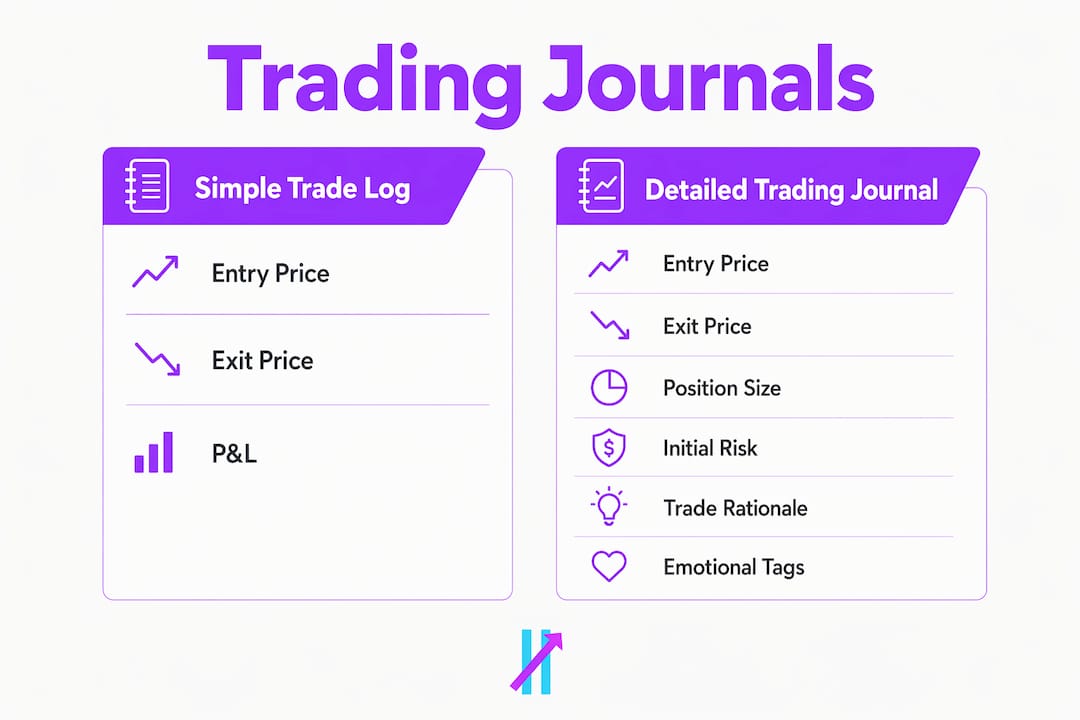
A simple log tells you your P&L. A detailed journal tells you whether your process is sound.
Pro Tip: Keep your post-trade note under five sentences. Long entries create friction and reduce the chance you will journal consistently. Brevity beats perfection.
How does keeping a trading journal improve trading performance?
Traders who systematically reviewed their trades improved risk-adjusted returns by 12%–18% over 12 months compared to peers who did not journal. That improvement does not come from trading more or finding better setups. It comes from eliminating the specific mistakes that erode returns over time.
Emotion logs are one of the most underused tools in a trading journal. Traders using structured emotion logs reduced maximum drawdowns by 23% in a quarter compared to peers who skipped emotional tracking. Drawdowns are often not a strategy problem. They are a behavior problem, driven by revenge trading, overconfidence after a winning streak, or fear after a losing one.
“Structured journaling accelerates pattern recognition within 1–2 weeks, leading to more reliable improvement regardless of trading strategy.” — Trading psychologist Brett Steenbarger
Pattern recognition is the core mechanism behind journaling’s performance benefits. Memory alone is too unreliable for timely improvements. A written record surfaces patterns in days that would otherwise take months to notice through experience alone. You might not realize you consistently lose on Friday afternoons, or that your best trades all share the same setup tag, until the data shows you.
Emotional tagging in journals counters cognitive biases by connecting feelings to specific profit and loss outcomes. This objective data highlights problematic behaviors like revenge trading and overconfidence before they compound into serious losses. The journal does not judge you. It just shows you the pattern.
Fewer than 15% of retail traders journal consistently. That low adoption rate means consistent journalers operate with a structural advantage over the majority of the market.
Best practices for maintaining an effective trading journal
The biggest reason traders quit journaling is friction. Manual data entry after every trade feels tedious, especially for active traders executing 25 or more trades per week. The solution is a hybrid approach: automate quantitative data capture and reserve manual input for qualitative notes only.
Automating quantitative data capture reduces the barrier to entry significantly. Many trading platforms and tools can export trade data directly, eliminating the need to manually type entry prices, exit prices, and position sizes. Once the numbers are handled automatically, you only need to write a few sentences about your rationale and emotional state.
A structured weekly review is the second non-negotiable habit. A 30-minute weekly review is the most effective workflow for active traders. Use that session to look for patterns across the week’s trades, not just to confirm what you already know. Ask three questions: Which setup performed best? Which emotional state correlated with losses? Did you follow your rules?
Here is a practical framework for building a sustainable journaling habit:
Set a minimum entry standard. Require at least five fields per trade: entry, exit, size, 1R, and one sentence of rationale. No exceptions.
Automate the numbers. Use your platform’s export function or a compatible tool to pull trade data automatically.
Write your note immediately after closing the trade. Memory degrades fast. A two-minute note right after the trade is worth more than a detailed reconstruction an hour later.
Schedule a fixed weekly review. Block 30 minutes on the same day each week. Treat it like a trading session, not an optional task.
Track rule compliance as a separate metric. Log whether each trade followed your criteria. Over time, this single metric reveals more about your edge than win rate ever will.
The greatest journaling power lies in tracking the “why” behind trades and enforcing compliance with specific rules. A journal that only records outcomes is just a slower brokerage statement.
Pro Tip: Pair your journal review with your TradingView workflow by screenshotting your chart at entry and exit. Visual context makes post-trade analysis significantly faster and more accurate.
What do trading journal examples and templates look like?
A practical trading journal entry does not need to be complex. The goal is consistency, not comprehensiveness. A well-structured entry for a single trade might look like this:
Date: March 12, 2026
Market: EUR/USD
Direction: Long
Entry price: 1.0845
Exit price: 1.0910
Position size: 2 standard lots
Initial risk (1R): 30 pips
Outcome: +2.2R
Setup tag: Pullback to 20 EMA in uptrend
Rationale: Price pulled back to a key moving average with a bullish engulfing candle on the 1-hour chart. Trend was clearly up on the 4-hour.
Emotional state: Calm and patient. Waited for confirmation before entering.
Rule compliance: Yes. Trade matched all criteria.
This structure works across asset classes. A crypto trader using signal-based entries would use the same fields with different setup tags. A stock trader would add a sector or earnings note. The template adapts to your style.
The table below shows how narrative and quantitative data work together in a journal entry.
Data type | Example | Purpose |
Quantitative | Entry 1.0845, Exit 1.0910, 1R = 30 pips | Calculates expectancy and R-multiple |
Setup tag | Pullback to 20 EMA | Groups similar trades for pattern analysis |
Rationale | Bullish engulfing on 1H in uptrend | Reveals whether the trade had a logical basis |
Emotional state | Calm, patient | Connects mindset to outcomes over time |
Rule compliance | Yes | Tracks discipline as a separate performance metric |
Tailoring your template to your trading style matters. A scalper running dozens of trades per day needs a leaner template than a swing trader taking three trades per week. The key is capturing enough data to run meaningful analysis without making entry so burdensome that you stop doing it.
A trading journal transforms random trade outcomes into measurable, trackable skills. Patterns in performance surface faster, allowing you to cut losing habits and scale winning setups with confidence.
Key Takeaways
A trading journal is the single most effective tool for separating disciplined, improving traders from those who repeat the same mistakes indefinitely.
Point | Details |
Definition matters | A journal captures both trade data and rationale, unlike a brokerage statement that records only outcomes. |
Five core fields | Entry, exit, size, initial risk (1R), and a qualitative note are the minimum required for meaningful analysis. |
Performance impact | Systematic journaling improves risk-adjusted returns by 12%–18% over 12 months. |
Emotion tracking | Structured emotion logs reduce maximum drawdowns by cutting behavioral mistakes like revenge trading. |
Habit over perfection | A hybrid approach (automated data, manual notes) and a 30-minute weekly review sustain the habit long term. |
Why most traders are journaling wrong
Most traders treat a journal as a passive log, something to fill out and forget. That is the wrong approach, and it explains why so many traders journal for a few weeks and then stop. The value of a journal is not in the entries. It is in the review.
I have seen traders with years of journal data who never improved because they never sat down to analyze it. They logged trades dutifully but skipped the weekly review. Their journals were archives, not coaching tools. The data was there. The insight was not.
The shift happens when you start treating your journal as a personal performance coach. That means asking hard questions during your weekly review. Why did I take that trade outside my criteria? What was I feeling when I doubled my position size? The answers are uncomfortable, but they are the ones that actually change behavior.
One pattern I have noticed consistently: traders who focus on rule compliance as a metric improve faster than those who focus on win rate. Win rate is an outcome. Rule compliance is a behavior you can control. When you track compliance, you start to see that your best weeks are almost always your most disciplined weeks. That connection is the most valuable thing a journal can show you.
The compounding effect of consistent journaling is real. The first month feels like bookkeeping. By month three, you start seeing patterns. By month six, you are making decisions differently because you have objective evidence of what works for you specifically, not what works in theory.
— Steven Hartwell
Big Move Algo: signals worth journaling
A trading journal is only as good as the trades you put into it. Clear, well-defined signals give you consistent entries to analyze, which makes your journal far more useful over time.

Big Move Algo is a TradingView indicator that delivers real-time Long, Short, and Exit signals across crypto, forex, stocks, indices, and commodities. Its built-in Fake Trend Detector filters out low-quality market conditions, so the trades you log are worth analyzing. AUTO Mode gets you started with minimal setup, while Manual Mode gives experienced traders additional control. When every signal follows a defined logic, your journal reviews become pattern-rich and genuinely diagnostic. See what Big Move Algo’s trading signals can add to your process.
FAQ
What is a trading journal used for?
A trading journal records every trade’s data and rationale to help traders identify patterns, improve decision-making, and measure their true edge over time. It functions as a diagnostic tool, not just a record of wins and losses.
How often should I review my trading journal?
A 30-minute weekly review is the most effective cadence for active traders. This session should focus on identifying behavioral patterns and rule compliance, not just reviewing profit and loss.
What is the most important field in a trading journal?
Initial risk (1R) is the most critical field because it enables expectancy calculations. Without it, you cannot determine whether your strategy has a genuine edge, regardless of your win rate.
Can a trading journal reduce emotional trading?
Traders using structured emotion logs reduced maximum drawdowns by 23% in a quarter. Connecting emotional states to specific outcomes makes behavioral patterns visible and correctable.
Do beginners need a trading journal?
Beginners benefit from journaling more than experienced traders because they have fewer established habits to correct. Starting with a simple five-field template builds the discipline that separates profitable traders from the rest.
Recommended
Comments