
The Best YouTube.com Alternatives for Creators in 2026
- Steven Hartwell
- a few seconds ago
- 13 min read

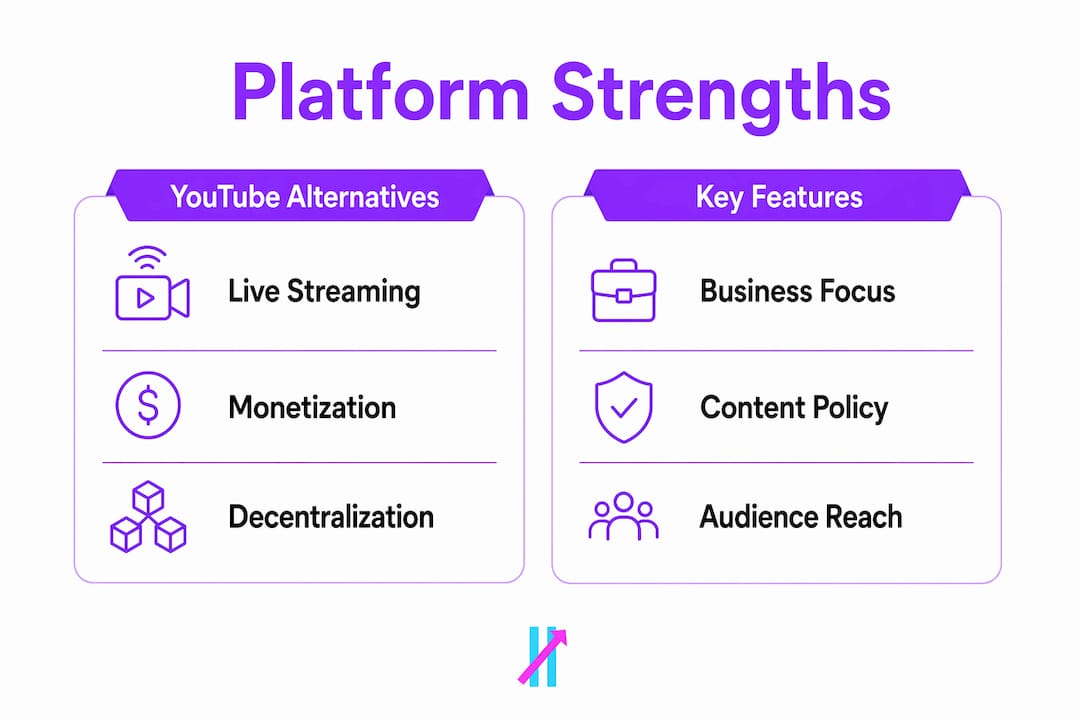
The strongest YouTube alternatives in 2026 are not one-size-fits-all replacements. They are specialized platforms built around specific goals: professional ad-free hosting, live streaming, censorship resistance, short-form virality, or paid community building. The right choice depends entirely on what you are trying to do with your video content.
Here is a quick map of the top platforms and what they are actually built for:
Vimeo — professional, ad-free hosting for businesses and creative teams
Twitch — live streaming with deep community interaction, especially for gaming
Rumble — monetization-first platform with licensing deals for news and commentary creators
PeerTube — open-source, federated hosting where you control moderation and data
TikTok — algorithm-driven short-form video with unmatched organic reach
Odysee — blockchain-based distribution for creators who want censorship resistance
Kick — live streaming with a 95/5 revenue split favoring creators
Nebula — subscription video network built as a creator cooperative
Uscreen / Thinkific — paid course and membership platforms for knowledge creators
Dailymotion — broad international reach with relaxed content policies
Facebook Video / IGTV — social-first video embedded in existing audience networks
The smartest move for most creators is not picking one platform and abandoning YouTube. It is what experienced creators call the Split Strategy: use YouTube for discovery, then route your audience to a platform that converts better, pays more, or gives you more control. That framing shapes everything that follows.
What are the best YouTube alternatives in 2026?
Every platform below earns its place by doing something YouTube does not do as well. The comparison table covers the core dimensions; the profiles after it go deeper on the ones that need more explanation.
Platform | Best For | Monetization | Content Policy | Live Streaming | Hosting Features |
Creative pros and businesses | Subscriptions, pay-per-view, tips | Strict, curated | Yes (paid plans) | Ad-free, privacy controls, custom player | |
General sharing, international | Ad revenue share | Relaxed, multilingual | Yes | Unlimited uploads, embed tools | |
Live gaming and community | Subs, bits, ads | Moderate | Core feature | VOD storage, channel points | |
Censorship-resistant creators | LBRY Credits, tips, memberships | Minimal, decentralized | Yes | Blockchain-backed, federated | |
News, commentary, licensing | Licensing deals, ads, subscriptions | Minimal moderation | Yes | CDN hosting, monetization dashboard | |
Self-governed communities | Instance-dependent | Community-set per instance | Yes (RTMP) | Self-hosted, ActivityPub federation | |
Premium educational creators | Revenue share from subscriptions | Curated, creator-led | No | Ad-free, exclusive content tools | |
Utreon | Emerging creators | Tips, subscriptions, chat | Moderate | Yes | Community tools, flexible monetization |
Visual artists and photographers | — | Community standards | No | Image-video integration | |
Veoh | Casual and niche video | — | Moderate | No | Long-form video support |
Crackle | Free entertainment viewers | Ad-supported | Curated, TV-style | No | Movies, TV, originals |
Free speech-focused creators | — | Minimal | No | Peer-to-peer hosting | |
Blockchain-first creators | Cryptocurrency rewards | Minimal, decentralized | No | Peer-to-peer, crypto-backed | |
Live streamers | 95/5 revenue split, subs | Moderate | Core feature | VOD, clip tools | |
TikTok | Short-form viral content | Creator Fund, gifts, brand deals | Moderate, algorithmic | Yes | Algorithm-driven discovery |
Chinese market and diaspora | Memberships, virtual gifts | Community-moderated | Yes | Anime-style community tools | |
Music artists and labels | Ad revenue | Curated, music-only | No | Official music video hosting | |
AI video production | SaaS subscription | Platform TOS | No | Text-to-video, avatar generation | |
Enterprise internal video | Subscription tiers | Strict, private | No | Access controls, engagement analytics | |
Playeur | Marketing embeds | — | Moderate | No | Ad-free, fast playback |
Paid memberships and courses | Subscription, pay-per-view | Curated | No | OTT apps, branded player | |
Online course creators | Course sales, memberships | Platform TOS | No | Integrated video with course builder | |
Fan-supported creators | Memberships, tiers | Creator-set | No | Video posts, community feed | |
Facebook Video | Social video sharing | In-stream ads, Stars | Moderate | Yes | Social graph, sharing tools |
IGTV | Instagram influencers | Brand deals, badges | Moderate | Yes (via Instagram) | Mobile-first, Instagram-integrated |
Blockchain content ownership | LBRY Credits | Minimal | No | Immutable blockchain hosting | |
Meme and entertainment | — | Community-moderated | No | Viral content curation | |
Thought leadership content | — | Highly curated | No | High-quality talk hosting | |
Broad social video reach | In-stream ads, Stars | Moderate | Yes | Social network integration |
Vimeo
Vimeo is the go-to platform when you need video to work for your business without YouTube pulling viewers toward competitor content. Unlike YouTube, Vimeo keeps viewers on your site without ads or related-video distractions, which matters enormously at the bottom of a sales funnel. The custom player, privacy controls, and collaboration tools make it the default choice for agencies, filmmakers, and marketing teams. Paid plans unlock advanced analytics and password-protected videos.
Twitch and Kick
Twitch holds a global traffic rank of 36 as of early 2025, making it the dominant live streaming platform by a wide margin. Its community features, including channel points, raids, and live chat, are built specifically for interactive audiences. Kick positions itself as the creator-friendly challenger with a notably generous revenue split in live streaming, and its moderation policies are noticeably looser. If you are already streaming on Twitch and frustrated by its 50/50 split, Kick is worth a serious look.

Rumble
Rumble has carved out a real niche in news and political commentary, partly because its licensing model lets creators earn money from their content without building a subscriber base first. Its global traffic rank of 1,222 reflects genuine scale. Moderation is light, which attracts creators who have been demonetized or restricted elsewhere. The platform also offers direct licensing deals where Rumble pays creators upfront for distribution rights.
PeerTube and Odysee
These two represent the decentralized end of the spectrum, but they work differently. PeerTube is open-source software developed by Framasoft, a French nonprofit, that you install on your own server to create an independent video platform. It connects to other PeerTube instances and to platforms like Mastodon via ActivityPub, forming a federated network. Odysee runs on the LBRY blockchain protocol and handles the hosting for you, making it easier to start without server management. Both platforms give creators control that centralized platforms cannot match, though their audiences are smaller.
Pro Tip: PeerTube’s federated structure means your experience varies significantly by instance. Before committing, explore the federation model and choose an instance whose community values and moderation standards align with yours.
TikTok and Bilibili
TikTok’s algorithm surfaces content to non-followers at a rate no other platform matches, which makes it the best discovery engine for short-form video in 2026. Its global traffic rank of 15 reflects its reach. Bilibili sits at rank 22 globally and serves a younger, anime-adjacent audience with strong community engagement features. For creators targeting the Chinese market or its diaspora, Bilibili is the platform YouTube cannot reach.

Nebula, Uscreen, and Thinkific
These three serve creators who want to monetize knowledge directly. Nebula is a creator cooperative where members share subscription revenue and retain content control. Uscreen and Thinkific go further, letting creators build fully branded OTT apps and course platforms. If your goal is recurring revenue from a dedicated audience rather than ad income from a mass one, these platforms offer a fundamentally different business model.
Elai.io and SproutVideo
Elai.io is not a traditional video hosting platform. It generates videos from text using AI avatars, which makes it useful for businesses that need to produce training or marketing videos at scale without a camera crew. SproutVideo targets enterprises that need secure internal video hosting with access controls, single sign-on, and engagement analytics that consumer platforms simply do not offer.
How do these platforms compare when you look at creator-friendliness and control?
The table above captures the basics. What it cannot show is how these platforms feel to use as a creator building a real business around video.
Platform diversification is the single most important strategic shift a creator can make in 2026. YouTube’s algorithm changes and policy updates have disrupted creator income repeatedly, and the creators who weathered those shifts best were the ones already established on secondary platforms. The question is not whether to diversify but which platforms to add first.
For monetization-first creators, Rumble, Kick, and Patreon offer the clearest paths to revenue without requiring massive audiences. Kick’s revenue split is notably favorable to creators. Patreon’s membership model gives creators predictable monthly income from fans who pay regardless of any platform’s algorithm.
For censorship-resistant creators, the choice is between ease and control. Odysee handles hosting for you and pays in LBRY Credits. PeerTube gives you full control but requires technical setup or a willing instance host. BitChute and DTube sit further along the decentralization spectrum with peer-to-peer hosting and cryptocurrency rewards, though their audiences remain small.
For business and enterprise video, the gap between consumer platforms and professional hosting is significant. Enterprise-grade platforms integrate with CRM systems, offer single sign-on, and provide security and marketing analytics that Dailymotion or BitChute cannot match. Vimeo and SproutVideo are the two names that come up most often in this category.
How to choose the right YouTube alternative for your goals
Start with one question: what is the primary job your video needs to do?
If the answer is discovery, you need a platform with algorithmic reach. TikTok and Facebook Video are the strongest options here. YouTube itself remains the largest search-based video discovery engine, so the goal is usually to use it for top-of-funnel exposure while routing engaged viewers elsewhere.
If the answer is conversion, you need ad-free hosting on your own site. Using YouTube for discovery and ad-free platforms for bottom-funnel content is the approach that maximizes both reach and conversion rate. Vimeo and Playeur are built for this use case.
If the answer is community, Twitch, Kick, Patreon, and Nebula each build different kinds of audience relationships. Twitch and Kick are real-time and interactive. Patreon and Nebula are subscription-based and asynchronous.
If the answer is ownership and control, PeerTube and Odysee are the serious options. Lbry and DTube add blockchain-backed immutability for creators who want provable ownership of their content.
Factors to evaluate before committing to a platform:
Audience fit: Does the platform’s existing user base match your target viewer?
Monetization structure: Does the platform’s revenue model align with your income goals?
Content policy: Will your content type be allowed, and what happens if policies change?
Technical requirements: Does the platform require server setup, or is it plug-and-play?
Integration: Does it connect to your email list, CRM, or marketing tools?
Budget: Free platforms trade money for control; paid platforms trade money for features.
Pro Tip: Do not migrate your entire audience to one alternative. The Split Strategy works because it uses each platform for what it does best. YouTube handles discovery; a second platform handles monetization or hosting. Trying to replace YouTube entirely with a single alternative usually means trading one dependency for another.
How experts think about multi-platform video strategy
The creator economy has matured past the point where any single platform is a safe long-term bet. Top creators treat YouTube alternatives as complementary tools, not replacements, building resilience by spreading their audience and revenue across multiple ecosystems.
The split-platform approach works like this in practice. A creator publishes a video on YouTube to capture search traffic and algorithmic recommendations. The same video, or a version of it, goes on Vimeo or SproutVideo for embedding on a sales page or landing page. The Vimeo embed keeps the viewer on the creator’s site, away from YouTube’s related-video sidebar and competitor ads. That separation between discovery and conversion is where the real revenue difference shows up.
Decentralized platforms add a different kind of resilience. PeerTube’s federated structure distributes content across independent servers, each with its own moderation rules and community standards. A creator whose content gets removed from one instance can move to another without losing their channel history, because the ActivityPub protocol allows content and followers to travel between compatible platforms. That portability is something no centralized platform offers.
The distinction between consumer-grade and enterprise-grade hosting matters more than most creators realize. Consumer platforms optimize for discovery; enterprise platforms optimize for control, security, and marketing integration. A business embedding a product demo on its website needs the latter, not the former.
What content policies and copyright enforcement look like across platforms
Content policy is where platforms diverge most sharply, and it is the factor creators most often underestimate until a video gets taken down.
YouTube uses Content ID, an automated copyright detection system that can demonetize or block videos containing copyrighted music, clips, or other protected material. The system is aggressive and sometimes flags content incorrectly, with appeals taking days or weeks to resolve.
Platforms with strict, curated policies: Vimeo, Nebula, TED, Crackle, and Thinkific all maintain editorial standards. Vimeo explicitly prohibits spam, commercial content without approval, and certain categories of adult content. TED is invite-only for speakers. These platforms trade reach for quality control.
Platforms with moderate policies: Twitch, Kick, TikTok, Facebook Video, IGTV, and Bilibili enforce community guidelines but rely on a mix of automated systems and human review. Twitch has faced criticism for inconsistent enforcement, particularly around DMCA music strikes during streams.
Platforms with minimal moderation: Rumble, BitChute, Odysee, DTube, and Lbry operate with light-touch or community-driven moderation. This attracts creators who have been restricted elsewhere, but it also means these platforms host content that mainstream platforms would remove. Creators should evaluate whether that association fits their brand.
Copyright enforcement specifically: Vimeo uses its own content matching system. Dailymotion has a rights management tool for copyright holders. PeerTube instances handle copyright independently, so enforcement varies by instance. Decentralized platforms like DTube and Lbry have minimal automated copyright enforcement, which is a feature for some creators and a risk for others.
Who actually uses these platforms in the US, and how much traffic do they get?
Traffic data tells a clearer story than platform marketing does. Based on Similarweb global rankings from early 2025, the platforms with the strongest US-relevant traffic are:
TikTok: global rank 15, with the US as its largest single market
Vimeo: global rank 1,092, with a professional and business-heavy US user base
Rumble: global rank 1,222, with a predominantly English-speaking, US-focused audience
Dailymotion: global rank 200, with broad international reach including the US
Twitch: global rank 36, with gaming and entertainment audiences skewing 18–34
Kick: global rank 485, growing rapidly among the same demographic as Twitch
Odysee: global rank 7,039, with a smaller but highly engaged English-speaking audience
Nebula: global rank 26,008, reflecting its subscription-only model and curated audience
BitChute: global rank 6,262, with a US-heavy free-speech-focused audience
Bilibili: global rank 22, but primarily serving Chinese-speaking audiences
Facebook and Instagram (including IGTV) sit at global ranks 3 and 4 respectively, making them the largest social video audiences by raw numbers. Their US user bases are massive and demographically broad, though video engagement rates on Facebook have declined as the platform has aged.
Crackle, Veoh, and 9GAG TV serve niche entertainment audiences. Crackle’s free ad-supported model appeals to cord-cutters. Veoh attracts casual viewers who want long-form content without a subscription. 9GAG TV is effectively a curated meme feed with video.
What monetization actually looks like on each platform
Monetization structures vary more than most creators expect, and the difference between a 50/50 split and a 95/5 split compounds significantly over time.
Ad revenue sharing: YouTube pays creators through AdSense after they meet the Partner Program threshold. Rumble offers ad revenue sharing alongside its licensing model. Dailymotion shares ad revenue with creators who qualify for its partner program. Facebook Video’s in-stream ads require meeting eligibility thresholds similar to YouTube’s.
Subscription and membership models: Patreon is the most established direct membership platform, letting creators set their own tier pricing and deliver video content to paying members. Uscreen and Thinkific go further, enabling creators to build fully branded subscription apps. Nebula pays creators from a shared subscription pool based on watch time and engagement.
Live streaming revenue: Twitch monetizes through subscriptions, Bits (a virtual currency viewers buy and send during streams), and ad revenue. Kick’s 95/5 subscription split is its headline differentiator. Both platforms also support brand sponsorships negotiated directly by creators.
Cryptocurrency and blockchain rewards: DTube pays creators in cryptocurrency based on community upvotes. Odysee distributes LBRY Credits to creators and viewers. These models are genuinely novel but come with volatility risk tied to crypto markets.
Licensing deals: Rumble’s licensing model is unique. The platform pays creators upfront for the right to distribute their content, which means a creator can earn money from a video without needing an existing audience. This is particularly valuable for news and commentary creators with strong individual videos.
Revenue potential context: Kick’s 95/5 split means a creator earning $1,000 in subscriptions keeps $950. On Twitch’s standard 50/50 split, the same creator keeps $500. That gap is the reason Kick has attracted established streamers away from Twitch.
What creator tools and analytics support looks like across platforms
Analytics quality separates platforms that treat creators as partners from those that treat them as content suppliers.
Vimeo offers detailed engagement analytics including heatmaps showing exactly where viewers drop off in a video. That data is genuinely useful for improving content and for demonstrating ROI to clients. SproutVideo provides similar depth with the addition of viewer-level tracking, which matters for enterprise use cases like training video completion rates.
Twitch and Kick both offer stream analytics covering concurrent viewers, follower growth, and revenue breakdowns. Twitch’s Creator Dashboard is more mature, with channel analytics going back years. Kick’s tools are newer but improving quickly.
TikTok’s Creator Tools include audience demographics, video performance metrics, and a sound analytics feature that shows which audio tracks drive views. The platform’s algorithm is opaque, but its analytics at least show creators what is working after the fact.
PeerTube offers analytics at the instance level, including watch time and geographic data. The depth varies by instance configuration. Creators running their own instance have full access to server-level data, which is more than any centralized platform provides.
Patreon and Uscreen both provide membership analytics covering subscriber growth, churn rate, and revenue trends. Uscreen adds video-specific metrics like completion rates and engagement scores, which help course creators identify weak points in their content.
Elai.io is production-focused rather than analytics-focused. Its value is in generating videos quickly from text, not in tracking how those videos perform after distribution.
For creators building a serious video business, the analytics gap between consumer platforms and professional hosting is real. Platforms like Vimeo and SproutVideo give you data you can act on. Platforms like Dailymotion or Veoh give you basic view counts and not much else.
Big Move Algo: a different kind of platform worth knowing about
The platforms compared above are all built around video content. Big Move Algo is built around something different: giving traders clear, structured signals in financial markets without the noise that most trading tools add.

If you are a creator in the finance or trading space, the platforms above help you distribute your content. Big Move Algo helps you generate the insights worth distributing. It is a TradingView indicator that reads market conditions in real time and outputs Long, Short, and Exit signals across crypto, forex, stocks, indices, and commodities. The built-in Fake Trend Detector filters out low-quality setups so you are not trading every signal that appears. For traders who want structure without complexity, see how automation works in Big Move Algo’s AUTO Mode, which requires minimal setup to get started.
Key Takeaways
The best YouTube alternative is the one that matches your specific goal, whether that is monetization, control, discovery, or community building.
Point | Details |
Split Strategy works best | Use YouTube for discovery and a second platform for monetization or ad-free hosting to maximize both reach and conversion. |
Kick leads on live streaming revenue | Kick’s creator revenue split is highly favorable in live streaming, compared to Twitch’s standard 50/50. |
Decentralized platforms offer real portability | PeerTube and Odysee let creators move content and followers between instances, a feature no centralized platform provides. |
Enterprise hosting is a different category | Vimeo and SproutVideo offer CRM integration, access controls, and engagement analytics that consumer platforms like Dailymotion cannot match. |
Big Move Algo | For finance and trading creators, Big Move Algo provides the real-time market signals worth building content around, available via subscription on TradingView. |
Recommended