Best Buy Sell Indicators for TradingView in 2026

The best buy sell indicator is the one that matches your market, your timeframe and your discipline. For traders who want clear Long, Short and Exit signals with little setup, we built Big Move Algo. If you want to learn the building blocks first, free tools like Supertrend, RSI, VWAP and UT Bot Alerts are worth knowing. Below we compare both groups, show what each is built for, and give you a simple way to test any of them before real money is on the line.
TL;DR
- No single indicator is best on every chart. Trend tools suit directional markets, and oscillators suit markets that rotate (Gate Learn).
- Free classics (Supertrend, RSI, VWAP, UT Bot) teach the logic but leave you to filter bad conditions yourself.
- Premium suites bundle signals, scanners and confirmation scores, with starter plans around $40 to $50 a month.
- Big Move Algo gives Long, Short and Exit signals, an AUTO Mode for fast starts and a Fake Trend Detector. Plans start at $55 per month.
- Whatever you pick, paper test it first. Short-term trading can lead to significant losses (Investor.gov).
Table of Contents
- What a buy sell indicator actually does
- The free classics worth knowing
- Premium signal suites
- Big Move Algo: Long, Short and Exit in one indicator
- Side-by-side comparison
- How to choose for your trading style
- How to test any indicator before risking money
- Risk and due diligence
- Our perspective
- Try Big Move Algo on your own charts
- FAQ
- Sources
What a buy sell indicator actually does
A buy sell indicator turns price, and sometimes volume, into a visible event on your chart: an arrow, a color flip, a line cross. Behind each one sits a rule. A moving average crosses another, price breaks through a volatility band, or momentum leaves an extreme zone.
That rule is the whole product. Two indicators with different rules will disagree on the same candle, and both can be “right” in the market type they were designed for. This is why the first question is never “which is most accurate?” It is “what market condition does this rule assume?”
If you want the math behind the arrows, our guide on how buy and sell signals are calculated walks through it. For the wider landscape of tool types, see our overview of TradingView indicator categories.
The free classics worth knowing
TradingView ships with dozens of built-in tools, and the community adds thousands more. Two independent roundups point to the same core group.
Barry D. Moore tested 103 TradingView indicators and named Volume Profile HD, VWAP, RSI, DMI, Relative Volatility, ATR, Technical Ratings, Chart Pattern Recognition, Supertrend and Vertical Volume as the ten most useful, noting that the right pick depends on whether you need trend, momentum, volume, volatility or day-trading signals (Liberated Stock Trader). Gate Learn’s September 2026 comparison lists Supertrend, MACD, RSI, EMA crossover, Bollinger Bands, VWAP, Parabolic SAR, Ichimoku Cloud, Cumulative Volume Delta and UT Bot Alerts as common buy/sell tools (Gate Learn).
Supertrend
Supertrend is ATR-based. When price moves up through the band, it implies an uptrend, and a move down implies a downtrend. Lower multipliers give faster signals that whipsaw more, while wider settings react more slowly (Gate Learn). It is a trend-following tool, and it can throw false signals during consolidation. In Moore’s tests it was not profitable as a standalone standard OHLC setup. Supertrend(14) won 42% of trades on 5-minute day-trading tests and 43% on daily swing-trading tests (Liberated Stock Trader).
RSI
RSI measures momentum on a bounded scale and flags stretched conditions. In Moore’s testing, RSI-14 on a 1-hour OHLC chart produced a 53% win rate, while the shorter 1-minute and 5-minute tests were weak (Liberated Stock Trader). The lesson is practical: the same indicator behaves very differently by timeframe.
VWAP
VWAP is a volume-weighted intraday reference, popular with day traders. Its strongest tested setup was VWAP(14) on a 5-minute Heikin Ashi chart, which beat buy-and-hold on 93% of tested DJ30 stocks. That setup also had a 29% winning trade rate and a 4.1 reward/risk ratio (Liberated Stock Trader). Read those two numbers together: a low win rate can still work when winners are much larger than losers.
UT Bot Alerts
UT Bot Alerts is a free community indicator built on an ATR trailing stop. It prints Buy or Sell when the close crosses the stop, with alert conditions named UT Long and UT Short. An intrabar alert can fire on a cross that the close later undoes, so a chart label and an alert set to trigger intrabar may not match (Whitman Trading). Set alerts to fire on bar close if you want them to match what you see after the candle finishes.
What the free route asks of you
Free tools cost nothing, but they ask for your time. You choose the settings, decide which market condition the rule fits, and judge when to skip a signal. That is a fine way to learn. It is also where many newer traders get tangled in settings and second-guessing.
Premium signal suites
Paid suites package signals with extras. Based on a May 2026 review, ChartPrime lists a $39.90 per month starter price and elsewhere $49 to $149 per month. It has non-repainting buy/sell arrows and a multi-timeframe confluence scanner. LuxAlgo starts at $49.99 per month and adds an AI Confirmation Score rating signal strength from 1 to 10, plus dynamic support and resistance (Lunefi). Prices change, so confirm on each provider’s page.
Remember that the indicator is only one cost. TradingView itself has tiers: Basic is free with 1 chart, 2 indicators and 3 alerts. Essential is $14.95 per month, Plus is $29.95, Premium is $59.95 and Ultimate is $199.95, as verified in July 2026 (KayaToday). Indicator and alert limits matter if you run several signals at once, so check which plan covers your setup.
Big Move Algo: Long, Short and Exit in one indicator
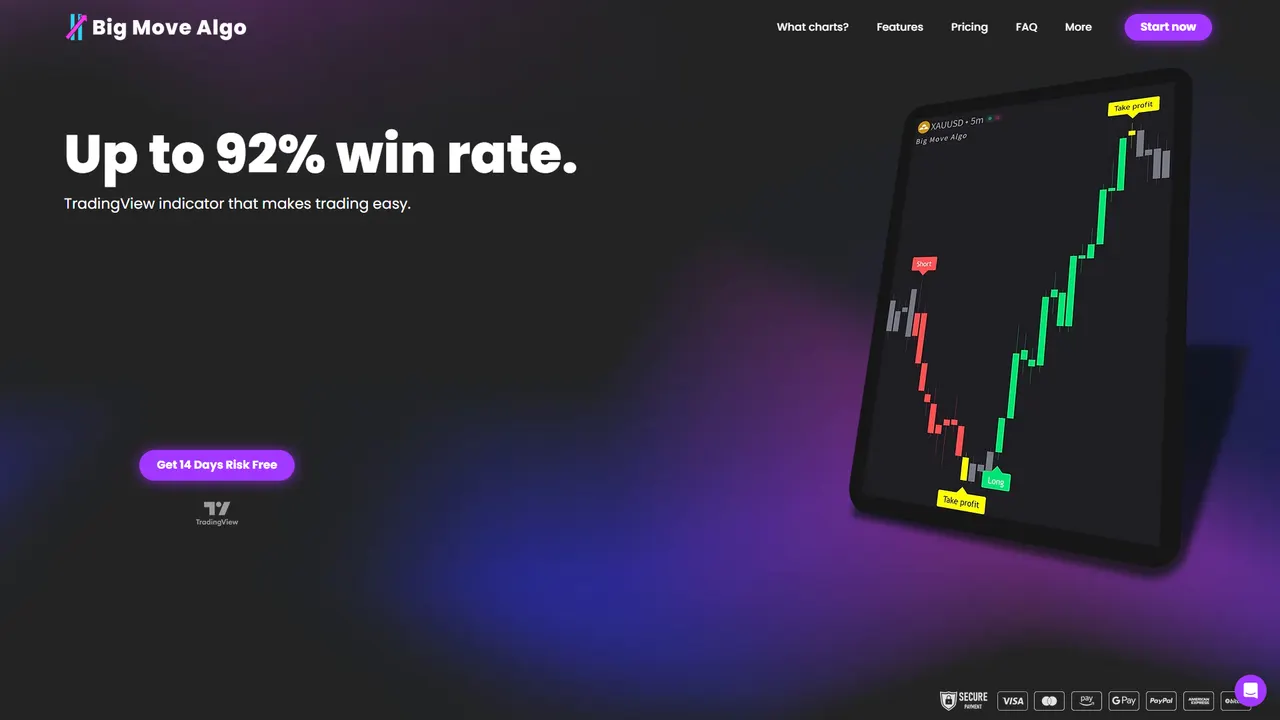
Big Move Algo is our proprietary TradingView indicator. It analyzes markets in real time and shows clear Long, Short and Exit signals across crypto, forex, stocks, indices and commodities. We built it for traders who are tired of stacking five indicators and arguing with themselves about which to trust.
What sets it up for that job:
- AUTO Mode needs minimal setup, so you can be on a chart quickly. Manual Mode adds customization for experienced traders.
- Fake Trend Detector is designed to filter out low-quality or misleading conditions where trading may not be recommended.
- No repainting is part of how we describe the indicator, so signals are meant to stay put once printed.
- Alerts to multiple platforms, unlimited devices, free updates, and integration with automated trading platforms.
- Instant access after purchase, with payments processed through Stripe.
If you plan to route alerts to a bot, read our guides on sending TradingView alerts to a bot without duplicate trades and how to set up indicator alerts.
Plans and pricing
Access is by subscription, as published on our site:
| Plan | Monthly | Annual |
|---|---|---|
| Version 2 | $55 per month | $660 per year |
| Version 3 | $64 per month | $768 per year |
| Version 3 Plus | $79 per month | $948 per year |
Compare that with building a stack yourself: several indicators, extra TradingView seats, and hours of tuning. The point of Big Move Algo is to fold that work into one structured signal.
Side-by-side comparison
| Option | Best for | Signal style | Cost | Setup effort |
|---|---|---|---|---|
| Supertrend | Trend following | Trend flips on ATR bands | Free | Medium: tune multiplier |
| RSI | Momentum, rotating markets | Overbought/oversold zones | Free | Medium: pick timeframe |
| VWAP | Intraday bias | Price vs. volume-weighted line | Free | Medium |
| UT Bot Alerts | Simple trailing-stop alerts | Buy/Sell on ATR cross | Free | Low to medium |
| ChartPrime | Confluence scanning | Non-repainting arrows | From $39.90 per month | Medium |
| LuxAlgo | Signal-strength scoring | Confirmation score 1-10 | From $49.99 per month | Medium |
| Big Move Algo | Clear Long/Short/Exit with filtering | Structured signals, Fake Trend Detector | From $55 per month | Low in AUTO Mode |
How to choose for your trading style
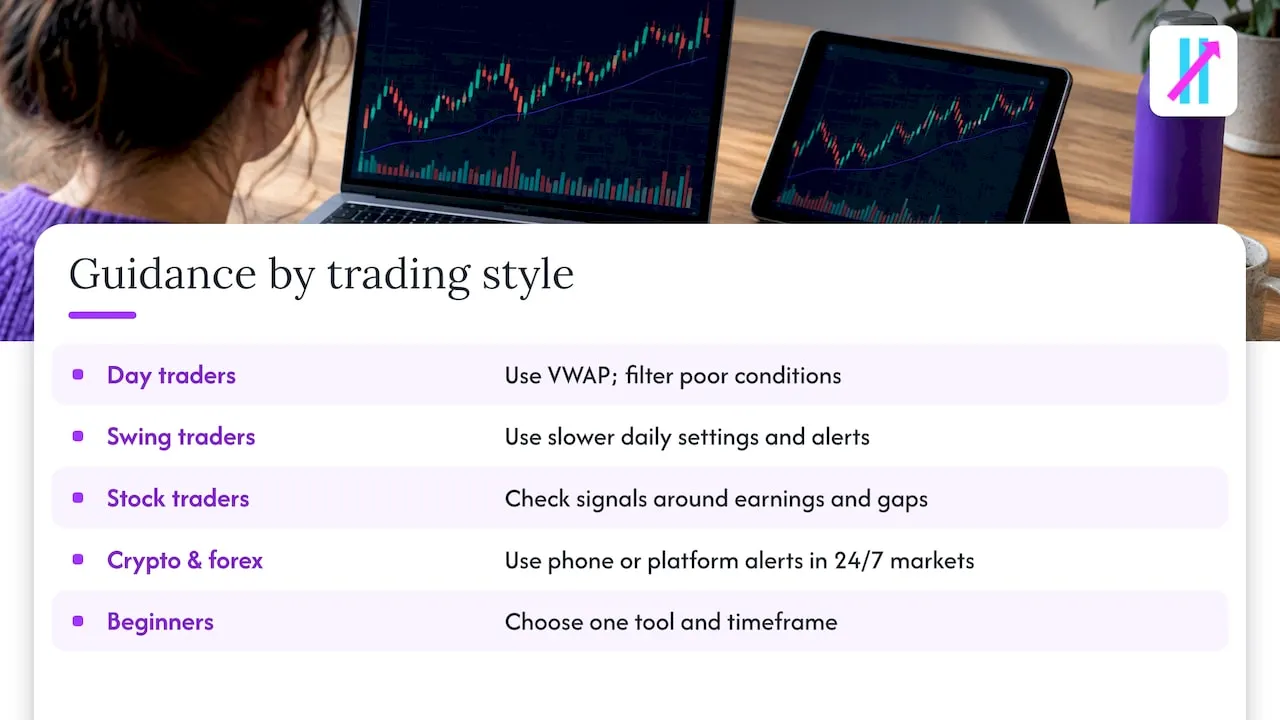
Day traders care about speed and intraday context. A VWAP-based view helps, and so does a tool that tells you when conditions are poor. Our Fake Trend Detector is aimed at exactly that moment: the choppy stretch where signals multiply and quality drops.
Swing traders can work with slower settings on daily charts. Wider Supertrend settings or a structured Long/Short/Exit indicator suit that rhythm, and alerts mean you do not have to watch the screen.
Stock traders should read how signals behave around earnings and gaps. We cover that in stock buy and sell signals: how they work and where they fail and in how to trade stocks using technical signals.
Crypto and forex traders run on markets that trade around the clock. Alerts delivered to your phone or a connected platform matter more than screen time here.
Beginners should pick one tool and one timeframe. Ten indicators on a chart produce ten opinions. A single structured signal gives you something to follow and review.
How to test any indicator before risking money
Testing is where most of the value is. Here is a simple routine that works for free tools and paid ones alike.
- Write the rule down. In one sentence, state what triggers a Long and what triggers an Exit. If you cannot, you do not yet understand the tool.
- Pick one market and one timeframe. The testing above shows how much results shift by timeframe. RSI looked decent on 1-hour bars and weak on 1- and 5-minute ones (Liberated Stock Trader).
- Set alerts on bar close. This keeps your records matched to the finished candle and avoids intrabar signals that disappear (Whitman Trading).
- Log every signal for two to four weeks. Record entry, exit, size, and what you did. Include the signals you skipped.
- Measure more than win rate. Track average win versus average loss, reward/risk, and the worst losing streak. The VWAP example shows a 29% win rate paired with a 4.1 reward/risk ratio.
- Compare against a benchmark. Investor.gov advises tracking performance against major market or sector indexes and not relying on a signal alone (Investor.gov).
- Go live small. Only after a paper record you trust, and only with money you can afford to lose.
Our alerts or automation test lays out a two to four week process in more detail, including regulatory steps.
Risk and due diligence
Signals support decisions. They do not remove risk. Investor.gov says day trading is extremely risky and can lead to substantial losses in a very short period (Investor.gov). It also notes that short-term trading, including with margin or options, can bring significant and unanticipated losses, and that momentum and noise trading can involve poor timing and overreaction (Investor.gov).
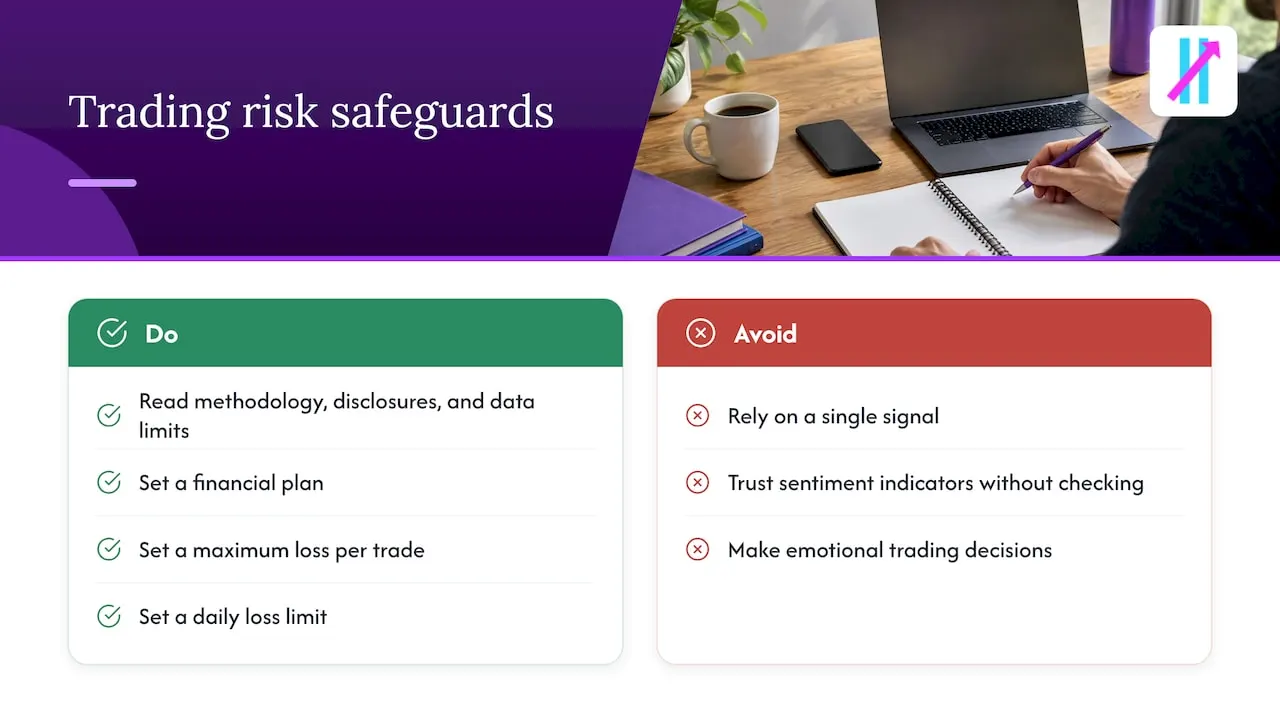
The same agency recommends reading a tool’s methodology, disclosures and data limitations, and never relying on a single signal. It warns that sentiment-driven buy/sell indicators can be inaccurate, incomplete or misleading, and can push emotional decisions (Investor.gov). Before trading size, set a financial plan, a maximum loss per trade and a daily loss limit. Discipline problems show up in every setting, including simulated challenges: this breakdown of common reasons traders fail challenges is a good reminder that risk rules matter more than any one signal.
Our perspective
Most traders do not lose because they lack an indicator. They lose because they have too many, trust none, and override the one that was right.
We built Big Move Algo around that problem. A signal should say Long, Short or Exit, and it should be quiet when conditions are poor. That is why the Fake Trend Detector sits inside the indicator, and why AUTO Mode lets you start without a settings marathon. Experienced traders still get Manual Mode when they want to tune it.
Our aim is a structured routine: one chart, one signal source, alerts that reach you where you are, and a record you can review. Pair that with the testing steps above and with firm risk limits, and the guesswork shrinks.
Steven Hartwell
Try Big Move Algo on your own charts
If you want one TradingView indicator that gives you Long, Short and Exit signals across crypto, forex, stocks, indices and commodities, start with Big Move Algo. Plans run from $55 per month, with annual options, instant access after checkout and free updates. See the current plans on the Big Move Algo site.
Want to connect signals to automation? Our automation walkthrough shows how, and the guide to TradingView buy/sell signals for active traders covers how to read them day to day.
FAQ
What is the best buy sell indicator on TradingView?
There is no single best one. Trend tools like Supertrend suit directional markets, and oscillators like RSI suit rotating ones. If you want clear Long, Short and Exit signals with little setup, Big Move Algo is built for that.
Are free buy sell indicators good enough?
Free indicators such as Supertrend, RSI, VWAP and UT Bot Alerts are useful for learning how signals work. They leave the settings and the filtering of poor conditions to you. A paid tool can save that work, but any option should be tested on paper first.
Do buy sell indicators repaint?
Some signals can change before the candle closes, especially alerts set to fire intrabar. UT Bot, for example, can trigger on a cross the close later undoes. Use bar-close alerts when testing. Big Move Algo is described by us as non-repainting.
How much do premium TradingView buy sell indicators cost?
Starter plans for ChartPrime and LuxAlgo were listed around $39.90 and $49.99 per month in May 2026. Big Move Algo costs $55 per month for Version 2, $64 for Version 3 and $79 for Version 3 Plus, with annual options.
How should a beginner start with a buy sell indicator?
Pick one market and one timeframe, write down the signal rule, and log every signal for a few weeks on a paper account. Track reward/risk as well as win rate, and compare results with a market index before going live.
Sources
- 10 Best Free TradingView Indicators: I Tested 103 for 2026
- 10 Best Buy Sell Indicators on TradingView | Gate Learn
- Best Premium TradingView Indicators 2026 (Lunefi)
- TradingView Review 2026 (KayaToday)
- UT Bot Alerts: The ATR Trail Behind the Signals
- Day Trading | Investor.gov
- Investor Alert: Thinking About Investing in the Latest Hot Stock (Investor.gov)
- Resources for Victims of Securities Law Violations (Investor.gov)