Structured Trading System: How to Build One You Can Follow

A structured trading system is a written set of rules that decides what you trade, when you enter, when you exit, how much you risk and when you stay out, all settled before the trade starts. If you struggle with second-guessing, chasing candles or too many indicators, the fix is fewer decisions made live. Big Move Algo is built around that idea: it puts Long, Short and Exit signals on your TradingView chart, so the entry and exit rules are on the screen rather than in your head.
This guide walks through what the system must contain, how to size positions, how to test it without fooling yourself, and how to tell after a few months whether it works.
TL;DR
- A structured, or rule-based, system moves decisions from the middle of the trade to before it: market, setup, entry, exit, size and risk cap are all defined in advance.
- Five questions make a complete system: what to trade, when to trade, when to enter, when to exit, and how to manage risk.
- Risk per trade is set first (a common benchmark is 1% to 2% of the account), and position size follows from your stop distance.
- Test on past data, but keep the rule count low, because every extra rule invites curve fitting and costs can erase a thin edge.
- Consistency is measured: log every trade against the rules and review in batches, not trade by trade.
Table of Contents
- What a structured trading system actually is
- The five questions your rules must answer
- Match the system type to your market and timeframe
- Position sizing: the rule that keeps you in the game
- Test the rules without fooling yourself
- How to follow the system and tell if it works
- Where Big Move Algo fits
- Our perspective
- FAQ
- Sources
What a structured trading system actually is
A rule-based approach makes decisions with predefined rules instead of making every call in the moment. According to QuantifiedStrategies, the key difference from discretionary trading is how much of the decision is made before the trade and how much during it. You decide the market, setup, entry, exit, size and cost assumptions first.
That is different from a vague plan such as buy strength, sell weakness. A system is specific enough that two people reading it would take the same trade on the same chart.
The discipline cuts both ways. CME Group’s education team points out that system trading makes discipline easier because discretion is removed, but you must carry out the system’s instructions to the letter to capture its full benefit. They also note that discretionary traders have rules too, applied by feel. The Balance puts the standard bluntly: if the criteria are met, the system trader takes the trade even against a gut feeling, and one deviation makes that trade discretionary.
Two clarifications for newer traders:
- Structured is not the same as automated. The IQT explains that systematic trading is rules-based, non-discretionary trading, and that it is not necessarily algorithmic or automated. You can follow rules by hand from a chart signal. If you want the automation side, our beginner’s guide to algorithmic trading covers it.
- A system includes risk management. The same source defines a trading system as one or more strategies plus the risk rules around them. An entry signal alone is not a system.
The five questions your rules must answer
A useful test for a US day or swing trader comes from EditorialGe, which describes a trading system as a written, testable rule-set answering five questions. Here they are, with what a good answer looks like.
| Question | What your rule must state | Example of a precise answer |
|---|---|---|
| What to trade | Market and instruments | Large-cap US stocks, or BTC and ETH, or two forex pairs |
| When to trade | Timeframe and session | 4-hour chart, or the first hour after the US open |
| When to enter | An exact trigger | A confirmed Long signal after a close above resistance |
| When to exit | Stop, target and signal exit | Stop below the last swing low, exit on an Exit signal |
| How to manage risk | Size, loss limits | 1% of the account per trade, stop trading after a set daily loss |
A complete system also says when it is not allowed to trade. Unger Academy lists this alongside entries, exits, capital at risk, sizing, stops and profit targets. Most beginners write the first four rows and skip standing aside, then lose money in exactly the conditions their entry rule was never meant for.
Write the rules so they can be checked
For each rule, ask whether someone could look at a finished trade and say yes or no, it followed the rule. Phrases like strong momentum or good-looking setup fail that test. A moving-average cross, a signal color change or a close beyond a stated level pass.
Match the system type to your market and timeframe
Interactive Brokers groups strategies into five broad types: trend trading, mean reversion, breakout, carry and event-based. Most retail systems are one of the first three.
- Trend following buys strength and sells weakness. Its weak spot is sideways markets, where it can get whipsawed through repeated small losses.
- Mean reversion fades stretches away from an average. It works in ranges and gets hurt when a trend just keeps going.
- Breakout enters when price leaves a defined range.
Timeframe follows your lifestyle. TraderLion matches day traders to charts from one minute to daily, swing traders to daily charts with holds of days to weeks, and position traders to daily through monthly charts with holds up to a year or more. It also lists US equities, bonds, forex, commodities and crypto as markets a system can target.
Pick one market type, one timeframe and one strategy style first. If you are unsure whether current conditions suit trend or reversion, our four regime checks give you a simple way to classify them, and our mean reversion signals article gives three you can test.
Position sizing: the rule that keeps you in the game
Set the exit first, then size the trade from it. Onda describes picking a repeatable stop method, such as a level below a defined swing low, a fixed percentage or a volatility multiple, and then dividing your risk budget by the estimated loss per share including costs.
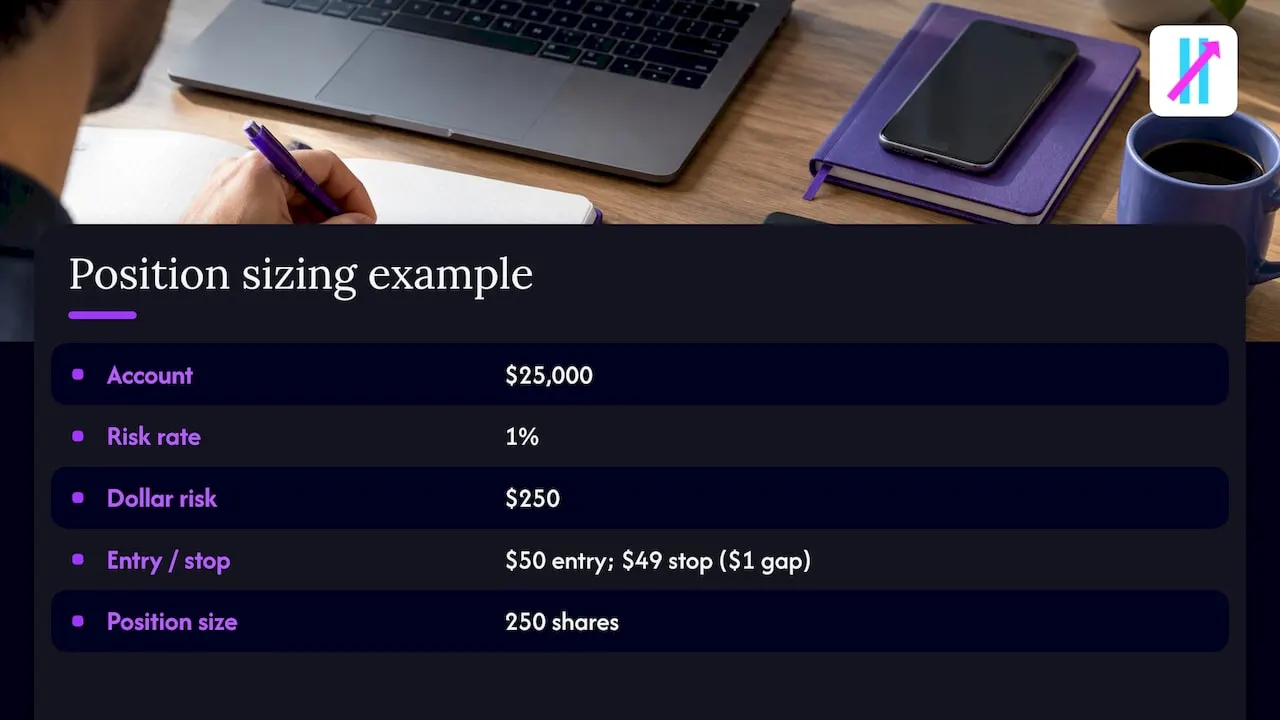
A common benchmark, described in Verified Investing’s day-trading guide, is to risk no more than 1% to 2% of total account value per trade. The formula is position size equals dollar risk divided by the gap between entry and stop.
Worked example. Your account is $25,000 and you risk 1%, so your dollar risk is $250. You want to buy a stock at $50.00 with a stop at $49.00. The gap is $1.00, so the position is 250 shares. If the stop is hit, you lose about $250, not a surprise chunk of the account.
Two practical cautions from the same Onda page: a triggered stock stop becomes a market order and can fill away from your trigger price, so leave room for that in your size. And include commissions and slippage in the loss per share. For automated setups, the Futures Industry Association recommends local pre-trade limits, such as maximum order size and maximum intraday position, as the primary safeguard. We cover how to apply those on TradingView in our risk controls guide.
Test the rules without fooling yourself
Backtesting means applying your rules to historical data to see how they would have behaved. Investopedia describes a trading model as a rule-based framework you can backtest before risking real money, and gives a sobering cost example: a theoretical $2 profit can vanish after a $2.50 brokerage fee. Build costs into every test.
The bigger trap is curve fitting. In a presentation hosted by Interactive Brokers, Adrian Reid defines it as fitting rules so closely to past data that they lose the ability to profit on unseen data, and says each additional rule requires exponentially more data for credible optimization. In plain terms: the more filters you bolt on to make the past look good, the less the result tells you.
Historical simulations also differ from live trading. The CFTC notes that hypothetical results use historical prices and often leave out stop-loss execution quality and bid/ask spreads. So treat a backtest as a first filter, then confirm with small live size.
A simple testing routine:
- Write the rules before you look at results.
- Keep the rule count low and the parameters few.
- Test across different market periods, including a trend and a range.
- Include commissions, spreads and slippage.
- Reserve a stretch of data you never touched while building, and check it once at the end.
- Go live at a small size before you scale.
For deeper help, see our guides on avoiding overfitting, a nine-step backtest pitfalls checklist and the TradingView Strategy Tester.
How to follow the system and tell if it works
A good system fails in practice when the trader will not execute it. The CME material above is clear that the burden of a system is carrying out its instructions exactly. Make that easier with a few habits.
Reduce the decisions left
Every live choice is a chance to override the plan. Use fixed alerts for your trigger so you are not watching every candle. Decide the size before the signal arrives. Put the stop order in at entry. If your system gives a defined Exit, the exit is not a debate.
Keep a rule-adherence log
For each trade, record the market, entry, exit, size, result and one yes or no: did I follow every rule? Review it weekly. A losing trade that followed the rules is the system working within its normal variance. A winning trade that broke the rules is a bad habit that got lucky, and it deserves a flag.
Judge in batches
One trade tells you almost nothing. Pick a review window, such as your next 30 to 50 trades, and agree in advance what would make you change the rules. Look at average win versus average loss, win rate, largest drawdown and how often you broke the plan. If results and live trades diverge from the backtest, check costs and fills first, then market conditions, before touching the entry logic.
Alerts or automation
Some traders take signals by hand, others route alerts into automation. If you are choosing, our alerts versus automation test plan lays out a short trial for each.
Where Big Move Algo fits
Big Move Algo is a proprietary TradingView indicator that analyzes markets in real time and gives Long, Short and Exit signals across crypto, forex, stocks, indices and commodities. Those are the entry and exit answers from the five-question table, on the chart where you already trade. AUTO Mode needs minimal setup, and Manual Mode gives experienced traders more customization.
The built-in Fake Trend Detector is designed to filter out low-quality or misleading conditions where trading may not be recommended, which supports the standing-aside rule most systems lack. Our indicator is built not to repaint, alerts can be delivered to multiple platforms, access works on unlimited devices and updates are free.
Plans are billed monthly or annually, with instant access after payment through Stripe:
| Plan | Monthly | Annual |
|---|---|---|
| Version 2 | $55 | $660 |
| Version 3 | $64 | $768 |
| Version 3 Plus | $79 | $948 |
See the plans on the Big Move Algo site. You still set your own position size and risk cap, which is the part of the system that belongs to you.

Our perspective
Most traders we talk about do not lack information. They have too many indicators, too many settings and too many chances to change their mind at the worst moment. A structured system is mostly subtraction.
That is why we built Big Move Algo around clarity: Long, Short and Exit, an AUTO Mode that gets you started quickly, and a Fake Trend Detector designed to flag conditions where trading may not be recommended. The fewer interpretations you have to make live, the easier it is to follow your own rules.
Pair the signals with a written risk rule, a trade log and a fixed review window, and you have a system that you can actually run on TradingView.
Steven Hartwell
FAQ
What is the difference between a rule-based and a discretionary trading system?
A rule-based system fixes the market, entry, exit, size and risk before the trade, so the live decision is just execution. A discretionary trader weighs context in the moment and can make exceptions. Per CME Group, discretionary traders have rules as well, but apply them by subjective judgment.
How many rules should a structured trading system have?
As few as it takes to answer the five questions: what, when, entry, exit and risk, plus a rule for standing aside. Extra filters make past results look better but raise the odds of curve fitting. Add a rule only if it solves a problem you can name.
Is a structured trading system the same as algorithmic trading?
No. Systematic trading means following rules without discretion, and it can be done by hand from chart signals. Algorithmic trading means a program places the orders. Many traders begin with signals and alerts and add automation later.
How much should I risk per trade?
A widely cited benchmark is 1% to 2% of your account per trade, so $250 to $500 on a $25,000 account. Choose a figure you can lose repeatedly without changing your behavior. Trading involves risk of loss, and a licensed financial adviser can help you set limits for your own finances.
How do I know if my system is working?
Track every trade against your rules and judge results over a set batch of trades, not a few days. Compare average win, average loss and drawdown with your test. If live results differ, check costs and fills first.
Sources
- Rule-Based Trading, QuantifiedStrategies
- System-Based vs. Discretionary Trading, CME Group
- Are You a Discretionary or System Trader?, The Balance
- What are Trading Systems and Systematic Trading?, The IQT
- Trading Systems Used by US Day Traders, EditorialGe
- Algorithmic Trading: How to Build a Robust System, Unger Academy
- Types of Trading Strategies, Interactive Brokers
- 8 Steps To Building A Successful Trading System, TraderLion
- Trading Rules: Define Entries, Exits and Position Size, Onda
- Day Trading Guide, Verified Investing
- Best Practices for Automated Trading Risk Controls, FIA
- How To Build a Winning Trading Model, Investopedia
- Uses and Abuses of Optimization in Systematic Trading, Interactive Brokers
- Commodity Trading Systems Sold on the Internet, CFTC