How to Follow Your Trading Rules When It Counts

Most traders do not lack rules. They lack a way to keep those rules once a position is open and money is moving. The fix is not more willpower. Write rules that are observable and testable, make breaking them harder than keeping them, and score yourself on adherence instead of profit. This guide shows you how, step by step.
TL;DR
- Discipline is the gap between what you decided and what you did. You close it with design, not effort.
- A usable rule has a trigger, an action, an exception policy and a way to score it.
- Judge each trade by whether you followed the plan, not by whether it made money.
- Gold and other fast markets need rules about context and risk, not a single indicator.
- Signal tools can remove some in-the-moment judgment, but they do not remove risk.
Table of Contents
- Why smart traders still break their rules
- Write rules you can actually check
- Test the rules before you trust them
- Make breaking the rules harder
- Build a daily process around the rules
- Following rules on gold and other fast markets
- Our perspective: take the in-the-moment decisions out
- Where Big Move Algo fits
- A review habit that makes the rules stick
- FAQ
- Sources
Why smart traders still break their rules
Breaking a rule rarely feels like breaking a rule. It feels like a reasonable exception: the stop is a little tight, the setup is almost there, this loss will be made back on the next trade.
The cost is not small. Research on retail futures day traders found that over 96% of trading days ended in aggregate losses, and a similar 2020 study of traders who persisted at least 300 days found 97% lost money. Those figures describe futures day traders, not every kind of trader, and they do not isolate rule-breaking as the cause. But they show how unforgiving the environment is when decisions are improvised.
Schwab’s educators make the same point in plainer terms: sticking to a predefined strategy is the main way experienced traders deal with the doubt, fear and greed that drive impulsive decisions.
Discipline is a measurement, not a personality
Alpari’s academy puts it well: discipline is the gap between what you decided and what you did. It is a measurement, not a character trait, and it narrows through design. That is good news. You do not need to become a different person. You need a system in which the default action is the correct one.
A winning rule break is the dangerous one
A losing trade that followed your plan is a normal cost of business. A winning trade that broke your plan is worse, because it rewards the mistake. Zerodha’s trading course warns that this trains you to repeat the error, which tends to produce much larger losses when conditions change. The same source suggests measuring success by your adherence rate to the plan, not by the profit and loss of one trade.
Write rules you can actually check
“Be patient” and “manage risk” are intentions, not rules. A rule you can follow is one you can verify afterward. Traders Second Brain describes a useful rule as having an observable trigger, a specific action, an exception policy and the evidence needed to score it.
Compare:
| Vague intention | Checkable rule |
|---|---|
| Don’t risk too much | Risk no more than 1% of the account on any trade, sized before entry |
| Wait for a good setup | Enter only when all items on the entry checklist are true on a closed candle |
| Don’t revenge trade | After two consecutive losses, stop trading for the session |
| Cut losses | Place the stop at the planned level when the order is entered, and never move it further away |
The percentages above are examples of format, not recommendations. Your account size, market and experience decide your own numbers.
The four questions every plan should answer
A trade plan is incomplete if it cannot answer four questions, according to Epic cTrader’s guide to trading rules: what activates it, what action follows, what happens if the platform or market fails, and what evidence shows you followed it. The last two get skipped most often. Decide now what you will do if your connection drops or a market gaps through your stop, because you will not decide well in that moment.
A minimal rule set to start with
If you have nothing written, start with these categories and keep each to one or two lines:
- Risk per trade: a fixed percentage of the account, sized from the stop distance.
- Daily loss limit: a number that ends your session when hit.
- Entry conditions: the exact conditions that must be true before you click.
- Exit conditions: where you are wrong, and where you take profit or trail.
- Markets and hours: what you trade and when you do not.
- Review: when you score the day and the week.
For a deeper entry framework, our guide to entry confirmation rules traders can copy walks through a six-step version. If you are unsure whether to wait for confirmation or act early, see our comparison of confirmation versus anticipation.
Test the rules before you trust them
A rule that has never been tested is a guess with a checklist around it. Before you commit real money, run your rules against historical data and look at win rate, profit factor and maximum drawdown together, not just the headline return. Tools such as Backtestify’s execution-first backtesting checklist lay out a sequence for doing this on futures strategies, and the same logic applies to any rule-based approach.
Backtests lie in predictable ways, so read up on the traps. Our backtest pitfalls checklist covers nine of them, and our note on the TradingView Strategy Tester explains what that tool can and cannot tell you.
Make breaking the rules harder
Good traders do not rely on remembering. They build friction. Traders Second Brain gives examples: a pre-entry checklist, automated stops, or a session cap that disables order entry once the day’s risk limit is reached.
Here are practical ways to do the same:
- Place the stop with the entry. If the stop is not in the market, it is a suggestion.
- Use alerts instead of staring at charts. Watching every tick invites impulsive trades. Set alerts at your planned levels and step away.
- Size the position before you look at the profit target. Fixed risk first, excitement second.
- Put a hard cap on trades per day. Overtrading is one of the most common ways rules get broken, and it also adds cost.
- Keep a one-line log. Date, setup, followed the plan yes or no. Evidence beats memory.
We go deeper on this in automated trading risk controls every TradingView user needs.
Build a daily process around the rules
Rules work best when they sit inside a routine. RulesFirst frames a daily process around three moments: what to do before the market, while you trade, and after you stop. It also advises setting the day’s risk limits before the first trade.
A simple version:
- Before the open: check the calendar for major data releases, mark your levels, write the day’s maximum loss.
- During the session: trade only setups on your checklist. If you feel the urge to deviate, write the reason down first and wait five minutes.
- After the close: score each trade as followed or broken. Calculate your adherence rate. Only then look at profit and loss.
If you want a structured month-long routine, our 30 day plan to beat emotional trading with written rules breaks this into weekly steps.
Following rules on gold and other fast markets
Gold attracts a lot of searches for buy and sell signals, and it is easy to see why: it moves quickly and responds to headlines. But signals alone are not a plan. FP Markets notes that gold is highly sensitive to macroeconomic inputs, so no single technical indicator should define a trade, and signals tend to be stronger when several factors line up.
That suggests rules like these for gold:
- Do not take a new signal in the minutes around a scheduled inflation or interest rate release unless your plan explicitly allows it.
- Require agreement between your signal and the higher-timeframe trend before entering.
- Use a stop distance that fits gold’s volatility, then reduce position size to keep risk at your fixed percentage, instead of tightening the stop to keep size.
- Know which session you trade, because liquidity differs between sessions.
The same logic applies to crypto, forex, stocks and indices. The market changes. The structure of the rule does not.
Know the rules that are not yours
Some rules are set by regulators, and they can change. In forex, the CFTC limits retail leverage to 50:1 on major currency pairs and 20:1 on others, and treats offers of higher leverage as a warning sign of fraud or unregistered operations.
On stocks, FINRA is replacing the pattern day trader rules with new intraday margin requirements. Under the current rules firms apply a $25,000 minimum equity requirement; the new approach drops that and monitors equity during the trading day against your actual positions. Check the FINRA page and your broker for what applies to your account today. Firms that promote day-trading strategies must also give customers a risk disclosure and assess whether day trading is appropriate for them, and the disclosure warns that frequent trading raises costs. If you are new, speak with your broker or a registered financial professional before trading on margin.
Our perspective: take the in-the-moment decisions out
We build trading software, so we see the same pattern in how traders describe their problem. They rarely say they do not know what to do. They say they knew and did something else.
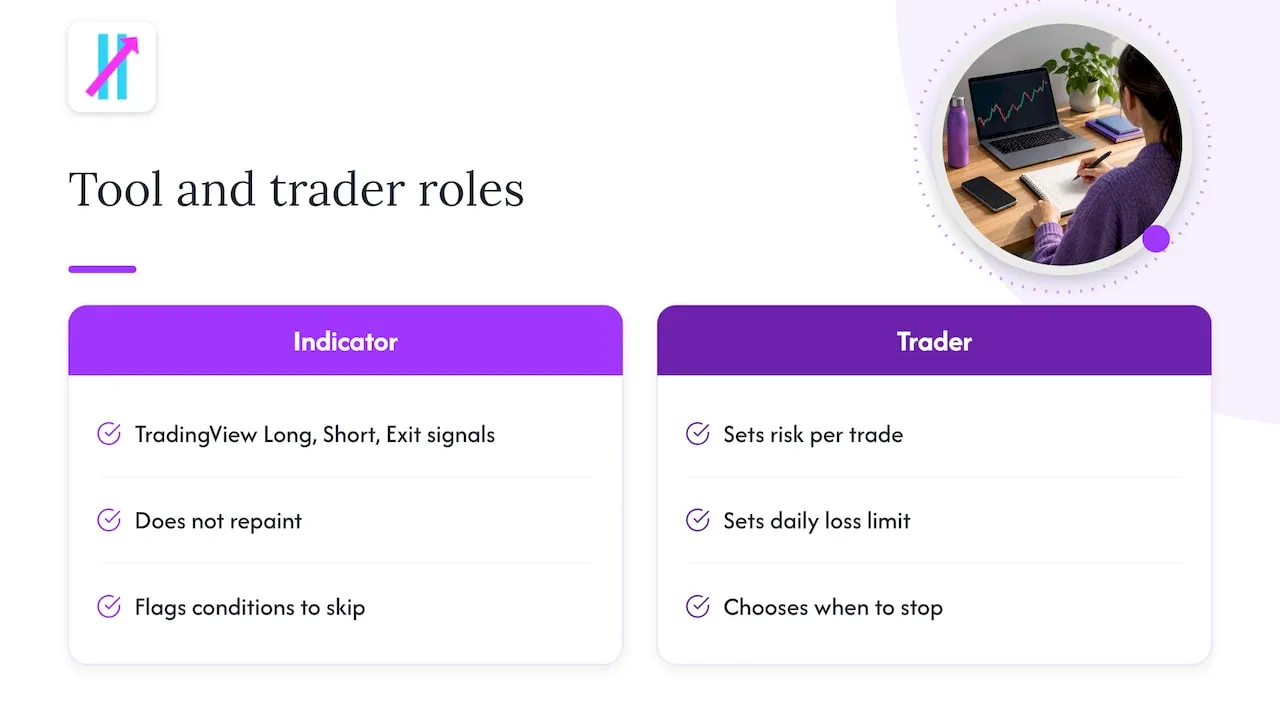
That is why we designed Big Move Algo around clarity instead of settings. It is a TradingView indicator that gives Long, Short and Exit signals, so the question at the moment of decision is narrower: does the signal match my plan, yes or no. It does not repaint, which matters for rule-following because a signal that changes after the fact cannot be scored honestly. The Fake Trend Detector flags conditions where trading may not be recommended, which turns “should I skip this?” into a visible, pre-agreed rule.
We are equally clear about the limits. An indicator does not decide your risk per trade, your daily loss limit or when you stop for the day. Those rules are yours, and they matter more than any signal. Our tool works best when it sits inside a written plan, with alerts doing the watching and you doing the reviewing.
— Steven Hartwell
Where Big Move Algo fits
If you trade on TradingView and want signals that map cleanly onto written rules, Big Move Algo offers AUTO Mode for a quick start with minimal setup and Manual Mode for traders who want more customization. It covers crypto, forex, stocks, indices and commodities, supports unlimited devices and sends alerts to multiple platforms. Access is instant after payment through Stripe.
Plans on our pricing page:
| Plan | Monthly | Yearly |
|---|---|---|
| Version 2 | 55 USD per month | 660 USD per year |
| Version 3 | 64 USD per month | 768 USD per year |
| Version 3 Plus | 79 USD per month | 948 USD per year |
Trading involves risk of loss, and no indicator guarantees results.
A review habit that makes the rules stick
Rules decay without review. Once a week, sit down with your log and answer three questions:
- What was my adherence rate, and which rule did I break most?
- What was the situation each time: after a loss, after a win, late in the day, during news?
- What single piece of friction would have prevented it?
Then add that friction. If you break the daily loss limit, set a platform-level cap or a hard alert. If you chase entries, require the checklist to be written before the order is sent. Change one thing per week so you can see what worked.
To see how this fits into a larger structure, read what a trading system is and these examples of systematic trading frameworks. If you are weighing automation, our beginner’s guide to algorithmic trading is a good starting point, and the role of entry signals in trade planning explains where signals belong.
FAQ
What are the most important rules to follow when trading?
Risk per trade, a daily loss limit, defined entry conditions and a defined exit come first. Without a stop and a size set before entry, other rules rarely matter. Write each one so you can check it afterward as followed or broken.
How do I build discipline in trading?
Treat discipline as design. Use a pre-entry checklist, place stops with the entry, cap trades per day and review your adherence rate weekly. Measure the gap between your plan and your actions instead of judging yourself by profit.
Can gold trading signals be trusted on their own?
Not on their own. Gold reacts strongly to macro data such as inflation and interest rate expectations, so a technical signal should be confirmed by trend, session liquidity and the news calendar. Define in advance when you will skip a signal.
Why do most day traders lose money?
Studies of retail futures day traders show that the great majority lose, and high costs, leverage and inconsistent decisions all contribute. The research cannot say how much is caused by rule-breaking. Consistent, tested rules and small risk are the most direct things you control.
Sources
- The COVID-19 and day-trade pandemics in Brazil (Brazilian Review of Finance)
- Schwab: 3 smart skills for informed trading
- Alpari Academy: Discipline in trading
- Zerodha Varsity: Trading with discipline
- Traders Second Brain: 20 trading rules
- Epic cTrader: Trading rules
- RulesFirst: How to create a daily trading process
- FP Markets: Gold trading signals guide
- CFTC: Forex frauds
- FINRA: Understanding the new intraday margin requirements
- SEC: FINRA Rules 2130 and 2270 order