Kelly Criterion Trading: Size Positions Without Overbetting

The Kelly criterion is a position-sizing formula. It does not tell you when to buy or sell. It tells you how much of your account to put behind a strategy that already has a measurable edge, so that your capital compounds as fast as possible over many trades. In trading, the common form is f* = W − (1 − W) / R, where W is your win rate and R is your average win divided by your average loss. If the result is zero or negative, the formula says to take no position at all.
That sounds tidy. In practice, full Kelly is aggressive, and the inputs are estimates. This guide shows the math, a worked example, the fractional versions most traders use, and a step-by-step workflow for sizing real trades in stocks, forex, crypto, indices and commodities.
TL;DR
- Kelly is a sizing rule, not a signal. It only works after you have recorded enough completed trades from one defined strategy.
- The trading formula is f* = W − (1 − W) / R, and a result at or below zero means the modeled edge does not justify a position.
- Full Kelly is sensitive to estimation error and can produce long, deep drawdowns. Most retail traders should size at a fraction of it, then cap total exposure.
- Count costs, leverage, and correlated positions before you trust any output.
Table of Contents
- What the Kelly criterion actually measures
- The Kelly formula for trading
- Why full Kelly is rarely the right answer
- Half Kelly and quarter Kelly
- Kelly in stocks, forex, crypto and indices
- A step-by-step Kelly workflow for retail traders
- Where traders get Kelly wrong
- Our perspective: signals first, sizing second
- Putting Big Move Algo behind your sizing plan
- FAQ
- Sources
What the Kelly criterion actually measures
John L. Kelly Jr. published the idea in 1956. Per this lecture treatment, the goal is to choose the fraction of capital that maximizes long-run expected log wealth, in other words geometric growth. It is not about predicting the next trade, and it is not about maximizing the average dollar return of a single trade.
That distinction matters. A Kelly-sized trader will lose plenty of individual trades, and the method should not be judged by whether the next one wins. It assumes repeated opportunities with the same edge and reinvestment of profits. Take away either assumption and the formula loses its footing.
There is also a hard honesty point. David Aldous, a mathematician at UC Berkeley, argues that the real-world problem is not the logarithm. It is that you never know the true future distribution of returns, and short-term risk can be larger than a trader is prepared to tolerate.
The Kelly formula for trading
For a binary trade, where you either win a typical amount or lose a typical amount, the form most traders use is:
f = W − (1 − W) / R*
- W is your win probability as a decimal (55% is 0.55).
- R is your average winning trade divided by your average losing trade.
- f* is the fraction of capital the formula suggests committing.
A worked example
Say your log shows a 55% win rate and winners that average 1.5 times your losers. That is the same illustration Investopedia uses.
- W = 0.55, so the loss probability is 0.45.
- 0.45 / 1.5 = 0.30.
- f* = 0.55 − 0.30 = 0.25, or 25%.
Half Kelly is 12.5%. Quarter Kelly is 6.25%. These are formula outputs, not limits anyone should copy.
Now a strategy with a 40% win rate and R = 1.2:
- 1 − W = 0.60, and 0.60 / 1.2 = 0.50.
- f* = 0.40 − 0.50 = −0.10.
A negative number means no modeled edge. Kelly says do not fund this strategy as it stands. That is a useful result, and it is one of the best reasons to run the calculation at all.
Capital allocated versus dollars risked
This is where many traders go wrong. The textbook bet loses the whole stake. A stock trade with a stop does not. If Kelly says 25% and you put 25% of your account into a position with a stop 3% below entry, you are risking under 1% of the account, not 25%. If you instead treat 25% as the share of the account you are willing to lose on a single trade, you are taking a risk almost no retail account can survive.
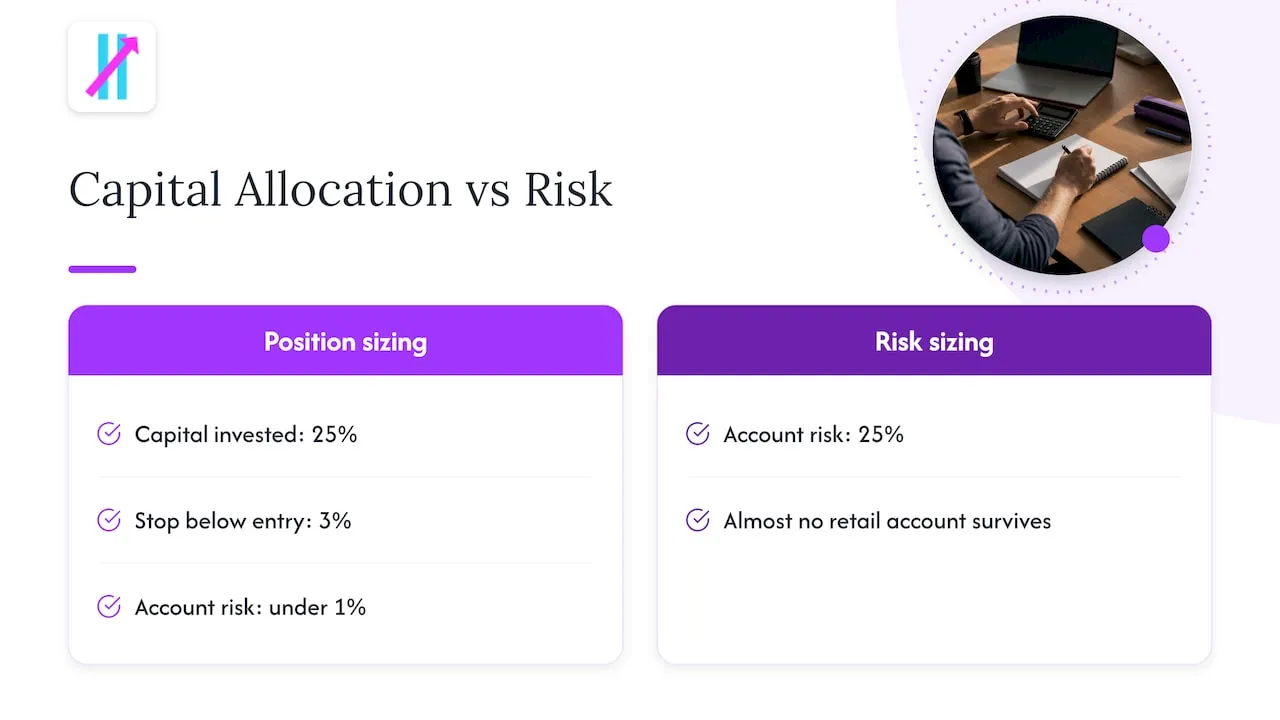
As Aldous’s notes point out, the convention must be stated before you use it. Decide whether your output means capital invested or capital at risk, and keep that choice consistent in any calculator or automation. Leverage, options structures and futures contract multipliers all change what the number means.
Why full Kelly is rarely the right answer
Full Kelly is the growth-maximizing bet if your inputs are exactly right. They never are. Small errors in win rate or payoff can turn an apparently optimal size into overbetting. José Carlos Gonzáles Tanaka’s 2024 piece for Interactive Brokers makes the point that ordinary Kelly is theoretically growth-optimal but can produce long-lasting, large drawdowns that conflict with real risk limits. He covers a risk-constrained version that adds a drawdown-probability limit while still optimizing growth.
There is also a behavioral cost. Fidelity’s trading educators frame position size as a tool for following your plan: the right size is one that lets you know your maximum acceptable loss and avoid emotional decisions. A mathematically optimal size that makes you panic and abandon the system is operationally wrong.
Half Kelly and quarter Kelly
Fractional Kelly means multiplying the full result by a fixed fraction, typically one-half or one-quarter. You give up some theoretical growth and get smaller swings and more room for error. Stony Brook lecture notes show that half Kelly delivers about 75% of the full-Kelly growth rate in that model’s framework. That is a result inside a stated model, not a promise for live markets.
| Approach | Multiplier | With f* = 25% | Trade-off |
|---|---|---|---|
| Full Kelly | 1.0 | 25% | Highest theoretical growth, largest drawdowns, most sensitive to input error |
| Half Kelly | 0.5 | 12.5% | Common compromise |
| Quarter Kelly | 0.25 | 6.25% | Much more tolerance for estimation error, slower growth |
Fractional Kelly is a shrinkage method, not a guarantee of safety. If your win rate is overstated, even half Kelly can be too much. Tools that let you stress-test those inputs help here. Backtestify’s guide to Kelly sizing walks through using half or quarter Kelly to limit risk and model error, and it is worth reading alongside your own trade log.
Kelly in stocks, forex, crypto and indices
The formula is the same in every market. What differs is how well the inputs hold up.
- Stocks. Kelly is a portfolio-allocation framework, not a single-stock rule. The continuous approximation for one risky asset against a risk-free one is p ≈ μ/σ², where μ is expected excess return and σ² is variance, and Berkeley’s explanation stresses how sample-dependent that is. Investopedia separately cautions against concentrating more than 20% to 25% of capital in one equity. That is a conservative guideline, not a Kelly theorem.
- Forex and indices. Leverage makes the capital-versus-risk confusion above much more dangerous. Size from the stop distance, not from notional.
- Crypto. Fat tails and sudden regime changes mean historical win rates can flatter you. Favor the smaller fraction.
- Commodities. Gaps and contract multipliers change the dollar risk per unit. Confirm the multiplier before converting.
In all of them, Kelly is a sizing layer. It does not make a market passive income, it does not guarantee financial freedom, and it does not improve how accurate your signals are.
A step-by-step Kelly workflow for retail traders
This follows the practical sequence described in AvaTrade’s Kelly guide, adapted for TradingView users.
- Pick one market and one setup. Mixing instruments blends different edges into a meaningless average.
- Write down the exact rules. Entry, stop and exit must be fixed before you count a trade.
- Gather completed, comparable trades. QuantConnect’s 2024 example estimates inputs from 40 historical trades and applies a 0.5 scaling factor. Those are that example’s parameters, not standards. Be aware that a small sample makes the output unstable.
- Calculate W and R after costs. Include commissions, spread and slippage. Our walkthrough on calculating spread and commission costs from your last 50 trades shows how, and our piece on cutting bad fills covers the slippage side.
- Compute f.* If it is zero or negative, stop. Fix the strategy, not the size.
- Apply a fraction you chose in advance. Half or quarter Kelly, decided before the trade, not after a losing streak.
- Convert risk into units. Suppose you have a $20,000 account and decide the fraction you will put at risk is 2%, or $400. If your stop is $2 per share from entry, that is 200 shares. The stop distance, not the dollar size of the position, sets the quantity.
- Cap total exposure. Set a ceiling on aggregate open risk and on daily loss.
- Recalculate on a rolling, out-of-sample basis. A historical Kelly output is not permanent.
Where traders get Kelly wrong
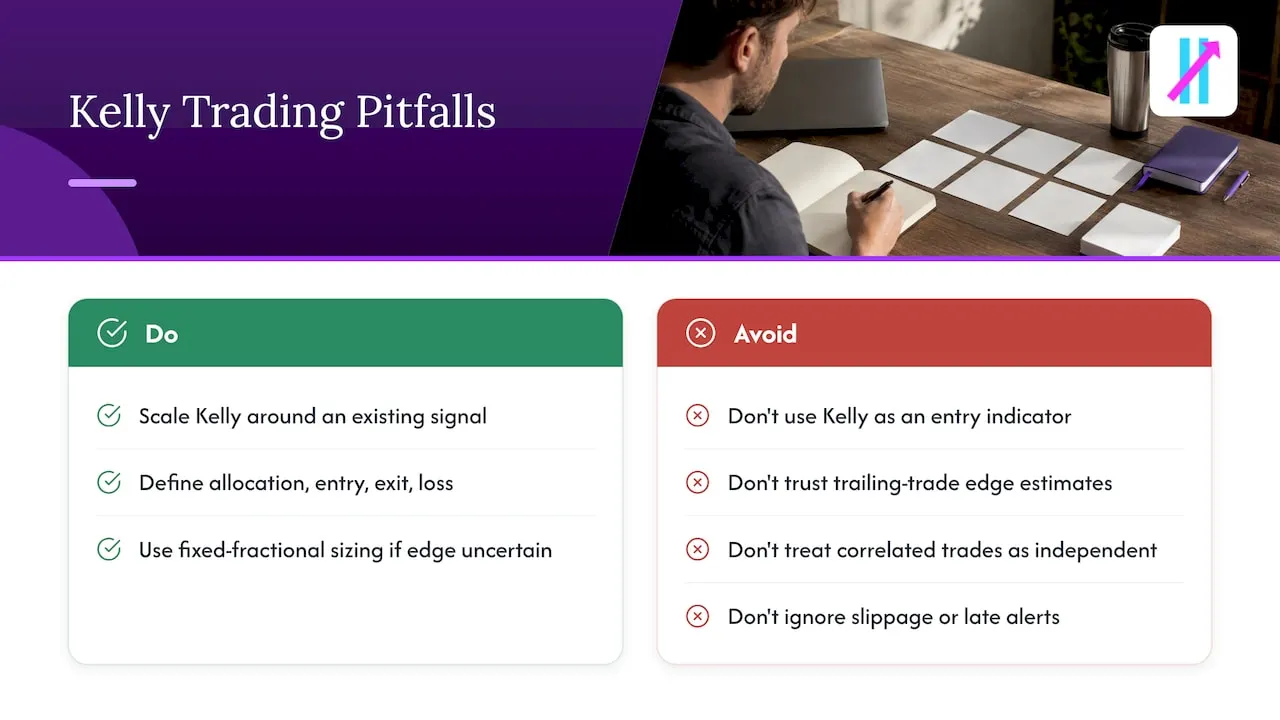
Using it as a signal. Derek Melchin’s QuantConnect research frames Kelly as scaling around an existing signal. It can raise exposure when the modeled edge is stronger, but it is not an entry indicator.
Trusting the backtest. Inputs estimated from trailing trades flatter the results, because the future edge may differ. Our nine-step backtest pitfalls checklist covers the usual traps, and testing signal settings beyond the backtest is the natural next step.
Treating every alert as independent. Several crypto, forex or index trades can be highly correlated, so five separate positions may be one concentrated bet. Fidelity’s pre-trade checklist asks you to define how much capital you will allocate to an idea, your entry and exit criteria, and your acceptable loss before you place an order. It also warns that position size can amplify unfavorable outcomes and emotional decisions.
Ignoring execution. A modeled win rate assumes you got the fill. Late alerts and slippage change both W and R. See how to measure TradingView signal latency and why fills matter more than ping.
Skipping the simpler method. If you cannot trust your edge estimate yet, a plain fixed-fractional rule is a legitimate choice. Our guide to 1% fixed fractional sizing with ATR is a good place to start, and you can move to Kelly-style scaling once you have a clean trade log.
Our perspective: signals first, sizing second
We build a TradingView indicator that gives Long, Short and Exit signals, so we see this question constantly. Traders find Kelly, plug in a win rate they half remember, and get a big number that feels like permission. We think that is backwards.
Sizing is the second step. The first is knowing what your signals actually do after fees and slippage. A TradingView alert can trigger an order, but it does not prove positive expectancy. That is why we care about clear, structured rules for entries and exits: you cannot calculate W and R for a strategy you cannot describe in a sentence. Our guides on what signal accuracy really means and how to verify a signal before entering cover that groundwork.
Our advice is plain. Log every trade under one fixed rule set. Compute Kelly once the sample is meaningful. Then use a quarter or a half of it, cap your total exposure, and treat the number as a ceiling, not a target. A size you can follow on a bad week beats a size that is optimal on paper.
— Steven Hartwell
Putting Big Move Algo behind your sizing plan
If you trade on TradingView and want defined Long, Short and Exit rules to build a trade log from, Big Move Algo is built for that. AUTO Mode needs minimal setup, Manual Mode adds customization, and the Fake Trend Detector helps filter out low-quality conditions. It works across crypto, forex, stocks, indices and commodities. Plans on our pricing page are Version 2 at 55 USD per month or 660 USD per year, Version 3 at 64 USD per month or 768 USD per year, and Version 3 Plus at 79 USD per month or 948 USD per year. No indicator removes risk, so treat any signal as input to your own tested plan.
FAQ
What is a good Kelly percentage for trading?
There is no universal figure. No authoritative source supports one Kelly percentage for all retail traders, because the output depends entirely on your own win rate and payoff ratio. Many traders use half or quarter of the calculated value and cap total account exposure.
Can Kelly tell me when to enter a trade?
No. Kelly is applied only after a strategy has a measurable edge, and it only answers how much to commit. You still need defined entry, stop and exit rules from a separate system.
How many trades do I need before calculating Kelly?
There is no fixed number. QuantConnect’s example used 40 historical trades, but that was an implementation choice. A small or shifting sample makes the result unstable, so recalculate on a rolling, out-of-sample basis and use a fraction.
Does Kelly work with leverage?
It can, but with extra care. Leverage, gaps and fat tails can make the formula suggest dangerously large sizes. Define whether your output means capital invested or capital at risk, and size from the stop distance. If you trade leveraged products, consider talking with a licensed financial professional.
Sources
- Forecasting: Lecture Notes, Kelly Betting
- Investopedia: Kelly Criterion
- Stony Brook lecture notes on Kelly betting
- Interactive Brokers: The Risk-Constrained Kelly Criterion, Part I
- David Aldous, UC Berkeley: Kelly
- QuantConnect: Kelly Criterion Applications in Trading Systems
- Fidelity: Trading basics part 4, managing risk
- Fidelity: How to Trade
- AvaTrade: Kelly Criterion in Trading