Scale in Trading: How to Add to a Position Without Adding Risk

Scaling in means building a position in planned parts instead of one order. Done well, you start small, add only when the trade proves you right, and keep total risk inside the limit you set before the first entry. Done badly, it is averaging down with a nicer name. The difference is the plan, and a plan needs clear signals to attach to. That is where a rule-based indicator such as Big Move Algo, which gives Long, Short and Exit signals on TradingView, gives your tranches a defined trigger.
TL;DR
- Scaling in is a gradual build of a position over time, decided in advance, not improvised.
- Set the stop and the maximum total loss first, then split that budget across the entries.
- Add to winners that confirm your thesis. Never add to a losing trade to lower your average.
- Recalculate the average entry and total risk after every add, and move the stop with them.
- Write the trigger for each tranche as a rule so emotion does not choose it.
Table of Contents
- What scaling in means
- Scaling in vs. averaging down
- The risk math, step by step
- Three tests before any add
- Where signals fit
- Scaling in, scaling out and dollar-cost averaging
- Our perspective
- Put the plan on TradingView
- FAQ
- Sources
What scaling in means
Scaling in is entering a trade in several pieces rather than all at once. Investopedia describes it as buying in increments: in its example, an investor wanting 1,000 shares of a $20 stock buys 250 shares each at $20, $19.90, $19.80 and $19.70, for a $19.85 average price.
That example scales into a falling price, which is one version. Most active traders working with trends use the other: a small starter position, then adds as price moves their way and the setup confirms. Both rely on the same idea. You decide the total size and the rules for each piece before you start.
Two reasons traders do it:
- Smaller initial risk. You are wrong sometimes. A starter position means those times cost less.
- A better average entry relative to confirmation. As The Complete Trader’s Edge argues, the average sits closer to the point where the trade was confirmed than to the first hunch.
The cost is real too. If price runs without pulling back, you profit on a partial size. Alpari’s academy frames scaling as a trade-off: lower risk per unit of conviction, smaller average win on clean moves. Investopedia also notes that several trades mean more fees than one larger order.
Scaling in vs. averaging down
This is the line that matters most. The mechanics are identical: you click buy again. The intent and the direction are not.
| Scaling in | Averaging down | |
|---|---|---|
| Planned before entry? | Yes | Usually not |
| Direction of the add | With the trade (winning) | Against the trade (losing) |
| Thesis | Confirmed by new evidence | Possibly already invalidated |
| Total risk | Capped by a pre-set budget | Grows if the stop stays put |
Trader and CMT Cory Mitchell puts it this way: most averaging down is unplanned and done to avoid a loss, while scaling in is premeditated with risk known up front. KCM Trade Academy makes the mechanical point: total risk rises unless the stop moves closer to the new average entry, because more volume now sits above the stop.
A useful filter comes from Extreme To Mean: ask whether the new tranche would independently deserve risk if you were flat. If you would not open that position fresh at this price, you are not scaling in. You are defending the first entry.
The risk math, step by step
Scaling only works if you can state your total risk in dollars before you add. Here is the routine.
Step 1: Fix the invalidation level
Before any size goes on, know where the trade is wrong. tastylive’s Errol Coleman describes invalidation as a specific price level that objectively proves the thesis no longer holds. Scaling is only viable when risk is binary: the thesis is intact or it is not.
Step 2: Set the dollar budget
Investopedia’s position-sizing guide says to set the stop first and then calculate size from that distance. Its example: on a $25,000 account risking 2% ($500), a $30 per-share stop distance on TSLA gives 16 shares ($500 ÷ $30 = 16.67, rounded down), for about $480 of maximum loss. Our guide to position sizing with a fixed fraction and ATR walks through the 1% version.
The budget belongs to the whole scaled position, not each piece. NexusFi’s example: with 3% risk on a $100,000 account and ES points worth $50, the maximum position-wide loss is 60 points, so a plan for three contracts lets each lose at most 20 points.
Step 3: Decide the tranches
Write down initial size, maximum size, number of adds and the confirmation each add needs. Two common forms:
- Pre-planned levels. The Complete Trader’s Edge gives an example of 40% at the signal, 30% after a break of structure, 30% on a retest, all levels defined in advance.
- Confirmation-based adds. You add only when a stated condition appears, such as a higher low. If it never arrives, you stay small or exit.
Decreasing sizes are a common pattern. QuantStrategy.io suggests layers such as 50%, then 30%, then 20%, so the biggest piece is never the latest, highest-priced one.
Step 4: Recalculate after every add
The average entry is (price 1 × volume 1 + price 2 × volume 2) ÷ (volume 1 + volume 2), and total risk is the distance from that average to the stop times the size of the whole position, recalculated after every add.
A worked example
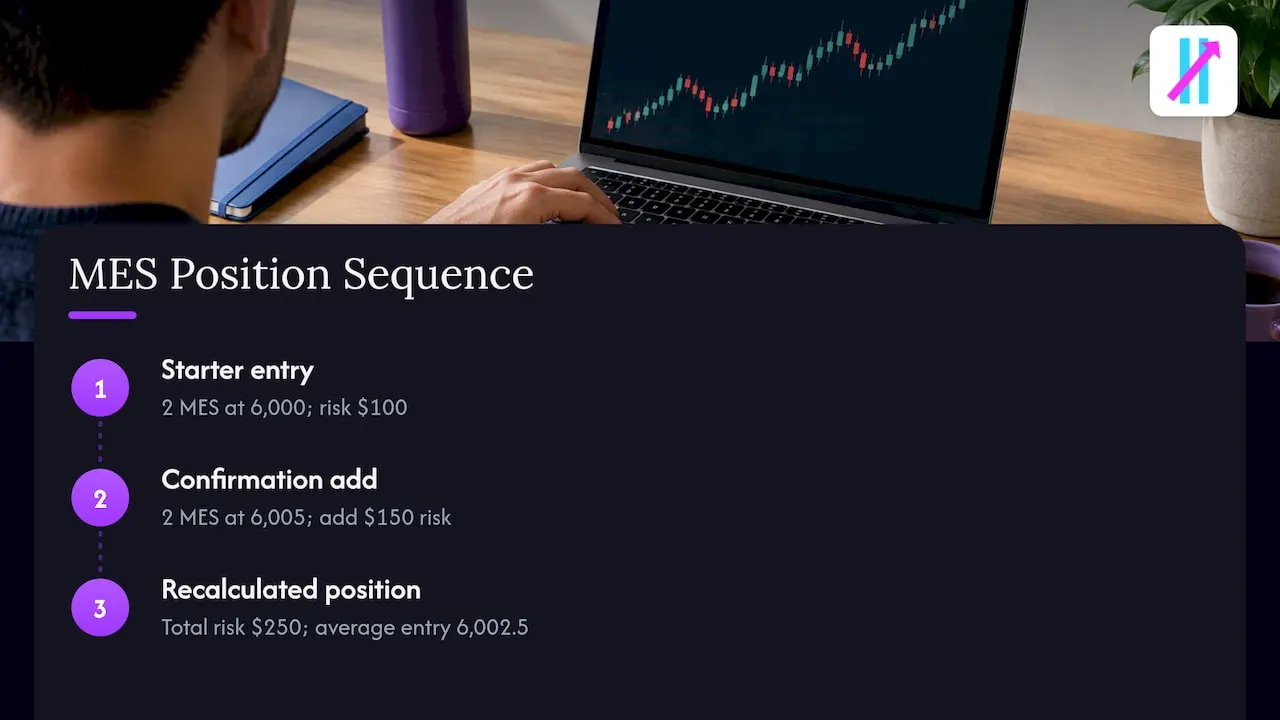
Extreme To Mean uses micro E-mini S&P futures. Structural entry near 6,000, invalidation at 5,990, maximum four MES contracts, maximum gross risk $250. Entry one: two MES at 6,000, risking 10 points × $5 × 2 = $100. Confirmation add: two MES at 6,005, adding 15 × $5 × 2 = $150. Total planned risk is $250 and the weighted average entry is 6,002.5. The sequence it prescribes is plan, starter, evidence, add, recalculate, stop.
Alpari shows the effect on a forex trade. Instead of 0.30 lots at 1.0800 with a 1.0750 stop (about $150 risk on a $15,000 account), take 0.15 lots at 1.0800, add 0.15 at 1.0830 and move the whole-position stop to 1.0790. The pieces risk $15 and $60, a total of $75, half the single-entry risk with the same upside.
Three tests before any add
ProfitByFriday states that a correct add needs three conditions at once: the position is already profitable, the add is smaller than the original, and the combined stop keeps total dollar risk within the original maximum. If one fails, the add raises risk instead of extending a proven move.
Add a fourth: the add is in the plan. Alpari’s rule is that adds are pre-planned, inside the original risk budget, and only in the direction the trade is working.
Situations where traders skip the add entirely include a market environment that has deteriorated since entry and a price already stretched far above its last base, where an add lands at the high before a pullback.
Where signals fit
The weak point in most scaling plans is the word “confirmation.” If it means “it feels good,” you will add on emotion, usually near exhaustion. Turning it into a checklist fixes that. Our posts on entry confirmation rules and signal confirmation checks give six-point lists you can adapt to each tranche, and the piece on confirmation versus anticipation explains why waiting for evidence beats guessing.
For a starter-then-add plan, a sample rule set might read:
- Starter at 40% of planned size on a fresh Long signal.
- Add 30% only if price holds above the prior swing low and the signal is still active.
- Add the final 30% on a retest that holds.
- Exit all tranches on the Exit signal or the invalidation level, whichever comes first.
Because the rules are written, the decision happens before the pressure does. A structured process also fits what disciplined scaling guides stress: rules first, size second, feelings last.
Sizing the tranches against the stop is also where the Kelly criterion and fractional scaling come up for traders who want a formal way to cap size. Most retail traders do well with a simple fixed percentage per trade.
Scaling in, scaling out and dollar-cost averaging
- Scaling out closes a position in parts as price rises. The Complete Trader’s Edge describes thirds at 1R–1.5R, at 2R–3R, and a trailing runner, with the stop moved to breakeven after the first.
- Dollar-cost averaging invests a fixed amount on a schedule regardless of conditions, for example $200 a month. It is a calendar rule for long-term investing. Scaling in is a market-based rule for a specific trade.
Many traders pair scaling in with scaling out: build on confirmation, trim on targets, and keep a runner.
Our perspective
Traders rarely lose because they cannot find an entry. They lose because the second, third and fourth decisions are made in the middle of a move, with money on the line. Scaling in multiplies those decisions.
That is why we build around clarity. Big Move Algo gives Long, Short and Exit signals directly on TradingView, so the trigger for the first entry and the exit for the whole position are defined by rules, not mood. AUTO Mode gets you started with minimal setup, and Manual Mode lets experienced traders tune it to their own plan.
Our Fake Trend Detector is designed to filter low-quality market conditions, which helps you avoid building a position into noise. Alerts reach multiple platforms, so a plan written down can also be a plan that reaches you on time.
Our advice: size the whole position first, write each add as a rule, and let the Exit signal close the book on every tranche together.
Steven Hartwell
Put the plan on TradingView
Big Move Algo is a TradingView indicator that analyzes markets in real time across crypto, forex, stocks, indices and commodities, with unlimited devices and free updates. Access is instant after payment through Stripe.
Plans are published as Version 2 at $55 per month or $660 per year, Version 3 at $64 per month or $768 per year, and Version 3 Plus at $79 per month or $948 per year. You can see them all on the Big Move Algo site.
FAQ
Is scaling in the same as averaging down?
No. Scaling in adds to a trade that is working, by a pre-set plan. Averaging down adds to a losing trade, usually to improve the average price. KCM Trade Academy notes the click is the same but total risk grows if the stop stays put.
How big should the first entry be?
It should be small enough that being wrong barely matters. Brooks Trading Course suggests an “I don’t care” size, typically under 2% of risk capital per trade. Then split your total budget so the adds never push risk past it.
How many times should I add?
Set the number before you enter. tastylive’s framework lists initial size, maximum size, number of adds and confirmation for each as the predefined parameters. Two or three tranches is plenty for most retail traders.
Can I scale in with a tool that automates entries?
Some brokers offer it. Interactive Brokers’ ScaleTrader algorithm, for example, buys in preset slices, such as 5,000 shares of XOM in 200-share pieces at 15-cent increments. On TradingView, Big Move Algo’s alerts can feed automated trading platforms.
Sources
- Scale in, Nasdaq glossary
- Scale In: Overview of the Trading Strategy, Investopedia
- Manage Trading Risk: Effective Position Sizing Techniques, Investopedia
- Scaling In and Out of Positions Like a Professional, The Complete Trader’s Edge
- Scaling, partials and trailing stops, Alpari
- Averaging Down vs. Scaling In, Trade That Swing
- Scaling In and Out of a Trade, KCM Trade Academy
- How to Scale Into a Trade, Extreme To Mean
- How I Scale Into Trades, tastylive
- Scaling In and Out of Futures Trades, NexusFi
- Pyramiding vs. Averaging Down, QuantStrategy.io
- How to Scale Into a Position Without Increasing Risk, ProfitByFriday
- Scale into trends, Brooks Trading Course
- Understanding dollar cost averaging, eToro
- ScaleTrader, Interactive Brokers